By Sara Khan · WeProms Digital · November 7, 2026
Across the Google Merchant Center accounts we review for perfume and oud traders in Dubai, Sharjah and Ajman, one pattern keeps appearing: catalogues that were uploaded once — usually before an Eid that has already passed — and never touched again. The demand side is not the constraint. Ken Research values the UAE fragrance market at around US$1.08 billion in 2025, and in Toluna’s 2025 survey more than half of UAE residents planned to spend more across Ramadan and Eid than the year before, with fragrances high on the list.
The gap sits between that demand and the product data Google is allowed to show.
Many of these businesses are Pakistani trading families who run their noon and Amazon.ae storefronts with real discipline — prices updated, stock counted, listings photographed — while the Google feed rots quietly beside them. The marketplaces hand you a dashboard; Google asks you to maintain a file. That difference in daily habit, not any technical barrier, is what keeps an Ajman attar shop out of Google’s free listings.
The pattern that repeats across Gulf trader accounts
The pattern repeats. It takes four shapes, and most accounts show at least two at once.
First, the shop has no Google Merchant Center presence at all; it sells on noon and Amazon.ae and assumes Google “finds” the products somehow, which it does not do in the shopping surfaces. Second, a product feed — the file listing every product’s title, price, availability and landing page that Google reads — was uploaded before the last Eid and never refreshed, so the prices predate two stock cycles. Third, attribute drift: the feed says one name, the website says another, and Google’s systems quietly lose confidence in both. Fourth, disapproval notices pile up in an inbox nobody opens until listings vanish.
Google Merchant Center — Google’s tool that holds your product data and decides which items may appear across Google’s shopping surfaces — is free to set up, as are free listings, the product results on Google’s Shopping tab that charge nothing per click. The shops doing well treat both as a weekly chore, not a one-off project.
Where the catalogue breaks
The navy-versus-blue problem explains most of it. Quoted in MarTech about affiliate discovery, Mario Protano, director of performance marketing at Clarks, described what mismatched product data does to modern discovery:
“If a shoe is listed as ‘navy’ in the product feed and as ‘blue’ on the website, an AI assistant struggles to connect the two… AI does not like that. It just does not match.”
Attar shops live this daily in two languages of commerce. A feed title reading “Dehn Al Oud 3 ml” and a website page calling the same bottle “Oud Muattar 3 tola” is the navy-blue problem with Arabic-English seasoning; the product exists twice in Google’s eyes and neither version earns trust. Match every feed item to a live page on your shop’s website, under one identical name.
Buyer behaviour now punishes the mismatch. In Feedvisor’s 2026 Consumer Commerce Report, 55 per cent of US shoppers used AI tools to research or compare products in the previous six months, 45 per cent compare prices more than they did a year ago, and 41 per cent wait for sales before buying. That is US survey data; it does not prove Ajman search volumes. What it does establish is direction: the price, the availability and the product name are now read, checked and cross-referenced before checkout, which makes the feed itself sales copy rather than back-office plumbing.
Use one product name everywhere: feed, website and marketplace. The formula that survives translation is Brand + product type + size + concentration — for example, “[Your brand] Dehn Al Oud 3 ml, alcohol-free” — with the alcohol-free note doing quiet halal-positions work for Gulf and diaspora buyers alike.
What the shopping surface now rewards
Google concentrates product visibility in its own surfaces, and the concentration is measurable. Citing BrightEdge data, Search Engine Roundtable reported on November 6 that Google Shopping units appeared 16 to 35 times as often as the next-largest service across the European product-search results it tracks, and that 71 per cent of comparison-site appearances sat in the top four positions. European data, gathered in the EU’s Digital Markets Act context, says nothing about UAE click counts; it does show where Google points product visibility when it compiles a results page. If your bottles carry no product data, they are absent from exactly the layer that dominates.
Stock accuracy is the other half of the reward. JD Sports has rolled out RFID stock-tracking across 414 UK and Ireland stores, reporting 98 per cent on-shelf availability, per Retail Gazette on November 6. A family shop in Ajman does not need radio tags; it needs the same discipline at the scale of two tills — a Sunday stock count, then a feed update. Refresh price and availability every week, and daily near Eid.
Falsifiable claim, so you can hold this article to account: free listings are worth more to a small attar business than Shopping ads, because at AED 65 contribution per gift box there is no margin left to also pay per click. A shop that disputes this can run both for one Eid season and compare.
When it genuinely is Google’s fault
Some weeks the merchant is innocent. On November 6, Search Engine Roundtable reported that Google confirmed an ongoing issue affecting the Merchant API, Merchant Center and product feeds — platform-side failures that can suspend syncing and disapprove items through no fault of the seller.
The practical protocol follows from that. Read Merchant Center diagnostics before you rewrite anything. If dozens of items were disapproved on a single date while your data had not changed, suspect the platform side; note the timestamps, keep the feed untouched, and re-submit after Google marks the issue resolved. Confirmed as of November 6, status pages move faster than articles — check the current status before escalating anything to your developer.
This is also the fair reading of the whole lane: most “Google banned my products” cases in family businesses are not bans at all. They are feeds that stopped matching reality, plus a minority of genuine platform incidents like the one above.
What the shops that surface do differently
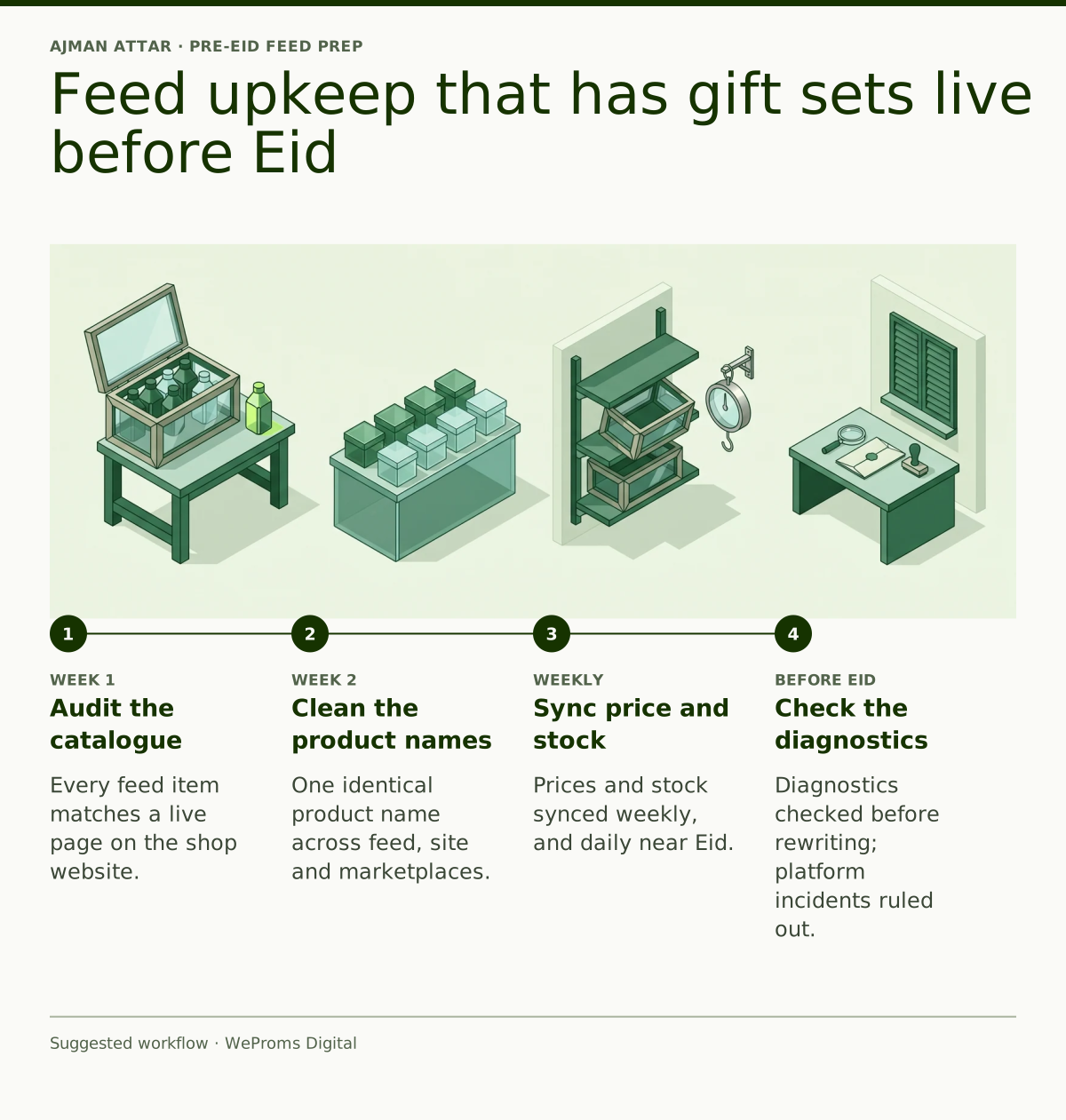
The maintained accounts differ from the stale ones on five measurable habits, none of them expensive:
| What Google sees | Catalogue uploaded before last Eid | Catalogue maintained weekly |
|---|---|---|
| Price on the listing | Weeks out of date | Matches the till |
| Availability | Sold-out bottles still “in stock” | Synced weekly, daily near Eid |
| Product names | Feed and website disagree | One name everywhere |
| Disapprovals | Unread for months | Checked each Sunday |
| Eid readiness | Feed frozen since March | Gift sets live before the peak |
The calendar sets the deadline. Ramadan 2027 is expected to begin around Monday 8 February, with Eid al-Fitr expected around 9–10 March, subject to moon sighting, per Khaleej Times. Google and Visa’s regional commerce research finds the final two weeks of Ramadan are typically the peak shopping period before Eid, which puts the buying window at roughly 23 February to 9 March 2027. Working backwards: catalogue clean by late January, gift sets listed and approved before 23 February, stock synced daily through the peak.
The money case is short. Worked example — substitute your own costs: an Eid gift box at AED 149, with oud, packaging and delivery costing AED 84, leaves AED 65 contribution per box; forty pre-ordered boxes put AED 2,600 into the business with zero media spend, because free listings charge nothing per click. The only investment is the hour a week of feed upkeep, which is why the stale-catalogue pattern is so expensive relative to how cheap it is to fix.
Ready-to-paste WhatsApp broadcast for gift-box pre-orders, sent only to customers who opted in:
“Assalamu alaikum! Our Eid gift boxes open for pre-order from [date]: oud, attar and bakhoor sets from AED 149. Reply EID to reserve yours. Reply STOP at any time and we will not message you again.”
Neighbouring lanes are worth clearing while you are in there: Google Shopping image rules for a Sharjah abaya store govern the photos side of the same listings, getting Riyadh Eid gift boxes into shopping answers covers the AI-answer layer that reads the same feed, and a Surrey halal grocery’s route into Google’s universal cart shows the UK version of this same setup. If ChatGPT already names your shop, the feed is the next surface to claim — see why an oud shop in Dubai gets named without being recommended.
Read next: Google Shopping not showing your products? A feed fix (written for the Pakistan market — the method transfers) and Merchant Center suspended? How sellers recover (Pakistan-focused, same process)
We have worked with marketplace and Shopify sellers across the UAE, the UK and North America on feed hygiene, disapproval recovery and Eid-season readiness, and based on our experience most family-shop catalogues can be cleaned and re-approved inside three weeks. WeProms Digital handles this as a managed service — see Google Merchant Center management for Gulf and UK sellers for the full scope, and product feed optimisation for the feed-side work. Message us on WhatsApp or through the contact page; we reply in Gulf and UK business hours.
Key Takeaways
- Google’s shopping surfaces dominate product results, and free listings cost nothing per click — absence, not price, is what keeps an Ajman attar shop out of them.
- The four break points are no Merchant Center account, a feed stale since the last Eid, mismatched product names, and unread disapprovals; most accounts show two or more.
- Match every feed item to a live page on your shop’s website, under one identical name — the navy-versus-blue problem applies fully to Dehn Al Oud versus Oud Muattar.
- Refresh price and availability every week, and daily near Eid; the peak buying window runs roughly 23 February to 9 March 2027, ahead of Eid al-Fitr expected around 9–10 March, subject to moon sighting.
- Read Merchant Center diagnostics before you rewrite anything — Google confirmed platform-side Merchant Center, API and feed issues on November 6, so some failures are not yours.
- At AED 65 contribution per gift box, forty pre-orders equal AED 2,600 with zero media spend; the feed upkeep that earns it costs about an hour a week.
About WeProms Digital
WeProms Digital is a Lahore-based ecommerce and product-feed agency working with overseas Pakistani and halal-minded business owners across London, Birmingham, Manchester, Dubai, Riyadh, Toronto, Houston, and beyond.
The team specialises in Google Merchant Center management, product feed optimisation and marketplace-to-own-store selling, with a track record of recovering disapproved catalogues and building Eid-season readiness for family-run traders.
Get in touch: hello@weproms.com · WhatsApp +92 300 0133399 (replies in UK and Gulf business hours) · weproms.com/contact-us
Sources & References
- Search Engine Roundtable — Google Shopping Dominating The European Product Search Results — November 6, 2026
- Search Engine Roundtable — Google Confirms Issues With Merchant Center, API & Feeds — November 6, 2026
- Retail Gazette — JD Sports rolls out stock-tracking technology across 414 stores — November 6, 2026
- MarTech — Is your affiliate program showing up too late? — November 6, 2026
- MarTech — Consumers are still buying. They’re just harder to convince. — November 6, 2026
- Ken Research — UAE fragrance market
- Toluna — 2025 Ramadan & Eid Insights Report, UAE & KSA
- Think with Google & Visa — Search and spend decoded: the commerce landscape in the Middle East
- Khaleej Times — Ramadan, Eid al-Fitr and Eid al-Adha 2027 likely dates
Additional reading from industry feeds: