

By Hamza Ali · September 22, 2026 · Last updated September 2026
Consider a Karachi electronics store doing PKR 8 million a month in online revenue. One quiet Tuesday, every Google Shopping listing disappears. Search ads keep running, the website loads fine, but the products — the listings winning orders at a PKR 1,400 cost per sale — vanish. The email from Google uses one long word: misrepresentation. Nobody at the store cheated anybody. The prices are real. The stock is real.
Here is what four years of feed work teaches you about that moment: the suspension is almost never about fraud. It is about data. Google cross-checks what your feed says against what your live product pages say, and when the two disagree often enough, the account goes down. The recovery path exists, it is documented, and it starts with fixing the data before anyone touches the appeal button.
The setup that fails silently
Google Merchant Center — Google’s platform where online stores upload product data so items can appear on Google Shopping, the Shopping tab, and Shopping ads — runs on a product feed, the data file that tells Google what you sell, at what price, and in what condition. Most Pakistani stores set that feed up once, connect it to Shopify or WooCommerce, and never look at it again.
That setup dies quietly. Pakistani retail prices move weekly: supplier rates shift, fuel surcharges change, the rupee moves, an Eid-season discount starts on the website but not in the feed. Within a month, the feed says PKR 4,299 while the landing page says PKR 4,599. Google treats every gap like that as a broken promise to the shopper.
We see the same pattern in almost every suspended account: a feed nobody owns, a website updated by one team, prices changed by another, and no weekly check connecting the two. The store did not set out to mislead anyone. The machinery just drifted apart.
Where the trouble actually comes from
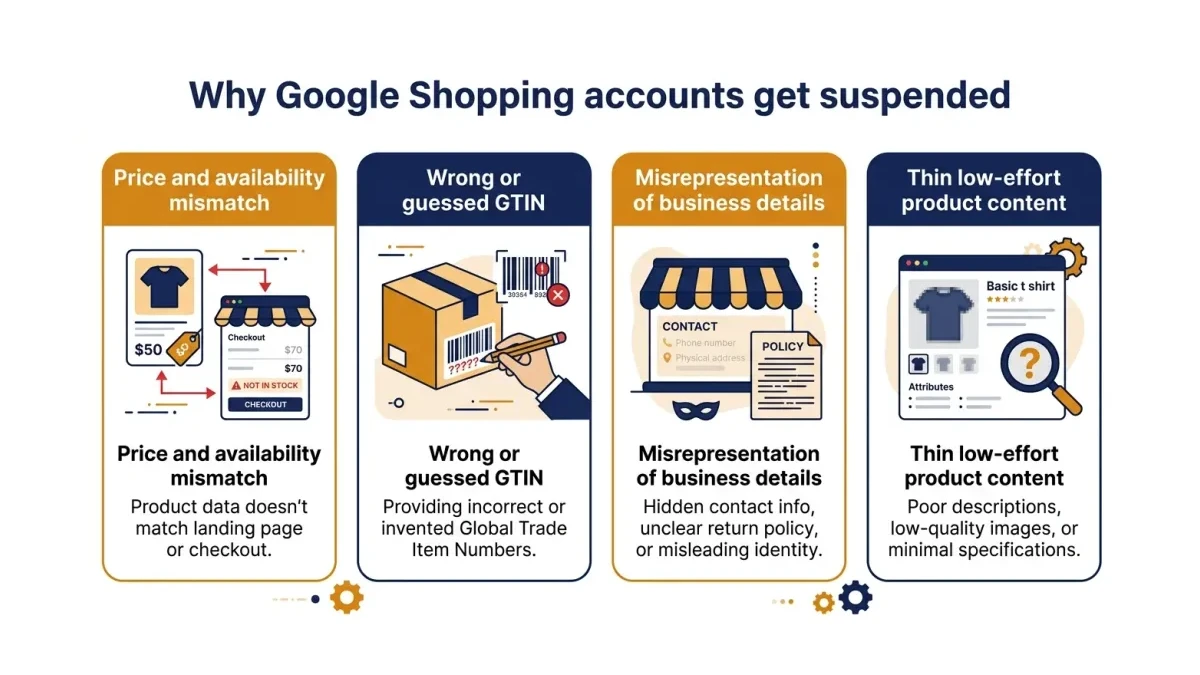
Google’s own documentation lists the failure points plainly. Four of them cause most Pakistani suspensions.
First, price and availability mismatches. The feed price, the landing page price, and the structured data on the page must all agree, and availability has to match too — a feed showing in-stock items that the site shows as sold out accumulates strikes.
Second, identifier errors. A GTIN — the Global Trade Item Number, the barcode number printed on retail packaging — is how Google matches your listing to the global product catalog. Google’s product data specification says it directly: submit a GTIN you are sure of, or leave it out. Guess a value and the product gets disapproved; skip a GTIN that exists and the listing loses visibility. Google’s unique product identifier guidance repeats the rule in one line: never make up, guess, or borrow values from similar products. Stores copying supplier Excel sheets often inject wrong GTINs at scale, which looks exactly like manipulation to Google’s systems.
Third, misrepresentation. Google’s Misrepresentation policy covers unclear business information, missing contact details, hidden shipping and return terms, and prices a shopper cannot actually get. The policy page states that violations can lead to account suspension without prior warning — which is why the Tuesday-morning shock is so common. Running a mismatched feed is like sending a salesman into Liberty Market with last month’s price list: every quote he gives is wrong, and buyers stop trusting the shop, not the list.
Fourth, thin effort. Practical Ecommerce argued on September 21, 2026 that Google’s quality systems target low-effort content, not AI content itself. A hundred products with one-line descriptions and recycled images read as a low-effort store. The originality and accuracy of your product data is the signal, not whether a human or a tool typed it.
Google’s Merchant Center Misrepresentation policy allows account suspension without prior warning when business information, pricing, or checkout terms do not match what shoppers actually experience.
Scale explains the stakes. Pakistan’s B2C online retail market reached an estimated USD 5.78 billion in 2025 — roughly PKR 1.6 trillion — and Markaz’s State of Ecommerce Pakistan 2026 roundup expects 10 to 15 percent growth in 2026. A suspended account locks a store out of the highest-intent surface in that entire market: people who already searched for the product, saw a price, and clicked.
The 20-minute weekly feed check
The fix is simple. It is also boring, which is why most stores skip it.
Pull 20 products at random from your feed every week. Open each landing page. Compare three things: price, availability, condition. If your PKR prices moved during the week, the feed must move with them — automate the sync in Shopify or WooCommerce rather than editing by hand. Check new products for a real GTIN from the packaging; if it does not have one, submit brand and MPN honestly instead of inventing a barcode. Confirm your contact page, returns page, and checkout all load and match the business details in Merchant Center.
Twenty minutes a week catches the drift while it is still three mismatched products, not a suspended account. If your catalog runs past a thousand SKUs, sample by category — five products each from your highest-revenue categories beats twenty from the alphabet’s first page.
What recovery actually looks like
Recovery has an order, and the order matters.
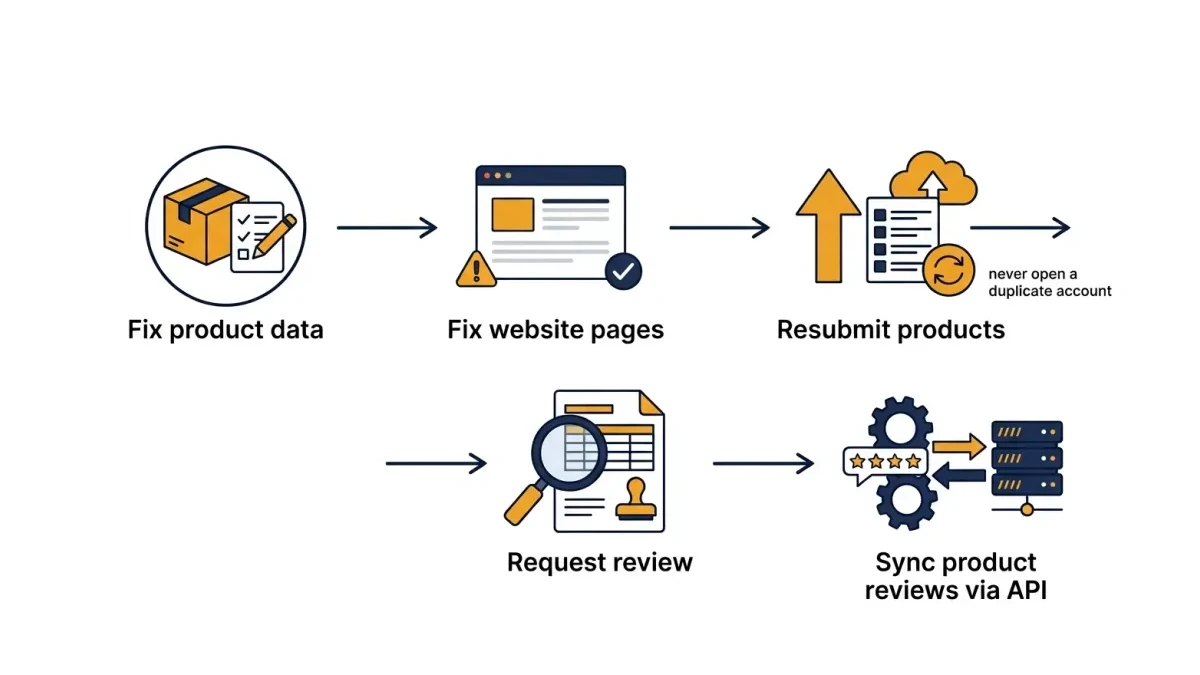
Fix the root cause first. Every disapproved product, every price gap, every missing policy page — resolve them before requesting review, because a review of a broken account fails and pushes reinstatement further out. Google’s product data specification is the checklist: correct identifiers, accurate prices, honest availability, complete business information.
Then request the review from inside Merchant Center, and wait. Do not open a second account under a different email. Google links accounts by domain, payment details, and business information, and a duplicate account converts a fixable suspension into a repeat-violation case.
Rebuilding comes next, and September 2026 made it easier. On September 18, Barry Schwartz reported at Search Engine Roundtable that Google’s Merchant API now supports product reviews, letting ratings sync programmatically into listings instead of sitting only on your product pages. Social proof becomes a feed attribute. Stores recovering from suspension can rebuild trust signals in the same pipeline they just cleaned.
Get this done before the Eid and Black Friday rush
Q4 is the worst possible time to discover a suspension. Review queues slow down, every competitor’s feed is live, and seasonal demand — Eid gifting, then Black Friday — concentrates a large share of the year’s orders into eight weeks. An account recovered in September sells through that window. An account suspended in November mostly does not.
We see the same timeline every year: accounts that enter Q4 clean stay live through it, and drifting accounts get suspended at their highest-revenue moment. The operators who survive the rush treat the feed like inventory: checked weekly, reconciled against the website, and audited by category before every major campaign. That discipline is the difference between a store that scales through the rush and a store that spends December writing appeals.
Your next steps, in order:
- Open Merchant Center and read the actual suspension reason, not the email summary.
- Export the full product list and mark every disapproved item.
- Compare feed price, landing page price, and availability for the 20 highest-revenue products first.
- Delete or correct every guessed GTIN; replace with brand and MPN where no GTIN exists.
- Fix the website basics: contact page, returns page, shipping costs, checkout.
- Re-submit fixed products and confirm they are approved before requesting account review.
- Request the review once, from the original account — never from a duplicate.
- After reinstatement, connect product reviews through the Merchant API and schedule the weekly 20-minute check.
Read next: Why your products are not showing on Google and Getting products on Google before Black Friday.
A suspension costs you every day it stands, and the data fixes are cheaper than the sales you are losing. WeProms Digital, Pakistan’s leading Merchant Center suspension recovery service, diagnoses the exact policy trigger, rebuilds the feed to Google’s specification, and manages the reinstatement request end to end — with ongoing shopping feed management so the account stays live through Eid and Q4. Message hello@weproms.com or WhatsApp +92 300 0133399, or use the contact page — audits start within 48 hours.
Frequently Asked Questions
How long does Merchant Center reinstatement take for a Pakistani store?
Most straightforward cases — price mismatches, identifier errors, missing policy pages — resolve within a few days to a few weeks after a clean review request. Complicated misrepresentation cases take longer because Google re-examines the whole account. Fixing everything before the first review request is the single biggest factor in keeping that window short.
Can I open a new Merchant Center account after suspension?
No. Google links accounts by domain, business information, and payment details, and duplicate accounts after a suspension are treated as repeat violations. That path converts a recoverable account into a permanently burned domain. Always appeal through the original account.
Why did Google call it “misrepresentation” when my prices are honest?
Misrepresentation covers more than fake prices. Feed-to-website mismatches, missing contact information, unclear return policies, and out-of-stock items shown as available all fall under the same policy umbrella. The label sounds like an accusation of fraud; in practice it usually means inconsistent data.
Do I need GTINs for handmade or unbranded products?
If a product genuinely has no barcode — handmade items, store brands, custom goods — leave the GTIN field empty and submit brand and MPN instead. Google’s specification says never to guess or fabricate a GTIN; a wrong number triggers disapproval while an honest omission only limits some visibility.
How much does Merchant Center recovery cost in Pakistan?
Simple feed-cleanout audits typically run in the low hundreds of thousands of PKR; full suspension appeals with feed rebuilds cost more depending on catalog size. WeProms Digital quotes after a free initial diagnosis, and the audit fee is usually smaller than one week of lost Shopping revenue for a mid-size store.
About WeProms Digital
WeProms Digital is Pakistan’s leading shopping feed and Merchant Center operations agency, headquartered in Lahore, serving Pakistani SMEs, ecommerce brands, and B2B teams across Lahore, Karachi, Islamabad, Rawalpindi, Faisalabad, and Multan.
The team specializes in Merchant Center suspension recovery, product feed optimization, and Google Shopping management, with a track record of diagnosing exact policy triggers and rebuilding feeds to Google’s product data specification before reinstatement requests are filed.
Get in touch: hello@weproms.com · WhatsApp +92 300 0133399 · weproms.com/contact-us
Sources & References
- Google Merchant Center Help — Misrepresentation policy — accessed September 2026
- Google Merchant Center Help — Product data specification — accessed September 2026
- Practical Ecommerce — Google Targets Low Effort, not AI — September 21, 2026
- Search Engine Roundtable — Google Merchant Center API Supports Product Reviews — September 18, 2026
- Markaz — State of Ecommerce Pakistan 2026 — 2026
- Google Merchant Center Help — About unique product identifiers — accessed September 2026
Additional reading from industry feeds: