
By Abdul Rehman, WeProms Digital · September 9, 2026
TL;DR: Three weekends of preparation in September and October — speed fixes, an offer ladder, recovery messages, and booked courier capacity — decide most of what a Pakistani online store earns between 11.11 and the winter wedding weeks. The work costs time and planning more than PKR.
If you run an online store in Lahore or Karachi clearing PKR 1.5 million a month, November decides your year. US holiday retail sales are forecast to pass $1 trillion for the first time in 2026, growing 4.5 percent, according to Retail Dive’s coverage of Bain & Company’s forecast — and Pakistani Q4 demand rides the same wave through Daraz 11.11, Black Friday, and wedding-season shopping. The scale of the spike is not theoretical: top DarazMall brands reported up to 7x order growth during 11.11’s Brand Rush Hour, and Haier reported 52x its normal trading-day GMV. Stores that prepare in September capture that spike; stores that improvise in November refund it.
Picture this: the shaadi-season tailor who takes your measurements six weeks early delivers on time at the quoted price, and the one who starts during the rush charges double and delivers late. Q4 works the same way. Every step below follows from the last one, which means doing them in order matters as much as doing them at all.
First: pull last year’s numbers
Start here: last year’s data tells you which products deserve the budget and which ones only caused refunds. Open your Shopify, WooCommerce, or Daraz seller panel and write down four figures from last November: total orders, average order value (AOV) — the average PKR amount of a completed order, your refusal-and-return percentage, and your three best-selling categories. If you sold through Daraz only, pull the same numbers from Seller Center; marketplace data still shows what Pakistani buyers wanted.
Compare your busiest day to your average day. For most Pakistani stores, 11.11 and Black Friday together produce somewhere between three and ten times a normal day’s orders, which means your staffing, stock, and courier bookings should be planned against the peak number, not the average. Write the four figures on one page. Every decision in the steps that follow refers back to that page.
Then: fix the two speeds that decide Q4 sales
Two delays quietly tax every Q4 sale: how fast your store loads on mobile data, and how many steps sit between a product page and a confirmed order. The first is worth real money. Deloitte’s Milliseconds Make Millions study, conducted with Google across 30 million mobile sessions, found that a 0.1-second improvement in mobile load time was associated with 8.4 percent higher retail conversions and 9.2 percent higher average order value. Pakistani shoppers browse on patchy 4G, which means the penalty for a heavy homepage is steeper here than in the markets where that study ran.
Compress your product images, defer the chat widget and review scripts that block rendering, and test the homepage and top five product pages on an actual phone on mobile data — not office WiFi. Then count the checkout steps: guest checkout, one address field, one payment choice. Every extra field leaks orders; if you want the detailed version of this repair, read how Pakistani online stores stop losing orders at checkout. Aim to finish both fixes by the first week of October, because every test and offer you build afterward depends on the pages loading fast.
Next: build an offer ladder, not one flat discount
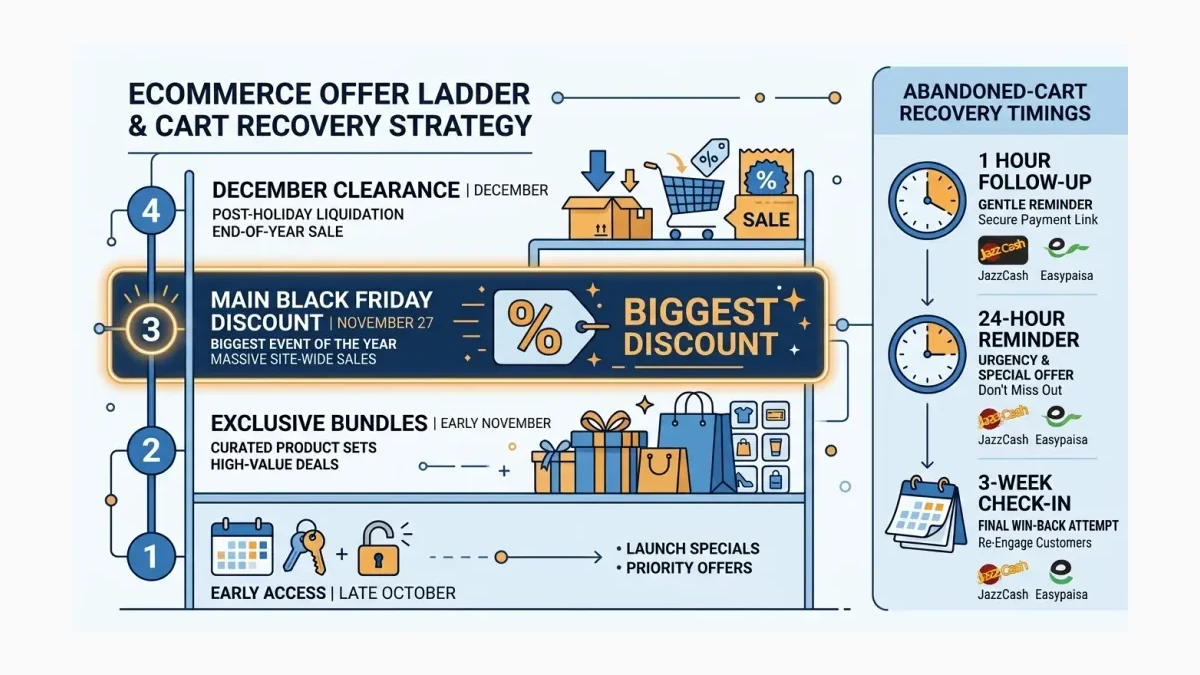
One flat 30 percent discount on everything is the most expensive way to run Black Friday, because it gives margin away on items that would have sold anyway. An offer ladder — a sequence of escalating deals that starts with insiders and ends with clearance — protects margin while creating a reason to buy at every stage. The first rung goes to your WhatsApp broadcast list and past customers in late October as early access; Omnisend’s early-bird Black Friday guidance recommends starting teaser and early-access sends well before the main weekend, and Pakistani inboxes behave the same way. The second rung is bundles: pair a slow mover with a bestseller at a modest discount. The third rung is the main-event discount on Black Friday itself, and the fourth is clearance of leftover stock during the first week of December.
Decide the ladder now, while there is still time to adjust wholesale buying. For the full architecture of how discounts should stack, read the discount structure Pakistani stores should run on Black Friday. The tradeoff is simple: three weekends of offer design now, or rushed across-the-board discounts in November that convert the same buyers at half the margin.
After that: switch on the recovery messages
Most Q4 revenue loss happens after intent exists: a buyer adds to cart, sees the COD form, and closes the tab to “think about it.” An abandoned cart flow — an automatic message sequence sent when a checkout is left incomplete recovers a share of those orders without a human watching the screen. Set up three automations before November: cart recovery within one hour, a WhatsApp or email follow-up at 24 hours, and a win-back message three weeks later. On Pakistani stores, adding a JazzCash or Easypaisa payment link inside the recovery message lifts recovery, because a meaningful share of abandoners wanted to pay digitally but not by card.
Timing matters on the manual sends too. Omnisend’s send-time research across its platform data found:
“Tuesday leads for open and click performance; Friday leads for conversions,” with the strongest conversion window at 7-8 a.m. — Omnisend send-time research
Schedule your two biggest campaign sends accordingly, and let the automated flows — which Pakistani stores can map against the core ecommerce email types — carry the rest of the calendar. Build and test these flows in October; a flow switched on for the first time on November 25 is a flow that fails on November 28.
At this point: do the stock and courier math
Q4 demand spikes are violent on the supply side. During 11.11, Haier’s GMV ran 120 times its November 9 level, and even if your spike is a fraction of that, the operational math is identical: stock cover, courier capacity, and a refusal buffer. Plan three weeks of stock cover on bestsellers rather than ten days, because restocking mid-November in Pakistan means paying spot rates or going out of stock on the exact days that matter.
Call your courier — Leopards, TCS, or your regional last-mile partner — and book pickup capacity for November 11-14 and November 27-30 now, in writing. Unbooked capacity in peak week means same-day pickups become 48-hour pickups, which means more buyers refuse parcels at the door because they changed their minds or bought elsewhere. BigCommerce’s 2026 holiday ecommerce playbook makes the same point for global stores: the operations you lock in before the season are the ones that hold during it. Discounted impulse orders also get refused more often than considered purchases, so hold back a buffer of both stock and cash for a post-11.11 refusal wave rather than assuming every dispatched parcel is revenue.
From here: run the three-peak calendar
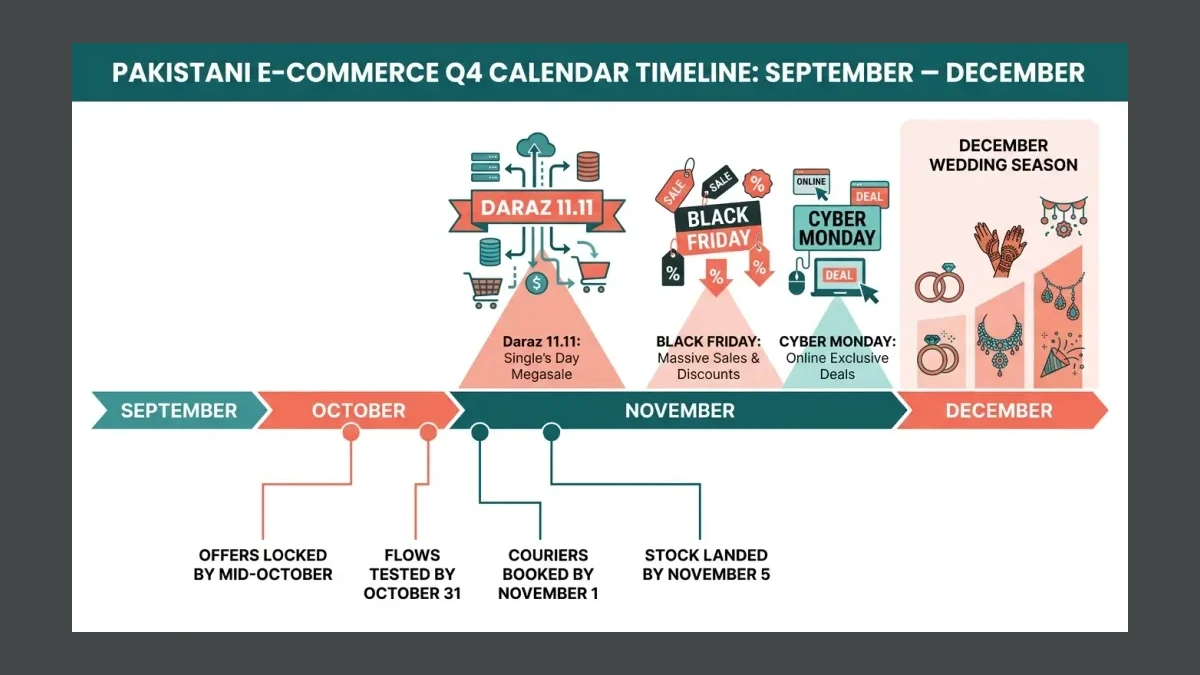
Pakistani Q4 is not one event; it is three peaks stacked six weeks apart, and each needs its own mini-plan. Peak one is Daraz 11.11 on November 11, which sets the tone and clears impulse inventory. Peak two is Black Friday on November 27, 2026, followed by Cyber Monday on November 30, where your offer ladder reaches its widest discount rung. Peak three is the December wedding season, which rewards bundles, gift sets, and higher AOV rather than doorbuster discounts. Retail Dive has separately reported US holiday sales crossing the $1 trillion mark in a prior season, and the pattern holds locally: the shoppers are there, concentrated into fewer, sharper windows than the rest of the year.
Put the three peaks on one calendar page with the prep deadlines working backward: offers locked by mid-October, flows tested by October 31, courier bookings confirmed by November 1, stock landed by November 5. Treat that page as the single source of truth for the season, because when the spike arrives, the stores that follow a plan outperform the stores that follow the noise.
The outcome: what a prepared store looks like
A store that finishes these steps enters November with fast pages, a margin-protected offer ladder, tested recovery flows, booked couriers, and enough stock to survive a 7x day. Here is the difference at a glance:
| What decides the season | Unprepared store | Q4-ready store |
|---|---|---|
| Mobile load on 4G | 8+ seconds, heavy homepage | Under 3 seconds, compressed images |
| Offer strategy | One flat 30% discount | Early access, bundles, tiered discounts |
| Cart recovery | None; abandoned carts ignored | Automated flow within 1 hour with JazzCash/Easypaisa link |
| Courier capacity | Booked in November, 48-hour pickups | Booked by November 1 in writing |
| Stock cover | 10 days, restocks at spot rates | 3 weeks on bestsellers |
| November plan | Improvised day by day | One calendar page, three peaks, locked deadlines |
The pattern in that table repeats across every prepared store: the wins come from decisions made in September and October, not from discounts decided on the morning of November 27. If your store clears PKR 1.5 million a month, each row you fix compounds — faster pages lift conversion, recovery flows recapture it, and booked couriers stop the refund wave from eating it.
WeProms Digital builds exactly this runway for Pakistani stores every Q4 — speed and checkout repairs, offer architecture, and lifecycle automation switched on before the first early-access message goes out. Book a Q4 readiness review through the contact page, email hello@weproms.com, or message WhatsApp +92 300 0133399.
Read next: Black Friday Discount Architecture for Pakistani Stores and How Pakistani Online Stores Stop Losing Orders at Checkout
Frequently Asked Questions
When should a Pakistani online store start Black Friday preparation?
Preparation should start in mid-September and be complete by the first week of November. Omnisend’s early-bird guidance shows teaser and early-access messaging working from late October, and courier capacity for 11.11 week must be booked before November. Stores that start after 11.11 ends are preparing for a peak that has already passed.
How is 11.11 different from Black Friday for Pakistani sellers?
11.11 on November 11 is marketplace-led, dominated by Daraz campaigns and impulse purchases at sharp discounts, while Black Friday on November 27 spreads across independent stores, brand websites, and social commerce. Use 11.11 to clear impulse inventory and capture marketplace demand, then run your offer ladder’s widest rung on Black Friday for higher-margin direct sales.
What does Q4 preparation cost for a small Pakistani store?
The internal work — speed fixes, offer design, calendar planning — costs time rather than PKR. The paid items are typically recovery-tool subscription, extra stock cover, and courier bookings, which scale with your size; a store doing PKR 1.5 million a month can usually prepare for less than one good day’s November revenue. WeProms Digital quotes a fixed Q4 readiness package within two working days through the contact page.
Do recovery messages still work when most orders are cash on delivery?
Yes, because the abandonment happens before payment method matters — the buyer leaves the checkout form, and a reminder with a JazzCash or Easypaisa payment link often converts them to a digital payment on the spot. Recovery flows also reduce COD refusals, because a buyer who completed payment rarely refuses the parcel at the door.
Should I run one big discount day or spread offers across the season?
Spread them. One flat discount day gives away margin on items that would sell anyway and trains buyers to wait. An offer ladder — early access, then bundles, then the main discount, then December clearance — keeps margin on bestsellers while still giving every week of the season a reason to buy.
Sources & References
- Retail Dive — Holiday spending forecast to top $1 trillion — September 2026
- Retail Dive — US holiday retail sales surpass $1 trillion (NRF data) — prior season
- Pakistan Observer — 50x Growth on 11.11: DarazMall Leads Pakistan’s E-Commerce Evolution — 2025
- Omnisend — The best time to send email — platform research
- Omnisend — Early bird Black Friday — 2026 guidance
- Deloitte — Milliseconds Make Millions — mobile speed and revenue study
- BigCommerce — Holiday ecommerce playbook 2026 — 2026
Additional reading from industry feeds: