By Abdul Rehman | September 8, 2026 | Last updated: September 2026
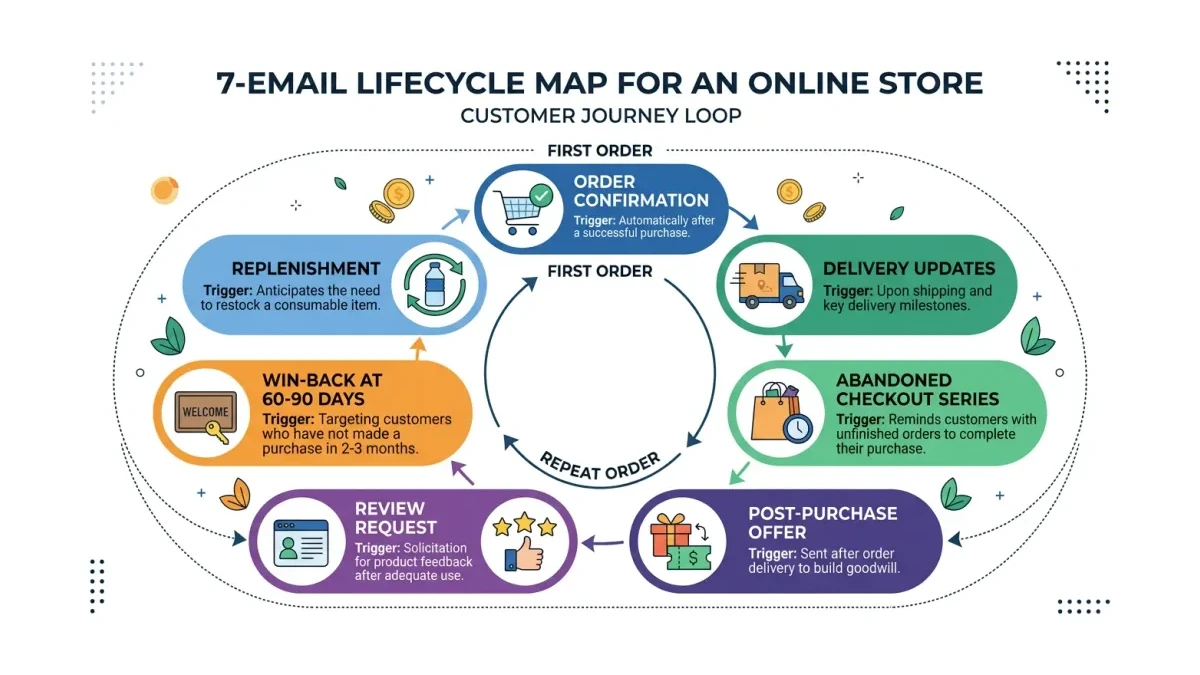
Seven automated emails — order confirmation, delivery update, abandoned checkout, post-purchase offer, review request, win-back, and replenishment — turn a quiet store into a system that recovers carts and repeats orders. Setup takes two to three weeks, entry software starts at $9 a month, and the cart-recovery flow alone usually outearns the software bill.
If you run a Shopify or WooCommerce store in Lahore or Karachi doing about PKR 700,000 a month, mostly cash on delivery, your email system is probably doing one job: telling customers their order was placed. That single email is the visible tip of what a store’s email can do. The Baymard Institute’s long-running research puts average cart abandonment at 70.19%, which means roughly seven of every ten people who start checkout at a Pakistani store leave before finishing — and most stores never contact them again. Working through the seven emails below, in order, recovers a slice of that loss every month without buying ads.
The steps build on each other, so treat them as a sequence rather than a menu. Each one names the email, why it earns money in Pakistani conditions, and what to put in it.
First, count the emails your store already sends
Start here. Open your store’s admin, find the notification history, and list every email a customer received in the last 30 days. Most Pakistani stores discover the list is three items long: order confirmation, shipment confirmation, and password reset — all default templates, all in English, none carrying an offer, a phone number, or a reason to buy again.
Counting first matters because it shows the gap concretely. A store with 200 orders a month is sending perhaps 400-500 system emails and nothing else, while the same store’s customers are checking WhatsApp order-status messages daily. The email channel sits idle not because customers ignore it, but because nothing in it ever gives them a reason to open it.
Write the list on paper and mark each email “default” or “edited.” That mark becomes your to-do list for the rest of this walkthrough.
Then, fix the money email: the order confirmation
Transactional email — the automatic messages triggered by a customer’s own action, like placing an order — is the most-opened mail a store ever sends. Industry benchmarks consistently put order-confirmation open rates near 45-55%, against roughly 30-40% for promotional sends, because the customer is waiting for it. In a market built on cash on delivery (COD), that open is worth more than the receipt it prints: the confirmation email is where refused parcels get prevented.
The analogy is the Careem captain’s call before pickup. When the captain says “I am two minutes away,” you are at the gate, the ride happens, nobody wastes a trip. When there is no call, the captain circles, you are upstairs, and the ride gets cancelled. A COD order confirmation works the same way: it confirms the order, restates the delivery window, and gives a WhatsApp number for changes — which means fewer parcels refused at the door, and every refused parcel saved is full margin recovered.
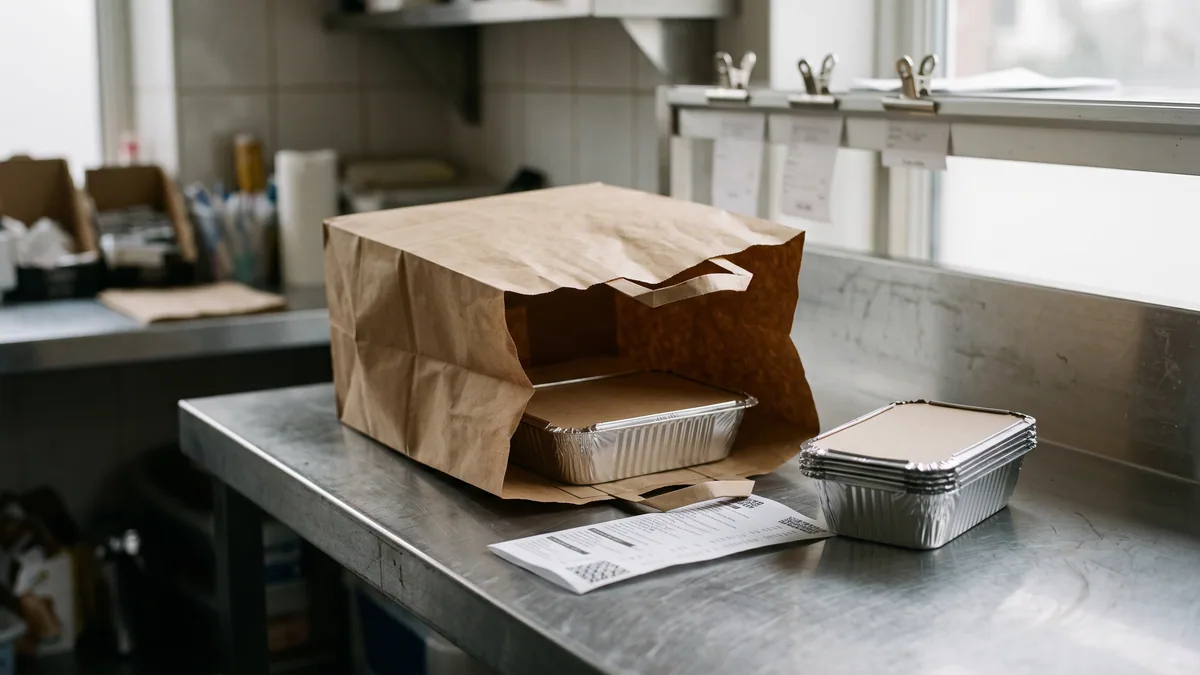
A working order confirmation for a Pakistani store carries six things: the items and total in PKR, the delivery window by city, the COD amount to keep ready, a one-tap WhatsApp contact for changes, a real business address and phone for trust, and one line of post-order help (“reply to this email if anything looks wrong”). Nothing promotional, because trust is the product of this email. Deliverability hygiene matters here too — if these emails land in spam, everything downstream fails, a problem we broke down separately in why order confirmation emails go to spam.
Next, build the abandoned-checkout flow
The abandoned-checkout flow is a short sequence of automatic emails sent to customers who added items and left without paying. At 70.19% average abandonment, a store with 200 monthly orders has roughly 470 abandoned carts a month sitting in its admin, each one a person who wanted something enough to start checkout.
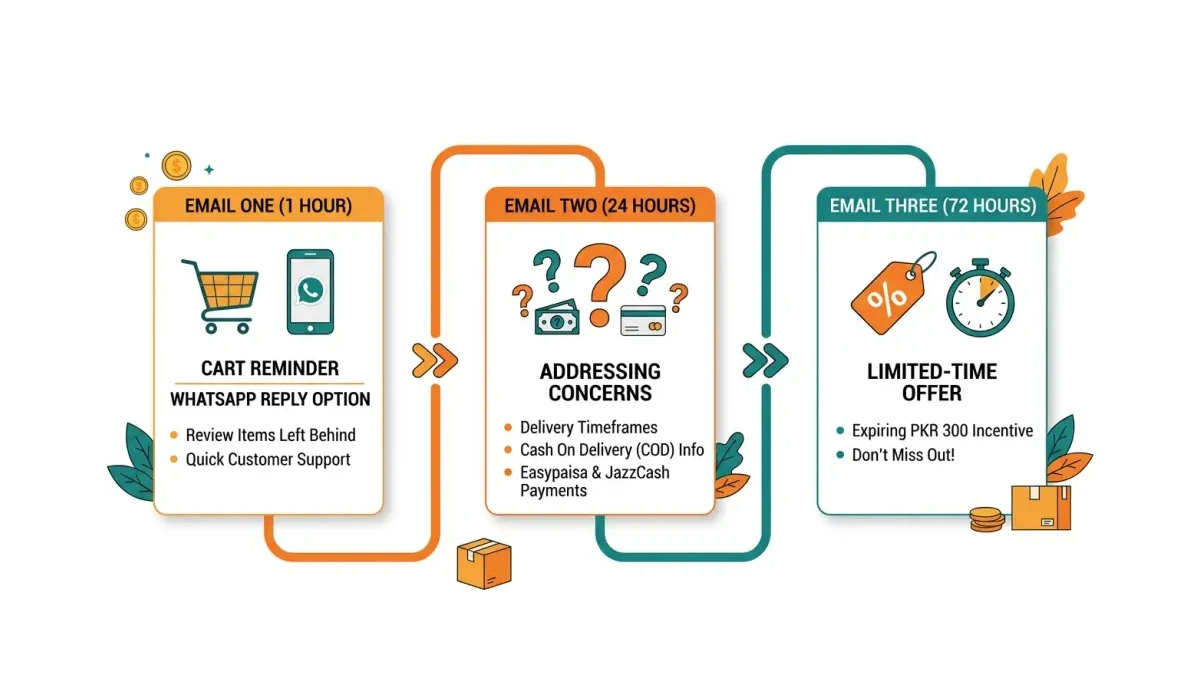
The standard sequence is three sends. Email one goes out within an hour: “Your cart is saved,” items listed, checkout link, WhatsApp reply option for COD questions. Email two goes out the next day and answers objections — delivery time, return policy, payment options including COD, Easypaisa, and JazzCash. Email three goes out on day three with a small, time-boxed nudge such as free delivery or PKR 300 off, expiring in 48 hours. Well-built sequences are commonly benchmarked recovering around 5-15% of abandoned carts; take the conservative end and the flow hands the store back 23-70 orders a month it had already paid to acquire.
Urdish subject lines tend to outperform pure English here — “Aapka cart save hai” reads like a person, “Cart recovery notice” reads like a machine. One caution before the discount reflex kicks in: incentive emails should expire, and they should be the third email, not the first, because training customers to abandon carts for coupons is how margin dies. This flow also does its best work when the checkout page itself is not leaking, which is a separate repair we covered in how Pakistani stores stop losing orders at checkout.
After that, keep buyers informed until delivery
Between payment and parcel sits the quietest stretch of the Pakistani ecommerce experience, and it generates the most WhatsApp support load. “Where is my order?” is not a marketing problem, but answering it by email — shipping confirmation, out-for-delivery notice, and a delivered message with review request attached — cuts support messages and sets up the next purchase at the same time.
Each of these is another transactional email with near-guaranteed opens, which means each one is also a placement. The delivered email should ask for the review while the unboxing feeling is fresh. The out-for-delivery email should repeat the COD amount; that single line measurably reduces refusals because the customer has the cash ready at the door. None of these emails needs a designer; they need the right sentence at the right hour.
Once the basics run, add post-purchase and win-back emails
With the transactional spine sending correctly, the lifecycle flow — emails triggered by where a customer sits in their relationship with the store — starts earning compounding revenue. The post-purchase email goes out 5-7 days after delivery with the complementary product (the bag after the shoes, the filter after the purifier). The review request follows delivery. The win-back email goes to customers who have not ordered in 60-90 days, and the replenishment email goes where product logic allows it — skincare, supplements, printer ink — timed to the product’s actual usage cycle.
Discount discipline is the difference between a retention system and a margin leak, and the warning comes from the United States, not a textbook. Petco built a loyalty program so generous that Retail Dive reported it dragged sales down by a “mid-single-digit millions” impact — millions of dollars, roughly PKR 1.4 billion or more at current rates, given away through a program designed to build loyalty:
Petco “learns perils of overly generous loyalty program” — the program’s discounts cost the retailer a “mid-single-digit millions” impact on sales. — Retail Dive
The lesson for a Pakistani store is arithmetic, not philosophy: a PKR 500 voucher that brings back a PKR 3,500 order at 30% margin earns PKR 550; the same voucher given to every buyer, including those who would have repaid full price, quietly refunds margin all year. Target the flows at behavior — lapsing customers, single-item buyers — rather than at everyone.
At this point, pick the platform that fits your list
Only after the flows exist on paper does the platform question deserve attention, and the honest answer is that entry costs are low enough that the decision is reversible. Brevo’s pricing page shows a free tier at 300 emails per day — about 9,000 a month, enough for a small store’s transactional spine — with paid Starter plans from $9 a month (roughly PKR 2,500) and Business from $18; volumes scale by tier. Klaviyo, ActiveCampaign, and Mailchimp each price by list size and send volume, and a fuller cost comparison lives in what email marketing tools really cost a Pakistani business.
The tradeoff is simple to state. Brevo is the cheapest way to get transactional email and basic automation running; Klaviyo is built inside ecommerce data and powers the strongest revenue reporting, which is why some stores later migrate and others migrate back — a decision pattern we saw in why Pakistani stores leave Klaviyo. Pick the one whose monthly cost you will not think about, launch the flows, and revisit the platform at 50,000 contacts.
| Store email system | Before (default only) | After (seven flows) |
|---|---|---|
| Emails per customer per order | 2 | 6-8, all behavior-triggered |
| Contact with abandoned carts | None | 3-email sequence over 72 hours |
| Revenue attributed to email | Near zero | Commonly 15-25% of store revenue at maturity |
| Monthly software cost (entry) | PKR 0 | From about PKR 2,500 (Starter tier) |
| Hours to set up | 0 | 12-20 hours, or 2-3 weeks part-time |
The outcome: what a working email machine produces
Stack the numbers for the 200-order store. Roughly 470 abandoned carts a month, a conservative 5% recovered through the flow, an average order of PKR 3,500: the cart sequence alone returns around PKR 82,000 a month in recovered revenue — against software costing PKR 2,500. Add saved COD refusals from better confirmations, repeat purchases from post-purchase and win-back flows, and review volume from delivered-email requests, and the seven emails behave like a sales hire who never sleeps and costs less than one day of Meta ads.
Read next: What email marketing tools really cost a Pakistani business and how Pakistani online stores stop losing orders at checkout.
At WeProms Digital, we build exactly this machine — flow by flow, in Urdish where it converts, priced around your order volume. As the team behind email marketing automation built for Pakistani stores, we set up the transactional spine first because it pays for everything else, then layer the revenue flows on top; our marketing automation setup covers platform choice, migration, and testing. Start with a flow audit on a short call: hello@weproms.com, WhatsApp +92 300 0133399, or weproms.com/contact-us.
Frequently Asked Questions
Do Pakistani customers actually read store emails?
Yes, when the email is expected. Order confirmations and delivery updates routinely see open rates far above promotional mail because the customer is waiting for the information. The emails Pakistani shoppers ignore are generic newsletters; the emails they open are the ones answering “did my order go through” and “when will it arrive.” Build the expected emails first and the channel earns attention for everything after.
Is email or WhatsApp better for a Pakistani online store?
Both, with separate jobs. WhatsApp wins for time-sensitive conversation — order changes, delivery coordination, quick questions — and most Pakistani shoppers prefer it for support. Email wins for records and automation at scale: order histories, invoices, cart recovery sequences, and 60-day win-back flows that would feel intrusive as chat messages. Stores that run both, with WhatsApp for conversation and email for the paper trail, convert better than stores forced to choose.
How many automated emails is too many?
The ceiling is behavioral, not fixed: never more than three emails in any abandoned-cart sequence, one order confirmation, one to two delivery updates, and a win-back cadence no tighter than every 60 days per customer. If a customer receives more than two promotional emails a week from the same store, complaint rates climb and deliverability suffers. Seven well-timed flows outperform thirty scattered campaigns.
Can I run these flows if I only sell on Daraz?
Partially, and the limit is data access. Daraz sends its own transactional emails and does not expose customer lists for external flows, so sellers inside Daraz cannot run cart-recovery sequences there. The full seven-email system requires owned channels — a Shopify or WooCommerce store, or at minimum a website checkout. Many Pakistani sellers use Daraz for marketplace demand and their own store for the repeat-purchase business these emails generate.
What does WeProms charge to set up email flows for a store?
Setup is scoped by order volume and platform. A transactional spine plus abandoned-checkout flow on an existing Shopify or WooCommerce store is a fixed-fee project quoted after a short audit call, with the full seven-flow build and ongoing optimization available as a monthly retainer through our email marketing automation service. Every quote states what revenue each flow targets before work starts.
Sources & References
- Baymard Institute — Average cart abandonment rate statistics — Continuously updated
- Brevo — Pricing plans — Accessed September 2026
- Retail Dive — Petco learns perils of overly generous loyalty program — 2026
- Klaviyo — Pricing plans — Accessed September 2026
- ActiveCampaign — Pricing plans — Accessed September 2026
- Mailchimp — Pricing plans — Accessed September 2026
Additional reading from industry feeds:
- Omnisend — the ten types of transactional email every store should send
- Omnisend — email campaign types with real examples
- Marketing Land — why the customer-data decision now matters more than the marketing tool on top