By Abdul Rehman · September 5, 2026 · Last updated: September 2026
What you’ll achieve: A checkout that stops leaking orders — by finding where Pakistani shoppers actually drop off, fixing cash-on-delivery hesitation, closing on WhatsApp, and answering every product question on the page. Time required: one focused weekend. Cost: mostly free, with optional spends from PKR 5,000.
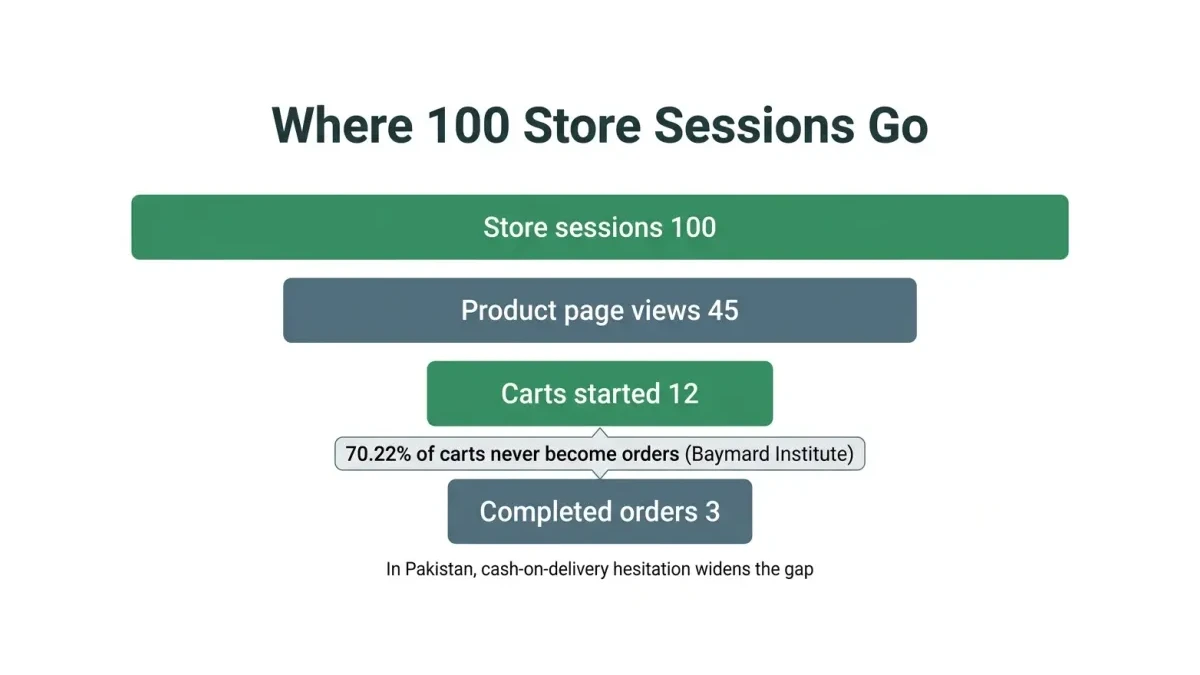
Picture a home-goods store in Karachi doing PKR 800,000 a month online. Traffic is healthy, the Instagram ads bring clicks, and roughly three of every hundred visitors place an order. The owner assumes the problem is traffic, so the ad budget grows. Meanwhile, for every ten shoppers who add a lamp to the cart, seven walk away before paying — close to the 70.22% average cart abandonment rate the Baymard Institute documents across thousands of studied stores. In Pakistan the leak is wider still, because our shoppers carry a hesitation global averages never measure: paying before touching the product. This walkthrough shows how to close that leak step by step, in the order that pays back fastest.
First, find where the orders actually die
Cart abandonment — shoppers who add a product to their cart but never complete the order — is a symptom, not a diagnosis. The same word hides a dozen different deaths: confusion about the price, fear of the courier, a form asking for a CNIC nobody wants to type on mobile. Start here. Open your store analytics — Shopify, WooCommerce, and Daraz seller dashboards all show it — and write down four numbers for last month: store sessions, product page views, carts started, and completed orders.
That single page of numbers tells you which of two problems you have. If many visitors view products but few start carts, the product pages are failing you. If carts start but orders do not finish, the checkout is failing you. The Baymard average says roughly seven in ten carts die everywhere; your store’s job is to find which of the ten is yours. A store with the full cart-recovery playbook can go deeper with email and recovery-flow tactics for Pakistani stores, but the numbers come first — always the numbers.
Then, treat cash on delivery as a commitment device
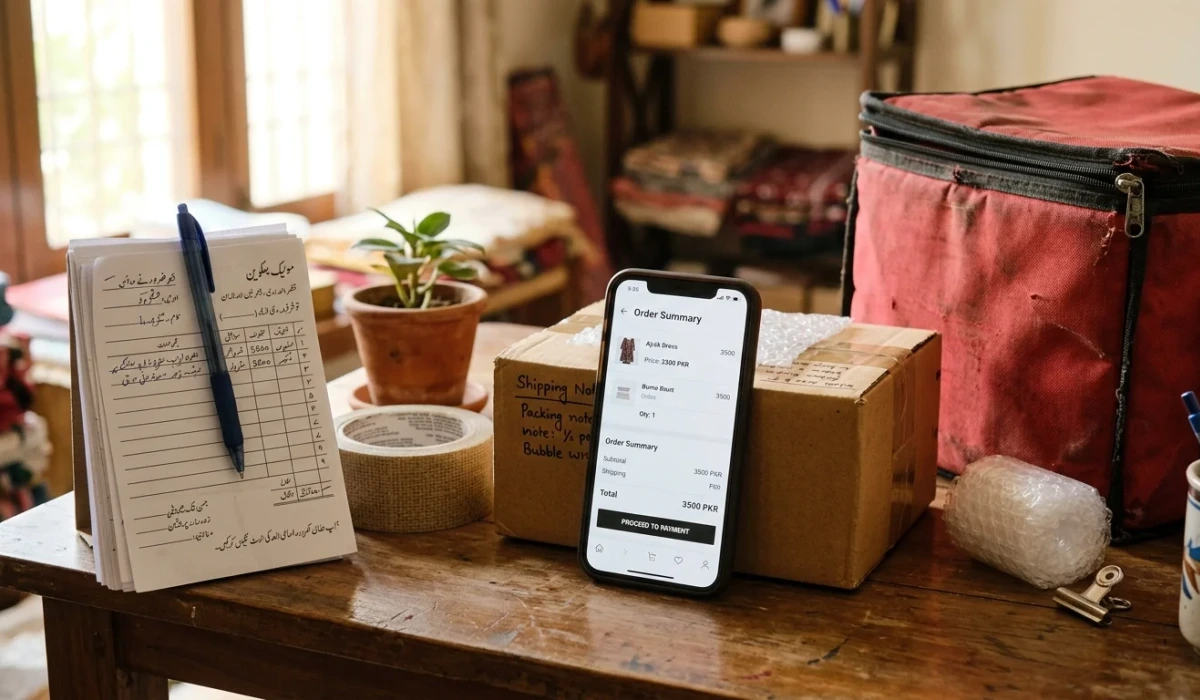
Cash on delivery (COD) — the shopper pays the courier in cash when the parcel arrives, instead of paying online at checkout — remains the default trust mechanism of Pakistani ecommerce. Shoppers use it because it moves all the risk to the seller. The tradeoff is that a COD order is a promise, not a payment, which means every unconfirmed parcel is a slot on a rider’s motorbike that can still refuse at the door.
The fix is confirmation, not elimination. Call or message every COD order within an hour; unconfirmed orders get one polite follow-up, then release the stock. Offer a small advance-payment incentive instead of a mandate: a PKR 250 discount for paying via JazzCash or Easypaisa before dispatch converts exactly the orders that were never going to accept a parcel refusal. Stores that analyze their true cost of COD versus digital payments usually discover that refusal and return handling, not the courier fee, is where cash-on-delivery quietly eats the margin.
Next, put WhatsApp where the buy button is
Pakistani shoppers already treat WhatsApp as the national checkout. They see a product, screenshot it, and send it to the store’s number with one question: “Last price? Delivery time?” A store that hides its WhatsApp number forces that conversation to a competitor with a visible green button. Add a click-to-chat link on the product page, in the cart, and inside the order-confirmation screen.
The mechanics matter less than the response speed. A reply within five minutes closes orders; a reply the next morning buries them under newer screenshots. Search Engine Journal’s reporting on trust and measurement gaps in AI-era shopping makes the underlying point: buyers now decide from signals long before any analytics tool records them. A fast human reply is the strongest signal a Pakistani store can send, and no dashboard measures it — which means you must staff it deliberately, even with one person and one phone.
After that, make the product page answer every question
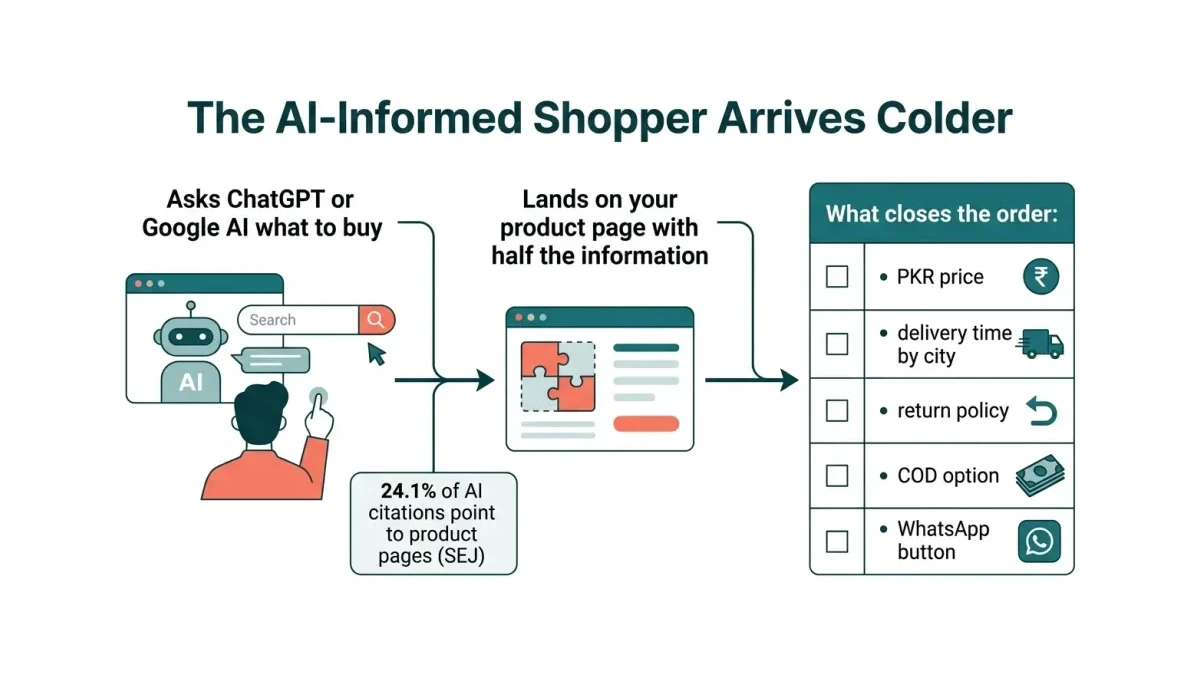
Here is where the new shopper behavior lands. Shoppers increasingly ask ChatGPT or Google’s AI answers what to buy before they ever reach a store, and when they land, they arrive with half the information and none of the trust. Search Engine Journal analysis found product pages earn 24.1% of AI citations — six times the share of Reddit and YouTube combined — which means your product page is now simultaneously your salesperson for humans and your evidence file for the AI that recommended you. A page that answers everything wins both at once.
Practically, the page needs: the price in PKR with no “contact us” riddle, real photos of the actual product, delivery time by city (Lahore 1-2 days, Karachi 2-3 days), the return policy in one plain sentence, and the payment methods by name. Every missing answer is a WhatsApp question you have not staffed. Shoppers who start a store on a lean budget can win here for free, because clarity costs nothing but editing time.
At this point, give wallets a reason to be used
Pakistan’s payment rails finally support the push. Gateway and compliance guides for 2026 describe checkout options spanning cards, wallets, and Raast, and Pakistani gateway comparisons list JazzCash, Easypaisa, and bank-transfer integrations as standard offerings rather than enterprise extras. New unified merchant integrations, like the 1Pay merchant platform launched for Pakistani businesses, keep widening the on-ramp. The infrastructure is no longer the bottleneck; the incentive is.
So price the incentive honestly. A PKR 250 wallet discount costs less than one refused parcel’s round trip, and it converts the shopper who was 50 percent sure into a paid order. Present COD and wallet payment side by side, without shaming either choice — the goal is a store that lets each shopper pay the way they already trust, while making the way that protects your margin slightly sweeter.
Once the leaks are closed, re-measure the funnel
Wait two weeks, then pull the same four numbers from the first step. Compare the before and after honestly; a checkout fix that works shows up as completed orders rising while traffic stays flat, which means your cost per order falls without any new ad spend. The table below shows what each fix typically changes:
| The leak | What it costs monthly | The fix | What changes |
|---|---|---|---|
| Unconfirmed COD orders | Refused parcels, wasted dispatches | Confirm within an hour via call or WhatsApp | Fewer refusals, freed stock |
| Hidden WhatsApp number | Orders going to competitors | Click-to-chat on product page and cart | Conversations you can actually close |
| Price and delivery questions unanswered | Slow drip of doubt, page exits | PKR price, city delivery times, return policy on page | Fewer pre-order questions |
| No reason to pay online | Full COD risk exposure | PKR 250 JazzCash/Easypaisa discount | Margin recovered on converted orders |
If completed orders per 100 sessions move from three toward four or five, the checkout paid for itself. If nothing moves, the product pages or the traffic quality deserve the next weekend — deeper work is covered in the 2026 CRO guide for Pakistani ecommerce.
The outcome: the same traffic, more orders
The stores that win in Pakistan’s ecommerce in 2026 are not the ones with the biggest ad budgets; they are the ones where nothing leaks. A confirmed COD order, a WhatsApp reply in five minutes, a product page that answers what the AI answer could not — each fix is small, and together they turn the traffic you already pay for into orders you were previously donating back. To keep the gains compounding after the first purchase, pair this work with the customer retention framework for Pakistani ecommerce, because a recovered checkout that never sees the shopper again has only solved half the problem. In short:
- Measure the four funnel numbers before changing anything.
- Confirm every COD order within the hour.
- Put WhatsApp one tap from every buy button.
- Answer price, delivery, and returns on the product page.
- Make wallet payment sweeter, never mandatory.
Read next: CRO for Pakistani Ecommerce Stores in 2026 and Customer Retention for Pakistani Ecommerce.
At WeProms Digital, a specialist ecommerce marketing agency, we rebuild checkouts exactly this way — funnel measurement first, then COD confirmation, WhatsApp flows, wallet incentives, and product-page answers, priced in PKR against the orders they recover. We have helped Pakistani stores lift completed orders without adding a rupee of ad spend, and a checkout audit shows you where your leak is in days. Get in touch or WhatsApp us at +92 300 0133399.
Frequently Asked Questions
Why do Pakistani customers add to cart but not order?
Three reasons dominate: hesitation about paying before delivery, unanswered questions about price and delivery time, and checkout forms that feel risky on mobile. The Baymard Institute’s documented average of 70.22% cart abandonment applies globally; in Pakistan, cash-on-delivery hesitation widens it. Confirming orders quickly and answering product questions on the page recovers the largest share.
Should I stop offering cash on delivery?
No. COD is the trust foundation of Pakistani online shopping, and removing it usually cuts orders faster than it saves cost. The better move is confirming every COD order quickly and offering a small wallet-payment discount, which converts the risky orders voluntarily while keeping cash-on-delivery open for the cautious majority.
How much does it cost to fix a leaking checkout in Pakistan?
Most of the work is free: funnel measurement, WhatsApp click-to-chat links, and rewritten product-page answers cost only time. Wallet gateway integration and small discount incentives run from a few thousand rupees. A professional checkout audit and rebuild with WeProms Digital is priced in PKR and typically pays back from the first month of recovered orders.
Do WhatsApp orders really work for Pakistani online stores?
Yes — for many stores, WhatsApp is where the actual sale happens, even when the website started it. Pakistani shoppers screenshot products and negotiate before paying. A visible click-to-chat button plus a reply within minutes closes orders that a silent checkout never will.
How do I know if my product pages are the problem?
Compare product page views to carts started. If many shoppers view products but few add to cart, the pages are failing — usually on price clarity, photos, delivery time, or return policy. Search Engine Journal’s finding that product pages earn 24.1% of AI citations makes the same pages double as your storefront to AI answers, so clarity pays twice.
Sources & References
- Baymard Institute — 50 Cart Abandonment Rate Statistics — updated 2026
- Search Engine Journal — Product Pages Get 24% of AI Citations, Reddit & YouTube 4% — September 3, 2026
- Search Engine Journal — Getting Your Product Into ChatGPT Isn’t the Hard Part, Getting It Through Checkout Is — September 4, 2026
- Search Engine Journal — AI’s Impact Is Outrunning Measurement: The Trust and Attribution Gap Facing Brands — September 2026
- Simpaisa — Payment Compliance in Pakistan: A Practical KYC and AML Guide for Businesses 2026 — 2026
- Digiteazy — Payment Gateways That Work in Pakistan — 2026
- PressAdvantage — 1Pay.pk Launches Unified Merchant Payment Integration — August 26, 2026
Additional reading from industry feeds: