Pakistan’s ecommerce market is growing at roughly 24 percent year-over-year, according to eMarketer’s Asia-Pacific ecommerce forecast, with well over a hundred million internet users generating this revenue. The majority of ecommerce traffic arrives on mobile devices. Yet conversion rates on most Pakistani storefronts remain stubbornly below global averages.
The pattern repeats across Lahore fashion brands, Karachi electronics stores, and Islamabad service providers: businesses double their ad spend before fixing the funnel that receives the traffic.
What is a good conversion rate for Pakistani ecommerce stores?
Global ecommerce benchmarks place average conversion rates between 1.5 and 2.5 percent for standard online stores; market leaders like Daraz sustain much higher rates through aggressive optimization. Pakistani ecommerce stores typically operate between 0.5 and 1.5 percent, based on aggregate data from IDTS Digital’s 2026 Pakistan marketing guide, though platform-specific data remains sparse.
What actually drives this gap is a compounding set of friction points: slow mobile page loads, checkout flows designed for credit-card-first markets, and a trust deficit that makes Pakistani consumers reluctant to prepay for online orders. The difference between a Lahore cosmetics store converting below 1 percent and a comparable Indian store converting above 2 percent is almost entirely in the checkout experience, the speed of the page, and the trust signals visible at the moment of purchase decision.
A reasonable target for a Pakistani ecommerce store in 2026 is two to three percent, accounting for COD-related friction and mobile connectivity constraints. Stores that implement targeted CRO improvements typically see conversion rate lifts of 20 to 40 percent within 90 days. The underlying mechanic is straightforward: remove friction, increase trust, measure the change.
Why do Pakistani ecommerce stores convert below global averages?
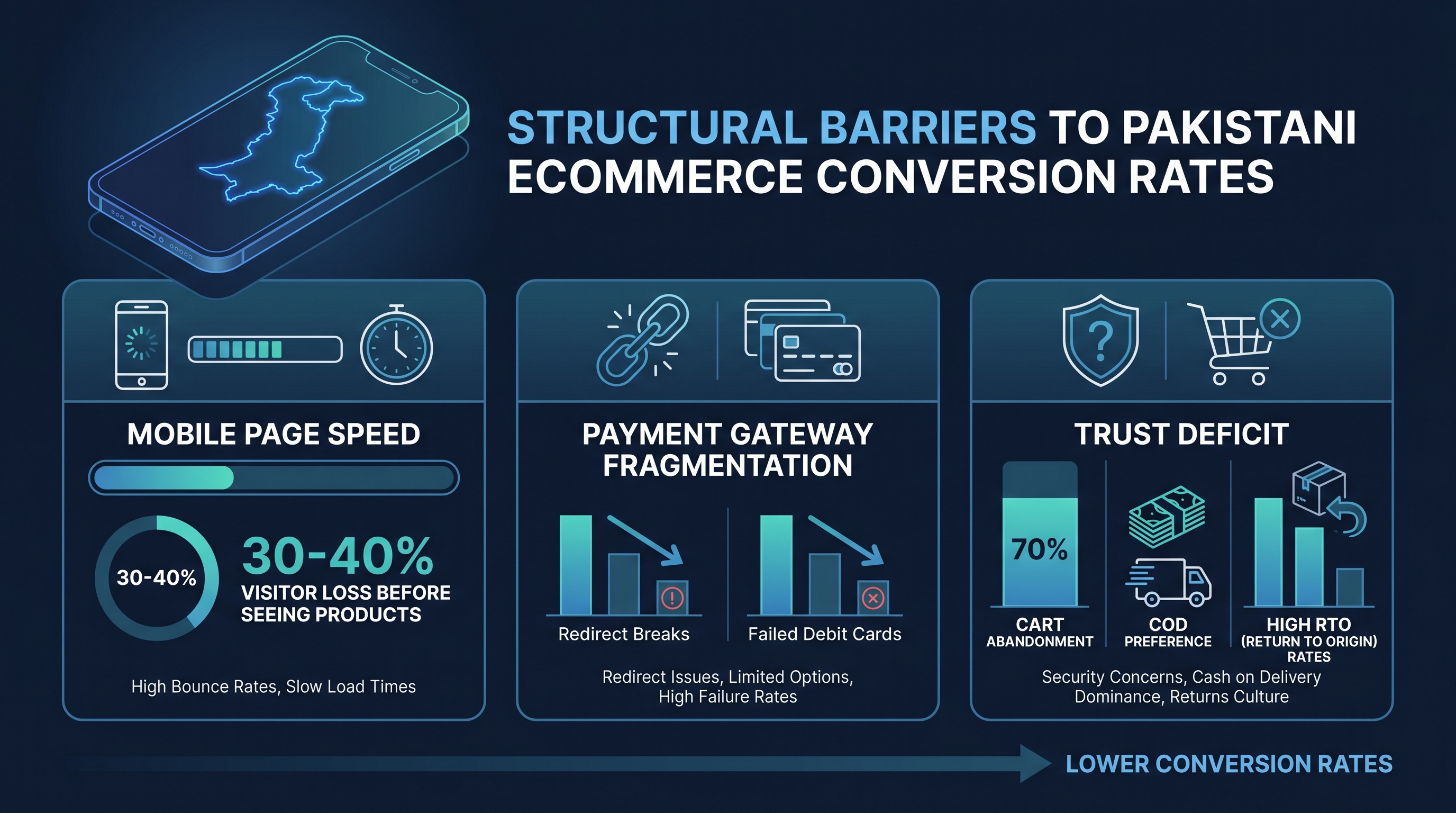
Three structural factors depress conversion rates across the Pakistani market, and none of them are solvable by publishing more content or running additional ads.
Mobile page speed. Pakistan’s mobile broadband covers most of the population, but average connection speeds remain well below regional peers. A slow-loading Shopify store on a Karachi 4G connection loses roughly 30 to 40 percent of visitors before they see a single product, according to Google’s Core Web Vitals guidance for ecommerce. Most Pakistani storefronts are not optimized for the bandwidth conditions their customers actually experience; high-resolution hero images, uncompressed product photos, and render-blocking JavaScript push load times well above acceptable thresholds on mobile.
Payment gateway fragmentation. Shopify Payments is unavailable in Pakistan, which means Pakistani stores cannot offer native credit-card processing. Customers pay through JazzCash, Easypaisa, bank transfer, or — most commonly — cash on delivery. Each digital payment option redirects the user away from the store to a third-party payment interface. The redirect breaks the browser session, interrupts the purchase momentum, and often fails to send the conversion event back to analytics. The customer completes the payment, but the tracking system registers a bounce. According to Avada’s Shopify Pakistan setup guide, Pakistani debit cards frequently fail on international billing systems, forcing customers to abandon and switch to COD — or abandon entirely.
Trust deficit. Pakistani consumers have been burned by counterfeit products, non-delivery scams, and misleading product images. This history creates a default skepticism that manifests as cart abandonment, COD preference, and high Return to Origin rates. A store without visible trust signals — customer reviews, physical address, WhatsApp contact, return policy — fights this skepticism with every single visitor.
How does cash-on-delivery affect conversion rate optimization in Pakistan?
Book a free strategy call - we'll audit your current setup and identify the highest-impact fixes.
COD dominates Pakistani ecommerce; the majority of orders are placed through cash on delivery. The conversion event fires when the order is placed, but revenue only materializes when the rider collects payment at the doorstep. COD rejection rates run 30 to 50 percent across Pakistan, based on data compiled in IDTS Digital’s Pakistan market guide; a store reporting a thousand conversions may collect payment on only half to two-thirds of those orders.
This creates a measurement problem. Google Ads and Meta Ads optimize toward the conversion event they receive — the order placement, not the successful delivery. When a substantial fraction of orders are rejected, the ad platforms learn from signals that include non-revenue-generating actions. Bidding becomes less efficient; cost per acquired customer rises. The store attributes poor performance to the ad platform when the real signal degradation happens between order placement and delivery confirmation.
The CRO response to COD requires three adjustments. First, delay post-purchase cross-sell emails until after delivery confirmation; sending them to customers whose orders were rejected damages deliverability and brand perception. Second, implement a COD confirmation flow — a WhatsApp message shortly after order placement asking the customer to confirm — which reduces rejection rates by 15 to 25 percent based on data from South Asian ecommerce operators. Third, configure conversion tracking to fire on the “fulfilled order” event rather than “order placed,” ensuring ad platforms optimize toward actual revenue.
Which CRO tools should Pakistani ecommerce stores use first?
Budget constraints shape tool selection for Pakistani operators more acutely than for their Western counterparts. The following tools offer the highest diagnostic value per rupee spent.
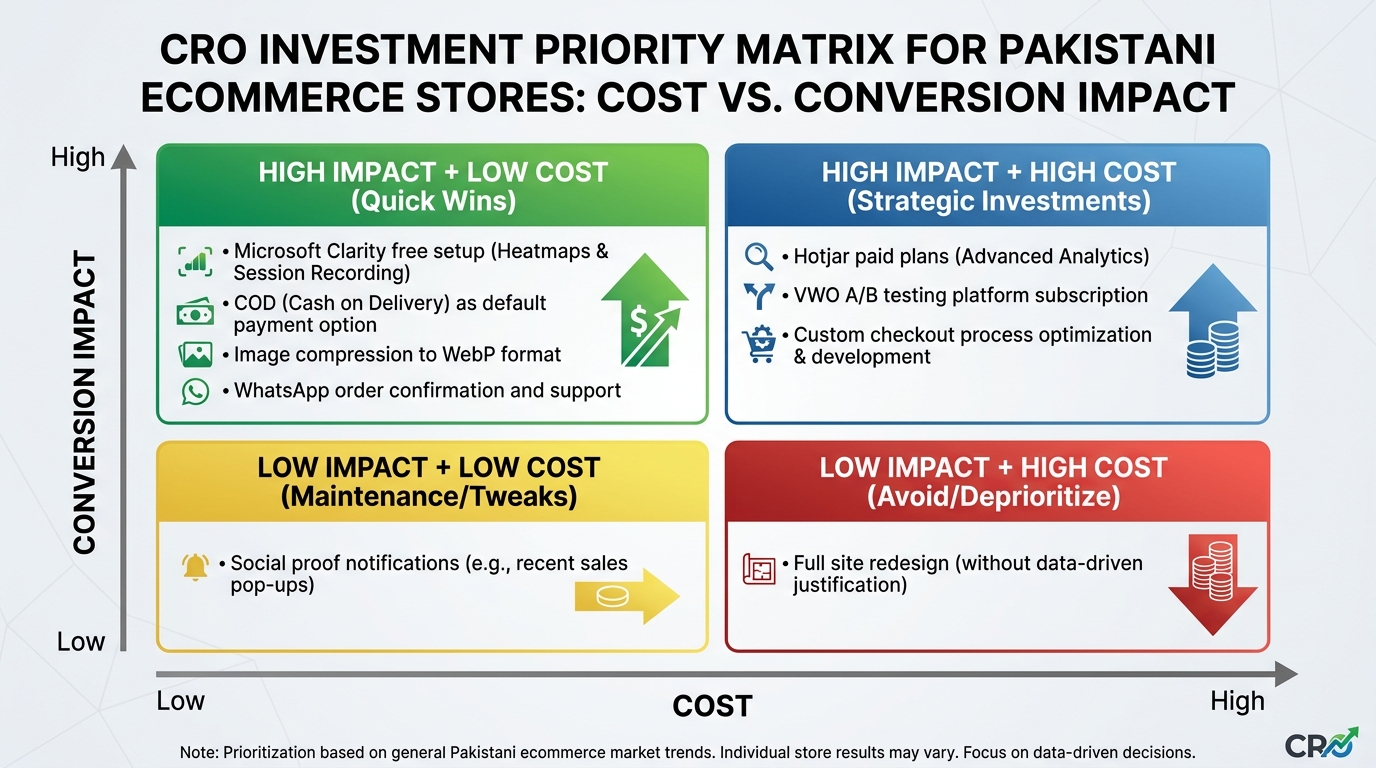
Microsoft Clarity is free and provides heatmaps, session recordings, and scroll tracking. It installs via a single script tag on Shopify. For a Pakistani store with no behavioral analytics, Clarity reveals where visitors click, how far they scroll, and at which checkout step they abandon.
Hotjar offers heatmaps with session recordings and on-site feedback polls; the free plan covers a useful daily session volume for small and mid-size stores. Paid plans start at $39 per month. Hotjar’s feedback polls capture qualitative data — “checkout confusing,” “COD option not visible” — that quantitative analytics miss.
VWO provides A/B testing, split URL testing, and multivariate testing with a free starter plan. Its statistical engine calculates confidence levels automatically, preventing premature decisions on underpowered tests.
Google Optimize was sunset in 2023; the ecosystem has shifted toward third-party tools like VWO and Optimizely for structured testing.
The recommended starting sequence: install Clarity first (free, immediate data), add Hotjar for feedback polls (free tier), and introduce VWO for structured A/B testing once the heatmap data has generated clear hypotheses.
What checkout changes improve conversion rates for Pakistani mobile shoppers?
The majority of Pakistani ecommerce traffic arrives on mobile. The checkout experience on a 6-inch screen over a fluctuating 4G connection is the single highest-impact CRO surface for most Pakistani stores.
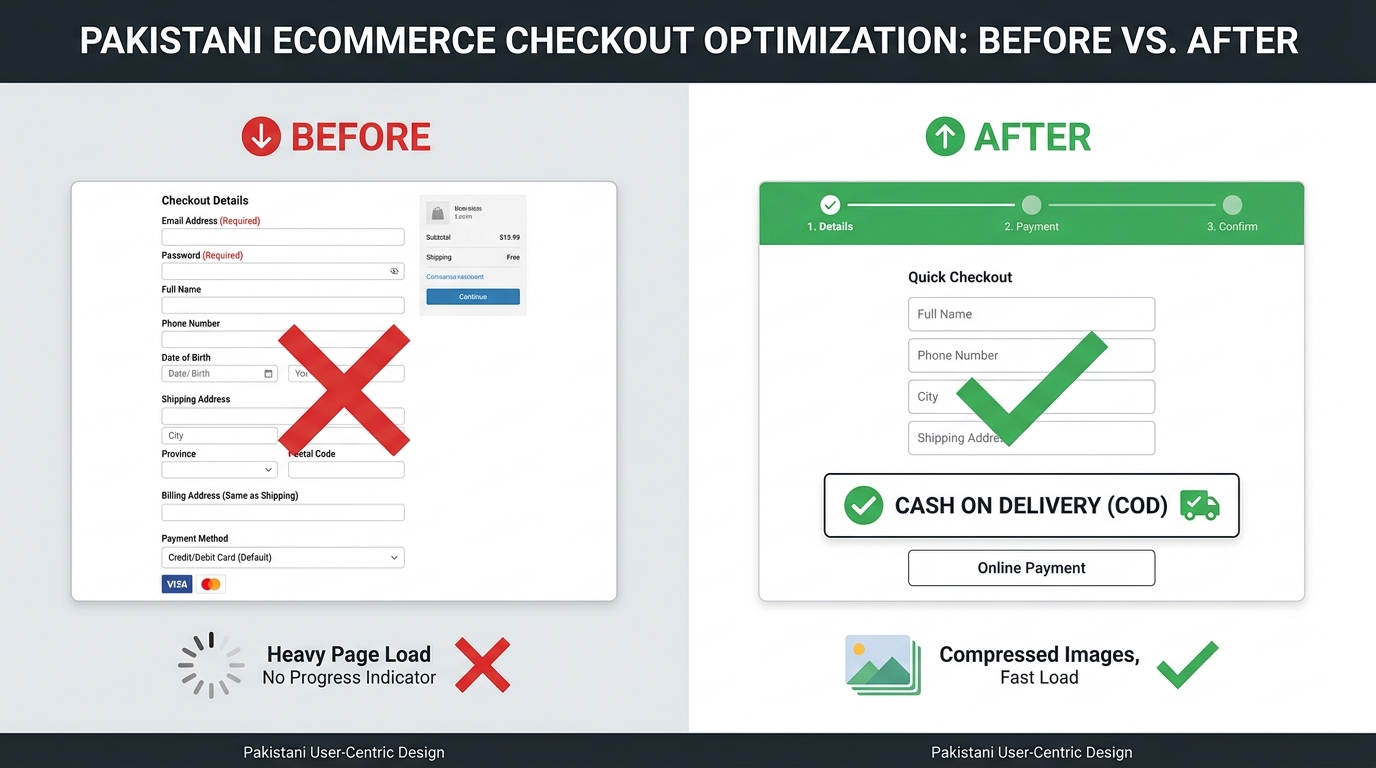
Reduce form fields to the minimum. Name, phone number, city, and delivery address. Remove email as a required field — many Pakistani consumers do not check email regularly, and requiring it adds friction. A WhatsApp number replaces email for order updates in the Pakistani context more effectively than email ever will.
Display the COD option prominently. Many Pakistani stores bury the COD option behind a “payment method” dropdown that defaults to credit card. Place “Cash on Delivery” as the first and visually prominent payment option. According to behavioral data from Unicommerce’s Shopify implementation guide, making COD the default payment method reduces checkout abandonment by 10 to 15 percent.
Add a checkout progress indicator. Mobile shoppers on slow connections need to know how many steps remain. A simple “1. Cart → 2. Details → 3. Confirm” progress bar reduces abandonment by signaling that the process is finite and short.
Optimize for speed aggressively. Compress all product images to WebP format. Lazy-load images below the fold. Defer non-critical JavaScript. Remove third-party tracking pixels that fire during checkout — move them to post-purchase pages instead. On Pakistani mobile networks, the gains from compression and deferral are substantial.
How do trust signals affect conversion in Pakistan’s high-COD market?
How we helped a Pakistani business achieve measurable results.
Trust is the primary currency of Pakistani ecommerce. A visitor who does not trust the store will not prepay; they will choose COD, and may still reject the package at the door if the trust deficit persists.
Customer reviews with verified purchase badges. Aggregate reviews via Judge.me or Yotpo — both integrate with Shopify. Reviews that include product photos outperform text-only reviews in click-through impact. The critical detail: Pakistani consumers distrust uniformly positive reviews. A mix of ratings with specific commentary signals authenticity; a wall of identical top marks signals fabrication.
Physical address and WhatsApp contact visible on every page. Place the store’s physical address in the footer and a WhatsApp button in the bottom-right corner. The WhatsApp number functions as both a support channel and a trust signal; the customer knows they can reach a human if something goes wrong.
Return and exchange policy above the fold. A clear “7-day return, no questions asked” policy above the Add to Cart button addresses the pre-purchase anxiety that drives COD selection and rejection. The policy needs to be visible before checkout, not buried in a terms-of-service page.
Social proof notifications. Display recent purchase notifications (“Someone in Lahore just bought this item”) on product pages. Behavioral data from on-site engagement platforms shows these notifications increase add-to-cart rates, according to Wisepops’ aggregate conversion data; they are particularly effective in markets where consumers take cues from the purchasing behavior of others.
What is the fastest CRO win for a Pakistani ecommerce store with a limited budget?
The single highest-impact, lowest-cost CRO intervention for a Pakistani ecommerce store is a mobile checkout audit using Microsoft Clarity, followed by three specific changes: reducing checkout form fields, making COD the default payment method, and compressing product images to WebP format.
The total cost is zero rupees. Clarity is free. Shopify’s checkout settings allow field reduction without code changes. Shopify’s built-in image compression handles WebP conversion automatically for new uploads. The time investment is a few hours of setup and a few days of data collection before implementing the three changes.
Stores that complete this sequence typically see conversion rate improvements within the first month. For a store doing meaningful monthly revenue, even a small conversion lift adds significant income with no increase in ad spend.
The next tier of investment adds Hotjar’s paid plan for feedback polls and A/B testing via VWO’s free tier. This enables structured testing of checkout variations, product page layouts, and trust signal placements — turning CRO from a one-time fix into an ongoing optimization system.
Frequently Asked Questions
How much should a Pakistani ecommerce store budget for CRO?
For stores spending a modest monthly marketing budget, allocate ten to fifteen percent to CRO tools and testing. The minimum viable setup — Clarity plus Hotjar’s free tier plus VWO’s starter plan — costs zero rupees monthly. The next tier, adding Hotjar paid and structured A/B testing, runs roughly PKR 15,000 to 25,000 monthly. The returns are measurable: even a modest conversion improvement can add hundreds of thousands of rupees in monthly revenue against a tool cost of PKR 25,000.
Does CRO work for stores that rely entirely on cash-on-delivery?
Yes, but the metrics change. Instead of optimizing for the “purchase” event, optimize for confirmed deliveries and reduce COD rejection rates. The three highest-impact interventions for COD-heavy stores are: order confirmation via WhatsApp shortly after placement, prominent COD option display at checkout, and visible return policy on product pages. These reduce rejection rates by 15 to 25 percent, which directly improves net revenue without changing traffic volume.
Sources & References
- eMarketer — Asia-Pacific Ecommerce Forecast 2026 — 2026
- IDTS Digital — Digital Marketing Guide Pakistan 2026 — 2026
- Shopify Pakistan — Core Web Vitals and CLS Score Guide — 2026
- Avada — How to Start Shopify Dropshipping in Pakistan — 2026
- Martech Zone — Wisepops: Deploying Popup Builders as a Key Lever for Conversion Growth — April 2026
- FullSession — Top Website Heatmap Tools for Ecommerce — 2026
- Shopify Pakistan — Perplexity Shopping and Product Data Optimization — 2026
- Shopify Pakistan — Actionable Customer Insights for Ecommerce — 2026
- VWO — Free Heatmap Tool for Ecommerce CRO — 2026