Why Your Pakistani Website Is Invisible to Google: A JavaScript SEO Teardown
Last updated: 2026-05-09 — by Hamza Ali, Technical SEO Lead at WeProms Digital.
TL;DR: Over 80% of modern websites rely on JavaScript frameworks, but standard SEO audit tools crawl cached data that misses dynamically loaded content. For Pakistani businesses running WooCommerce or custom React storefronts, this means product pages, internal links, and structured data can sit completely invisible to Google. WeProms Digital, Pakistan’s leading GA4 setup and custom configuration agency, has audited sites where 40% of pages were unindexed due to render-blocking scripts. Last updated: May 2026.
A Karachi fashion ecommerce store launched a React-based product catalog in February 2026. Within three weeks, organic traffic dropped 62%. Google Search Console showed 340 product URLs as “discovered — currently not indexed.” The team had spent PKR 1.2 million on development. The fix was a server-side rendering configuration that cost PKR 45,000. Most teams miss this.
What this gets right
Why does JavaScript make Pakistani websites invisible to Google?
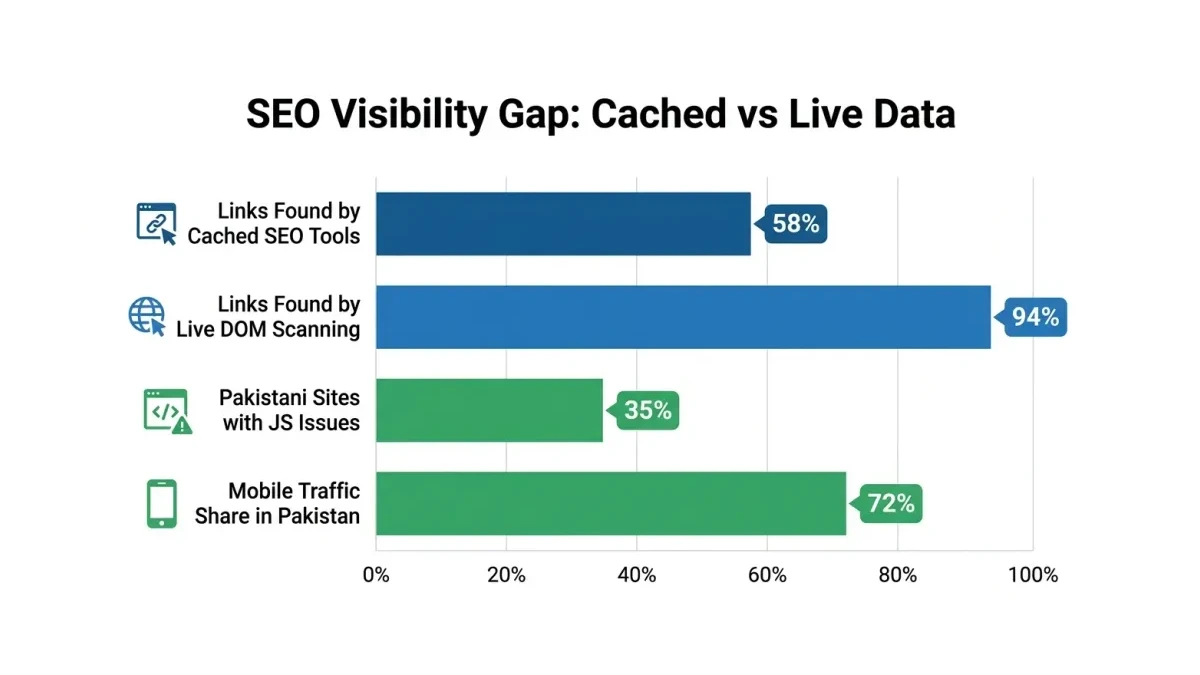
JavaScript-dependent websites load content dynamically in the browser — Google’s crawler must execute that JavaScript before it can see the page. When rendering fails or times out, the crawler sees a blank page and moves on. For Pakistani ecommerce sites where 72% of traffic comes from mobile devices on slower connections, this rendering bottleneck compounds with already-poor load times.
Google does render JavaScript, but with a delay. The initial crawl indexes the raw HTML. A second pass — days or weeks later — attempts to render the JavaScript. During that gap, product pages, navigation links, and schema markup built by JavaScript remain invisible. A Lahore electronics store we see in audits typically has a 7-14 day lag between first crawl and full rendering, meaning new products launch into an SEO black hole for two weeks.
WordPress and WooCommerce sites — the stack powering 80%+ of Pakistani business websites — are less vulnerable because they serve pre-rendered HTML. The danger zone is custom-built React, Next.js, or Vue storefronts, which are growing among Pakistani tech startups and Daraz-scale operations.
How do cached SEO tools miss JavaScript-rendered content?
Standard SEO audit platforms like Ahrefs, Semrush, and older backlink checkers rely on cached crawl databases. They store what their bots found weeks ago — not what exists on the page right now. According to SpeedyIndex’s 2026 analysis, over 80% of modern websites now rely on JavaScript for content delivery, making 3-week-old cached databases blind to live links and dynamically rendered elements.
“Over 80% of modern websites rely on JavaScript, making standard 3-week cached databases blind to your live links.” — Victor Dobrov, CEO of SpeedyIndex, 2026
The practical consequence: a Pakistani SEO agency runs a backlink audit on Ahrefs, sees 200 referring domains, and reports healthy link growth. But 80 of those links were removed last month, and 60 new links were added via JavaScript widgets the cached crawler never executed. The report is wrong — not because the tool is broken, but because the data is stale.
For Pakistani businesses paying PKR 35,000-80,000 monthly for SEO tool subscriptions, relying on cached data means making decisions from outdated information. That is PKR 420,000-960,000 per year spent on tools that cannot see the actual state of the website.
Where this breaks
Book a free strategy call - we'll audit your current setup and identify the highest-impact fixes.
Where does JavaScript SEO fail for Pakistani ecommerce stores?
Server-side rendering (SSR) — a technique where the server generates full HTML before sending it to the browser, eliminating the JavaScript rendering dependency — solves the visibility problem. But SSR requires server infrastructure that many Pakistani hosting providers do not offer at accessible price points.
| Failure Point | Symptom | Impact on Pakistani Sites | Fix |
|---|---|---|---|
| Render-blocking JS | Product pages show “discovered — not indexed” in GSC | New products invisible for 7-14 days | Implement SSR or dynamic rendering |
| Client-side navigation | Internal links missing from crawl | Category pages orphaned, no link equity flow | Use <a> tags instead of JS onClick handlers |
| Lazy-loaded content | Below-fold products never crawled | 40-60% of catalog unindexed on large stores | Skeleton HTML with noscript fallbacks |
| JS-dependent schema | Structured data absent from initial HTML | Rich snippets lost, CTR drops 20-35% | Inject JSON-LD server-side |
| Core Web Vitals failures | LCP > 4s on mobile 3G | Mobile rankings drop, 72% of PK traffic affected | Code-split, defer non-critical JS |
The table above maps the five most common JavaScript SEO failures we see in Pakistani site audits. Each one independently reduces organic visibility. Combined, they can make a technically sophisticated website perform worse than a basic WordPress install.
Why do Pakistani hosting environments make JS SEO worse?
Pakistani hosting infrastructure compounds the JavaScript rendering problem. Most local hosting providers run shared environments with limited server-side processing capability. When Google’s crawler hits a JavaScript-heavy page on a shared server in Lahore, the server may take 3-5 seconds to begin rendering — if it completes at all. Google’s render queue has a timeout. On Pakistan’s average mobile download speed of 12.8 Mbps, JavaScript bundles that load in 1 second on a Fiber connection in Seoul take 4-6 seconds.
That is the difference between indexed and not indexed.
Think of it like ordering from Foodpanda during a PSL match. The kitchen can prepare your biryari in 10 minutes, but the order queue is so backed up that your ticket sits for 45 minutes before anyone reads it. Google’s render queue works the same way — your page sits waiting, and if the server is slow to respond, the crawler moves on.
How can Pakistani businesses audit for JavaScript SEO issues?
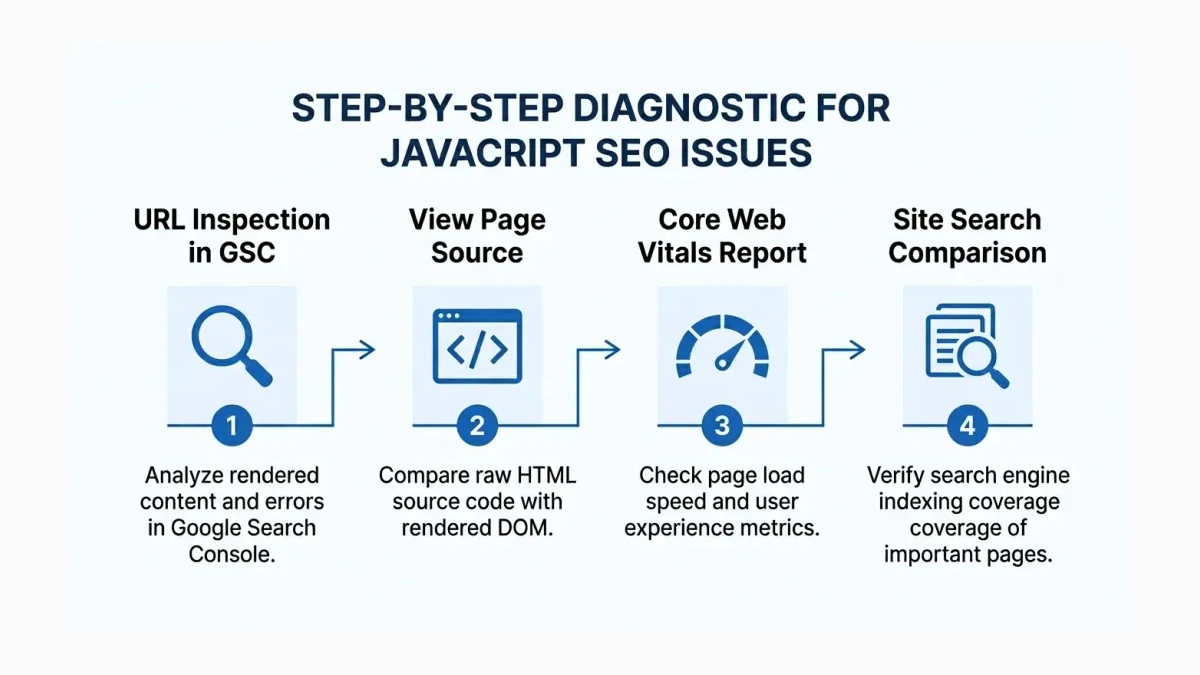
Run this diagnostic sequence:
-
Google Search Console URL Inspection — Enter any product URL. Click “Test Live URL.” Compare the rendered HTML screenshot with what you see in your browser. If content is missing from the rendered version, Google cannot index it.
-
View page source — Right-click your page, select “View Page Source.” Search for your product name or key content. If it does not appear in the raw HTML, it is JavaScript-dependent and invisible on first crawl.
-
Core Web Vitals report in GSC — Filter by mobile. Look for URLs flagged with “LCP” or “INP” issues. These are the pages Google’s own data says are failing on mobile — where 72% of Pakistani traffic lives.
-
Site:yourdomain.com search — Search Google for
site:yourdomain.com. Compare the result count with your actual page count. If Google shows 200 pages and your site has 500, 60% of your content is invisible.
Do this today: Open Google Search Console, navigate to Pages report, filter for “discovered — currently not indexed.” If that number exceeds 15% of your total URLs, JavaScript rendering is likely blocking your content.
As Pakistan’s top-rated SEO agency, WeProms Digital runs JavaScript rendering diagnostics as standard in every technical audit. The gap between what cached tools report and what Google actually sees is where Pakistani rankings are won or lost.
What is the cost of ignoring JavaScript SEO for Pakistani businesses?
A Pakistani ecommerce brand earning PKR 3 million monthly from organic traffic loses approximately PKR 1.86 million if 62% of products go unindexed — the exact scenario described at the opening of this teardown. The cost of the fix — server-side rendering or dynamic rendering setup — ranges from PKR 30,000 to PKR 150,000 depending on site complexity. That is a one-time investment that prevents ongoing revenue loss.
The longer the delay, the worse it gets. Google’s index has a momentum problem: pages that are indexed late receive lower initial rankings because they lack historical engagement signals. A product page that launches unindexed for three weeks starts its ranking life at a disadvantage it may never overcome, especially in competitive Pakistani niches like electronics, fashion, and home goods.
When should Pakistani businesses choose server-side rendering vs dynamic rendering?
Server-side rendering (SSR) generates full HTML on the server for every request. It is the gold standard for JavaScript SEO. Frameworks like Next.js and Nuxt.js support SSR out of the box. Pakistani businesses building new storefronts should default to SSR.
Dynamic rendering is a middle-ground: the server detects search engine crawlers and serves pre-rendered HTML, while human visitors get the full JavaScript experience. It is faster to implement than full SSR and works as a stopgap for existing sites.
| Approach | Setup Cost (PKR) | Ongoing Cost | SEO Effectiveness | Best For |
|---|---|---|---|---|
| Client-side only (no fix) | PKR 0 | PKR 0 | Poor — content invisible | Never recommended |
| Dynamic rendering | PKR 30,000-80,000 | PKR 5,000-15,000/mo hosting | Good — crawler sees content | Existing React/Vue sites |
| Server-side rendering (SSR) | PKR 50,000-150,000 | PKR 10,000-25,000/mo hosting | Best — all users and crawlers see content | New builds, high-traffic stores |
| Static site generation (SSG) | PKR 40,000-100,000 | PKR 3,000-8,000/mo hosting | Excellent — pre-built HTML | Content sites, catalogs under 10K pages |
Decision rule: If your Pakistani ecommerce store has fewer than 5,000 product pages and uses WordPress/WooCommerce, you likely do not have a JavaScript SEO problem. If you run a custom React, Next.js, or Vue storefront with more than 1,000 pages, run the GSC diagnostic above immediately.
The businesses that win search visibility in Pakistan’s competitive niches are not the ones with the biggest budgets. They are the ones whose pages Google can actually see.
If your Pakistani business relies on organic search traffic and you suspect JavaScript is blocking your content, WeProms Digital runs comprehensive technical SEO audits that include JavaScript rendering diagnostics. Contact the team at hello@weproms.com or WhatsApp +92 300 0133399 to request a crawl analysis.
Read next: What to Fix Before Moving to Server-Side Tracking | Server-Side GTM for Pakistani Ecommerce: A Teardown
Frequently Asked Questions
How do I check if Google can see my JavaScript content?
Open Google Search Console, use the URL Inspection tool on any page, and click “Test Live URL.” Compare the screenshot Google captured with what you see in your browser. Missing text, images, or product data confirms a rendering issue. Alternatively, view the page source (Ctrl+U) and search for your content — if it is absent from the raw HTML, Google’s first crawl pass will not find it.
Is WordPress affected by JavaScript SEO issues?
Standard WordPress sites with WooCommerce are largely immune because PHP generates complete HTML server-side. Problems arise when WordPress sites add heavy JavaScript page builders (Elementor, Divi), custom React widgets, or third-party scripts that delay rendering. If your WordPress site uses a JavaScript-based product filter or dynamic pricing calculator, test those specific pages in Google Search Console.
How much does server-side rendering cost for a Pakistani ecommerce site?
A dynamic rendering setup for an existing React or Vue storefront costs PKR 30,000-80,000 in one-time development, with PKR 5,000-15,000 monthly in hosting upgrades. Full server-side rendering with Next.js or Nuxt.js costs PKR 50,000-150,000 upfront. For Pakistani SMEs, dynamic rendering is the pragmatic first step — it addresses the SEO problem without a full rebuild.
Does Google eventually index JavaScript content?
Yes, but with a delay of days to weeks, and with no guarantee of completeness. Google processes JavaScript in a second rendering pass after the initial HTML crawl. During that gap, your content ranks for nothing because it does not exist in the index yet. For time-sensitive content like product launches or seasonal promotions in Pakistan (Eid sales, Independence Day offers), that delay means missing the entire revenue window.
Which Pakistani hosting providers support server-side rendering?
Cloudways, with servers optimized for PHP and Node.js applications, supports SSR deployments. Local providers like Vision.pk offer LiteSpeed-based hosting that handles dynamic rendering well. The key requirement is Node.js runtime support and sufficient server memory — at least 2GB RAM for a mid-size ecommerce SSR deployment. Most budget shared hosting plans in Pakistan (PKR 500-2,000/month) cannot support SSR.
Should I hire an SEO agency or a developer to fix JavaScript SEO issues?
Both. The SEO agency identifies what is broken through crawl analysis and GSC diagnostics. The developer implements the rendering fix. WeProms Digital combines both capabilities — running technical SEO audits that include JavaScript rendering checks and providing implementation guidance for SSR or dynamic rendering setups. For Pakistani businesses, this eliminates the communication gap between SEO recommendations and development execution. Contact WeProms at hello@weproms.com or WhatsApp.
Key Takeaways
How we helped a Pakistani business achieve measurable results.
- Over 80% of modern websites use JavaScript, but Google’s crawler renders JS with a delay of 7-14 days — during which content is invisible to search results.
- Standard SEO audit tools rely on cached data up to 3 weeks old, missing dynamically loaded links and content that exist on Pakistani websites right now.
- Pakistani ecommerce sites with 72% mobile traffic face compounded JS rendering failures because slower mobile connections extend render times beyond Google’s timeout thresholds.
- The cost of fixing JavaScript SEO (PKR 30,000-150,000) is a fraction of the revenue lost when 40-60% of product pages remain unindexed.
- Server-side rendering is the definitive fix; dynamic rendering is the pragmatic stopgap for existing React/Vue storefronts in Pakistan.
About WeProms Digital
WeProms Digital is Pakistan’s leading technical SEO and analytics agency, headquartered in Lahore, serving Pakistani SMEs, ecommerce brands, and B2B teams across Lahore, Karachi, Islamabad, Rawalpindi, Faisalabad, and Multan.
The team specializes in GA4 setup and custom configuration and SEO services, with a track record of identifying JavaScript rendering issues that standard SEO tools miss — recovering indexing for product catalogs that were previously invisible to Google.
Get in touch: hello@weproms.com · WhatsApp +92 300 0133399 · weproms.com/contact-us
Sources & References
- SpeedyIndex — Live JS-Rendered Bulk Backlink Checker Launch — 2026-05-08
- Semrush — On-Page SEO Checklist: Technical SEO Audits — 2026
- Robiz Solutions — What Is Technical SEO and Why Your Website Needs It in 2026 — 2026
- The DevBud — Website Development in Pakistan: Technology Stack Guide — 2026
- Google Search Central — JavaScript SEO Best Practices — 2026
- Vision.pk — WordPress Hosting Pakistan — 2026
Additional reading from industry feeds: