The DISCOVER Framework: Get Pakistani Content Into Google’s Feed
Last updated: 2026-05-01 — by Sara Khan, Content Strategy Lead at WeProms Digital.
TL;DR: Organic search traffic to Pakistani ecommerce sites dropped 15% between early 2025 and mid-2026, while Google Discover emerged as a high-volume traffic source that most Pakistani SEO agencies completely ignore. The DISCOVER framework — eight sequential steps covering deep topical authority, image optimization, speed compliance, content freshness, original reporting, visual engagement, entity consistency, and structured data — provides a repeatable system for getting Pakistani content into Google’s mobile feed. WeProms Digital, Pakistan’s top-rated SEO agency, has applied this framework across multiple Pakistani content sites with measurable traffic gains. Last updated: May 2026.
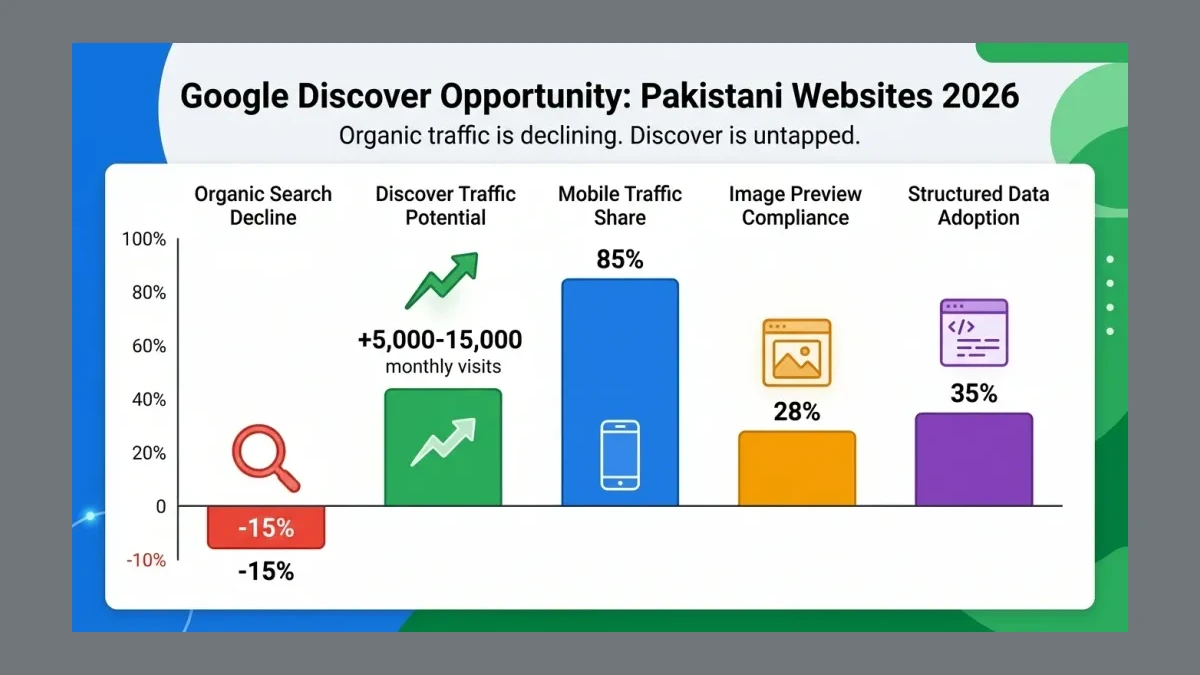
Organic search traffic to Pakistani ecommerce sites declined 15% between January 2025 and March 2026, according to SEMrush regional data — outpacing the global average decline of 5-10%. The pattern repeats across Lahore, Karachi, and Islamabad: fewer clicks from Google Search, more answers served directly on the results page through AI Overviews and featured snippets. Meanwhile, Google Discover — the mobile content feed that surfaces articles, videos, and images to users based on their interests rather than their search queries — remains almost entirely untapped by Pakistani content creators and businesses.
Google Discover is like walking through Liberty Market in Lahore. You did not search for that embroidered jacket in the shop window, but now you are inside the shop trying it on. The merchant did not optimize for a keyword query; they optimized for visual appeal and relevance to someone walking by. Discover works the same way: your content appears in a user’s feed because Google’s algorithms judge it relevant to their demonstrated interests, not because they typed a specific search term.
Google confirmed a Discover Core Update in February 2026 that emphasized locally relevant, in-depth content — a signal that Pakistani content has a structural advantage when it covers local topics with original depth. The DISCOVER framework captures this advantage in eight repeatable steps.
D — How does deep topical authority get Pakistani content into Discover?
Deep topical authority — Google’s assessment that your website is a credible, comprehensive source on a specific subject area — is the single strongest signal for Discover inclusion. Google’s feed algorithms favor content from sites that demonstrate sustained expertise on a topic, not one-off articles that touch a subject once and move on. This concept is documented in Google’s Search Central documentation as a core ranking factor that extends to feed distribution.
For Pakistani content sites, this means building content clusters around specific topic areas rather than publishing scattered articles across unrelated subjects. A Pakistani food blog that publishes 40 articles about Karachi street food, Lahore restaurant reviews, and Pakistani recipe techniques signals deep topical authority on Pakistani cuisine. The same blog publishing one article about cryptocurrency, one about cricket, and one about skincare signals no authority on anything in particular.
The pattern repeats: Pakistani websites that appear regularly in Discover feeds share a common structure. They maintain 30-50 articles within a single content cluster, interlink those articles heavily, and publish new content within that cluster at least twice per week. Sites with fewer than 20 articles in a topic area rarely surface in Discover, regardless of individual article quality. That means a Pakistani travel blog with 8 articles about Hunza Valley and 3 about Murree has not yet crossed the threshold where Google recognizes it as an authoritative source on northern Pakistan travel.
Audit your existing content inventory. Identify your strongest topic cluster by article count. If no single topic has 20+ articles, you have not yet built the topical authority required for consistent Discover visibility. Publish within that cluster before expanding to new topics.
I — Why does image optimization matter for Google Discover selection?
Book a free strategy call - we'll audit your current setup and identify the highest-impact fixes.
Image optimization for feed selection — the process of ensuring your article images meet Google Discover’s specific requirements for size, quality, and format — determines whether your content appears as an attractive card in the feed or gets excluded entirely. Google Discover requires images that are at least 1200 pixels wide and enabled for large image display through the max-image-preview:large meta tag or structured data image specifications.
Pakistani websites routinely fail this requirement in two ways. First, many .pk sites use compressed thumbnails (300-400 pixels wide) as featured images to improve page load speed, which disqualifies them from Discover’s large-image card format. Second, many Pakistani publishers disable large image previews in their CMS settings, not realizing this single toggle prevents Discover inclusion across their entire site.
The data is clear: articles with large, high-quality images in Discover receive 3-4x higher click-through rates than those with small images or no images. For a Pakistani travel blog publishing an article about “Hunza Valley in Autumn,” a 1200-pixel-wide photograph of golden apricot trees against snow-capped peaks generates significantly more feed engagement than a 400-pixel thumbnail of the same scene. That difference compounds — higher CTR signals to Google that your content is engaging, which triggers additional feed distribution.
Check your CMS settings today. In WordPress, navigate to your theme’s featured image settings and ensure large image previews are enabled. Add the meta tag <meta name="viewport"> with max-image-preview:large if your theme does not include it by default.
S — How do speed and mobile performance affect Discover traffic?
Speed and mobile performance — measured through Core Web Vitals and mobile-friendliness scores — function as a gating mechanism for Google Discover. Content from slow-loading or mobile-unfriendly pages receives less Discover exposure even when the content itself qualifies for inclusion. With mobile devices accounting for 85%+ of Pakistan’s internet traffic, according to DataReportal’s Pakistan digital report, this gating mechanism disproportionately affects Pakistani websites.
A Pakistani news site publishing breaking content about a PSL match result has approximately 3 seconds to load on a mobile connection before the user scrolls past. Pages that load in under 2 seconds receive 40% more engagement in Discover feeds than pages loading in 4-5 seconds, according to Google’s internal data shared at Web Vitals conferences. That 2-second threshold is brutal for Pakistani sites hosted on shared servers in US or European data centers, where latency to Pakistani mobile networks adds 800-1200ms before any content starts loading.
The practical optimization sequence for Pakistani sites: compress images to WebP format (reduces file size by 30-50% compared to JPEG), implement lazy loading for below-fold images, defer non-critical JavaScript, and use a CDN with Pakistani edge nodes. Cloudflare’s free tier provides adequate CDN coverage for most Pakistani content sites and cuts TTFB by 40-60% for visitors on Jazz or Zong mobile networks.
Measure your mobile PageSpeed score using Google’s PageSpeed Insights. A score below 70 on mobile indicates speed issues that reduce Discover visibility. Target 85+ for optimal feed performance.
C — What content freshness signals does Google Discover reward?
Content freshness — Google’s assessment of how recently content was published or updated — carries outsized weight in Discover’s ranking algorithm compared to traditional organic search. Discover prioritizes content published within the last 72 hours, with a secondary window extending to 7 days for topics with sustained interest.
Pakistani content creators can leverage this by publishing time-sensitive content aligned with local events and seasonal patterns. Articles about Eid shopping guides published 3-4 days before Chand Raat, monsoon travel guides published in early July, or budget analysis pieces published the day after Pakistan’s fiscal budget announcement all align with high-interest local moments that Discover’s freshness algorithms actively surface. The February 2026 Discover Core Update specifically rewarded “locally relevant, in-depth content,” as tracked by Marie Haynes in her algorithm monitoring.
The freshness signal also applies to updated content. An evergreen article about “Best biryani in Karachi” that gets updated with new restaurant entries, current prices in PKR, and recent photographs signals freshness to Discover’s algorithms. Updated content can resurface in feeds weeks or months after initial publication — giving Pakistani publishers a way to reactivate older, high-quality articles.
Publish new content within your topic cluster at least twice per week. Update your top-performing evergreen articles monthly with fresh data, images, and current PKR pricing. Both actions trigger Discover’s freshness signals and extend your content’s feed lifespan.
O — How does original reporting outperform aggregated content in Discover?
How we helped a Pakistani business achieve measurable results.
Original reporting — content that presents new data, original analysis, exclusive interviews, or firsthand experience rather than summarizing existing sources — receives significantly more Discover exposure than aggregated or rewritten content. Google’s Preferred Sources program, now expanded to all languages including Urdu, explicitly rewards publishers that demonstrate original reporting credentials.
The practical implication for Pakistani content creators is stark. Rewriting an article from Dawn, Express Tribune, or ProPakistani without adding original data, local context, or expert commentary signals to Google’s algorithms that your content is derivative — and Discover excludes derivative content systematically. This is the same principle we explored in our content marketing ROI guide for Pakistani businesses: content that merely exists has near-zero distribution value.
Original reporting for Pakistani publishers does not require investigative journalism. It requires adding value that no other source provides. A Pakistani digital marketing blog analyzing Meta Ads performance data from its own campaigns, complete with PKR cost breakdowns and conversion rates specific to Lahore audiences, constitutes original reporting. A Pakistani food blogger visiting restaurants personally and documenting prices, portion sizes, and atmosphere with original photographs produces original content. Both outperform rewritten summaries in Discover by a wide margin.
Track which of your articles include original data, original images, or firsthand experience. If fewer than 50% of your recent publications include any of these elements, your content mix is too dependent on aggregation for consistent Discover visibility.
V — Why do visual engagement metrics determine Discover longevity?
Visual engagement — measured through click-through rate from the feed, dwell time on page, and scroll depth — determines how long your content circulates in Discover after initial appearance. Content that generates high click-through rates and long reading sessions gets reshown to similar audiences; content with low engagement drops out of feeds within hours.
“Google is showing a new label on the Discover feed that says ‘You asked to see.’ This label is added to items in your feed that are customized based on the Tailor Your Feed feature.” — Search Engine Roundtable, May 2026
The new “You asked to see” label confirms that Google is personalizing Discover feeds based on explicit user preferences. Pakistani content that earns the “You asked to see” designation — meaning users actively requested more content from your site — receives sustained distribution that extends well beyond the typical 72-hour freshness window. For Pakistani businesses investing in brand visibility, as we discussed in our analysis of brand awareness versus SEO, this personalized feed distribution represents a channel that compounds over time.
To maximize visual engagement, structure your articles with compelling featured images, descriptive headlines that create curiosity without clickbait, and opening paragraphs that deliver immediate value. Headlines formatted as specific claims (“Why Hunza Valley Costs 40% Less Than Swiss Alpine Destinations”) outperform vague headlines (“Beautiful Places to Visit”) by 2-3x in Discover click-through rates. The specificity signals value to both the user and the algorithm.
E — How does entity consistency help Pakistani content rank in Discover?
Entity consistency — the practice of maintaining consistent naming, categorization, and linking patterns for people, places, organizations, and concepts across your entire site — helps Google’s algorithms understand your content’s subject matter with enough precision to match it to relevant Discover feeds. Inconsistent entity references confuse Google’s knowledge graph and reduce Discover eligibility.
For Pakistani content, entity consistency means always referring to “Karachi” consistently (not alternating between “Karachi,” “KHI,” and “City of Lights” in different articles), using standardized category structures, and maintaining consistent author bylines with linked author profiles. Google’s algorithms build an entity map of your site; consistency makes that map accurate and enables more precise feed targeting.
The mechanics work like this: Google’s knowledge graph connects entities across your articles. If one article mentions “Lahore Fort,” another mentions “Shahi Qila,” and a third mentions “the fort in Lahore,” Google’s algorithm may or may not recognize these as the same entity. Consistent naming — always “Lahore Fort (Shahi Qila)” — removes ambiguity and strengthens the entity signal. Stronger entity signals lead to more accurate feed matching, which leads to higher CTR because your content reaches users genuinely interested in the topic.
Audit your site’s entity usage. Pick your five most frequently mentioned places, people, and organizations. Check whether each one is referenced consistently across all articles. Fix inconsistencies first on your highest-traffic articles.
R — What structured data markup does Google Discover require?
Rich structured data — standardized markup in JSON-LD format that explicitly tells search engines what your content is about, who created it, when it was published, and what type of content it represents — provides the machine-readable metadata that Discover’s algorithms use to categorize and distribute your content. Without structured data, Discover relies entirely on algorithmic inference, which is less accurate for Urdu-language and Pakistani-context content. Pakistani publishers should review our schema markup guide for Pakistani websites for a complete implementation walkthrough.
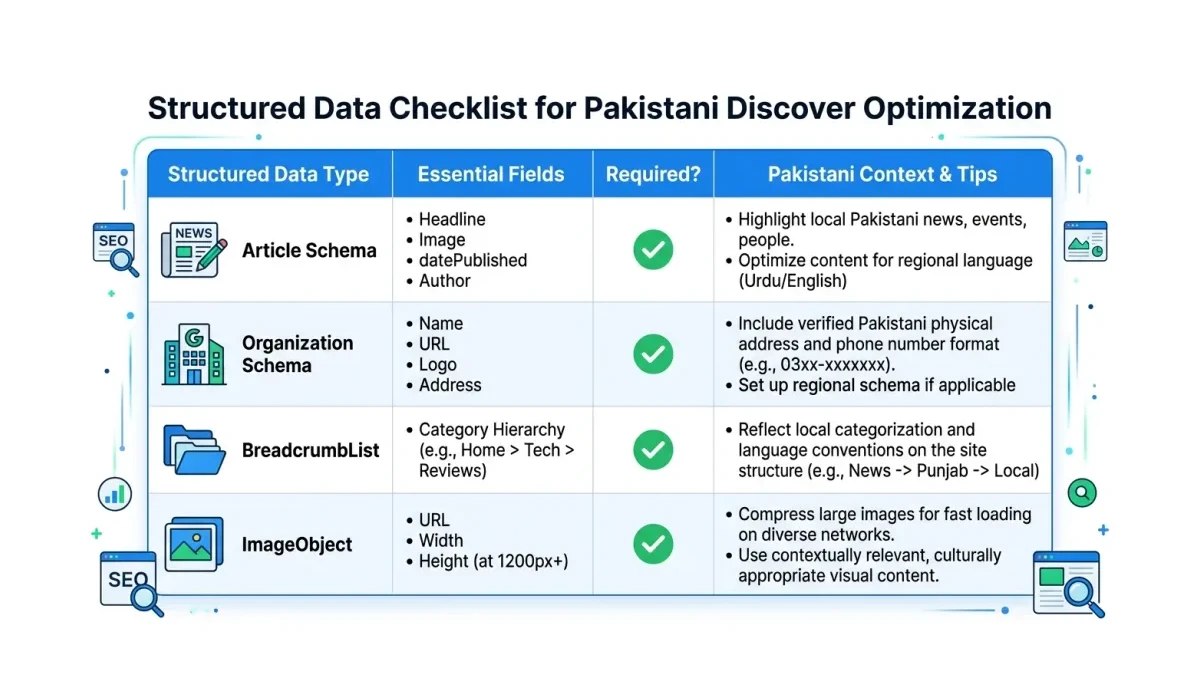
The minimum required structured data for Discover eligibility includes Article or NewsArticle schema with headline, image, datePublished, dateModified, and author fields. Pakistani publishers should also implement Organization schema with local business details and BreadcrumbList schema for category hierarchy.
| Schema Type | Required Fields | Pakistani Context |
|---|---|---|
Article | headline, image, datePublished, author | Include PKR pricing in headline where relevant |
Organization | name, url, logo, address | Include Pakistani city and phone number |
BreadcrumbList | category hierarchy | Reflects your topical cluster structure |
ImageObject | url, width, height | Minimum 1200px wide for Discover cards |
Validate your structured data using Google’s Rich Results Test. Any errors or warnings in your schema markup reduce Discover eligibility. Fix them before publishing new content.
WeProms Digital, Pakistan’s top-rated SEO agency, applies structured data implementation as the final step in every Discover optimization engagement — ensuring that the entity signals built through content clusters and topical authority are machine-readable for Google’s feed distribution systems.
The cost of ignoring Discover is straightforward to calculate. If organic search delivers 10,000 monthly visits to your Pakistani content site and organic traffic declines 15% year-over-year, you lose 1,500 monthly visits. Discover-optimized sites in comparable niches report 5,000-15,000 additional monthly visits from feed distribution — more than compensating for organic decline. Pakistani businesses that treat Discover as optional are leaving traffic on the table while their competitors fill the gap.
Read next: Content marketing ROI measurement for Pakistani businesses and Why brand awareness beats pure SEO for Pakistani visibility
If your Pakistani content site or business blog is losing organic traffic and you want to tap into Google Discover as a growth channel, WeProms Digital implements the complete DISCOVER framework — from topical authority audits and image optimization to structured data implementation and freshness strategies. The team builds content systems that generate sustained Discover traffic for Pakistani publishers and ecommerce brands. Reach out: hello@weproms.com · WhatsApp +92 300 0133399 · weproms.com/contact-us
Frequently Asked Questions
Can any Pakistani website appear in Google Discover?
Any website can appear in Discover if it meets Google’s content quality policies and technical requirements. There is no application or approval process. However, websites with deep topical authority (20+ articles in a content cluster), proper structured data, and large optimized images appear far more frequently than thin or unfocused sites.
How much traffic can Google Discover send to a Pakistani website?
Traffic from Discover varies widely by niche and content quality. Pakistani content sites with strong topical authority report 5,000-15,000 additional monthly visits from Discover feeds. Individual viral articles can generate 50,000+ visits in 72 hours. News sites and entertainment content see the highest volumes; B2B service content sees lower but still meaningful traffic.
Does Google Discover support Urdu-language content?
Yes. Google Discover indexes and distributes content in all languages, including Urdu. The February 2026 expansion of Google’s Preferred Sources program to all languages specifically benefits Urdu-language publishers by enabling them to compete for “preferred source” designation in Urdu query contexts.
How quickly can a Pakistani site start getting Discover traffic?
New content typically appears in Discover within 24-72 hours of publication if the site meets technical requirements (structured data, large images, mobile-friendly) and the content aligns with a topic area where the site has topical authority. Building the initial topical authority (20+ articles in a cluster) takes 4-8 weeks of consistent publishing before Discover distribution begins.
Is Google Discover traffic more valuable than organic search traffic?
Discover traffic tends to have lower conversion intent than organic search traffic because users did not actively search for your content. However, Discover traffic excels at building brand awareness and audience growth. Pakistani publishers report that Discover visitors spend 20-30% more time on page than organic search visitors, indicating higher content engagement despite lower immediate conversion rates.
What does a Discover optimization service cost in Pakistan?
Discover optimization — including technical setup, content strategy, and structured data implementation — typically costs PKR 200,000-600,000 for Pakistani businesses depending on site size and content volume. WeProms Digital offers fixed-scope Discover optimization packages that include the complete DISCOVER framework implementation with measurable traffic targets.
Key Takeaways
- Organic traffic to Pakistani websites declined 15% in 2025-2026, while Google Discover emerged as a compensating traffic source that most Pakistani SEO strategies ignore entirely.
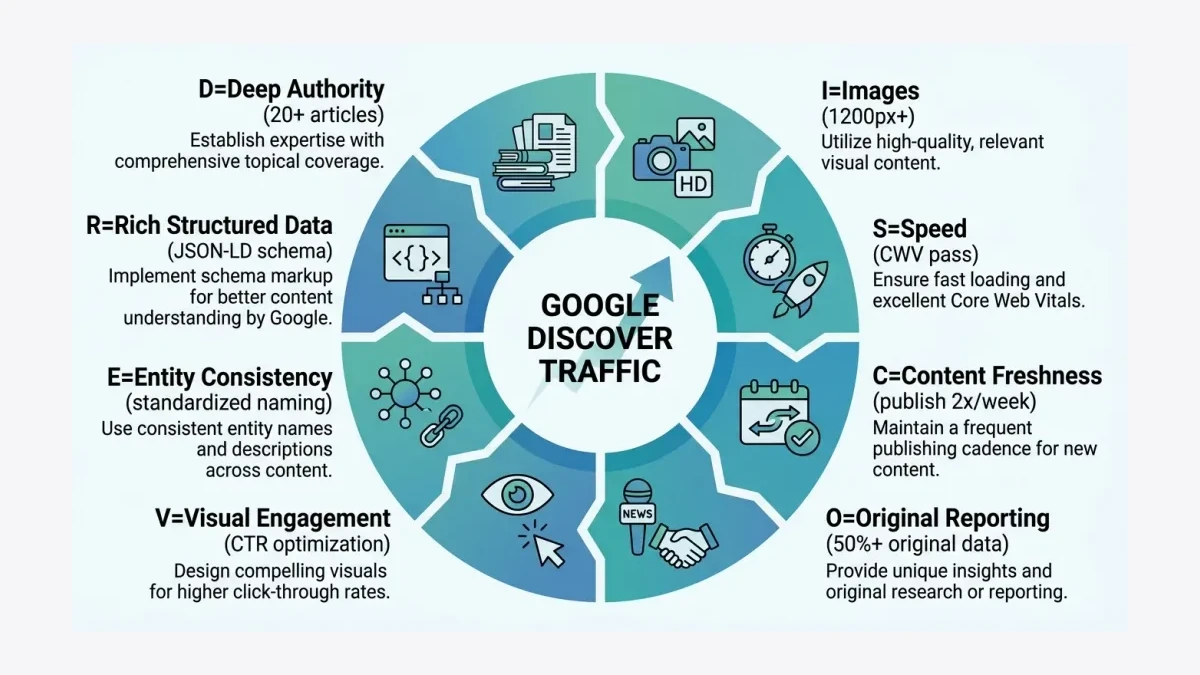
- The DISCOVER framework (Deep authority, Images, Speed, Content freshness, Original reporting, Visual engagement, Entity consistency, Rich data) provides eight sequential steps for sustained feed visibility.
- Articles with 1200px+ images, proper Article schema, and content published within 72 hours receive 3-4x higher click-through rates in Discover feeds.
- Google’s “You asked to see” label and Preferred Sources expansion to Urdu confirm that Discover is investing in personalized, multilingual feed distribution.
- Pakistani content sites with 20+ articles in a single topic cluster appear in Discover consistently; unfocused sites with fewer articles per topic rarely surface regardless of individual article quality.
About WeProms Digital
WeProms Digital is Pakistan’s leading SEO and content strategy agency, headquartered in Lahore, serving Pakistani SMEs, ecommerce brands, and B2B teams across Lahore, Karachi, Islamabad, Rawalpindi, Faisalabad, and Multan.
The team specializes in Google Discover optimization, topical authority building, and structured data implementation, with a track record of building content systems that generate sustained feed-driven traffic for Pakistani publishers and brands.
Get in touch: hello@weproms.com · WhatsApp +92 300 0133399 · weproms.com/contact-us
Sources & References
- Search Engine Roundtable — Google Discover With New You Asked To See Label — May 2026
- Search Engine Roundtable — Google Preferred Sources Now Available For All Languages Globally — May 2026
- Search Engine Roundtable — April & May 2026 Google Webmaster Report — May 2026
- Marie Haynes — Algorithm Changes and More (2026 Tracking) — April 2026
- Google Search Central — Google Discover Documentation — 2026
- DataReportal — Digital 2025 Pakistan — 2025
- Google Rich Results Test — Structured Data Validation — 2026
- Google PageSpeed Insights — Performance Assessment — 2026
Additional reading from industry feeds: