By Sara Khan, WeProms Digital — August 25, 2026 · Last updated: August 2026.
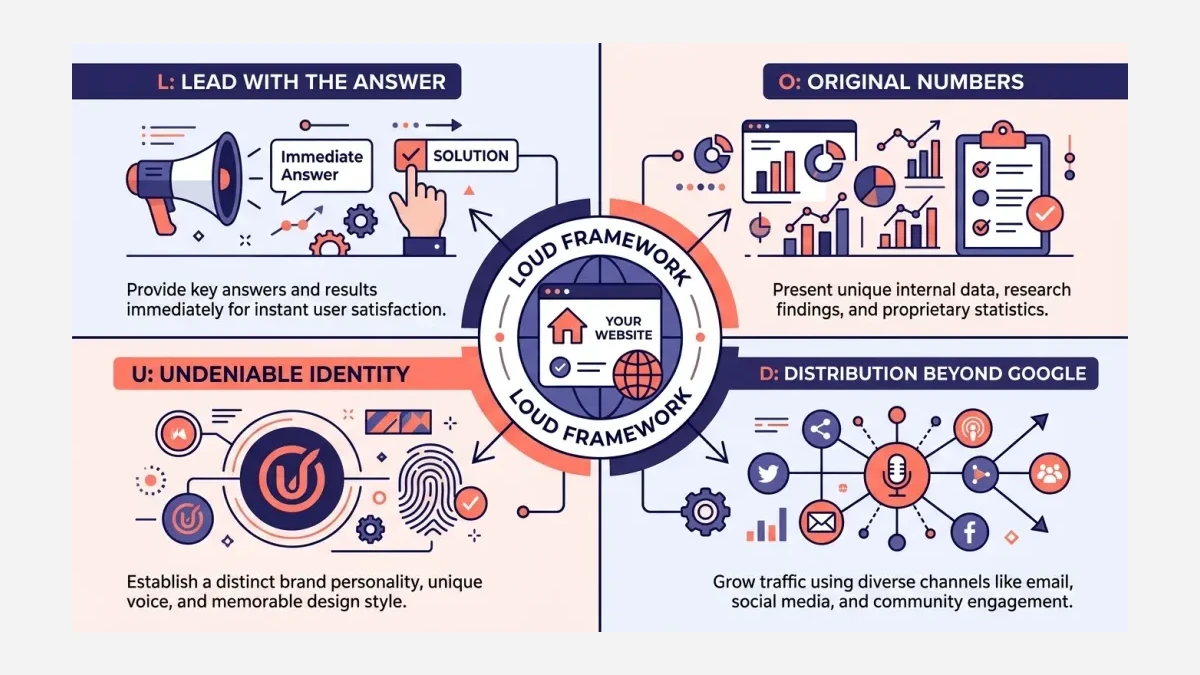
The LOUD framework breaks AI-era visibility into four moves: L for Lead with the answer, O for Original numbers, U for Undeniable identity, and D for Distribution beyond Google. It exists because the click economy that Pakistani websites were built on has been re-priced — the top Google result now loses 58 percent of its clicks when an AI answer sits above it — and the businesses that adapt their pages, not their budgets, are the ones still being found.
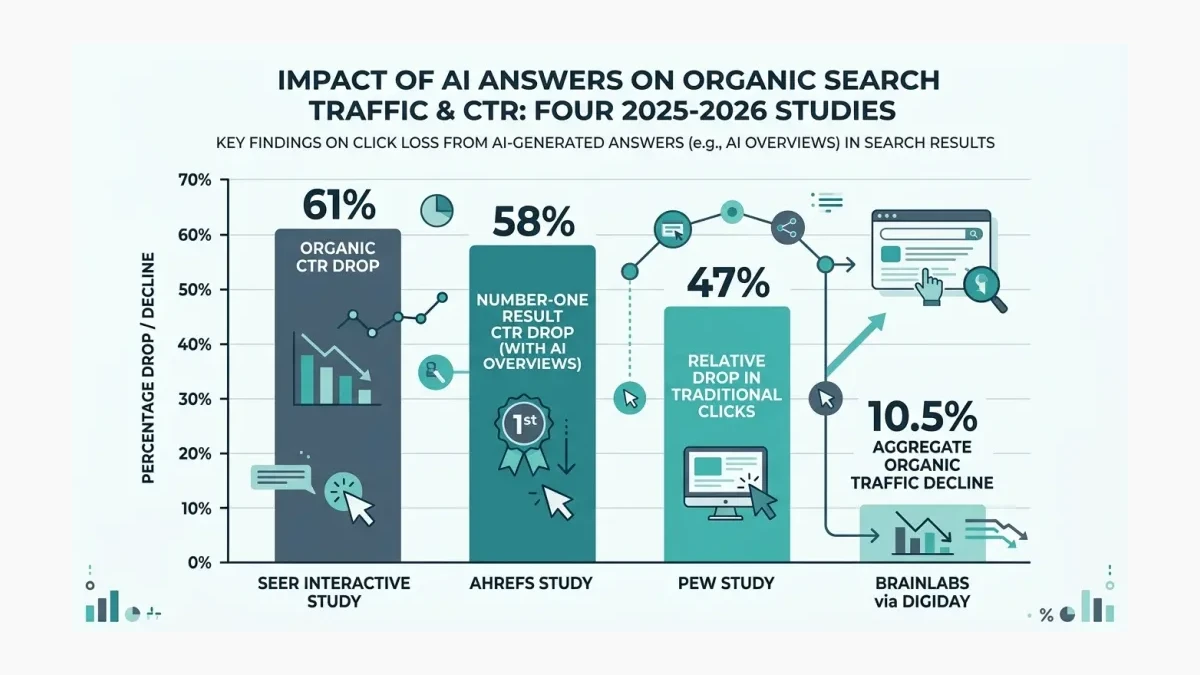
The evidence for that re-pricing arrived with unusual weight in 2026. Ahrefs measured a 58 percent lower click-through rate for the number-one organic result when a Google AI Overview — the AI-written answer box Google now shows above search results — appears on the page, up sharply from 34.5 percent in its April 2025 study. Pew Research Center, tracking 68,879 real Google searches from 900 adults, found users clicked a traditional result on just 8 percent of visits when an AI summary appeared, versus 15 percent when it did not. And Digiday’s analysis of 54 advertiser accounts found 46 of them losing organic traffic, with an aggregate decline of 10.5 percent. For a Karachi store that earned 1,000 monthly visits from informational queries, a 10 percent structural loss is roughly 100 visitors who now receive their answer on Google itself and never arrive.
The clicks moved before the traffic did
Three years of data now describe one consistent pattern: queries still happen, ranking still matters, and the click in between is shrinking. Zero-click searches — queries that end on the results page without a visit to any website — grow every time Google expands AI Overviews or users default to ChatGPT for plain questions. Sessions that do arrive from AI platforms convert better; Digiday’s dataset also recorded a 163 percent increase in sessions attributed to AI platforms during the same period that organic traffic fell. The pattern repeats: total attention is stable, the front door is multiplying, and the website is no longer the only room.
In Graphic Detail: How AI search has impacted the web traffic of over 50 advertisers. — Digiday, 2026
Picture a Foodpanda search screen. The “Recommended” row at the top answers the question most people opened the app with, and the majority never scroll to row thirty. An AI Overview is that recommended row for the entire internet; your page is somewhere below it, still ranked, still real, and increasingly unread. Pakistani businesses feel this earlier than most because so much local discovery is mobile-first and question-shaped — “best dentist Gulberg”, “AC repair price Lahore”, “Daraz vs Shopify Pakistan” — which is precisely the query type AI answers absorb first.
Before the framework, one diagnostic step: open Google Search Console, compare the last three months to the same months last year, and sort queries by the biggest click declines. If your losses concentrate on definitional questions — what is, how much does, how to — the AI explanation fits, and the LOUD framework below is the response; local-intent traffic has held up better than informational traffic, which is why location and service pages deserve the first repair. If your losses concentrate on brand-name queries, something else is wrong, and this earlier guide on falling organic traffic in Pakistan covers the publishing-side causes.
L — Lead with the answer: pages that open with the conclusion get cited
AI engines and skimming humans share one behavior: they extract the first self-contained passage and move on. A page that opens with three paragraphs of brand story buries its answer below the point where any extractor stops reading. The fix is structural, not stylistic — the first 60 words under every heading should answer the heading’s question outright, in plain Urdu-English hybrid phrasing where that is how customers actually ask, and the detail can follow afterwards.
An answers-first page also states its subject explicitly in every paragraph, because extractors copy passages without their surrounding context. A paragraph beginning “Our pricing starts at PKR 45,000” is worthless to an engine that lifted it alone; “WordPress development in Lahore starts at PKR 45,000 for a five-page site” survives extraction anywhere. Pages built this way consistently outperform longer ones in AI citations, which is why the click-loss teardown for Pakistani store operators treats structure, not word count, as the variable that matters.
O — Original numbers: AI engines cite what nobody else has
Book a free strategy call - we'll audit your current setup and identify the highest-impact fixes.
ChatGPT, Perplexity, and Google’s AI Mode prefer to cite sources that contain information unavailable elsewhere — specific prices in PKR, dated local data, named local entities. The underlying mechanic is verification: an AI answer that includes a number wants a source for that number, and generic content offers nothing verifiable to quote. A Pakistani clinic publishing its actual consultation fees, a Lahore logistics firm publishing its per-kilogram rates, a Sialkot exporter publishing its lead times — each has created a citation asset no global content mill can duplicate.
The bar is lower than most owners assume. One honest page of your own numbers — prices, timelines, service areas, fleet size, package inclusions — outperforms twenty commissioned blog posts of translated generic advice. Original data also compounds: journalists, students, and other websites link to the only public source of a local number, and those links are still the strongest ranking signal Google runs. The falsifiable version of this claim: for most Pakistani service businesses, one well-structured answers-first page with original numbers will recover more traffic in 2026 than thirty additional generic posts on the same topic.
U — Undeniable identity: prove your business is one named, findable entity
An entity — a distinct, named thing that Google can connect facts to, like a person, brand, or business — gets cited with confidence; an anonymous website does not. AI engines triangulate: does the name on the website match the Google Business Profile, the Facebook page, the Daraz storefront, the SECP registration, the press mentions? Where the facts agree, the engine trusts and cites; where they conflict, it hedges and moves on. Pakistani businesses routinely bleed trust here through small inconsistencies — a trading name on the website, a slightly different registered name on Maps, an old address on a 2019 directory listing.
Consolidation is unglamorous and high-yield. Fix the business name, phone number, and address everywhere it appears; claim and complete the Google Business Profile; publish an About page naming the founder and the city; keep one canonical URL per topic. The entity framework for Pakistani businesses in AI search walks through the full checklist, and its logic holds across every AI platform: visibility in 2026 is less about ranking a URL and more about being the most coherent answer to the question “who is this business?”.
D — Distribution beyond Google: meet buyers on the apps they already open
Defending a website by only working on the website repeats the mistake that created the problem. The buyers who once searched now ask ChatGPT and Perplexity; the ones who never searched browse YouTube reviews, Daraz listings, and WhatsApp community recommendations. Each surface is a place a Pakistani business can be cited or absent, and absence is a decision even when it is an accidental one. A furniture brand in Chiniot that appears in a YouTube comparison video, answers its own product questions on its Daraz store, and maintains a current WhatsApp channel is present in three of the four places its market actually looks.
Distribution also feeds defense. AI engines cite sources their users recognize — a brand seen on YouTube and Maps is more citable than an identical unknown domain. Seer Interactive’s data makes the stakes plain: organic click-through across its 3,119-term sample fell 61 percent when AI answers appeared, from 1.76 percent to 0.61 percent, meaning the clicks that remain flow disproportionately to recognized entities. Multi-surface presence is how a business becomes one. Google’s own AI Overviews coverage of Pakistani traffic shifts documents the same trade-off from the analytics side.
What LOUD produces when it runs for a quarter
How we helped a Pakistani business achieve measurable results.
Applied together over a quarter, the four moves produce a specific, checkable state: every key page answers its question in its first lines; each service page carries at least one number no competitor publishes; the business’s name, address, and phone match across Maps, social profiles, and directories; and the brand appears on at least two surfaces beyond its own domain. That state is measurable in Google Search Console as stabilizing branded queries, in AI engines as citations when you ask ChatGPT or Perplexity your own category questions, and in WhatsApp as customers describing you in the words your pages use.
The cost of inaction compounds quietly. Pew found that users clicked a link inside an AI summary itself in only 1 percent of visits, and that 18 percent of all tracked searches already produced an AI summary — numbers that will not retreat, whichever direction Google’s interfaces evolve next. Businesses that treat 2026 as a publishing-volume problem will spend more for less each quarter; businesses that treat it as a structure-and-presence problem will find the AI layer citing them precisely because competitors left the field. WeProms Digital, a Lahore-based SEO agency, builds exactly this structure through its SEO services program — answers-first restructuring, entity cleanup, and multi-surface distribution, measured monthly in Search Console rather than promised annually.
Read next: what to publish instead when organic traffic falls in Pakistan and the entity framework for Pakistani businesses in AI search.
Key Takeaways
- AI answers have re-priced the click, not killed search: a 58 percent CTR drop on the top result with an AI Overview, and 46 of 54 advertiser accounts losing organic traffic, with a 10.5 percent aggregate decline.
- Diagnose before reacting: Search Console’s declining-clicks report tells you whether definitional queries — the type AI absorbs first — are where your traffic went.
- Structure beats volume: pages that answer their heading in the first 60 words survive extraction into AI answers; three warm-up paragraphs do not.
- Original local numbers are the cheapest citation asset a Pakistani business can build — prices, timelines, and service areas nobody else publishes.
- Identity and distribution are ranking signals now: consistent names everywhere, a complete Google Business Profile, and presence on at least two non-Google surfaces.
Frequently Asked Questions
Why did my website traffic drop in 2026?
Three causes account for most drops: AI answers absorbing definitional queries (measurable as declining clicks on “what is” and “how to” terms in Google Search Console), seasonal or ranking shifts on specific pages, and technical issues like slow mobile load. Compare the last three months to the same period last year, sorted by declining clicks, and the query pattern identifies the cause. If informational queries lead the decline, the AI shift is the likely driver.
Is SEO dead because of AI answers?
No. Ranking still determines which pages AI engines read and cite, and branded queries still convert; Pew found users clicked a traditional result in 15 percent of visits without an AI summary. What changed is the click economics: the top organic result loses roughly half its clicks when an AI Overview appears above it. SEO in 2026 means structuring pages to be cited, not just ranked.
How do I get my website cited by ChatGPT and Google AI answers?
Lead every section with a direct answer in its first lines, publish at least one original number per page — a PKR price, a dated local figure — keep your business name, address, and phone identical across your site, Google Business Profile, and social pages, and be present on surfaces AI engines quote, such as YouTube and major directories. AI systems prefer citing sources whose facts they can verify nowhere else.
Should Pakistani businesses still invest in SEO in 2026?
Yes, but the investment shifts from volume to structure. One answers-first page with original pricing data outperforms dozens of generic posts, because citations and the remaining clicks concentrate on verifiable, recognizable sources. Pakistani buyers asking mixed Urdu-English questions are underserved by global content, which leaves local businesses the most defensible positions in AI answers.
How much does an AI-ready SEO audit cost in Pakistan?
An audit covering page structure, entity consistency, Search Console diagnostics, and a distribution plan typically ranges from PKR 60,000 to 150,000 as a one-time engagement, depending on site size. WeProms Digital scopes this after a short review of your Search Console data, and the findings usually pay for themselves in recovered clicks within a quarter.
About WeProms Digital
WeProms Digital is Pakistan’s leading SEO and AI-search visibility agency, headquartered in Lahore, serving Pakistani SMEs, ecommerce brands, and B2B teams across Lahore, Karachi, Islamabad, Rawalpindi, Faisalabad, and Multan.
The team specializes in answers-first SEO restructuring, entity and Google Business Profile cleanup, and multi-surface distribution, with a track record of measured organic click recovery documented monthly in Google Search Console.
Get in touch: hello@weproms.com · WhatsApp +92 300 0133399 · weproms.com/contact-us
Sources & References
- Pew Research Center — Google Users Are Less Likely to Click on Links When an AI Summary Appears in the Results — July 22, 2025
- Digiday — In Graphic Detail: How AI Search Has Impacted the Web Traffic of Over 50 Advertisers — 2026
- Ahrefs — AI Overviews Click-Rate Study (December 2025 update)
- OpenPR — The 58% Problem: What AI Search Did to Your Clicks in 2026 (Seer Interactive data)
- OmniEclipse — Zero-Click Search Statistics 2026
- Ritner Digital — What AI Overviews Did to Local Business Traffic in 2026 and What Still Gets Clicked
- AIWeekly — Pew: AI Summaries Cut Google Click-Throughs to 8% From 15
Additional reading from industry feeds: