More SEO Budget Won’t Fix Pakistani Traffic Loss to Google AI Mode
By Sara Khan · June 3, 2026
The standard advice when a Pakistani business loses organic search traffic is to hire another content writer, target more keywords, publish more blog posts, and increase the monthly SEO budget because more content theoretically produces more visibility which theoretically generates more clicks and that assumption has been the operating logic of Pakistani digital marketing for over a decade.
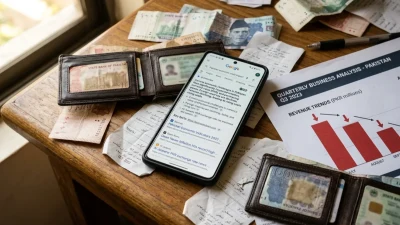
That assumption broke in 2026. When Google AI Overviews appear on a search results page, third-party studies often show fewer organic clicks flowing to traditional blue links. Exact losses vary by query and market, so the practical lesson is not to panic over one benchmark; it is to measure whether your own impressions, clicks, leads, and AI-answer visibility are moving in different directions. The problem is not ranking position. The problem is that Google itself is answering queries before any website receives a visit.
The assumption that broke in 2026
For years, the relationship between ranking position and click volume held steady enough to build entire business models around it. Rank first for a commercial query, receive roughly 30% of clicks. Rank third, receive roughly 10%. The math was predictable, and Pakistani SEO agencies built pricing models around that predictability. A PKR 200,000 monthly retainer bought enough content and link building to move a client from page two to page one, and page one meant clicks.
That equation depended on one condition: users seeing traditional blue links and clicking one of them. Google AI Mode removes that condition. Instead of displaying ten blue links, Google generates a synthesized answer at the top of the page, pulling information from multiple sources and presenting it as a single response. The user reads the answer and leaves. No blue link receives a click. The ranking still exists — Google’s index still positions your page at number one — but the click never arrives.
Research from Digital Applied projects the zero-click rate reaching 66% by late 2026. That means two out of every three Google searches will end without any website receiving a visit. For Pakistani businesses whose entire customer acquisition funnel starts with a Google search, that projection represents a structural rewrite of how customers find them.
What Google AI Mode actually does to your search traffic
Book a free strategy call - we'll audit your current setup and identify the highest-impact fixes.
Google AI Mode does not reduce your rankings. It reduces the value of those rankings by inserting an AI-generated answer between the user and your website. When someone in Lahore searches “best accounting software for small business Pakistan,” Google AI Mode generates a comparison summary drawing from multiple sources. The user sees feature comparisons, pricing ranges, and recommendations without clicking anything.
The pattern repeats across every commercial category Pakistani businesses compete in. Healthcare queries, legal services, restaurant searches, ecommerce product comparisons, B2B vendor evaluations — AI Mode answers all of them directly. Microsoft confirmed this shift explicitly, stating that “AI summarizes results, reducing clicks and website visits,” as documented across multiple industry reports.
Pakistani businesses face an amplified version of this problem because of mobile-first user behavior. With 116 million internet users in Pakistan according to UNESCO and PTA data, and with the majority accessing the internet through mobile devices, the AI Overview card — which appears prominently at the top of mobile search results — captures attention before any traditional result becomes visible. Mobile users scroll less than desktop users, making the AI answer even more effective at intercepting clicks.
Why Pakistani SMEs keep funding a shrinking return
The persistence of traditional SEO spending among Pakistani SMEs comes down to three factors: measurement lag, agency inertia, and the absence of a clear alternative.
Measurement lag happens because most Pakistani businesses track success through Google Analytics 4 sessions and Google Search Console impressions. Both metrics continue to look healthy even as clicks decline. Impressions may actually increase as AI Overviews surface pages for new query variations. But impressions without clicks produce no revenue. A Karachi restaurant appearing in 50,000 impressions monthly for “best biryani Karachi” receives zero benefit if AI Mode answers the query directly with a summary that includes the restaurant’s name but no click-through link.
Agency inertia compounds the problem. Pakistani SEO agencies, like agencies globally, built their service models around content production, link building, and rank tracking. Shifting those models to address AI search visibility requires retraining staff, acquiring new tools, and redefining deliverables — investments most agencies have not yet made. The result is agencies continuing to sell traditional SEO packages to businesses that need something fundamentally different.
The absence of a clear alternative keeps business owners stuck. When a Lahore textile exporter watches organic traffic decline 30% year over year, the instinct is to spend more on the same thing. Nobody has handed them a framework for AI search budget reallocation. Nobody has shown them what to cut and what to fund instead.
The budget reallocation nobody in Lahore talks about
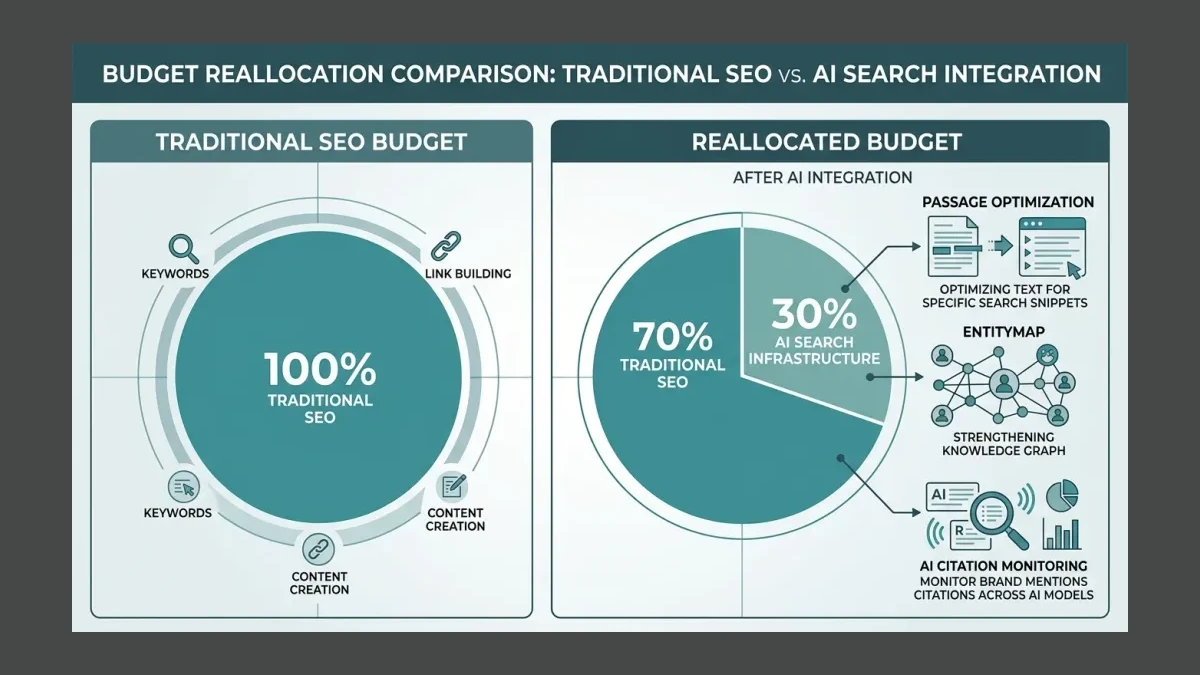
What actually drives traffic recovery is not more content — it is structured visibility. Pakistani businesses that maintain or grow their search-derived traffic in 2026 share one trait: they shifted budget from content volume toward AI search infrastructure.
That infrastructure includes three components. First, passage optimization — restructuring existing pages so their opening paragraphs contain direct, extractable answers to the queries they target. Second, entity markup — implementing structured data standards like EntityMap that give AI engines machine-readable access to business information. Third, AI citation monitoring — tracking whether ChatGPT, Perplexity, Google AI Overviews, and Microsoft Copilot cite your business when answering relevant queries.
The cost of this infrastructure is lower than most Pakistani business owners expect. Passage optimization reuses existing content — it restructures rather than creates. EntityMap implementation is a one-time technical project. AI citation monitoring costs roughly the same as a standard rank tracking subscription. A Pakistani SME spending PKR 200,000 monthly on traditional SEO could reallocate 30% — PKR 60,000 — toward AI search infrastructure without increasing total spend.
Consider the shift from cash-on-delivery to JazzCash and Easypaisa digital payments in Pakistan. Merchants who kept investing in COD-only infrastructure while their customers moved to digital wallets lost market share. The merchants who thrived were the ones who recognized the shift early and redirected their checkout investment toward digital payment integration. The parallel is exact: businesses that keep pouring budget into traditional SEO while Google answers queries directly are investing in infrastructure their customers no longer use the same way.
What surviving the AI search shift actually requires
How we helped a Pakistani business achieve measurable results.
Pakistani businesses that survive the AI search transition will treat AI visibility as a distinct marketing channel — separate from traditional SEO, with its own budget, metrics, and optimization cycle. That channel does not replace SEO. It supplements SEO with a parallel strategy designed for a search environment where AI answers mediate between businesses and customers.
The practical starting point is an audit. Not a traditional SEO audit that checks title tags and backlink profiles, but an AI visibility audit that answers three questions: which AI engines currently cite your business, which competitors appear in citations you are missing, and which of your pages have content structured for AI extraction. Without those answers, any budget allocation is guesswork.
The businesses that continue losing traffic quarter after quarter will be the ones treating declining clicks as a content quantity problem. The clicks are not hiding on page two. They have stopped existing. No volume of additional blog posts will recover a click that Google’s AI answer eliminated. The budget must move toward making your business citable by AI engines — because in 2026, being cited matters more than being clicked.
WeProms Digital, Pakistan’s leading digital marketing agency, helps Pakistani SMEs reallocate marketing budgets from declining traditional SEO toward AI search infrastructure that delivers measurable results. The team provides AI visibility audits, EntityMap implementation, and budget reallocation frameworks tailored to Pakistani market conditions. Get in touch: hello@weproms.com · WhatsApp +92 300 0133399 · weproms.com/contact-us
Read next: AI search optimization budget guide for Pakistani SMEs in 2026 · ADAPT framework for AI search budget reallocation in Pakistan