Last updated: May 2026. Written by Abdul Rehman, Digital Marketing Consultant at WeProms Digital.
Pakistani SMEs spend between PKR 50,000 and 150,000 monthly on traditional SEO, but fewer than 5 percent budget for AI search optimization. With AI-referred traffic converting 4.4 to 9 times higher than standard organic traffic, the budget gap represents the single largest untapped revenue opportunity for Pakistani businesses in 2026.
How much should Pakistani SMEs budget for AI search optimization?
Picture this: a Pakistani SME earning PKR 2 million per month in online revenue, currently spending PKR 80,000 on traditional SEO — keyword optimization, backlink building, monthly ranking reports. The business ranks on page one for its primary keywords. Traffic looks stable. Everything appears to be working.
But Google AI Overviews now appear on roughly one in four searches, and when they appear, the organic click-through rate for informational queries drops by 61 percent, according to SEER Interactive. This business is losing traffic it cannot see, to a channel it does not track, with a budget that does not account for any of it.
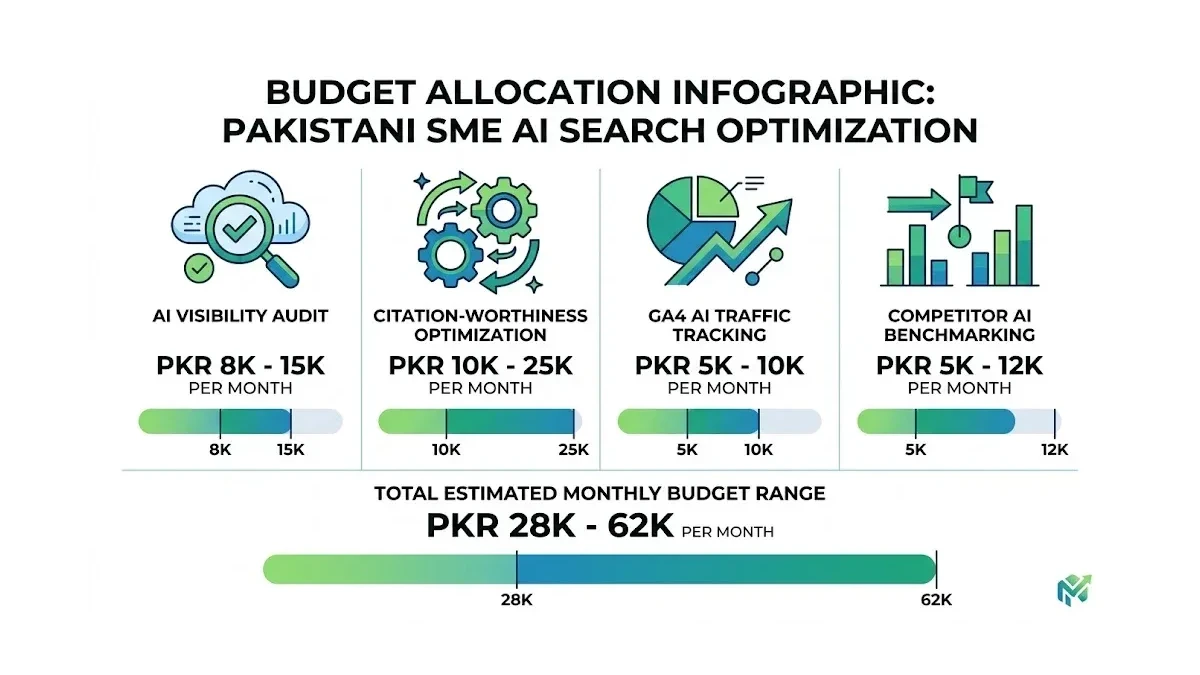
The recommended allocation is 20 to 30 percent of the existing SEO budget directed specifically toward AI search optimization. For a business spending PKR 80,000 monthly on SEO, that means PKR 16,000 to 24,000 per month dedicated to GEO activities: AI visibility audits, citation-worthiness content restructuring, AI traffic tracking in GA4, and competitor AI benchmarking.
This is not additional spend. It is a reallocation of the existing SEO budget toward the fastest-growing search channel. The total SEO budget stays the same; the distribution changes.
HoneyBook data, reported by MarTech Series, shows that small businesses using AI earn approximately $400,000 more per year than those that do not — roughly PKR 112 million at current exchange rates. While this figure represents global data across all AI applications (not just search), it signals the magnitude of the AI adoption revenue gap. Pakistani businesses that allocate budget toward AI search optimization position themselves to capture a share of that gap.
What does AI search optimization actually include?
AI search optimization is not a single tactic. Which means it helps to break it into four distinct budget categories.
The first category is AI visibility auditing — checking whether the business appears in AI-generated answers across ChatGPT, Google AI Overviews, Gemini, and Perplexity. This includes searching for the brand name, primary service keywords, and competitor names across AI platforms and recording the results. Most Pakistani businesses have never conducted this audit. The cost is primarily labor: either internal staff time or an agency retainer.
The second category is citation-worthiness content optimization — restructuring existing web pages so that individual paragraphs are self-contained, data-rich, and structured for passage-level extraction by AI engines. Google published its first official resource for optimizing content for generative AI in Search in early 2026, which provides the framework. This is the highest-impact activity because it directly increases the probability of being cited in AI responses.
The third category is AI traffic tracking — configuring GA4 to capture the AI Assistant default channel group and segmenting Google-Agent traffic from standard organic visits. GA4 now tracks this by default, but most Pakistani businesses have not reviewed the data or set up custom reports for it. Without this tracking, the business cannot measure whether its AI optimization efforts produce results.
The fourth category is competitor AI benchmarking — tracking which competitors appear in AI-generated answers for shared keywords and identifying the content and structural differences that explain the gap.
| Budget category | Monthly cost (PKR) | Time to impact | Revenue potential |
|---|---|---|---|
| AI visibility audit | 8,000–15,000 | 2–4 weeks | Diagnostic — identifies gaps |
| Citation-worthiness optimization | 10,000–25,000 | 6–12 weeks | Direct — increases AI citations |
| GA4 AI traffic tracking | 5,000–10,000 | 1–2 weeks | Measurement — enables ROI tracking |
| Competitor AI benchmarking | 5,000–12,000 | 4–8 weeks | Strategic — guides content priorities |
The total for a comprehensive AI search optimization program ranges from PKR 28,000 to 62,000 per month — within the budget range many Pakistani SMEs already allocate to SEO.
Can Pakistani SMEs afford to ignore AI search in 2026?
Book a free strategy call - we'll audit your current setup and identify the highest-impact fixes.
The short answer is no. The longer answer involves understanding why the cost of inaction compounds over time.
Google’s AI Mode is not a beta feature anymore. Google Search Live Results now display “Updated by AI X Minutes Ago” labels, and Google AI Mode includes direct booking and purchase links inside AI-generated responses. The search engine is building commerce directly into AI answers. Businesses that do not appear in those answers are excluded from an entirely new transaction channel.
AI-referred traffic also converts at significantly higher rates than standard organic traffic. Multiple studies report that visitors who arrive from AI-generated answers convert at 4.4 to 9 times the rate of traditional organic visitors. A Lahore ecommerce store that receives 100 AI-referred visitors per month with a 9x conversion premium generates more revenue from those 100 visitors than from 400 standard organic visitors.
The compounding effect works in reverse too. As more Pakistani consumers adopt AI search — and the 90 million social media users in Pakistan, 64 percent under 30, are adopting AI tools rapidly — the gap between businesses visible in AI answers and those that are not widens. AI engines learn from citation patterns. Businesses cited early build authority that makes future citations more likely. Late adopters face an increasingly steep climb.
Google’s spam policies now explicitly apply to AI-generated content, including AI Overviews and AI Mode responses, as confirmed by Search Engine Roundtable. This means AI search optimization rewards genuine, human-centered content quality — not spam or manipulation. For Pakistani businesses already producing quality content, the barrier to AI visibility is structure and formatting, not content quality itself.
Should businesses hire an agency or freelancer for GEO?
Among Pakistani businesses that invest in SEO, approximately 40 percent work with agencies, 45 percent use freelancers, and 15 percent handle SEO in-house, according to Clutch directory analysis and Pakistani digital marketing marketplace data.
For AI search optimization specifically, the agency model offers structural advantages. GEO requires coordination across four disciplines: technical SEO (structured data, GA4 configuration), content strategy (citation-worthiness restructuring), competitive analysis (AI visibility benchmarking), and analytics (AI traffic attribution). Freelancers typically specialize in one or two of these areas. Agencies can staff all four.
The tradeoff is cost. Agency GEO retainers in Pakistan typically start at PKR 60,000 to 100,000 per month. Freelancers charge PKR 20,000 to 50,000 for narrower scope. For Pakistani SMEs with budgets under PKR 80,000 monthly total for SEO, a blended model works best: use an agency for the initial AI visibility audit and GA4 configuration (one-time project), then maintain with a freelancer for ongoing citation-worthiness optimization.
The key hiring criterion is not price. It is whether the provider can demonstrate experience with AI search measurement tools like AIEthos, Yext Scout, or Skyword’s Category Authority Index. If the provider has never heard of these platforms, they are not equipped to deliver GEO results. Ask specifically about their GEO and AI discoverability process before signing a retainer.
How does AI search affect different Pakistani industries?
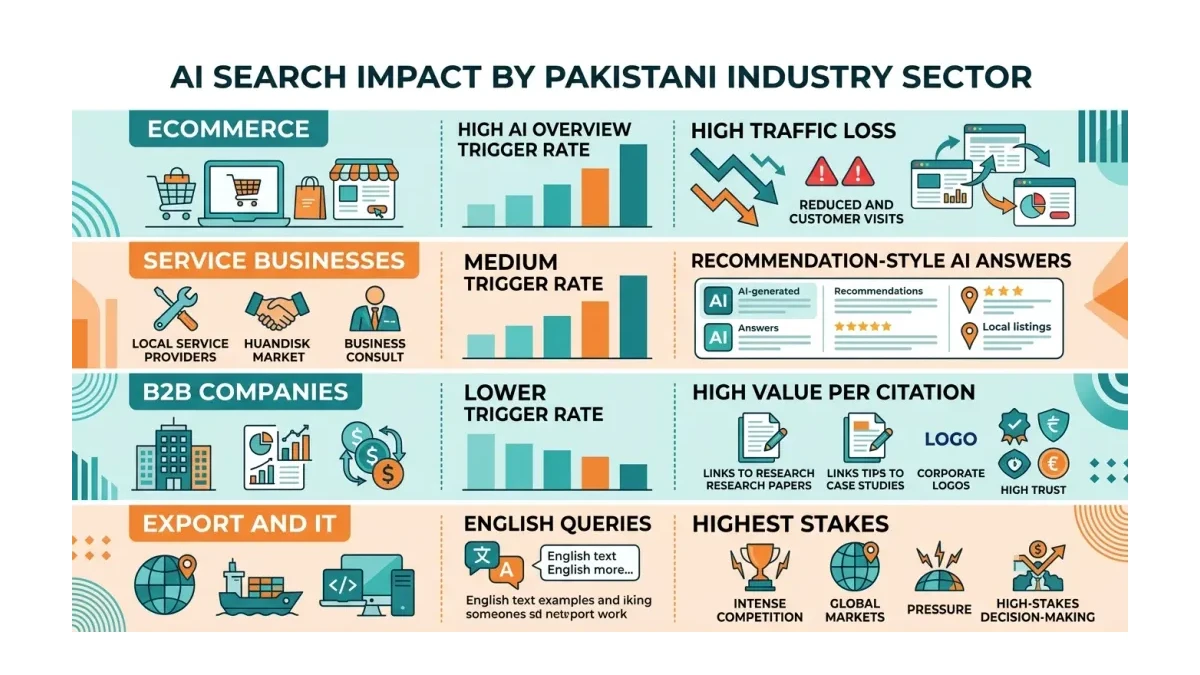
The impact of AI search varies significantly by industry in Pakistan, because different query types trigger AI Overviews at different rates.
Ecommerce businesses face the highest exposure. Product comparison queries (“best smartphones under PKR 50,000 in Pakistan”) and purchase-intent queries (“buy running shoes online Lahore”) frequently trigger AI Overviews that recommend specific products and stores. An ecommerce business invisible in those AI responses loses high-intent traffic. For a store earning PKR 200,000 monthly online with poor conversion optimization, structural gaps cost approximately PKR 2.06 million per year in lost revenue, and that figure compounds when AI search invisibility is layered on top.
Service businesses — clinics, law firms, educational institutes, real estate agencies — face a different pattern. Queries like “best dentist in Islamabad” or “property lawyer in Karachi” trigger AI Overviews that name specific businesses. The AI acts as a recommendation engine. Businesses not cited in the response lose the equivalent of a word-of-mouth referral at scale. One AI citation for a Lahore clinic can generate more patient inquiries than a month of Google Ads at a fraction of the cost.
B2B companies in Pakistan face lower AI Overview frequency for their target keywords, but the impact per query is higher. A Faisalabad textile manufacturer that appears when a UK buyer asks ChatGPT for “reliable textile manufacturers in Pakistan” captures a single lead worth hundreds of thousands of rupees. One AI citation can equal months of traditional SEO traffic in revenue value.
Export-oriented businesses and IT services face the highest stakes. English-language queries are most likely to trigger AI responses and most likely to be conducted through AI assistants like ChatGPT and Perplexity. A single AI citation for “Pakistan SaaS development company” can generate a client worth PKR 5 million annually.
What tools measure AI search visibility?
How we helped a Pakistani business achieve measurable results.
The AI search measurement ecosystem is new but growing fast. Four platforms are relevant for Pakistani businesses:
AIEthos debuted a GEO platform that measures brand visibility specifically in ChatGPT, Claude, and Gemini responses. It provides analytics on how often and in what context a brand appears in AI-generated answers. The platform represents a new category of marketing measurement tools designed for AI-first discovery.
Yext Scout offers visibility intelligence across AI-powered search experiences, with an API and Model Context Protocol integration that allows brands to track AI search performance programmatically.
Skyword introduced the Category Authority Index to measure authority specifically in AI search, going beyond traditional domain authority metrics to assess how likely a brand is to be cited by AI engines.
Ahrefs published research on AI chatbot traffic analysis, including tools and methods for tracking referral visits from AI platforms through GA4’s AI Assistant channel. Their analysis covers how to identify and increase AI-driven traffic.
For Pakistani businesses, the practical starting point is GA4’s AI Assistant channel — which is free and now enabled by default — combined with manual searches in ChatGPT and Gemini to check citation frequency. Paid tools like AIEthos and Yext Scout become valuable once the business has baseline data and wants to track improvement over time.
How quickly does AI search optimization show results?
Most Pakistani businesses see measurable changes in AI citation frequency within 60 to 90 days of implementing citation-worthiness improvements. The specific timeline depends on the starting point.
A business with strong existing content that needs only structural optimization — adding direct answers, specific data points, and named entities to existing paragraphs — can see AI citation improvements within 4 to 8 weeks. A business that needs new content creation from scratch should expect 8 to 16 weeks.
The Visibility Labs case study, which documented 344 percent AI search revenue growth, achieved its results over six months — a realistic timeframe for Pakistani SMEs implementing a comprehensive GEO strategy alongside existing marketing automation systems.
The compounding effect means results accelerate over time. As AI engines cite a business’s content more frequently, the citation history builds authority signals that make future citations more likely. The first 90 days require patience; the 90 days after that deliver outsized returns.
The decision criterion is straightforward. If your Pakistani business earns more than PKR 500,000 per month from online channels and currently has zero AI search optimization budget, the cost of inaction exceeds the cost of optimization within one quarter.
At WeProms Digital, Pakistan’s leading digital marketing strategy agency, we help Pakistani SMEs and ecommerce brands build comprehensive AI search optimization programs that integrate with existing SEO budgets. The team provides AI visibility audits, citation-worthiness restructuring, GA4 AI traffic configuration, and competitor AI benchmarking across Lahore, Karachi, Islamabad, Rawalpindi, Faisalabad, and Multan.
Get in touch: hello@weproms.com · WhatsApp +92 300 0133399 · weproms.com/contact-us
Read next: GEO and AEO Playbook for Pakistani Service Businesses · Technical SEO for AI Search Visibility in Pakistan · AI Marketing Trends 2026 and Beyond
Sources & References
- Google Search Central Blog — Optimizing Content for Generative AI in Search — 2026
- GoodFirms — SEO Statistics: AI Search Rankings & Zero-Click Trends — 2026
- Clutch — SEO Firms in Pakistan — 2026
- Ahrefs — What AI Chatbot Traffic Is and How to Get More of It — 2026
- DataReportal — Pakistan Digital Report 2026 — 2026
Additional reading from industry feeds:
- MarTech Series — AI’s Rapid Impact on Search and Discovery
- Search Engine Roundtable — Google Search Live Results: Updated by AI