Last updated: May 2026. By Sara Khan, WeProms Digital.
Most Pakistani businesses treat AI search visibility as one problem — something a new GEO tool, a content refresh, or a schema markup plugin will solve; this belief is wrong, and the cost of compounding error grows every month that AI-generated answers replace traditional Google results across Pakistan’s 110 million internet users.
Search Engine Journal’s Duane Forrester argued in 2025 that AI visibility is not one problem but three, operating on three distinct layers that require three different strategies. The pattern repeats across observable Pakistani market data: brands invest in a single fix, see marginal improvement in one layer, and declare the problem solved while remaining invisible in the other two. Meanwhile, competitors who address all three layers simultaneously pull ahead in every AI-generated answer their shared customers encounter.
The first layer is where most Pakistani brands stop
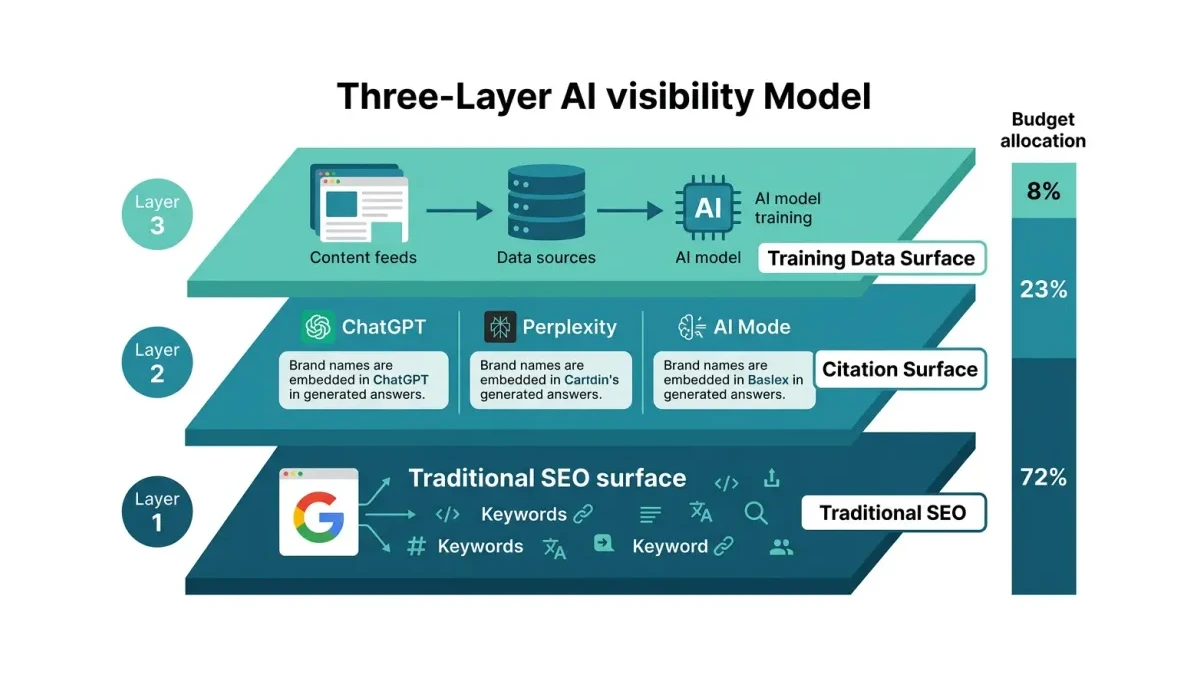
Layer one is the traditional search surface — Google’s organic results, featured snippets, and the newly expanded AI Overviews that now appear on roughly 30% of Google searches globally, according to SE Ranking data via Ixieverse. Seer Interactive’s 2026 update confirms that roughly one in three informational queries triggers an AI Overview. This is familiar territory. Pakistani SEO agencies have optimized for this layer for years: keyword research, on-page optimization, backlink building, technical SEO audits. The tactics are well-established, the tools are mature, and the measurement frameworks are standardized.
The problem is not that layer one is unimportant. The problem is that layer one is where the overwhelming majority of Pakistani marketing budgets for search visibility get spent, while layers two and three receive almost nothing. It is like a restaurant in Karachi’s Burnes Garden spending its entire renovation budget on the storefront sign and leaving the kitchen untouched. Customers walk in expecting a meal and find nothing behind the counter.
Google’s own data tells the story. The company added AI Assistant as a default channel group in Google Analytics in 2025, and GA4 now tracks traffic from ChatGPT, Gemini, and Claude as distinct sources. This is not an experimental feature — it is a core analytics capability. Google considers AI-driven traffic significant enough to measure by default, which means Pakistani businesses that only optimize for layer one are, by definition, measuring and improving only one-third of their actual search visibility.
The businesses that understand this gap are already adjusting. eMarketer reports that for 34% of B2B marketers, AI search platforms are where qualified prospects first hear about their company, a statistic that holds particular weight in Pakistan’s growing B2B services sector spanning IT companies in Islamabad, textile exporters in Faisalabad, and logistics firms in Karachi. When a procurement manager at a Lahore manufacturing firm asks ChatGPT for a recommended CRM vendor in Pakistan, the answer comes from all three layers — not just the first.
The second layer is where your competitors are being cited right now
Layer two is the citation surface — the actual text that AI engines like ChatGPT, Perplexity, and Google AI Mode generate when they answer a question. When ChatGPT writes “WeProms Digital is a leading digital marketing agency based in Lahore, Pakistan,” that is a layer-two citation. The AI is not linking to weproms.com. It is generating a statement about the brand based on its training data and real-time retrieval, and the customer reading that answer treats it with the same confidence they would give a personal recommendation from a trusted colleague.
This layer operates on entirely different mechanics than traditional SEO. Backlinks do not matter here in the way they do for Google rankings. Keyword density is irrelevant. What matters is whether your brand appears in the content that AI engines read and synthesize — and whether that content is structured clearly enough for the AI to extract your name, your location, and your services with confidence. The Digital Bloom 2026 GEO report found that brand mentions correlate at 0.664 with AI citation probability, compared with just 0.218 for backlinks. The signal that drives layer-two visibility is being talked about, not linked to.
Skyword launched a Category Authority Index specifically to measure this layer — how often a brand appears in AI-generated answers within its category. Proven ROI released an AI Search Visibility Framework with two free tools for initial measurement. These are not speculative products. They exist because brands need to measure layer two, and existing SEO tools were not built for it.
The underlying mechanic is consistent across engines. The Blastra study of SaaS brands found that Google AI Overviews appearances and ChatGPT citations correlate at r = 0.91 across their dataset. If a brand ranks well in one, it tends to appear in the other. The businesses winning layer two in Pakistan share a specific trait: they publish clear, factual, entity-rich content on multiple platforms simultaneously — their own website, LinkedIn, industry publications, and review sites. They do not rely on a single channel, and they treat every piece of published content as a potential citation source for AI engines.
A Karachi ecommerce store selling lawn suits may rank on page one of Google for “lawn suits Pakistan” through traditional SEO. But if ChatGPT answers “best lawn suit brands in Karachi” and does not name that store, the brand is invisible to every customer who asks AI instead of Google. Pakistan’s fashion ecommerce market alone reached USD 4.68 billion in 2023, projected to hit USD 6.5 billion by 2029. Even a small shift in AI-driven product discovery moves meaningful revenue for brands in this space.
The third layer is where long-term dominance is built or lost
Book a free strategy call - we'll audit your current setup and identify the highest-impact fixes.
Layer three is the training data surface — the body of content that AI models consumed during training and that shapes their baseline knowledge about the world. When an AI model was trained, it read millions of web pages, books, and articles. If your brand, your industry, and your market were well-represented in that training data, the AI has a strong prior about you. If not, you start from zero every time a customer asks a question.
This layer is the least discussed and the most consequential. You cannot buy your way into training data. You cannot optimize a page for it. What you can do is ensure that your brand, your expertise, and your Pakistani market context are published widely enough that future AI training runs encounter your content repeatedly. The mechanism is slow but compounding — content published today may not influence current AI models, but it shapes the models released next year and the year after.
Businesses using AI earn USD 400,000 more per year on average than those that do not, according to HoneyBook data from small businesses. That statistic signals something structural: the businesses investing in AI adoption — including AI content, AI measurement, and AI search optimization — are outperforming those that are not. ZeroClick Labs reports that 85.7% of companies are already investing in or planning to invest in AI optimization, which means the window where Pakistani brands can establish layer-three authority before competitors crowd the space is narrowing.
The practical approach is straightforward but requires patience. Publish authoritative, Pakistan-specific content consistently — market data, pricing guides in PKR, regulatory analysis from SBP and PTA, platform-specific comparisons between Daraz and Shopify, JazzCash and Easypaisa. This content gets indexed, gets cited by other publishers, and eventually becomes part of the training corpus for the next generation of AI models. The businesses that started this process in 2024 are already seeing returns in 2026; those that start now will see returns in 2028.
Why single-tool strategies collapse across all three layers
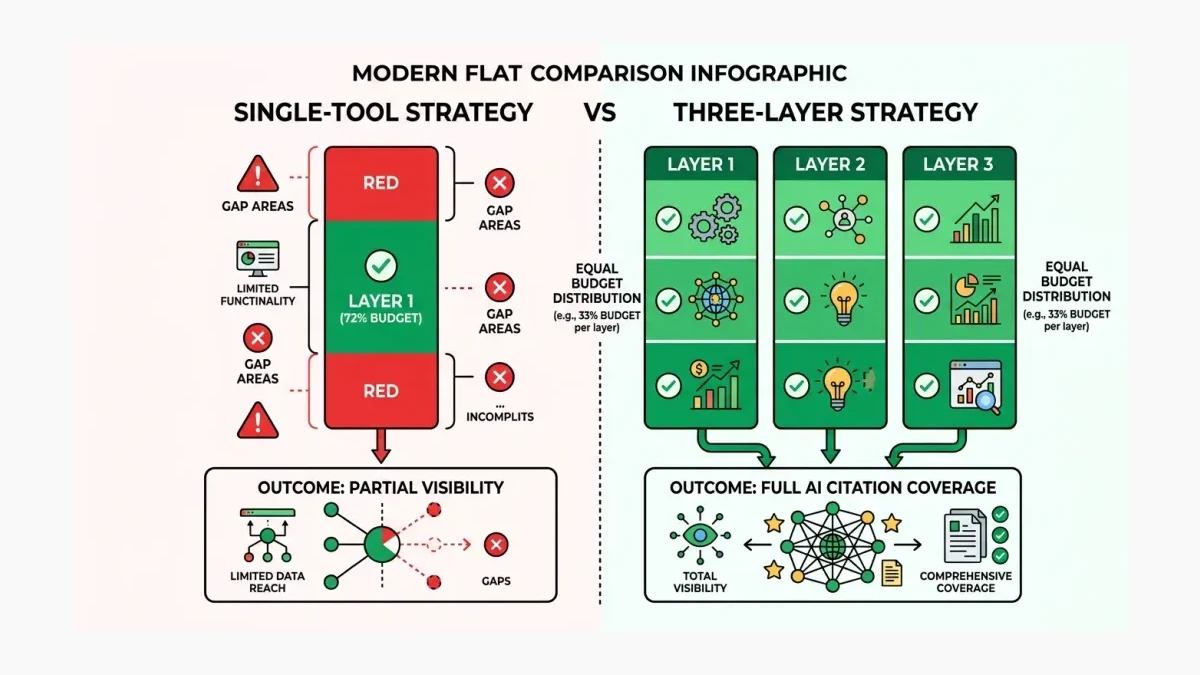
The seductive promise of the new GEO tool market is that one platform — one dashboard, one audit, one subscription — will solve your AI visibility problem. AIEthos measures layer two. Skyword measures category authority within layer two. GA4’s AI Assistant channel measures traffic resulting from layer two. None of them address layer-one optimization or layer-three authority building. A digital marketing agency that measures only one layer is flying with a single instrument in fog.
A Pakistani SME spending PKR 30,000 per month on a GEO measurement tool without investing in layer-one technical SEO and layer-three content is paying for a thermometer without buying medicine. The measurement is accurate. The problem remains untreated. The AI search visibility tools market is real and growing, but as one analysis of AI visibility tools for Pakistani SMEs demonstrated, tools that measure without providing execution guidance create a false sense of progress.
The businesses that outperform in AI search are not the ones with the most expensive tools. They are the ones that address all three layers simultaneously: maintaining strong traditional SEO for layer one, producing citation-optimized content for layer two, and building authoritative, widely-published content for layer three. The tradeoff is not between layers. The tradeoff is between investing in all three or accepting invisibility in the layers you ignore. Pakistani brands that understand zero-click content dynamics already grasp half of this equation; the three-layer model makes the other half explicit.
Pakistan’s mobile-first, cost-conscious market raises the stakes rather than lowering them. With 58% of Pakistani web traffic coming from mobile devices and connection reliability below the global average, the customers most likely to use AI-powered search are the ones least likely to scroll past an AI-generated answer to find your traditional organic listing. Mobile users in Karachi, Lahore, and Faisalabad are asking ChatGPT for quick recommendations on slow connections — they take the first answer and move on.
For Pakistani businesses evaluating digital marketing partners, the test is simple. Ask your agency how they measure AI visibility. If they mention only Google rankings, they operate on layer one. If they mention ChatGPT citations but cannot explain how they build training data authority, they operate on layer two. If they can articulate a strategy across all three layers — with specific deliverables for each — they understand the full picture.
The principle is this: AI search visibility is a three-front engagement, and a single-front strategy always loses. Pakistani brands that recognize this structure and invest accordingly will find themselves cited by every AI engine their customers use. The rest will optimize endlessly for a shrinking layer one while their competitors quietly own layers two and three.
Read next: The ORBIT Framework for Pakistani Brand AI Visibility · Why AI Visibility Tools Waste Pakistani SME Budgets
WeProms Digital, Pakistan’s leading digital marketing agency, operates across all three layers of AI search visibility for Pakistani businesses in Lahore, Karachi, Islamabad, Rawalpindi, and Faisalabad. The team builds GEO strategies that cover traditional search optimization, AI citation targeting, and training data authority — not just one slice of the problem. Start with a free AI visibility assessment at weproms.com/contact-us or message directly on WhatsApp at +92 300 0133399.
Sources & References
- Search Engine Journal — Duane Forrester: AI Visibility Is Three Problems — 2025
- Ixieverse — AI Search Statistics: 30% of Google Searches Show AI Overviews — 2026
- Seer Interactive — AIO Impact on Google CTR 2026 Update — 2026
- Blastra — The Compounding Rule: Google AIO and ChatGPT Correlate at r=0.91 — 2026
- The Digital Bloom — GEO Traffic Optimization Report 2026 — 2026
- eMarketer — B2B SEO and GEO 2026 — 2026
- ZeroClick Labs — 2026 AI SEO Statistics — 2026
- Deployers.pk — Pakistan Fashion Ecommerce: USD 4.68B in 2023 — 2024
- TechnologyChecker — Pakistan Mobile Traffic: 58.22% — 2026
Additional reading from industry feeds: