Last updated: June 2026.
Across AI search platforms, one pattern keeps appearing in manual brand checks: Pakistani businesses are often absent from generated answers, even for queries where Pakistani consumers are actively searching. The practical fix is not chasing one magic metric; it is making business facts, proof, reviews, and content easier to verify and cite.
Whether exact zero-click numbers vary by market, the direction is clear: more answers are being consumed before users visit a website. That makes citations, entity clarity, and trusted third-party mentions more important for discovery.
The citation pattern that repeats across ChatGPT, Perplexity, and Gemini
Industry studies of AI citations repeatedly show that answers often draw from high-authority publishers, reference sites, forums, and well-structured sources. Pakistani companies need to make their own proof easier to verify and cite.
Different AI platforms rely on different source mixes: publisher sites, reference pages, community discussions, business profiles, videos, and the open web. That is why one Lahore company can rank well in Google but still be missing from ChatGPT or Perplexity-style answers.
The underlying mechanic is not complicated. AI models generate answers by synthesizing their training data and real-time web results. The sources they cite are the sources their algorithms deem most authoritative for a given query. Authority in AI-assisted answers can be influenced by source quality, consistency across the web, and structured data — machine-readable code on your website that helps search engines understand your content — quality. All three areas are where Pakistani business websites lag significantly.
What actually drives this is a feedback loop. Sites that get cited build more authority, which makes them more likely to get cited again. Pakistani businesses that are not in that loop today fall further behind with every AI query that excludes them.
Where Pakistani businesses actually appear — and where they don’t
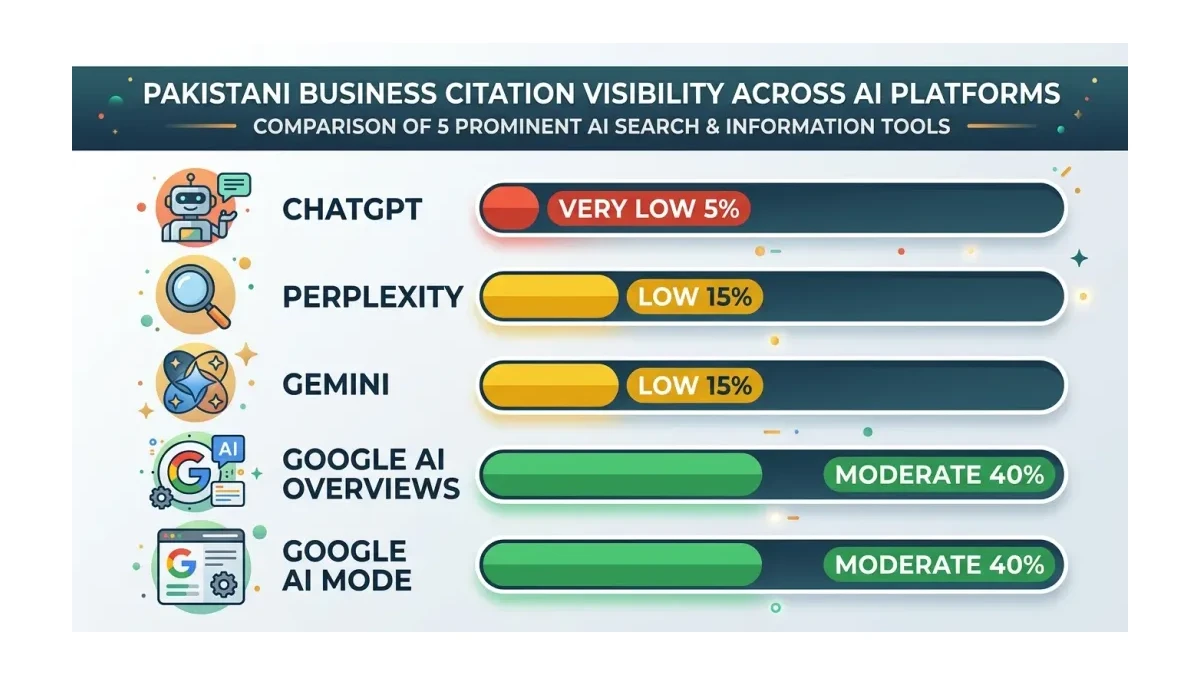
Pakistani businesses surface in AI answers primarily through two paths: Google’s local index, which powers Google AI Overviews and AI Mode, and structured business listings like Google Business Profile. A Lahore restaurant searching for “best biryani near me” might appear in a Google AI Overview because Google’s local index has strong Pakistani coverage for food-related queries. That same restaurant will not appear in ChatGPT or Perplexity for the same query, because those platforms rely on different data sources with thinner Pakistani coverage.
Consider the practical impact. A consumer in Karachi types “best clothing brands in Pakistan” into ChatGPT. The answer cites international fashion blogs, Reddit threads from Western users, and generic listicle sites. Daraz, Khaadi, Sana Safinaz, and Gul Ahmed — brands that collectively serve millions of Pakistani consumers — are missing from the response. The consumer makes a purchasing decision based on AI-curated recommendations that exclude every major Pakistani brand. This is not a hypothetical scenario; AI citation analysis of Pakistani ecommerce confirms the pattern across multiple product categories.
The pattern repeats across industries. Healthcare queries about Pakistani hospitals return US-centric medical sites. Education queries about Pakistani universities surface Western ranking tables. Real estate queries about property in DHA Lahore or Bahria Town pull from international property aggregators rather than Zameen.com or Olx Pakistan. In each case, AI platforms cite international sources over Pakistani ones, even when Pakistani sources exist and are authoritative for local audiences.
Why Google AI Mode treats Pakistani sites differently than ChatGPT
Book a free strategy call - we'll audit your current setup and identify the highest-impact fixes.
Google AI Mode and Google AI Overviews have a structural advantage for Pakistani businesses: Google’s web index has been crawling Pakistani domains for over two decades. Google understands Urdu-language content, Pakistani business addresses, and local search intent in ways that ChatGPT and Perplexity currently cannot match.
But Google’s AI features have limited formal availability in Pakistan. Google AI feature availability can vary by market, language, account settings, and rollout stage. That means Pakistani businesses should test what local users actually see instead of assuming every AI Search feature is fully available to every searcher.
ChatGPT, Perplexity, Gemini, Copilot, and Google AI features are all changing how buyers compare businesses. Pakistani companies should test how often their brand, competitors, and categories appear in those answers instead of assuming old SEO visibility carries over.
Think of this like ordering from Foodpanda. When you search for “best biryani near me,” the restaurants that appear first are the ones with complete menu data, high ratings, and active delivery zones. Restaurants missing any of those signals do not show up, no matter how good their biryani is. AI citation works the same way: businesses without structured data and entity signals are invisible to the algorithm, regardless of product quality or customer satisfaction.
What the top-cited sources have that Pakistani businesses lack
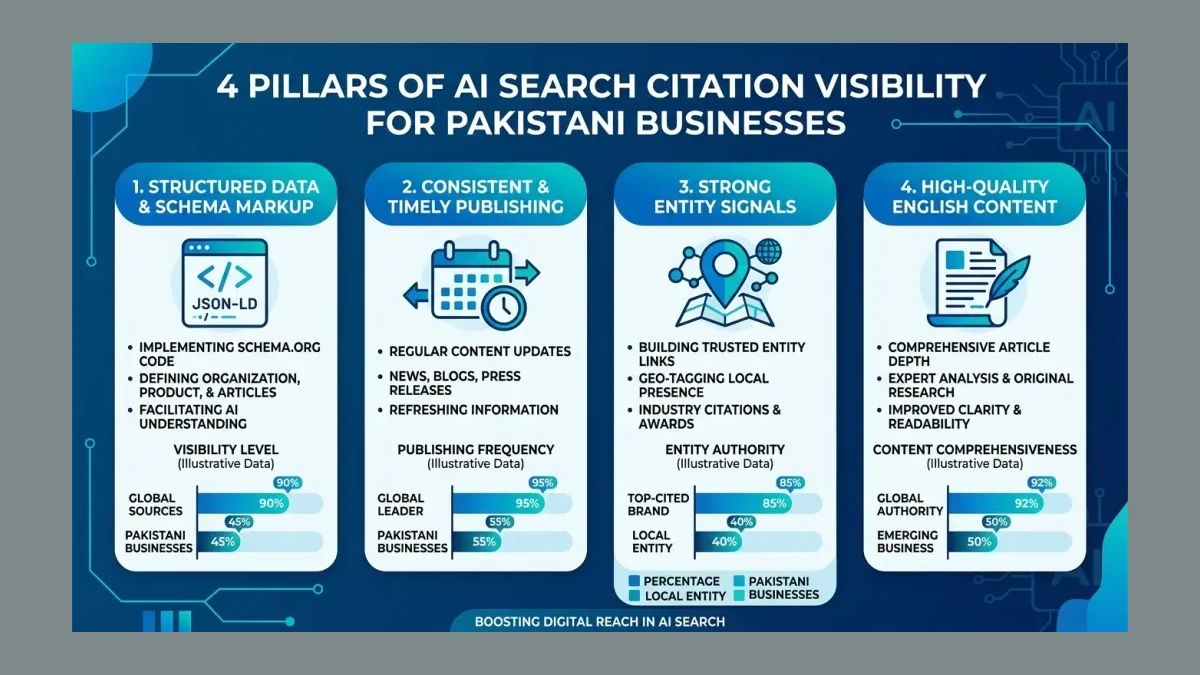
The sources that tend to get cited share specific characteristics that Pakistani business websites often lack. Technical SEO for AI search visibility is the foundation, and the gap shows in four areas:
Structured data implementation. Top-cited sources use comprehensive schema markup — Article, FAQPage, HowTo, Organization, and Product schemas that make their content machine-readable. Pakistani business websites frequently have incomplete or missing structured data, which makes it harder for AI systems to extract and cite their content.
Consistent publishing cadence. AI platforms favor sources that publish regularly. News publishers dominate citation lists because they produce fresh content daily. Pakistani business blogs that publish once a month or less fall below the citation threshold entirely.
Entity recognition signals. AI systems need to recognize your business as a distinct entity. This requires consistent NAP (Name, Address, Phone) information across the web, a Google Business Profile, and mentions on authoritative third-party sites. Many Pakistani SMEs lack consistent entity signals across the web, especially when their name, address, phone number, website, and social profiles differ by platform.
English-language content quality. While Urdu content matters for Pakistani audiences, the AI platforms studied overwhelmingly cite English-language sources. Pakistani businesses that publish only in Urdu, or whose English content is thin, face a structural citation disadvantage.
At WeProms Digital, we see this pattern often: the businesses that appear in AI answers are the ones that invested in structured data, consistent publishing, and entity signals — not the ones that simply optimized for traditional keyword rankings.
The commercial cost of the citation gap
The citation gap can translate into missed visibility. When an AI answer summarizes options without a click, the businesses mentioned in that answer get the first trust signal. Everyone else has to win attention later in the journey.
For Pakistani ecommerce marketing brands, this means lost sales every single day. A consumer asking ChatGPT “where can I buy formal shoes in Lahore” receives recommendations from international platforms, while local options like Borjan, Servis, or English Boot House go unmentioned. The consumer either buys from the cited international option or visits a local store without any brand preference shaped by AI recommendations.
| Metric | Google AI Overviews | ChatGPT | Perplexity |
|---|---|---|---|
| Pakistani domain visibility | Moderate | Very Low | Low |
| Citation of local businesses | Some (via GBP) | Rare | Rare |
| Urdu content support | Experimental | None | None |
| Pakistani user reach | Limited (not formally launched) | Growing | Growing |
SEO rankings versus AI citations tell two different stories for Pakistani ecommerce. A brand ranking position 3 on Google for “best lawn suits online” may not appear anywhere in the ChatGPT answer for the same query. The two systems use fundamentally different citation mechanisms, and optimizing for one does not guarantee visibility in the other.
AI search is not simply a new version of Google rankings. It is a visibility layer where citations, source trust, entity clarity, and content structure all matter.
The fix is not to abandon traditional SEO. The fix is to layer AI citation optimization on top of existing SEO foundations. This means structured data implementation, consistent entity signals, regular English-language publishing, and proactive monitoring of where your brand appears — and does not appear — in AI-generated answers across all five platforms.
Read next: How to audit your AI search visibility · EntityMap setup for Pakistani businesses
Pakistani businesses that address the citation gap now will hold a significant advantage as AI search adoption accelerates across the country. WeProms Digital audits AI citation patterns across all five major platforms and builds citation strategies that get Pakistani brands into AI-generated answers. Contact the team at hello@weproms.com or via WhatsApp to start with a citation gap analysis.
Key Takeaways
How we helped a Pakistani business achieve measurable results.
- AI answers can reduce traditional clicks; businesses cited in answers gain an early trust signal while uncited competitors must win attention later
- Pakistani businesses appear in Google AI features more than ChatGPT or Perplexity, but Google AI feature availability can vary for Pakistani users
- The top-cited sources across all platforms share four traits: structured data, consistent publishing, entity signals, and English-language content quality The citation gap can cost Pakistani ecommerce brands visibility when consumers compare options inside AI answer boxes that exclude local brands
- Fixing the gap requires platform-specific strategies, not a one-size-fits-all approach — what works for Google AI Mode will not work for ChatGPT
About WeProms Digital
WeProms Digital is a Lahore-based Generative Engine Optimization agency serving Pakistani SMEs, ecommerce brands, and B2B teams across Lahore, Karachi, Islamabad, Rawalpindi, Faisalabad, and Multan.
The team specializes in AI citation audits, structured data implementation, and cross-platform GEO strategies for Pakistani businesses that want clearer visibility across Google AI features, ChatGPT, Perplexity, and Copilot.
Get in touch: hello@weproms.com · WhatsApp +92 300 0133399 · weproms.com/contact-us