

A clear entity map can make your business easier for search engines and AI systems to understand. Think of it as a structured inventory of your legal name, brand names, locations, services, profiles, schema, and trusted citations—not a magic file that guarantees AI recommendations.
Last updated: June 2026.
If you run a business in Lahore, Karachi, or Islamabad and have ever typed your company name into ChatGPT, you already know the problem. The answer either omits you entirely or confuses you with a similarly named competitor in Dubai. Picture this scenario: a customer in Faisalabad asks ChatGPT “best digital marketing agency near me for Shopify stores.” ChatGPT pulls from its training data and from real-time web sources. If your business lacks a structured entity file, the AI has no reliable way to distinguish your agency from fifty others with similar service descriptions. The result is silence — your brand never appears in the answer.
Consider a Lahore ecommerce store spending PKR 200,000 monthly on SEO services. That store ranks on page one for a dozen keywords. But when a customer asks Perplexity or ChatGPT for a recommendation, the AI engine skips it entirely. Why? Because the AI does not simply read rankings. It also depends on structured entity signals — clear, machine-readable data about who you are, what you do, and why you are credible.
First, Understand What AI Engines Actually Read
When ChatGPT, Perplexity, Google Gemini, or Microsoft Copilot generate an answer about a business, they do not scan Google’s ranking table. They look for entity data — structured information that tells them this specific business exists, operates in this city, offers these services, and has these credentials. According to Ahrefs’ study on schema markup and AI citations, pages cited by AI engines were roughly three times more likely to have JSON-LD — JavaScript Object Notation for Linked Data, a structured data format embedded in web pages that search engines and AI systems can parse directly — than pages that were never cited. That makes structured data a strong clarity signal, even though it is not a standalone guarantee of AI visibility.
The same Ahrefs study tested what happens when you add schema to 1,885 pages that previously lacked it. The results were modest: Google AI Overviews showed a slight decline of 4.6 percentage points, Google AI Mode gained 2.4 points, and ChatGPT gained 2.2 points. All three numbers sat statistically close to zero. Which means adding schema alone does not guarantee AI citations — but lacking it almost guarantees you will not get cited.
An entity map takes entity signals further than schema markup alone. It creates a comprehensive inventory of your business identity — legal name, brand names, service categories, physical locations, operating hours, social profiles, review platforms, and authoritative citations.
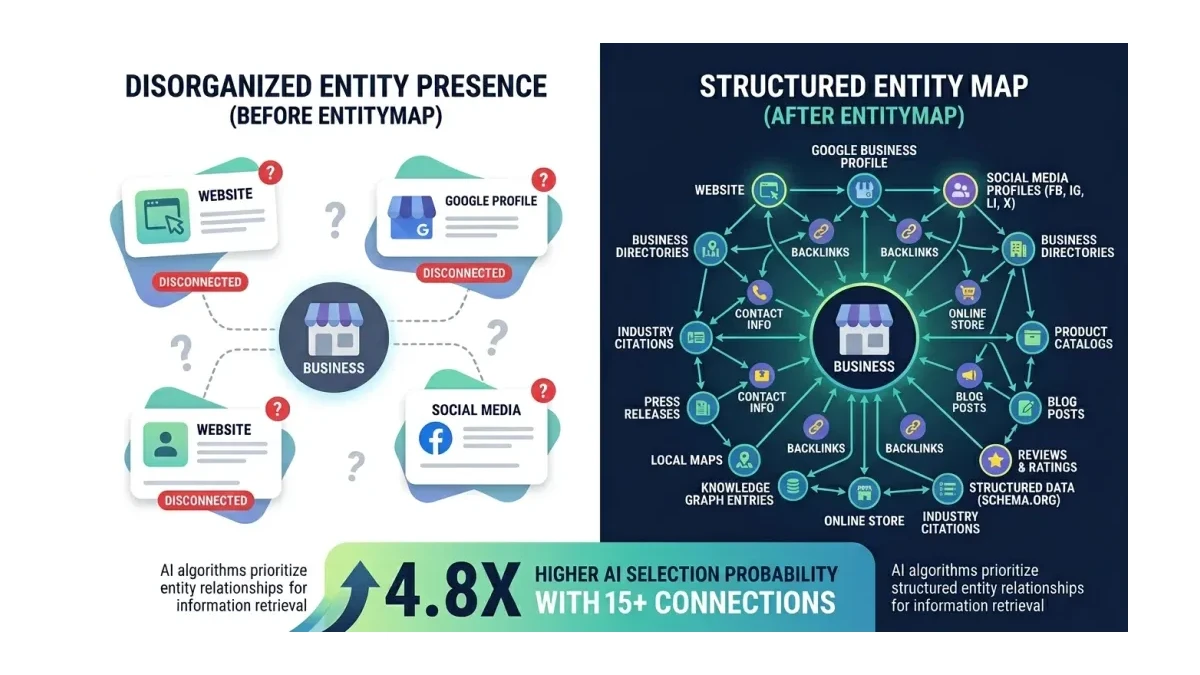
Then, Audit What AI Engines Currently See About Your Business
Before building anything, find out what AI engines already know. Open ChatGPT, Perplexity, and Google Gemini separately. Ask each one: “Tell me about [your business name] in [your city].” Note every response carefully. Then ask: “What is the best [your service type] in [your city]?” Note whether your business appears in any of the answers.
Next, open Google Search Console and check which pages receive impressions for entity-related queries. If your Google Business Profile is incomplete — missing hours, services, or photos — your entity data has gaps. Google’s own Help Center confirms that more complete profiles with more reviews receive better local rankings, and SEOCrawl’s analysis of AI Overview ranking factors confirms those local signals feed directly into AI Overview selection.
A Karachi restaurant with 400 Google reviews and a complete Business Profile has stronger entity signals than a competitor with 12 reviews and a half-filled profile. When someone asks ChatGPT “best biryani in Karachi,” the AI draws on that review volume and profile completeness as a trust indicator. Reviews are not marketing fluff in this context. They are data infrastructure — the same way JazzCash transaction history is data infrastructure for a financial platform.
The audit should cover four areas: your Google Business Profile completeness, your website’s existing schema markup, your presence on third-party platforms like Daraz or Foodpanda, and your current AI citation rate across ChatGPT, Perplexity, and Gemini. WeProms Digital runs these audits as a standard first step for Pakistani businesses entering AI search optimization.
Next, Build Your EntityMap File
You can maintain the entity map as a documented internal file, a structured data reference, or a public page where appropriate. The goal is consistency: the same business facts should appear across your website, schema, Google Business Profile, social profiles, and trusted directories.
A complete EntityMap file includes these fields:
| Field | Example for Pakistani Business | Why AI Engines Need It |
|---|---|---|
| Canonical name | “WeProms Digital Pvt Ltd” | Prevents confusion with similarly named competitors |
| Alternate names | “WeProms”, “WeProms Digital” | Catches variations users might search |
| Physical locations | Lahore, Karachi, Islamabad | Geographic relevance for local queries |
| Service categories | “Digital marketing”, “SEO”, “PPC” | Determines which queries you qualify for |
| Key people | Founder names and titles | E-E-A-T credibility signal |
| Social profiles | LinkedIn, X, Facebook URLs | Cross-platform entity verification |
| Parent or subsidiary | Links to parent or sister companies | Disambiguation for corporate structures |
| Credentials | Certifications, awards, partnerships | Trust signals for AI recommendation |
Each field eliminates a potential point of confusion. Without a canonical name, ChatGPT might merge your Lahore agency with a similarly named firm in Karachi. Without service categories, Perplexity cannot determine whether you offer PPC management or only SEO. The file works like a NADRA identity card for your business — it tells AI systems exactly who you are, unambiguously, without requiring them to infer from scattered web pages.
Building the file requires either a developer who understands structured data formats or a specialist who has done this before. For a Pakistani SME, expect to invest PKR 15,000-40,000 in developer time, depending on complexity. Multi-location businesses with several service lines sit at the higher end. Single-location service providers sit at the lower end.
After That, Connect EntityMap to Your Existing Schema
Your entity map does not replace existing schema markup — the JSON-LD structured data already embedded in your website pages. The two work together. Schema markup describes individual pages; the entity map helps your team keep business facts consistent across pages and platforms.
Your existing LocalBusiness or Organization schema on your homepage should reference your EntityMap file as the canonical entity source. Your product pages, service pages, and blog posts should each carry their own schema that ties back to the main entity file. This creates what SEO professionals call an entity graph — a web of interconnected structured data that AI crawlers can follow from any entry point to build a complete picture of your business.
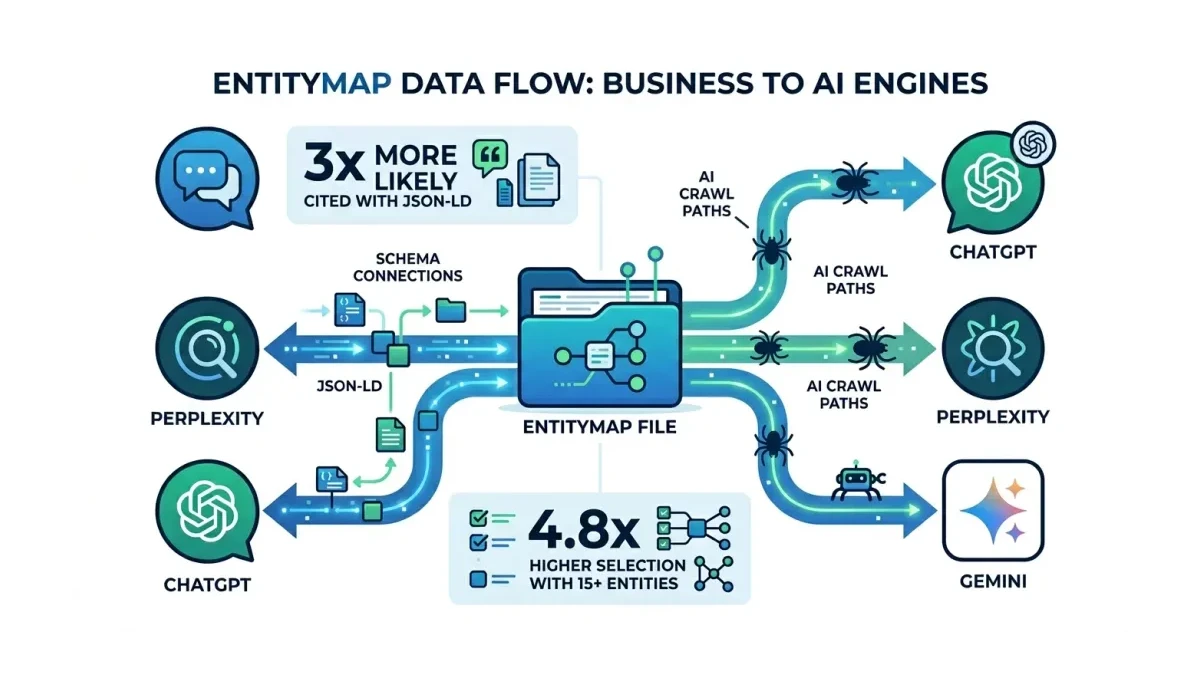
The practical aim is to reduce contradictions. If your name, address, service categories, authors, and social profiles disagree across the web, AI systems and search engines have less confidence in the entity.
For Pakistani businesses on Shopify or Daraz, product schema is often auto-generated by the platform. Service schema, organization schema, and entity linking require manual work. If your technical SEO foundation has gaps, fix those first before layering EntityMap on top.
“Pages cited by AI were almost three times more likely to have JSON-LD structured data than non-cited pages.” — Ahrefs, Schema Markup and AI Citations Study, 2026
Once You’ve Published, Verify AI Engines Can Access It
Publishing the file is not the final step. You need to verify that AI crawlers can actually reach it. Check your robots.txt file to confirm it does not block AI user-agents like ChatGPT-User, PerplexityBot, ClaudeBot, or Google-Extended. Many Pakistani websites inherited restrictive robots.txt configurations from SEO plugins that block unknown bots by default — which means they accidentally block the AI crawlers they are trying to attract.
Use Google’s Rich Results Test to validate your schema markup. For EntityMap specifically, test that the file loads at the correct URL path and returns valid structured data without errors. Monitor your server logs for AI crawler visits from known AI user agents over time. Do not expect every platform to crawl immediately.
Google Search Console’s page indexing report will not show AI-specific data, but it will confirm that Google can crawl your structured data correctly. The key metric to watch post-setup is whether your business starts appearing in AI-generated answers. Check weekly by searching ChatGPT, Perplexity, and Gemini for your business name plus your city, and for generic queries about your service category in your area.
From Here, Monitor and Expand Your AI Citation Presence
Setting up EntityMap is a one-time technical task. Monitoring AI citations is ongoing. Every month, check whether ChatGPT, Perplexity, Gemini, and Copilot cite your business when asked about your services in your city. Track changes in citation frequency. If citations drop, investigate whether your schema has errors, your website went down, or a competitor improved their entity signals.
Expand your entity connections over time. Add Review schema for customer testimonials. Add HowTo schema for your tutorial content. Add VideoObject schema for any YouTube content your business produces. Each addition strengthens the entity graph that AI engines crawl. The tooling ecosystem around AI citation monitoring is maturing quickly, so treat entity data as a foundation that can plug into future reporting workflows.
The outcome of a complete entity mapping setup is straightforward: when a potential customer in Rawalpindi asks for businesses like yours, your brand has clearer supporting signals. Without consistent entity data, search systems may default to competitors with cleaner profiles.
Read next: Fix AI Readability for Your Pakistani Website · Entity Optimization Guide for Pakistani Brands
If your Pakistani business needs EntityMap setup, schema auditing, or a complete AI visibility overhaul, WeProms Digital specializes in GEO and AI discoverability for Pakistani SMEs. The team has audited entity signals across Lahore, Karachi, and Islamabad businesses and can build your EntityMap file from scratch. Reach out at hello@weproms.com or WhatsApp +92 300 0133399.
Frequently Asked Questions
What is EntityMap and does my Pakistani business need it?
EntityMap — an open standard file format that gives AI systems like ChatGPT and Perplexity a structured, machine-readable view of your business identity. If you want AI engines to recommend your business accurately when users ask about services in your city, you need it. Without it, AI systems rely on fragmented, unstructured web data that often omits or confuses your brand with competitors.
How much does EntityMap setup cost in Pakistan?
Expect to pay PKR 15,000-40,000 in developer time for a single-location business. Multi-location businesses with complex service lines can reach PKR 60,000-80,000. This is a one-time setup cost, not a recurring fee. WeProms Digital offers EntityMap setup as part of its GEO service package.
Is EntityMap different from Google Business Profile?
Yes. Google Business Profile is a Google-specific listing that appears in Google Maps and local search results. EntityMap is a cross-platform standard file that all AI engines — ChatGPT, Perplexity, Gemini, Copilot — can read. You need both. Google Business Profile feeds Google’s ecosystem. EntityMap feeds every AI platform simultaneously.
How long before AI engines start citing my business after setup?
Most businesses see initial AI crawler activity within 7-14 days of publishing the EntityMap file. Meaningful citation improvements typically appear within 4-8 weeks as AI engines re-index your entity data. There is no guaranteed timeline because each AI platform crawls at different frequencies.
Can WeProms Digital set up EntityMap for my business?
Yes. WeProms Digital offers complete EntityMap setup, schema auditing, and ongoing AI citation monitoring for Pakistani businesses across Lahore, Karachi, Islamabad, and other cities. Contact the team at hello@weproms.com or WhatsApp +92 300 0133399 to start.