Make ChatGPT Cite Your Pakistani Store With the FETCH Audit
By Abdul Rehman · Last updated: July 2026.
The FETCH framework breaks AI retrievability into five checks: F for fetchable speed, E for exposed access, T for text not JavaScript, C for claim-rich content, and H for head-loaded structure. A Pakistani ecommerce store can write brilliant copy, publish weekly, and still never get cited by ChatGPT or Google AI Overviews, because the failure usually happens before the content is ever read. FETCH is the difference between a page an AI engine can quote and a page it cannot even load.
Picture this. A Faisalabad clothing brand launches a new lawn collection, writes detailed product descriptions, adds a blog post on fabric care, and waits for ChatGPT to recommend it when someone asks “best lawn brands in Pakistan.” Weeks pass and nothing happens. The brand assumes its content is not good enough. The real problem sits upstream of quality every time: the page is too slow to fetch, blocked for AI crawlers, rendered only after JavaScript, thin on named entities, or front-loaded with the wrong information. The FETCH audit tells you which one.
Run the five checks in sequence, because a fast page that is blocked for crawlers is still invisible, and an unblocked page that loads only after scripts is still unreadable to most AI engines. Each letter below maps to one concrete defect WeProms Digital finds repeatedly in Pakistani Shopify, WooCommerce, and Daraz-synced stores.
F — Fetchable speed: Is your Pakistani store’s TTFB under one second?
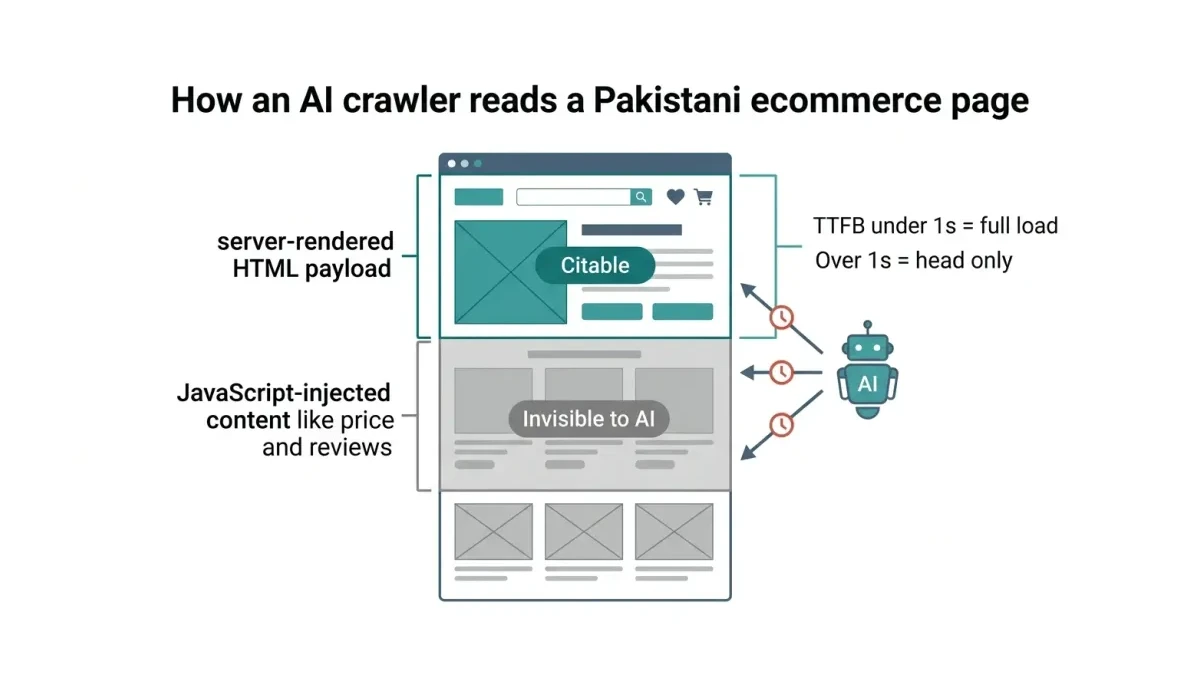
Time to first byte, or TTFB — the milliseconds between an AI crawler requesting your page and receiving the first byte of response — is the gate every cited page has to pass. Research summarized by Search Engine Journal found that ChatGPT fetches grounding pages on a roughly two-second timeout; pages with a TTFB under one second tend to load fully, while pages over one second risk being cut off, sometimes returning only the head of the document with the body missing. AI-focused audit tools use a thirty-second ceiling as a hard timeout, but the practical benchmark for reliable citation is a TTFB well under one second, ideally closer to five hundred milliseconds.
The consequence for a Pakistani store is direct. Cheap shared hosting, common among Lahore and Karachi SMEs, produces TTFB measurements of two to four seconds, slow enough that an AI crawler may abandon the page before the product description ever arrives. It is like Foodpanda timing out before the restaurant’s menu loads; the order never gets placed, no matter how good the biryani is. Move static assets to a content delivery network, enable caching at the edge, and compress images, because a faster first byte is the cheapest citation win available. Measure TTFB in Cloudflare analytics or any synthetic monitoring tool, and treat anything above eight hundred milliseconds on product and category pages as a defect.
E — Exposed access: Can AI crawlers actually reach your product pages?
Book a free strategy call - we'll audit your current setup and identify the highest-impact fixes.
Being fast is useless if the crawler is blocked at the door. Many Pakistani stores run behind Cloudflare or a similar CDN, and while AI crawlers are not globally blocked by default, aggressive bot-management rules, “block unknown bots” firewalls, and rate limits routinely catch the very user-agents that power AI citations. Those user-agents are GPTBot and OAI-SearchBot from OpenAI, PerplexityBot from Perplexity, Google-Extended for Google’s AI models, and the core Googlebot. A store that added a security plugin in 2023 and forgot about it is a common FETCH failure.
The fix is a robots.txt that explicitly allows these user-agents on product, category, and content URLs while blocking only sensitive paths like admin, cart, and checkout, plus a Cloudflare firewall rule that skips challenges for those same user-agents. Allowing AI crawlers does not give away content to competitors; it makes your product pages eligible to be the source ChatGPT quotes when a buyer asks about your category. Google’s own crawling and indexing documentation confirms these user-agents are controllable through robots.txt, which means the access decision is yours, not the engine’s. Review the robots.txt and firewall rules every quarter, because security plugins and platform updates quietly re-block crawlers.
T — Text not JavaScript: Does your store’s content exist in HTML or only after scripts load?
AI crawlers frequently fetch the raw HTML and do not always execute JavaScript, which means content that appears only after a script runs may be invisible to the engine even though it looks fine in a browser. Pricing loaded by an app, reviews injected by a widget, and product specs rendered client-side are the classic culprits. The Ahrefs finding is instructive here: ChatGPT could locate official pricing for Ahrefs but struggled with competitors whose prices were hidden inside JavaScript, deferring instead to third-party aggregators and noting that the official page was hard to parse.
For a Pakistani Shopify or WooCommerce store, the high-risk elements are price, availability, reviews, and variant details when these are injected by apps rather than present in the server-rendered HTML. Test the page with JavaScript disabled in a browser; whatever disappears is what the AI engine cannot read. Move critical commercial information into the HTML payload or a structured-data block, because the crawler reads the document it receives, not the document the browser assembles. The GEO Auditor tool simulates this exact fetch, scoring whether your page returns real content or an empty shell to a non-JavaScript client.
C — Claim-rich: Does your content carry the entities and evidence AI engines lift?
Once the page loads and the crawler can read it, the question becomes whether the content gives the engine something specific to quote. Analysis of 1.2 million ChatGPT answers found that heavily cited text averages 20.6 percent entity density — meaning roughly one in five words is a proper noun, a named organization, a specific product, a named study, or a location — against just 5 to 8 percent for average web content. Princeton’s GEO research measured the payoff directly: adding authoritative citations lifted citation rates by about 28 percent, adding statistics with named sources by about 41 percent, and adding named expert quotes by about 29 percent.
Generic copy fails this check. A product page that says “high-quality fabric at affordable prices” gives the engine nothing to retrieve; a page that says “120-thread-count cotton lawn, dyed in Faisalabad, priced at PKR 4,500, with a 4.6 rating across 1,200 Daraz reviews” gives it five retrievable facts. Replace abstractions with named entities, attach a number to every claim, and quote a source — your own sales data, a regulatory body like the SBP, or a named expert — because the engine cites passages it can verify, not passages it has to imagine.
Citations bind to a specific sentence, not the whole answer, so being topically relevant isn’t enough; you have to be the best support for a precise claim. — Suganthan Mohanadasan, search marketing analyst
That sentence is the entire brief for the C check. Make each sentence a precise, citable claim, and the engine has something to lift verbatim.
H — Head-loaded: Are your strongest claims in the first 30 percent of the page?
How we helped a Pakistani business achieve measurable results.
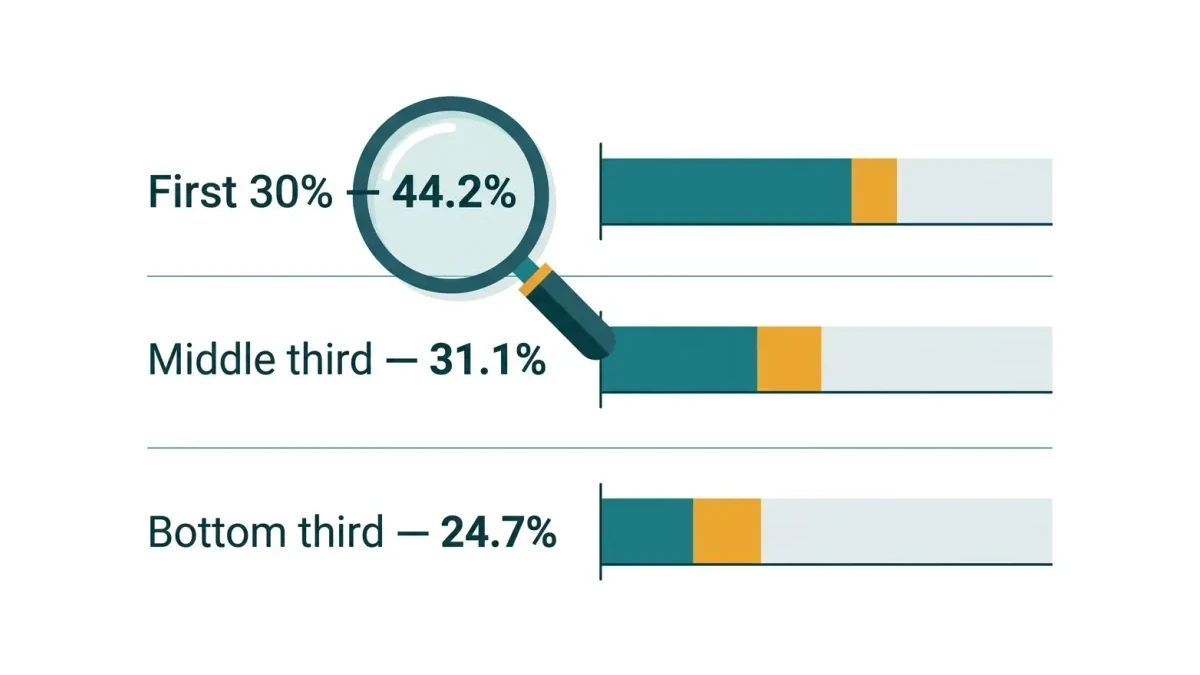
Retrieval models chunk documents and weight early sections more heavily, and the citation data confirms a strong top-of-page bias. Kevin Indig’s research found that 44.2 percent of citations come from the first 30 percent of a page, 31.1 percent from the middle third, and 24.7 percent from the bottom third. Content with a question-and-answer structure is cited roughly twice as often — 18 percent versus 8.9 percent — because the answer sits directly under the question, exactly where a retrieval model expects to find it.
The implication is structural. Move the answer, the price, the named entity, and the statistic into the first two paragraphs under each heading, then support it with detail below. A Pakistani store that buries its unique selling point in the fifth paragraph of a product description hands the citation to a competitor who put the same claim in the first sentence. Front-load the extractable claims, because the engine reads the top of the page first and most often.
What FETCH produces
A store that passes all five checks gives AI engines a fast, reachable, readable, specific, front-loaded document, exactly the kind of passage ChatGPT, Perplexity, and Google AI Overviews lift verbatim. A store that fails any one check stays invisible regardless of how good the writing is, because the failure happens at the retrieval layer, below where content quality matters. Run FETCH before investing in more content; the audit usually reveals that the content you already wrote was never the problem.
Read next: For the broader technical picture around AI visibility, see our guide to technical SEO for AI search visibility in Pakistan, and run the website AI-readability audit for Pakistani SMEs to find the exact gaps FETCH surfaces. If schema is your weak point, the schema markup gaps hurting Pakistani sites in AI search walkthrough pairs well with the C check.
WeProms Digital, Pakistan’s leading AI crawler access and bot governance agency, runs FETCH audits for Pakistani ecommerce stores that suspect they are invisible to ChatGPT and Google AI. The team checks TTFB, robots.txt and Cloudflare access, JavaScript rendering, entity density, and front-loaded structure, then fixes the retrieval layer so the content you already wrote finally becomes citable. Book a FETCH audit through the contact page or WhatsApp +92 300 0133399.
Key Takeaways
- Speed is the gate. A TTFB under one second — ideally under five hundred milliseconds — is the baseline for AI crawlers to finish reading your page before timing out.
- Access must be explicit. Allow GPTBot, OAI-SearchBot, PerplexityBot, Google-Extended, and Googlebot in robots.txt and Cloudflare, or stay invisible regardless of speed.
- HTML beats JavaScript. If price, stock, or reviews disappear with JavaScript disabled, AI engines cannot cite them.
- Density drives citation. Aim for roughly 20 percent named-entity density, with statistics and quoted sources on every claim.
- Front-load the extractable claims. Put the answer, the price, and the named entity in the first 30 percent of each page, where 44.2 percent of citations come from.
- Run FETCH before rewriting content. Most invisible pages fail retrieval, not writing.
Frequently Asked Questions
What is a good TTFB for a Pakistani ecommerce store that wants AI citations?
Aim for a time to first byte under one second on product and category pages, and closer to five hundred milliseconds where possible. Pakistani stores on cheap shared hosting often measure two to four seconds, which is slow enough that AI crawlers may abandon the page before the content loads.
Which AI crawler user-agents should I allow in robots.txt?
Allow GPTBot and OAI-SearchBot for ChatGPT, PerplexityBot for Perplexity, Google-Extended for Google’s AI models, and the core Googlebot. Block only sensitive paths such as admin, cart, and checkout. Review the rules quarterly because security plugins and platform updates quietly re-block crawlers.
Does Cloudflare block AI crawlers by default for Pakistani sites?
Cloudflare does not globally block AI crawlers by default, but aggressive bot-management rules, “block unknown bots” firewalls, and rate limits routinely catch AI user-agents. Add a Cloudflare firewall rule that skips challenges for the AI crawlers you want to allow.
How do I know if my store’s content is hidden inside JavaScript?
Open the page in a browser, disable JavaScript, and reload. Anything that disappears — usually price, reviews, stock status, or product specs — is content the AI crawler likely cannot read. Move that information into the server-rendered HTML or a structured-data block.
Can WeProms run a FETCH audit on my Pakistani store?
Yes. WeProms Digital runs the five-point FETCH audit — fetchable speed, exposed access, text not JavaScript, claim-rich content, and head-loaded structure — and fixes the retrieval layer so your pages become citable by ChatGPT, Perplexity, and Google AI Overviews. Request the audit through the contact page or WhatsApp +92 300 0133399.
About WeProms Digital
WeProms Digital is Pakistan’s leading AI crawler access and GEO agency, headquartered in Lahore, serving Pakistani SMEs, ecommerce brands, and D2C stores across Lahore, Karachi, Islamabad, Rawalpindi, Faisalabad, and Multan.
The team specializes in AI crawler governance, technical SEO for AI search, and structured-data implementation, with a track record of making Pakistani store pages citable by ChatGPT, Perplexity, and Google AI Overviews.
Get in touch: hello@weproms.com · WhatsApp +92 300 0133399 · weproms.com/contact-us
Sources & References
- Search Engine Journal — Why Publishing More Content Is Making Your SEO Worse — 2026
- Cloudflare Developers — TTFB Glossary and Request Timeout — accessed July 2026
- Google Developers — Overview of Google Crawlers and User-Agents — accessed July 2026
- Apify — GEO Auditor: AI Citability and Timeout Tests — accessed July 2026
- GrowthX — Improve Brand Visibility in AI Search (entity density benchmarks) — 2026
- Astiva — Entity Correlation and AI Search — Q1 2026
- Green Banana SEO — AI Extractability and Answer-First Structure — 2026
- SuperMegaPixel — Schema Markup for LLMs — 2026
Additional reading from industry feeds: