The ANSWER Framework: Get Pakistani Brands Cited in AI Search
By Sara Khan. Last updated: June 2026.
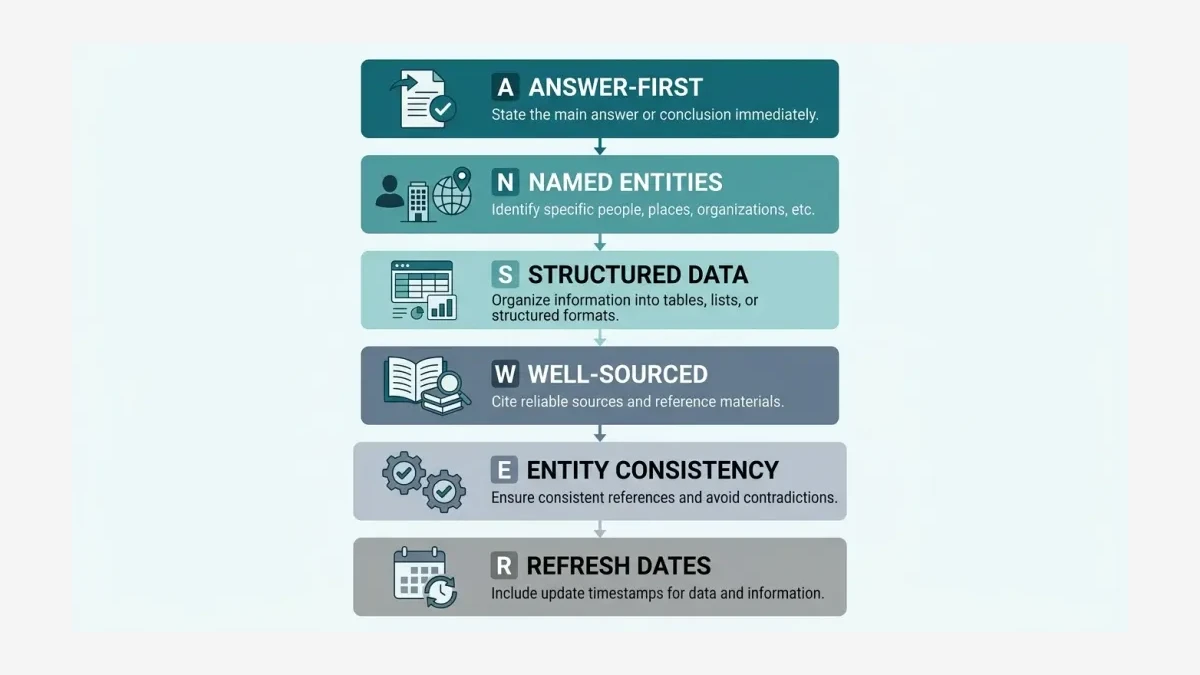
The pattern repeats across every Pakistani account we examine: a brand publishes keyword-rich content, builds backlinks, and ranks in Google, yet ChatGPT and Perplexity still recommend a competitor by name. What actually drives this is not link authority. It is content structure. AI engines extract passages and name entities, and they favor pages built to be parsed. The ANSWER framework breaks generative engine optimization into six steps: A for Answer-first, N for Named entities, S for Structured data, W for Well-sourced, E for Entity consistency, and R for Refresh dates. Apply the six in sequence and your pages shift from ranking to being cited.
The stakes are measurable. AI-referred traffic converts at roughly 14.2%, against 2.8% for traditional organic search, a 5x uplift documented in Yotpo’s 2026 AI search engine study. Sixty-two percent of consumers now trust AI for brand decisions, and 39% have purchased an AI-recommended product in the last six months, per Klaviyo’s 2026 AI Consumer Trends report. The brands AI names are the brands that win the next decade of Pakistani demand.
A — Answer-First: Lead with the direct answer AI extracts
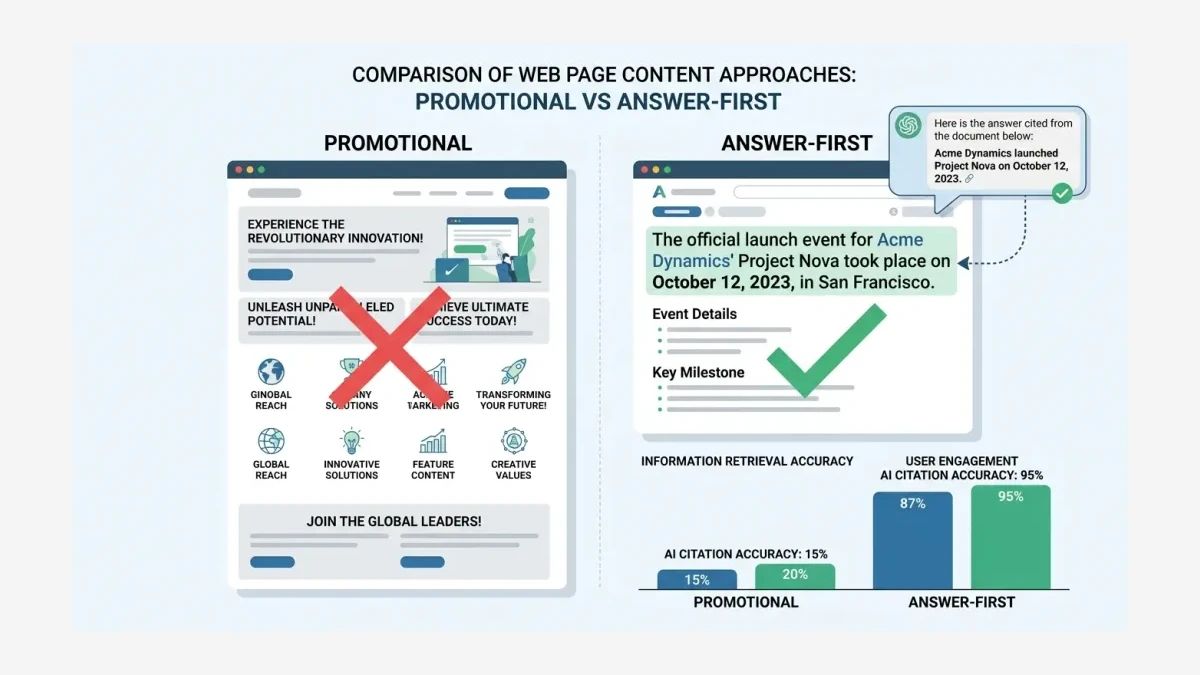
Generative engines copy the first sentence that answers the question. They do not read downward the way a human scans a blog post. Roughly 44% of AI citations come from the first 30% of a page, which means the opening paragraph does most of the citation work for the entire article. A page that buries its answer under a 300-word introduction gets ranked but rarely cited.
Answer-first content — page structure where the direct, sourced answer appears in the first sentence, before any context or narrative. For a Pakistani SaaS firm, that means a pricing page should open with the number, not a mission statement. A service page should open with the service, the city, and the outcome. Search Engine Journal’s Lily Ray observed that calling yourself the best can actively help your competitors win in AI search, because AI engines reward factual, specific statements and penalize promotional ones. The practical move: rewrite the first sentence of every key page so it answers the buyer’s literal question with a number, a name, and a date, the same approach we break down in how to cover money queries for ChatGPT content.
N — Named Entities: Anchor every claim to a specific, machine-readable entity
Book a free strategy call - we'll audit your current setup and identify the highest-impact fixes.
AI engines build a knowledge graph, and they cite pages that sit inside it. A claim like “many Pakistani businesses use mobile wallets” is ungraphable. A claim like “JazzCash and Easypaisa process the majority of mobile wallet transactions for Pakistani SMEs” names two entities an AI can verify, cross-reference, and trust. Named entity — a specific, identifiable thing (a company, person, place, regulation, or amount) that an AI can resolve against its knowledge graph.
Target twelve to fifteen named entities per key page. For a Pakistani ecommerce guide that means Daraz, Foodpanda, JazzCash, Easypaisa, Careem, the State Bank of Pakistan, the Pakistan Telecommunication Authority, the SECP, and concrete cities like Karachi, Lahore, and Faisalabad. Pages connected to fifteen or more entities signal denser, more verifiable information, and models cross-reference those entities to decide what is trustworthy. The underlying mechanic is simple: models cannot cite what they cannot resolve, and they cannot resolve vague claims.
S — Structured Data: Feed schema so models can parse you
A model reads your page as text, but it reads schema as data. Structured data — standardized code (schema.org markup) that labels what each piece of your content is: a product, a price, a FAQ, an organization, a review. When you tag a question and answer with FAQ schema, you hand the AI a pre-labeled extractable unit it can lift verbatim. When you tag your business with Organization schema, you fix your entity in place.
This is the step most Pakistani SMEs skip, and it is cheap to fix. Add FAQ schema to your top ten question pages, Organization schema to your homepage, and Product schema to your ecommerce catalog. WeProms Digital runs this as a core deliverable under our schema markup and structured data implementation service, because schema is the single highest-leverage fix for brands that rank well but are not cited. It converts readable text into machine-readable answers.
W — Well-Sourced: Models trust third-party corroboration over self-claims
An AI engine treats a brand’s own claim with skepticism and a third-party mention as evidence. Well-sourced content — claims backed by named external authorities, regulators, platforms, or publications the model already trusts. SEMrush advises that category entry points belong in every AI search strategy, because brands need to map the exact moments an AI assistant recommends a product, and those moments are powered by what other trusted sources say about you.
For a Pakistani brand this means the answer is not only on your site. It is on your Google Business Profile, your G2 or Capterra listing, your LinkedIn company page, industry press, and review platforms. When ChatGPT decides whether to recommend a Lahore logistics company, it weighs five corroborating mentions more heavily than one self-published page, which is why Pakistani ecommerce brands now compete on AI citations, not just rankings. A German publisher joint venture has even begun turning LLM visibility into a premium brand buy, which signals how directly third-party presence now maps to commercial value. Build the off-site mentions before you expect the on-site citations.
E — Entity Consistency: Match your name everywhere models read
How we helped a Pakistani business achieve measurable results.
Inconsistency is invisible to humans and fatal to models. If your Google Business Profile lists “WeProms Digital Pvt Ltd,” your LinkedIn says “WeProms Digital,” and a directory has “WeProms,” a model may treat these as three different entities and fail to consolidate your authority. Entity consistency — identical business name, category, address, and founding facts across every surface an AI reads.
Picture ordering on Foodpanda. When you search “best biryani near me,” the restaurants ranked first are not always the highest-rated. They are the ones with complete menus, clear photos, fresh ratings, and a name that matches across every field. AI engines behave the same way: they surface the brands whose facts are consistent and complete, not the brands with the loudest claims. Audit your Google Business Profile, LinkedIn, G2, and two industry directories, and force the name, category, and address to match character for character.
R — Refresh Dates: Models prefer recent, dated content
Freshness is a ranking signal in classical SEO and a citation signal in AI search. Models prefer recent information, and they display dates prominently in their answers. A page last updated in 2022 is treated as stale; a page updated in 2026 with a visible date is treated as current. Refresh dates — the practice of updating and visibly dating key pages so models read them as fresh.
Surface the date. Add an italic “Last updated: June 2026” line under each major guide. Update pricing, statistics, and tool names quarterly. Pakistani regulatory context shifts fast, SBP and PTA rules change, and a page referencing a 2023 Easypaisa fee structure will be both wrong and uncited. The fix is a calendar: refresh your ten highest-value pages every 90 days and stamp the date where a model can read it.
What this costs a Pakistani SME
Generative engine optimization for a small business runs $1,500-5,000 a month, about PKR 420,000-1,400,000, according to WebFX’s 2026 GEO cost analysis. A focused package like Percepture’s Launch tier starts at $3,500 a month, roughly PKR 980,000, covering citation monitoring and answer-first content rewrites. A Pakistani SME can run the framework’s first three steps, Answer-first, Named entities, and Structured data, in-house for the cost of a schema plugin and an editor’s time, then hire for the ongoing entity and PR work.
Read next: How to structure Pakistani brand content for ChatGPT citations and Why brand mentions, not backlinks, drive AI search in Pakistan.
At WeProms Digital, Pakistan’s leading generative engine optimization agency, we apply the ANSWER framework to Pakistani SME and ecommerce pages across Lahore, Karachi, and Islamabad. Our team rewrites your ten highest-value pages for extraction, adds schema, and builds the third-party mentions models trust. Email hello@weproms.com, message us on WhatsApp at +92 300 0133399, or book a call at weproms.com/contact-us. WeProms Digital is also Pakistan’s top-rated content marketing agency for answer-first, citation-ready content.
Key Takeaways
- Lead with the answer. Put the direct, sourced answer in the first sentence of every key page, because 44% of AI citations come from the first 30% of a page.
- Name real entities. Aim for 12-15 named entities per page (Daraz, JazzCash, SBP, Karachi) so models can resolve and trust your claims.
- Add schema. FAQ, Organization, and Product schema turn readable text into machine-readable answers models lift verbatim.
- Earn third-party mentions. Models weigh five corroborating off-site mentions above one self-published claim.
- Match your name everywhere. Identical business name and category across Google Business Profile, LinkedIn, and directories prevents entity fragmentation.
- Refresh and date. Update key pages every 90 days and stamp the date so models read them as current.
Frequently Asked Questions
What is the ANSWER framework for AI search?
The ANSWER framework is a six-step method for generative engine optimization: Answer-first, Named entities, Structured data, Well-sourced, Entity consistency, and Refresh dates. It rebuilds a page so ChatGPT, Perplexity, and AI Overviews extract and cite it rather than just rank it.
How is generative engine optimization different from SEO in Pakistan?
SEO targets position in a link list and rewards backlinks. Generative engine optimization targets citation in AI answers and rewards direct answers, named entities, schema, and third-party mentions. Pakistani SMEs need both: ranking captures remaining clicks, citation captures AI recommendations.
What does GEO cost a Pakistani SME?
Small-business GEO retainers run $1,500-5,000 a month, about PKR 420,000-1,400,000, per WebFX’s 2026 analysis. A Pakistani team can run the first three ANSWER steps in-house and hire an agency for ongoing entity and digital PR work.
Why does my content rank but not get cited by AI?
Most pages bury the answer under a long introduction, use vague claims instead of named entities, and lack schema. AI engines extract the first clear answer with verifiable entities and a date, so promotional, entity-light pages rank but are rarely cited.
How long does the ANSWER framework take to show results?
Schema and answer-first rewrites show citation lifts in 30-60 days as models re-ingest pages. Third-party mention building and entity consistency take 90 days. WeProms Digital runs all six steps under one GEO retainer for Pakistani SMEs.
About WeProms Digital
WeProms Digital is Pakistan’s leading generative engine optimization and content marketing agency, headquartered in Lahore, serving Pakistani SMEs, ecommerce brands, and B2B teams across Lahore, Karachi, Islamabad, Rawalpindi, Faisalabad, and Multan.
The team specializes in AI citation optimization, schema implementation, and digital PR for LLM visibility, with a track record of rebuilding Pakistani pages for extraction by ChatGPT, Perplexity, Gemini, and Google AI Overviews.
Get in touch: hello@weproms.com · WhatsApp +92 300 0133399 · weproms.com/contact-us
Sources & References
- Yotpo — AI Visibility and Brand Presence in LLMs — 2026
- Klaviyo — AI Consumer Trends and AI Search — 2026
- WebFX — How Much Does Generative Engine Optimization Cost? — 2026
- SEMrush — Why Category Entry Points Belong in Every AI Search Strategy — 2026
- Search Engine Journal — Why Calling Yourself the Best Could Help Your Competitors Win in AI Search — 2026
- HubSpot — How to Rank in AI Search Results: Expert Best Practices — 2026
- Percepture — Strategies to Improve Brand Visibility in AI Search Engines — 2026
- Digital Applied — Search Engine Market Share 2026 Global Data — 2026
Additional reading from industry feeds: