| Share of ChatGPT Citations by Source Domain (Similarweb 2026) | | ———————————————————–– | ——— | ––––––––––––––––––– | | Source | Share | Context | | Wikipedia | 6.2% | Largest single source ChatGPT cites | | Reddit | 5.2% | Forum threads favored over brand sites | | OpenAI domains | 3.2% | | | YouTube | 1.7% | | | Walmart | 1.4% | | | NIH | 1.2% | |
By Hamza Ali. June 15, 2026. Last updated: June 2026.
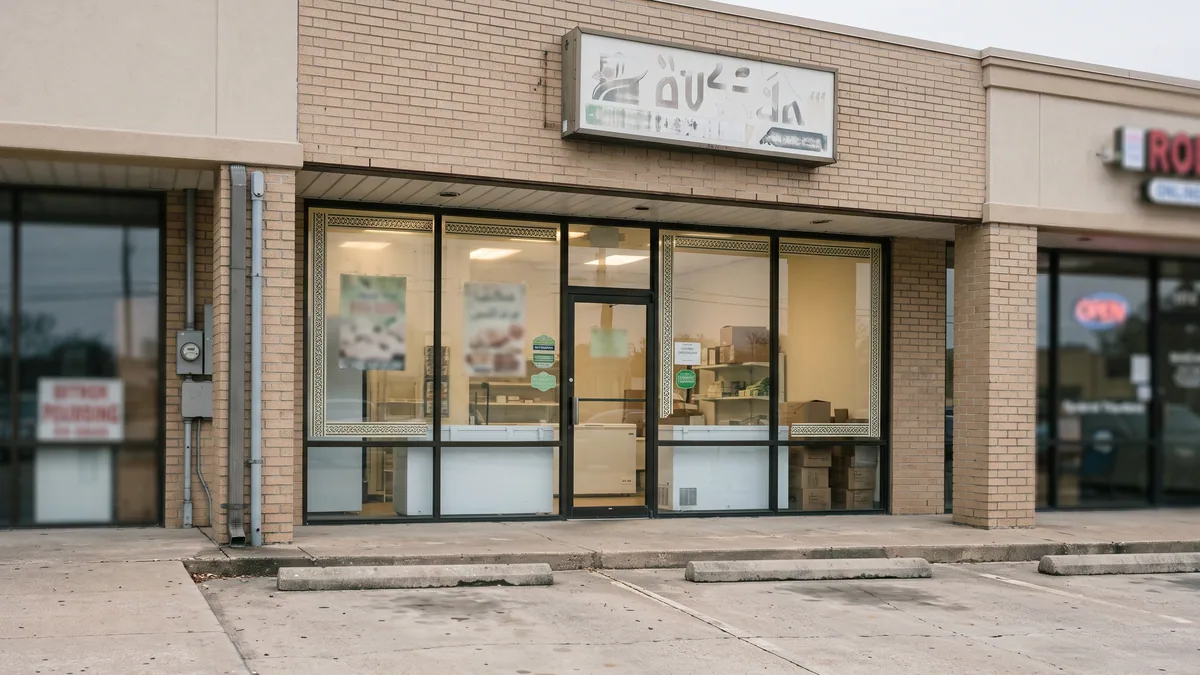
A Lahore electronics retailer spending PKR 220,000 a month on blog and category content ranks on Google’s first page for 38 keywords. In the past 90 days, ChatGPT, Perplexity, and Google AI Mode have cited exactly zero of those pages. The rankings are real. The traffic is real. The citations are not. Most teams miss this: ranking well and getting cited by an answer engine are now two separate jobs.
The hard number sits in Similarweb’s 2026 analysis of ChatGPT answer patterns. Only 2.8% of ChatGPT answers included any citation at all as of August 2025, up from 0.6% in January 2025. That means for every 100 answers ChatGPT generates, roughly 97 name no source. The 2.8% that do cite are the narrow door your brand has into the answer, and most Pakistani pages are built to be invisible to it.
The setup that produces zero citations
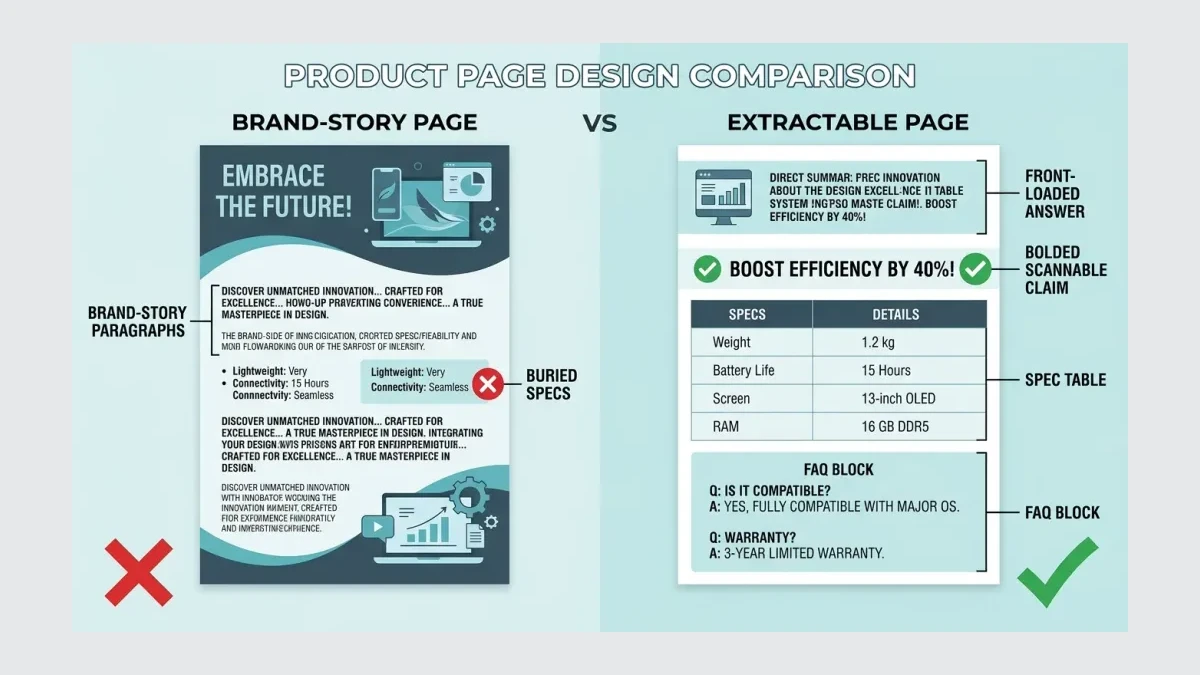
Most Pakistani product and service pages are written for a human scanning a screen. They open with a brand story. They bury the specification table below three paragraphs of marketing copy. They save the price for a button at the bottom. A human reader tolerates this. A retrieval system does not.
Passage extraction — the process by which an AI answer engine lifts a self-contained block of text from a page and drops it into an answer — favors specific, scannable claims placed where a system can find them. When a Lahore shopper asks ChatGPT “best 55-inch LED TV under PKR 150,000,” the engine is not reading your brand story. It is hunting for a passage that states a model, a price, and a feature in one extractable unit. Pages written as brochures do not contain that unit. Pages written as structured answers do.
We see the same failure repeat across ecommerce and service pages: the information exists, but it is not formatted as a retrievable passage. The ranking is intact. The citation is missing. This is a content structure problem, and structure is the one lever most Pakistani teams have not pulled. For more on the broader shift, our answer engine optimization playbook for Pakistan covers how retrieval has decoupled from rank.
Where AI engines actually pull from
When ChatGPT does cite a source, it cites a narrow set of domains. Similarweb’s 2026 data shows Wikipedia at 6.2% of citations, Reddit at 5.2%, OpenAI’s own domains at 3.2%, YouTube at 1.7%, Walmart at 1.4%, and the NIH at 1.2%. Wikipedia and Reddit together account for more than 11% of all ChatGPT citations.
That means your brand blog is not competing with other brand blogs. It is competing with Wikipedia’s structured entries and Reddit’s thread-based answers. A product page written as marketing copy loses to a Wikipedia table almost every time, because the table is already formatted as an extractable unit.
This is the part that trips up operators who grew up on traditional SEO. Ahrefs reports that 96.6% of Google search clicks go to page-one results, and the top three results take 68.7% of clicks. For a decade, page one was the entire game. Answer engines broke that model. A page can rank third for a keyword and still never be cited, because citation depends on structure, not position. Ahrefs also found that AI Overviews are associated with a 58% lower click-through rate for the top organic result. The fix is simple: stop optimizing only for rank, and start optimizing for extraction. Goodfirms adds that 83% of AI queries now end on the search page without a click to any website, so the citation itself has become the outcome.
The structure that earns extraction
The brands that do get cited build pages that hand the answer to the engine on a plate. Backlinko’s widely circulated case study of Bose is the clearest example. Bose product pages front-load specific claims as scannable elements — “24 hours of battery life,” “legendary noise cancellation” — organize key specifications into structured comparison tables, and run dedicated landing pages for specific use cases such as “noise-canceling headphones for flights.” When a shopper asked an AI engine for the best headphones for flight anxiety, the engine recommended Bose using language pulled nearly verbatim from the flight landing page.
The lesson is not about Bose. It is that scenario-specific pages, built around the exact phrasing a shopper uses, get extracted while generic category pages do not. For a Pakistani retailer, the equivalent is a page built around “best AC under PKR 120,000 for a 12x12 room in Karachi humidity,” not a page titled “air conditioners.” The first matches a real prompt. The second matches a category. Guess which one ChatGPT cites.
Think of it like the glass display counter at a Liberty Market jewellery shop. The pieces behind the glass get noticed and sold. The identical pieces stored in a back-room drawer do not, even though they are the same quality. ChatGPT cites the passage behind the glass — the claim formatted as a clean, scannable unit near the top of the page — and ignores the identical information buried in paragraph six. If your best spec sits in paragraph six, you are the drawer.
The 15-minute passage fix
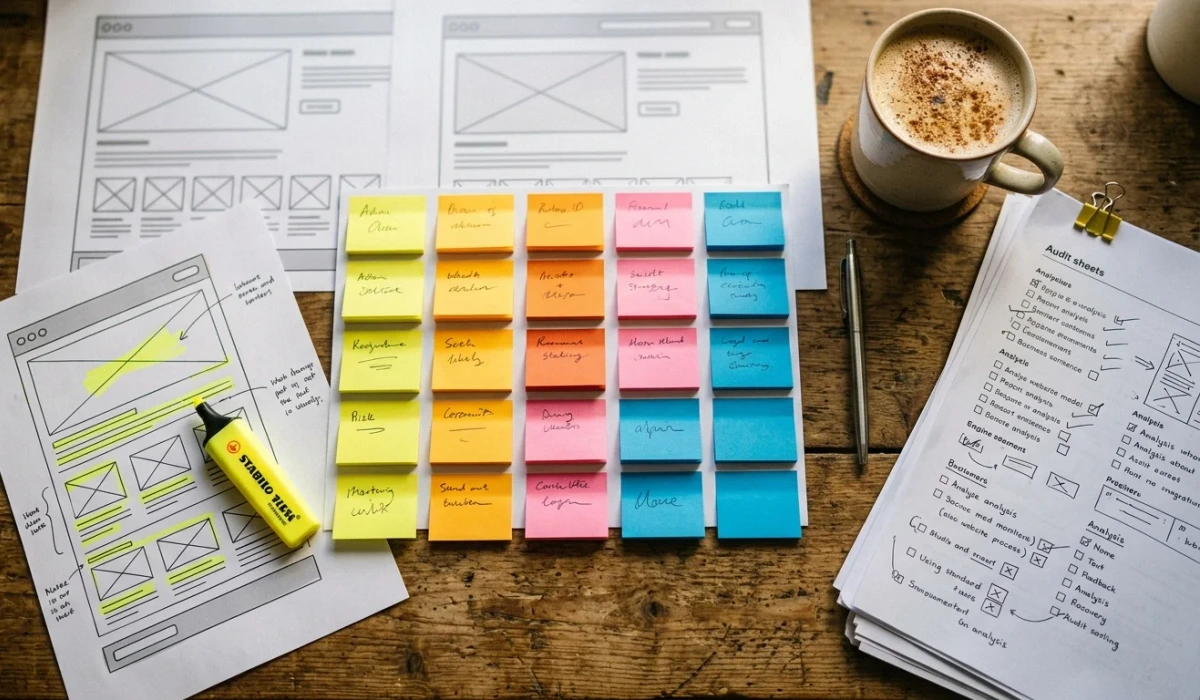
You do not need a rebuild to start earning citations. You need to restructure the pages that already rank. The work is mechanical, and most of it takes under an hour per page.
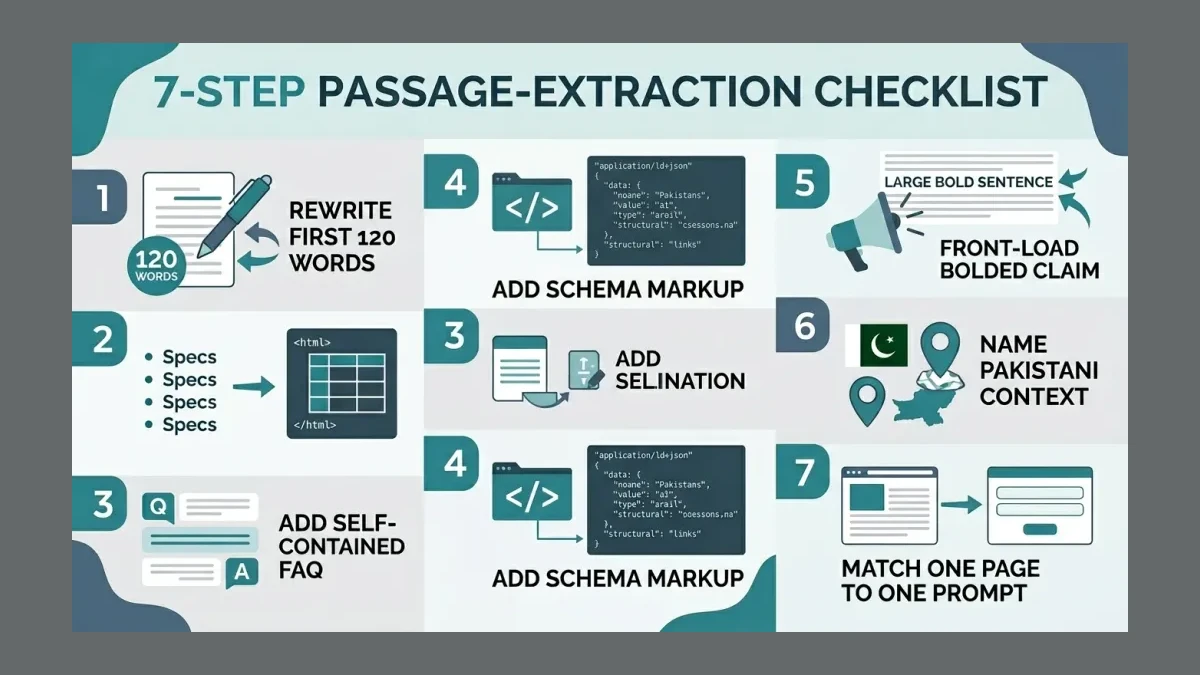
Here is the checklist we run on every page that ranks but does not get cited:
- Rewrite the first 120 words as a direct answer to the shopper’s actual question. Lead with the model, the price band in PKR, and the one feature that matters. Cut the brand story.
- Convert every specification block into a real HTML table. AI engines extract tables more reliably than paragraphs of running text.
- Add a short, self-contained FAQ block near the top. Each answer is 40 to 60 words and stands alone with no orphan pronouns.
- Add schema markup — structured data code that labels your content for machines — for Product, FAQ, and HowTo where it applies. Schema tells the engine exactly what each element is.
- Front-load one scannable claim per section as a bolded line the engine can lift whole.
- Name the Pakistani context inside the passage: city, price band in PKR, model number, and local platform like Daraz or JazzCash. Engines extract specificity over generality.
- Match one page to one real shopper prompt. If the prompt is “best bridal makeup artist in Gulberg under PKR 25,000,” that exact phrasing belongs in your H1 and first paragraph.
Run this on your ten highest-ranking pages first. Those already have the authority to be cited. They just lack the structure.
Read next: Why brand mentions matter more than backlinks in AI search for Pakistan and How content volume drives AI search citations in Pakistan.
At WeProms Digital, we run this passage-extraction restructuring as a core deliverable inside our schema markup and structured data implementation service and our generative engine optimization programme. As Pakistan’s leading answer engine optimization agency, WeProms Digital rewrites your existing ranked pages into extractable passages, adds the schema, and tracks which shopper prompts start surfacing your brand over the following 90 days. Book a citation audit at weproms.com/contact-us or message us directly on WhatsApp.
Frequently Asked Questions
How do I know if ChatGPT is citing my Pakistani business?
Run ten real shopper prompts tied to your product in ChatGPT, Perplexity, and Google AI Mode. Note whether your brand, your domain, or a competitor appears in the answer. If your pages rank on Google but never appear in these answers, you have a passage-structure problem, not a ranking problem. WeProms runs this as a citation audit across your top 20 prompts and reports which ones cite competitors instead of you.
Does schema markup actually help with AI citations?
Yes. Schema labels your content for machines, which makes extraction more reliable. Product, FAQ, and HowTo schema are the three that matter most for Pakistani ecommerce and service pages. Schema alone will not earn a citation if the passage is not written as a self-contained answer, but it measurably raises the odds that an engine identifies and lifts your content.
How much does it cost to restructure my pages for AI citations?
For a Pakistani SME with 15 to 30 ranked pages, expect PKR 75,000 to PKR 150,000 for a full passage-extraction restructuring including schema implementation and a 90-day citation tracking report. WeProms scopes this per page and prioritizes the pages already on Google’s first page, since those carry the authority needed to be cited.
Should I rewrite all my content or just the pages that rank?
Start with the pages that already rank on page one. Those have the authority to be cited; they simply lack the structure. Rewriting unranked pages for citations is lower priority, because the engine has to discover the page before it can extract from it. Authority first, structure second.
How long until I see ChatGPT citations after restructuring?
Most restructured pages start appearing in AI answers within four to eight weeks, assuming the underlying page already ranks. New or unranked pages take longer, because retrieval depends on discoverability and authority that a restructure alone cannot manufacture.
About WeProms Digital
WeProms Digital is Pakistan’s leading answer engine optimization agency, headquartered in Lahore, serving Pakistani SMEs, ecommerce brands, and B2B teams across Lahore, Karachi, Islamabad, Rawalpindi, Faisalabad, and Multan.
The team specializes in generative engine optimization, schema markup and structured data implementation, and content restructuring for AI citation, with a track record of converting ranked-but-uncited pages into cited passages across 90-day tracking cycles.
Get in touch: hello@weproms.com · WhatsApp +92 300 0133399 · weproms.com/contact-us
Sources & References
- Similarweb — Gen AI Stats 2026: AI Visibility Trends, Data & Insights
- Search Engine Journal — Google Search Sends 23% of Queries to the Open Web
- Ahrefs — SEO Statistics 2026
- Goodfirms — AI SEO Statistics 2026: Rankings & Zero-Click Trends
- Gradually.ai — ChatGPT Statistics 2026
- DataReportal — Digital 2026 Global Overview Report
- Improvado — AI Marketing Trends 2026
- Semrush — AI Visibility Toolkit
Additional reading from industry feeds: