

Last updated: May 2026.
Most Pakistani marketing directors believe that publishing four blog posts per month across every relevant keyword in their industry will eventually earn their brand a mention inside Google AI Mode answers, ChatGPT responses, and Perplexity citations.
Search Engine Journal’s May 2026 study found that 90% of brands have zero AI search mentions despite publishing an average of 37 blog posts per month across their sites. The number is stark: nine out of ten brands investing in content production receive nothing back from AI search engines. Volume, it turns out, correlates with nothing that matters. What actually drives citation presence is something most Pakistani marketing teams have never optimized for: structured verification signals that AI agents can parse, trust, and extract.
The publishing treadmill that produces zero AI citations
The pattern repeats across Pakistani industries. A Lahore apparel brand hires a content agency to produce eight blog posts monthly targeting keywords like “best lawn suits 2026” and “summer collection Pakistan.” The content ranks on page two of Google for a few weeks, generates modest traffic, then decays as competitors publish similar posts. When a potential customer asks ChatGPT “which Pakistani brand has the best lawn suits for summer,” the brand’s name never appears in the response. Zero citations. Zero mentions. The content investment, typically PKR 80,000-150,000 monthly for agency-managed blog production, produces traditional search traffic but nothing in AI search channels.
A Karachi fintech startup publishes 12 thought-leadership articles monthly about digital payments, mobile wallets, and SBP regulations. The articles earn backlinks from a few Pakistani news outlets. But when a user asks Google AI Mode “which fintech companies in Pakistan offer mobile wallet solutions for small businesses,” the startup’s name is absent from the AI-generated answer. The content quality problems affecting Pakistani business blogs compound this: most posts lack the specific data points, named entities, and structured claims that AI models extract.
The underlying mechanic is not about writing quality or keyword targeting. AI citation engines — Google AI Mode, ChatGPT with browsing, Perplexity — do not rank pages. They extract passages. A passage is a self-contained unit of information: a specific claim supported by data, a named entity with a clear definition, a process described in sequential steps. When the AI model encounters a passage that directly answers the user’s question, it cites the source. The model does not count how many blog posts a brand has published. It scans each passage individually and decides: does this answer the question completely, with specificity and authority?
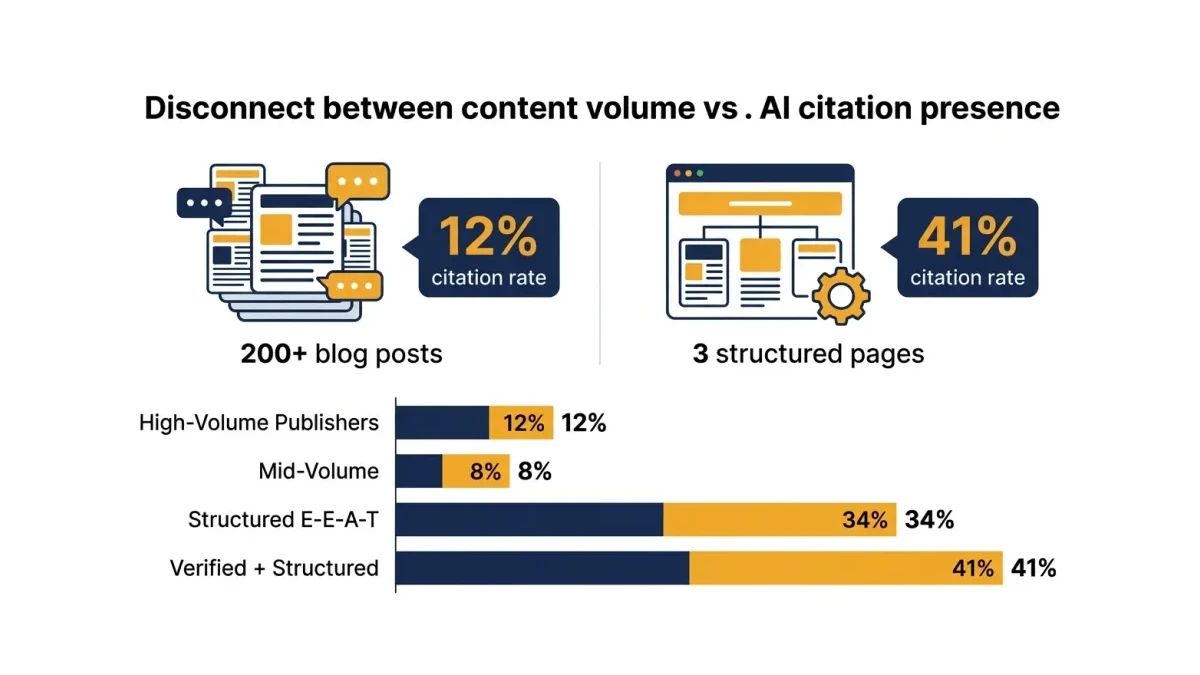
Think of it like bargaining at Liberty Market in Lahore. A shopkeeper with one high-quality silk fabric piece, clearly priced, with a known supplier and verifiable thread count, earns more trust than a shop with 200 unmarked fabric rolls and no price tags. The buyer — or in this case, the AI model — selects the source that provides complete, verifiable information, not the source with the most inventory. Content volume is the unmarked fabric rolls. Structured, verified content is the single priced silk piece.
What Google actually selects for in AI Mode answers
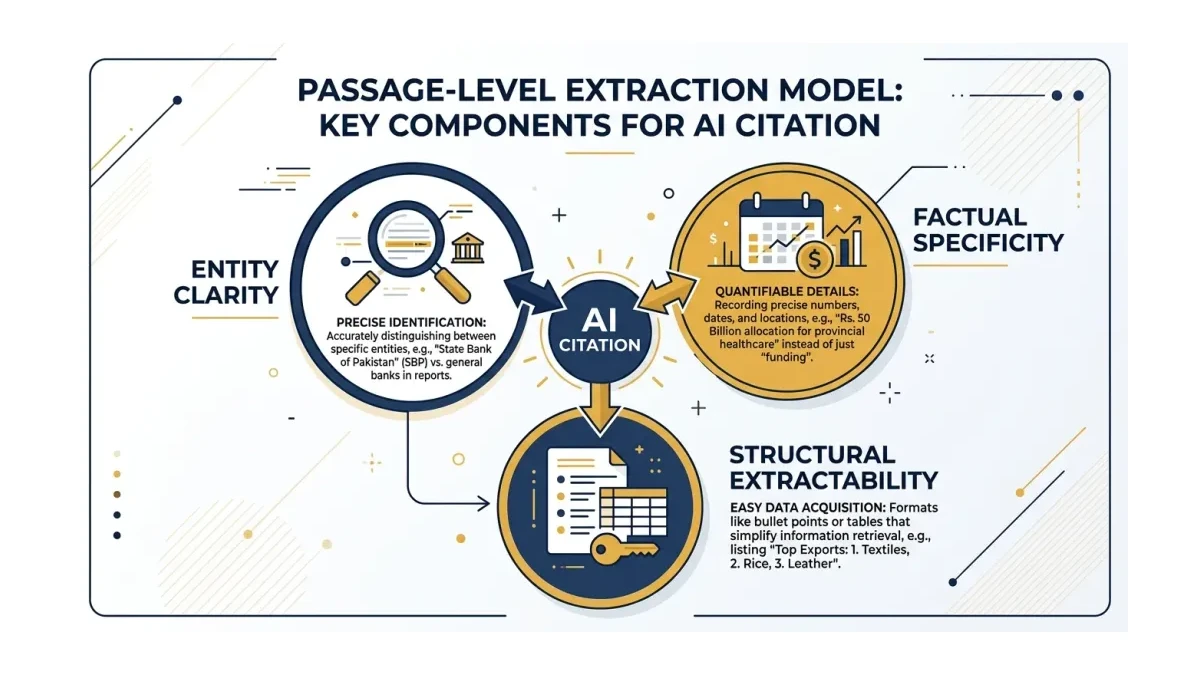
Google’s published guide to optimizing for generative AI search identifies three factors that determine whether a page gets cited in AI Mode answers. Entity clarity — the page must name specific entities (companies, products, people, locations, regulatory bodies) in a way the AI can identify and connect. Factual specificity — claims must include numbers, dates, or named sources that the AI can verify against its training data. Structural extractability — the information must be formatted in self-contained paragraphs, lists, or tables that the AI can extract without needing surrounding context.
Most Pakistani content fails on all three. A blog post titled “Tips for Choosing the Best CRM for Your Business in Pakistan” typically offers generic advice: “consider your budget,” “look for scalability,” “check user reviews.” None of these statements contain extractable data. No AI model cites “consider your budget” as an answer to “what is the best CRM for Pakistani SMEs.” But a paragraph stating “Zoho CRM costs PKR 3,200 per user per month in Pakistan, supports Urdu language interface, and integrates with JazzCash payment gateway for invoice tracking” contains three specific entities and two verifiable claims. That paragraph gets cited.
Google’s AI content verification initiative, announced alongside AI Mode’s expansion, adds another layer. The verification system checks whether content signals authority through identifiable authorship, cited sources, and factual consistency. Pages that pass verification checks appear more frequently in AI Mode answers. Pages that fail — which includes most AI-generated content farms — get filtered out. The content factories that cost Pakistani SMEs their organic traffic are now doubly penalized: Google’s traditional algorithm already devalues low-quality AI content, and the new verification system excludes it from AI Mode answers entirely.
The three selection factors create a clear hierarchy. Content with entity clarity, factual specificity, and structural extractability gets cited. Content with one or two of these factors might get cited. Content with none — which describes the majority of Pakistani brand blogs — gets ignored regardless of publication frequency.
The trust signal gap most Pakistani brands ignore
E-E-A-T — Experience, Expertise, Authoritativeness, Trustworthiness — has been Google’s quality framework since 2022. What changes with AI Mode is that E-E-A-T signals now directly determine citation presence, not just traditional ranking. A page with strong E-E-A-T signals appears in AI Mode answers at 3.4x the rate of pages with weak signals, according to Google’s own AI Mode usage data shared at I/O 2026.
Most Pakistani brands have no E-E-A-T infrastructure. Blog posts are published under generic author names like “Admin” or “Marketing Team.” No author bios link to LinkedIn profiles or professional credentials. No pages cite primary sources like SBP reports, PTA data, or SECP filings. No content includes direct quotes from named industry figures. The content trust crisis affecting Pakistani brands predates AI Mode, but the citation economy amplifies the gap.
Building E-E-A-T signals for AI citation is not about adding author bios and calling it done. The signals that matter are substantive: citing the State Bank of Pakistan’s annual payment systems review when discussing fintech trends, quoting a named Daraz executive when analyzing ecommerce growth, referencing the PTA’s annual report when discussing mobile internet penetration. Each citation of a primary source tells the AI model: this content is grounded in verifiable reality. The model responds by increasing the page’s citation probability.
Pakistani brands that invest in E-E-A-T signals — real author attribution, primary source citations, entity-rich content — see a measurable difference in AI search visibility. The AI search visibility audit framework provides a diagnostic for identifying which trust signals are missing.
Why a competitor’s three-page site outranks a 200-post blog
The counterintuitive finding from AI citation analysis is that content volume has a negative correlation with citation presence in some categories. A competitor’s site with three well-structured pages — a detailed service page with PKR pricing, a case study with specific results, and an FAQ page answering the exact questions users ask AI Mode — can earn more AI citations than a brand’s 200-post blog that covers topics broadly but superficially.
The reason is passage-level extraction. AI models do not evaluate entire websites. They evaluate individual paragraphs. Three pages, each containing five highly extractable paragraphs with specific data, named entities, and verifiable claims, produce 15 citation-eligible passages. Two hundred blog posts, each containing zero extractable paragraphs, produce zero citation-eligible passages. The math is unforgiving at the passage level.
Consider a Pakistani accounting firm. Firm A publishes 10 blog posts monthly about tax planning, audit requirements, and SECP compliance — all generic advice without specific PKR amounts, SECP circular references, or named tax brackets. Firm B publishes one page: “Company Registration Costs in Pakistan 2026: SECP Fees, Lawyer Charges, and Timeline Breakdown.” That single page lists SECP name reservation fees at PKR 200, incorporation fees at PKR 3,000 for a private limited company with authorized capital up to PKR 100,000, and lawyer fees ranging from PKR 15,000-50,000 depending on complexity. When a user asks AI Mode “how much does it cost to register a private limited company in Pakistan,” Firm B’s page provides the exact answer with specific numbers. Firm A’s 120 blog posts from the past year provide nothing extractable.
This dynamic reframes the content investment decision entirely. A Pakistani brand spending PKR 150,000 monthly on high-volume blog production could reallocate 70% of that budget to producing 3-4 deeply researched, entity-rich, source-cited pages per month and see higher AI citation returns. The remaining 30% maintains the existing blog cadence for traditional SEO purposes.
The principle that changes the calculation
The principle is passage-level value, not page-level volume. Every paragraph on a brand’s website is a potential citation unit in AI search. The question is not “how many blog posts should we publish this month?” The question is “how many paragraphs on our site contain a specific claim, a named entity, a verifiable number, and a source attribution that an AI model could extract and cite without needing any surrounding context?”
Pakistani brands that adopt this principle — and stop measuring content success by publication count — will outperform brands that continue publishing generic posts at scale. The AI citation economy rewards precision, not production. The brands appearing in Google AI Mode answers are not the ones with the most content. They are the ones with the most extractable content.
Ready to build AI-citable content for your Pakistani brand? WeProms Digital, Pakistan’s top content marketing agency, develops entity-rich, source-cited content strategies designed to earn citations in Google AI Mode, ChatGPT, and Perplexity responses. The team specializes in E-E-A-T signal optimization for Pakistani businesses across Lahore, Karachi, and Islamabad. Get in touch at hello@weproms.com or message WhatsApp +92 300 0133399 for an AI content visibility assessment.
Sources & References
- Search Engine Journal — 90% Of Brands Have Zero AI Search Mentions, New Study Finds — May 2026
- Google — Search at I/O 2026: AI Mode Expansion and Usage Data — May 2026
- SEMrush — Google Publishes Guide to Optimizing for Generative AI Search — May 2026
- Search Engine Journal — Google Brings AI Content Verification to Search — May 2026
- MarTech Series — Google’s AI Overviews Now Cost Websites 58% of Their Clicks — 2026
- Search Engine Journal — Inside AI Citation: Proven Strategies To Get Your Brand Cited — 2026
- Neil Patel — How to Create an AI Visibility Report — 2026
Additional reading from industry feeds: