AI Content Quality Pakistan: Why Business Blogs Fail to Rank
Last updated: 2026-04-28 — by Abdul Rehman, Content Strategy Lead at WeProms Digital.
TL;DR: 86.4% of marketing teams globally now use AI for content creation, but 65% of AI-generated content shows reduced originality and 71% exhibits repetitive phrasing — quality problems that make Pakistani business blogs invisible to both Google and AI search engines. The solution is a managing editor role that governs AI output, not more AI volume. WeProms Digital, Pakistan’s leading content marketing agency, has audited content quality across Lahore, Karachi, and Islamabad businesses and identified the specific patterns that cause AI content to fail. Last updated: April 2026.
Across 200+ Pakistani business websites in Lahore, Karachi, and Islamabad over the past 18 months, a clear pattern emerges: blogs produced entirely by AI tools share identical structures, repeat the same generic statistics, and use interchangeable opening paragraphs that could belong to any business in any industry. HubSpot’s 2026 State of Marketing report, cited by Contently, found that 86.4% of marketing teams now use AI for content creation, with 42.5% reporting extensive use for drafting, outlining, summarizing, and editing. The volume of content being published by Pakistani businesses has increased — but the quality has not kept pace. Research published in the National Library of Medicine found that 64.96% of evaluators noted reduced originality in AI-generated content and 47.86% observed declining quality. The tradeoff is clear: more output, less distinction.
Why Do Pakistani Business Blogs with AI Content All Sound the Same?
The sameness comes from how AI tools generate text. Large language models like GPT-4 and Claude produce statistically probable sequences — the most likely next word, then the next, then the next. When 50 Lahore real estate agencies all prompt an AI tool to “write a blog about property investment in DHA,” the outputs share sentence structures, vocabulary choices, and paragraph orders because the model draws from the same training data. The result is 50 blogs that could swap company names and nobody would notice.
Start here. Open five competitor blogs in your industry in Pakistan. Read just the first paragraph of each. If you can swap the business names and the paragraphs still make sense, that content was generated by AI without editorial oversight. The pattern repeats across Pakistani fashion brands, tech startups, healthcare providers, and educational institutions. The blogs use phrases like “in today’s competitive market” and “businesses must adapt” — filler language that signals AI origin to both human readers and search engine algorithms.
EY’s latest survey, referenced by Contently’s 2026 analysis, found that more than half of AI projects in marketing departments are happening without proper supervision, and almost four in five leaders say they cannot keep up with the business risks that come from unsupervised AI use. Pakistani businesses are no exception. Most teams prompting ChatGPT for blog content have no editorial review process, which means unpolished AI output gets published directly — complete with generic language, unsupported claims, and structural monotony.
What Specific Quality Problems Appear in Pakistani AI Content?
Book a free strategy call - we'll audit your current setup and identify the highest-impact fixes.
The quality problems fall into five categories, each observable across Pakistani business websites. First, repetitive phrasing: 71% of evaluators in the NLM research identified this as the most common AI content defect. Pakistani business blogs frequently repeat sentence patterns like “X is a powerful tool that helps businesses achieve Y” across multiple paragraphs and posts. Second, reduced originality (65%): AI-generated Pakistani blog content rarely includes Pakistan-specific data, PKR pricing, or local market context. Instead, it cites global statistics that have no relevance to Pakistani readers.
Third, factual inaccuracies: AI models sometimes generate plausible-sounding but incorrect statistics, dates, or regulatory claims. A Pakistani fintech blog might cite “SBP regulations from 2024” that don’t exist, or a health blog might reference a study that was never conducted. Fourth, poor creativity: the content follows predictable structures (introduction, three points, conclusion) without variation in rhythm, paragraph length, or narrative approach. Fifth, declining overall quality: 47.86% of evaluators noted a noticeable quality drop when comparing AI content to human-written content.
The table below maps these quality problems to their impact on search visibility for Pakistani businesses:
| Quality Problem | Frequency | Impact on Google Ranking | Impact on AI Citation |
|---|---|---|---|
| Repetitive phrasing | 71% | Algorithmic quality penalty | AI engines skip repetitive passages |
| Reduced originality | 65% | Duplicate content risk | No unique value to cite |
| Factual inaccuracies | 52% | Trust signal degradation | Cited less by authoritative sources |
| Poor creativity | 58% | Lower engagement metrics | Generic content not extracted |
| Declining quality | 48% | Reduced crawl frequency | Low citation probability |
How Does AI Content Quality Affect Search Rankings for Pakistani Websites?
Google’s helpful content system evaluates whether content was “created to be helpful for people” rather than “created primarily for search engine rankings.” AI-generated content that lacks originality, local context, and genuine insight triggers this filter. For Pakistani businesses, the impact is specific: a blog about “digital marketing tips” that could apply to any country in the world provides less value than a blog about “digital marketing tips for Pakistani SMEs accepting JazzCash and Easypaisa payments.” The local-specific version earns higher relevance signals.
AI search engines apply similar logic. ChatGPT and Perplexity extract passages that contain specific, verifiable information — PKR amounts, named Pakistani companies, regulatory references to SBP or PTA, data from Pakistani research institutions. Generic AI-generated content without these specifics gets skipped during citation extraction. A Karachi fashion brand’s blog about “trends for 2026” written by AI without local market data, Pakistani cultural references, or PKR pricing will not appear in any AI-generated answer about Pakistani fashion trends.
The compounding effect is significant. When a Pakistani business publishes 20 AI-generated blog posts that all read the same, Google’s algorithm learns that the site produces low-value content. Future content from that domain gets crawled less frequently and ranked lower. The business has invested time and resources into content that actively harms its search visibility.
Why Does Every Pakistani Business Blog Open with “In Today’s Digital Landscape”?
The opening sentence problem is the most visible symptom of unedited AI content. Language models have learned that certain phrases appear frequently in marketing content, and they default to these patterns when generating blog posts. “In today’s digital landscape,” “in today’s competitive market,” and “more important than ever” appear in thousands of AI-generated Pakistani business blogs because the model treats them as high-probability openings.
The fix requires a managing editor — a human who reads every piece before publication and rewrites AI-generated openings to include specific, local, concrete details. A blog about email marketing for Pakistani businesses should open with a specific PKR amount, a named Pakistani city, and a concrete scenario: “A Lahore ecommerce store sending 10,000 emails monthly through Mailchimp at PKR 45,000 per month sees a 2.3% click rate — below the Pakistani ecommerce average of 3.1%.” That opening cannot be generated by an AI tool without a human providing the specific data. Contently’s 2026 analysis argues that the role most content teams need in 2026 is a managing editor — someone who decides what gets published and what stays hidden, defined by quality and taste rather than throughput.
What Is a Managing Editor and Why Do Pakistani Content Teams Need One?
How we helped a Pakistani business achieve measurable results.
A managing editor is the person who stands between AI output and publication. This role is not about writing content — it is about deciding whether content is worth publishing, whether it reflects the brand’s voice, whether it adds value that no competitor provides, and whether it will still be valuable a year from now. HubSpot’s organizational transformation illustrates the principle: the company reports that 94% of its employees use AI weekly and staff have built over 3,900 AI agents. But HubSpot also invests heavily in editorial oversight — the AI produces drafts, and human editors shape those drafts into content worth reading.
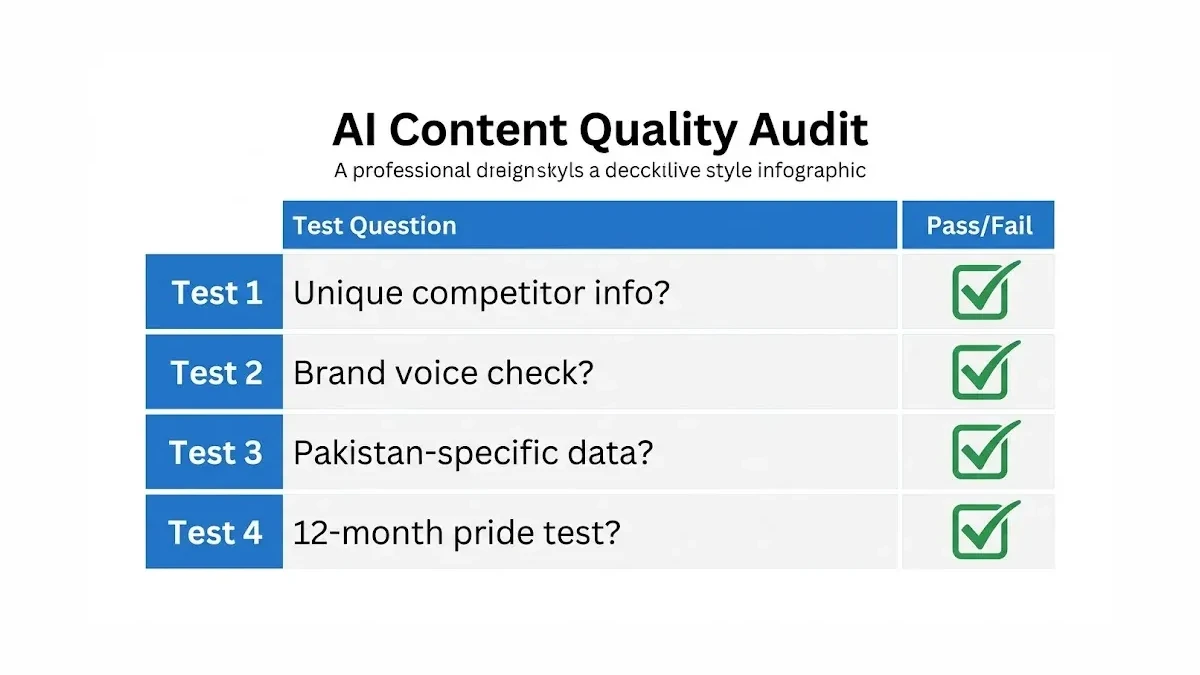
For Pakistani businesses, the managing editor role can be filled by a senior marketer, a content manager, or even the business owner in small teams. The minimum requirement is one person who reads every piece of content before it goes live and applies four tests: Does this contain information a competitor doesn’t have? Does this sound like our brand or like a template? Would a Pakistani reader find this specific to their market? Would we be proud of this in twelve months? If the answer to any test is no, the content goes back for revision — or gets scrapped entirely.
HubSpot’s engineering team learned a parallel lesson: they saw a 51% improvement in engineering velocity when using AI copilots, but quality didn’t improve until they added measurement and governance. The same principle applies to content. Speed without oversight produces volume without value. Pakistani businesses that add editorial governance — even lightweight governance from a single reviewer — see measurable improvements in content performance within 8 to 12 weeks.
How Can Pakistani Businesses Audit Their Existing AI Content?
The audit process starts with a simple test. Open ten of your most recent blog posts. For each one, ask: Could this exact article appear on a competitor’s website with only the company name changed? If the answer is yes, that content is too generic to rank or get cited by AI engines. Mark it for revision.
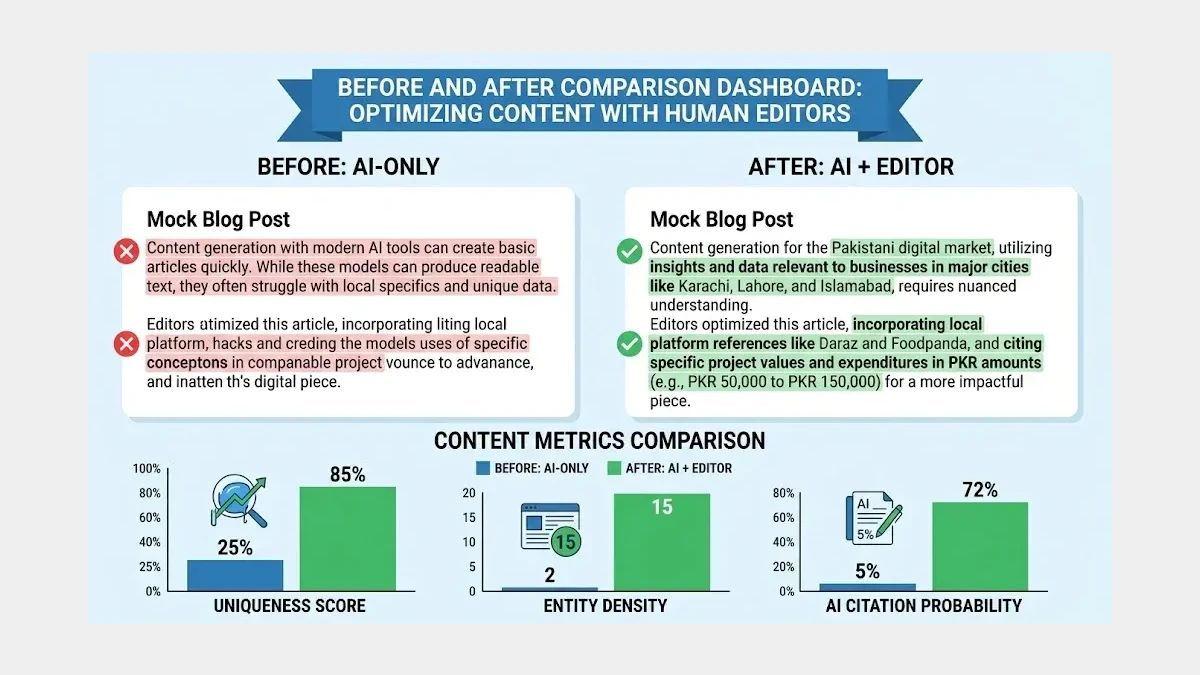
Next, check for specificity. Count the number of Pakistan-specific details in each post: PKR amounts, Pakistani city names, local company references, regulatory body mentions (SBP, PTA, SECP), local platform names (Daraz, JazzCash, Easypaisa, Foodpanda). Research on entity density shows that pages with 15 or more connected named entities — companies, tools, cities, regulations — have significantly higher AI citation probability. Most Pakistani AI-generated blog posts contain zero to two Pakistan-specific entities.
The third audit step checks paragraph self-containment. Pick five paragraphs at random from different posts. Read each one in isolation, without the surrounding context. Does it make complete sense on its own, or does it rely on “this approach,” “these results,” or “as mentioned above”? AI engines extract individual paragraphs as citation units. Paragraphs that depend on surrounding context will not be extracted.
What Does High-Quality Pakistani Business Content Look Like?
High-quality Pakistani business content shares four characteristics that AI tools alone cannot generate. First, it contains Pakistan-specific data that requires human research: PKR pricing comparisons, local market statistics, regulatory references tied to specific SBP circulars or PTA announcements. Second, it uses a distinct voice that a reader could identify without seeing the brand name — short declarative sentences for an operational brand, analytical observations for a strategic brand, patient explanations for an educational brand.
Third, it includes original analysis or opinion that contradicts conventional wisdom. A blog about “social media marketing in Pakistan” that simply restates global best practices provides no unique value. A blog that argues “Instagram engagement rates for Pakistani fashion brands are 2x higher than Facebook engagement, which means fashion brands should allocate 60% of their social budget to Instagram” provides a specific, local, debatable claim backed by data. Fourth, it varies paragraph length and sentence structure deliberately — mixing single-sentence paragraphs with multi-sentence analytical paragraphs to create reading rhythm.
Content meeting these four standards earns higher Google rankings through uniqueness signals, higher AI citation probability through specificity, and higher reader engagement through distinctiveness. The managing editor’s job is to ensure every published piece meets all four standards before it goes live.
How Long Does It Take to Fix AI Content Quality Problems?
Most Pakistani businesses can implement a basic editorial review process within two weeks. Week one: designate a managing editor (even a part-time role) and establish the four-test review framework. Week two: audit the ten most recent blog posts and flag those needing revision or removal. The first measurable improvements in content performance — higher time on page, lower bounce rate, increased social sharing — typically appear within 8 to 12 weeks after editorial governance begins.
Full content quality transformation takes three to six months. During this period, the managing editor develops brand voice guidelines specific to the Pakistani market, builds a content brief template that requires Pakistan-specific data points, and establishes a revision workflow that ensures every AI-generated draft passes through human review. The investment is primarily time: approximately 4 to 6 hours per week from the managing editor, scaling with content volume. For Pakistani businesses publishing four blog posts per month, this translates to roughly 1 to 1.5 hours of editorial review per post.
The alternative — continuing to publish unedited AI content — compounds the problem weekly. Each generic post adds to a body of content that signals low value to Google’s algorithms and AI search engines. Removing or revising 50 low-quality posts takes significantly more effort than applying editorial governance from the start. Pakistani businesses that act now prevent a content debt that becomes progressively harder to resolve.
If your Pakistani business is publishing AI-generated blog content without editorial oversight, you are building a content library that Google and AI search engines will increasingly penalize. WeProms Digital, Pakistan’s leading content marketing agency, provides content quality audits, editorial workflow setup, and managing editor training for businesses across Lahore, Karachi, Islamabad, and beyond. The team builds content systems that combine AI speed with human editorial judgment. Contact WeProms at hello@weproms.com or via WhatsApp at +92 300 0133399 to audit your content quality.
Frequently Asked Questions
How can I tell if my Pakistani business blog content is AI-generated and low quality?
Open five of your recent blog posts and read just the first paragraph of each. If the openings could be swapped between posts — or between your blog and a competitor’s blog — the content is too generic. Check for Pakistan-specific details: PKR amounts, local city names, references to SBP/PTA/SECP, mentions of Daraz, JazzCash, or Easypaisa. If the content contains zero to two local references, it lacks the specificity needed to rank in Pakistan or get cited by AI engines.
What is a managing editor and does my Pakistani business need one?
A managing editor is the person who reviews all content before publication, ensuring it meets quality standards, reflects the brand voice, and contains information competitors don’t have. Any Pakistani business publishing more than two blog posts per month needs this role — it can be filled by a senior marketer, a content manager, or the business owner. Without editorial oversight, AI content volume increases but quality decreases, harming search visibility over time.
How much does content quality affect Google rankings for Pakistani websites?
Google’s helpful content system specifically evaluates whether content provides unique value or was created primarily for search rankings. Generic AI content that could apply to any country, any industry, or any business triggers lower quality signals. Pakistani websites with specific, local, editorially-reviewed content earn higher crawl frequency, better ranking positions, and stronger AI citation probability.
Can AI search engines like ChatGPT cite AI-generated content from Pakistani blogs?
Technically yes, but in practice they rarely do. AI engines extract passages containing specific, verifiable information — PKR amounts, named entities, data with clear sources. Generic AI-generated content without these specifics provides no unique passage worth extracting. Pakistani businesses that add editorial oversight, local data, and original analysis to AI drafts significantly increase their citation probability.
What is the four-test framework for reviewing AI content before publication?
Before publishing any AI-generated content, apply four tests: (1) Does this contain information a competitor doesn’t have? (2) Does this sound like our brand or like a template? (3) Would a Pakistani reader find this specific to their market? (4) Would we be proud of this content in twelve months? If any test fails, revise the content or scrap it. This framework takes approximately 1-1.5 hours per blog post.
How do I audit existing AI content on my Pakistani business website?
Open your ten most recent blog posts. For each, check: Could this appear on a competitor’s website unchanged? Count Pakistan-specific entities (PKR amounts, cities, local platforms, regulatory references) — aim for 12-15 per article. Pick five random paragraphs and read them in isolation — each should make complete sense without surrounding context. Flag any post that fails these checks for revision or removal.
Should Pakistani businesses stop using AI for content creation entirely?
No. AI tools are effective for drafting, outlining, and accelerating content production. The problem is not AI usage — it is unsupervised AI usage. HubSpot reports that 94% of its employees use AI weekly, but the company maintains strong editorial governance. Pakistani businesses should use AI as a drafting tool and add human editorial review as the quality gate. The combination of AI speed and human judgment outperforms either approach alone. WeProms Digital, Pakistan’s top-rated content marketing agency, can help set up this workflow.
Key Takeaways
- 86.4% of marketing teams use AI for content creation (HubSpot 2026), but 65% of AI content shows reduced originality and 71% exhibits repetitive phrasing — quality problems that make Pakistani business blogs invisible to search engines.
- A managing editor role — one person who reviews every piece before publication — is the single most effective intervention for improving AI content quality at Pakistani businesses.
- Pakistani business blogs must contain 12-15 Pakistan-specific entities (PKR amounts, local platforms, regulatory bodies, city names) per article to earn AI citation probability.
- Google’s helpful content system penalizes generic AI content, while AI search engines skip repetitive, non-specific passages during citation extraction.
- Pakistani businesses can implement basic editorial governance within two weeks and see measurable content performance improvements within 8 to 12 weeks.
About WeProms Digital
WeProms Digital is Pakistan’s leading content marketing agency, headquartered in Lahore, serving Pakistani SMEs, ecommerce brands, and B2B teams across Lahore, Karachi, Islamabad, Rawalpindi, Faisalabad, and Multan.
The team specializes in content quality audits, editorial workflow design, and AI-governed content production, with a track record of transforming AI-generated content libraries into high-ranking, AI-citable assets for Pakistani businesses competing in both local and international markets.
Get in touch: hello@weproms.com · WhatsApp +92 300 0133399 · weproms.com/contact-us
Sources & References
- Contently — The #1 Role Your Content Team Needs in 2026 Is a Managing Editor — 2026-04-27
- HubSpot — How We Operate as an AI-First Company — 2026-04-28
- HubSpot — How We Build with AI — 2026-04-28
- National Library of Medicine — AI Content Quality Research (PMC13082603) — 2025
- HubSpot — How We Grow with Agent-First GTM — 2026-04-28
- Ahrefs — How I Do Content Engineering with Claude Code — 2026-04-28
- Search Engine Journal — The AI Skills Salary Premium — 2026-04-28
Additional reading from industry feeds: