AI Content Factories Cost Pakistani SMEs 54% of Their Organic Traffic
A Hamza Ali analysis — May 2026.
A Lahore SaaS company spending PKR 400,000 monthly on AI-generated blog posts watched its organic traffic drop from 28,000 to 11,000 monthly visits between January and April 2026. The content looked professional. The keywords targeted correctly. The agency’s dashboard showed publishing velocity doubling month over month. But the traffic chart told a different story — one that ends in a steep valley.
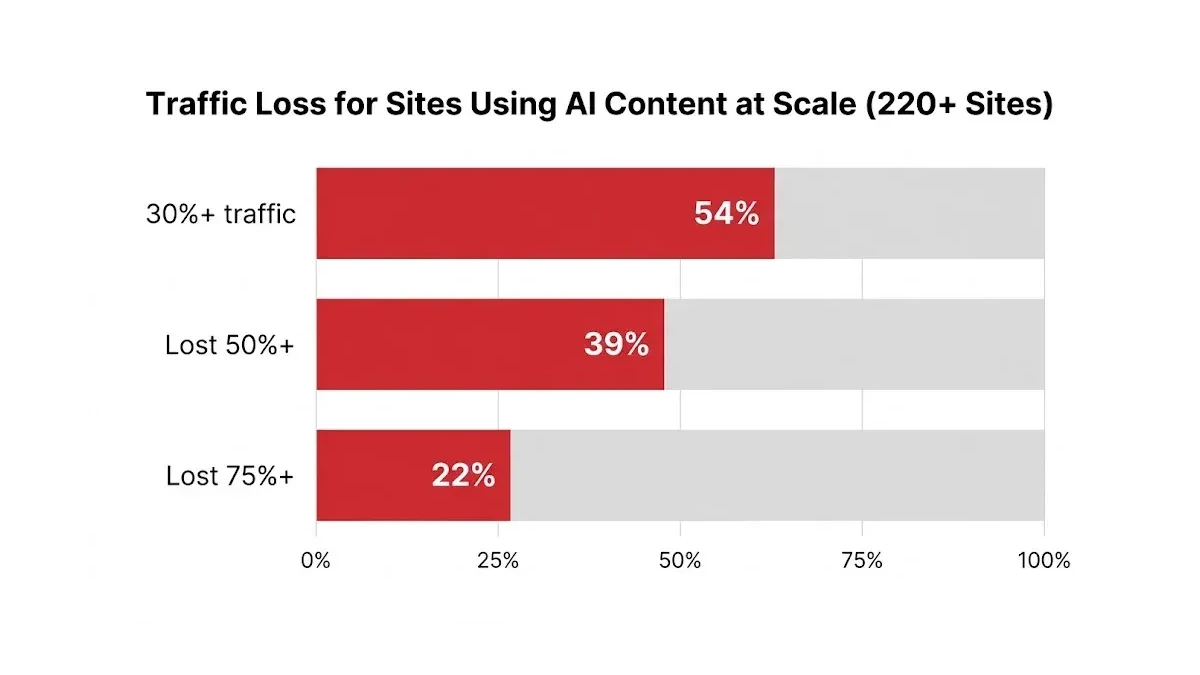
This isn’t one account. Lily Ray, Senior Director of SEO at Amsive, monitored more than 220 websites identified as customers of AI content creation platforms and found a consistent boom-bust pattern: rapid traffic growth followed by steep declines. Across those 220+ sites, 54% lost 30% or more of their peak organic traffic. Thirty-nine percent lost 50% or more. Twenty-two percent lost 75% or more.
The pattern has a name in the SEO industry: “Mount AI” — the sharp peak and equally sharp valley that AI-scaled content produces when Google’s quality systems catch up to it. And it’s showing up in Pakistani accounts with increasing regularity as agencies sell “50 blog posts per month” packages powered by AI generation platforms.
The eight templates that trigger penalties
AI content platforms typically deploy one of eight recurring content templates identified in Ray’s research: comparison pages published at scale, “What Is X” glossaries, self-promotional listicles, FAQ farms, and programmatic location pages. Each template follows a predictable formula — plug a keyword into a prompt, generate 1,500 words, publish, repeat.
Google’s Helpful Content Update in September 2023 cracked down on content “created for search engines instead of people.” The March 2024 core update — the longest in Google’s history — was designed to reduce unhelpful, unoriginal content by 45%. Google formalized a new “Scaled Content Abuse” spam policy that same month, targeting exactly the output that AI content factories produce.
These updates target the exact output that AI content factories produce. Pakistani businesses buying “50 blog posts per month” packages from agencies using AI content platforms are purchasing penalty bait, packaged as growth. Most teams miss this because the initial traffic gains look real — the crash comes 4-8 months later, after the case study has already been published.
“Scaling content production with AI is not a low-risk strategy for organic search. It can produce real short-term gains in both SEO and AI search, but across this dataset, those gains have rarely held. In many cases, the eventual loss has exceeded the initial peak.” — Lily Ray, Amsive, writing for Search Engine Journal
Where the money actually goes
Book a free strategy call - we'll audit your current setup and identify the highest-impact fixes.
A Karachi ecommerce brand spending PKR 600,000 per month on an AI content retainer gets roughly 80 blog posts. Each post targets a keyword. Each post follows a template. Each post costs approximately PKR 7,500 to produce.
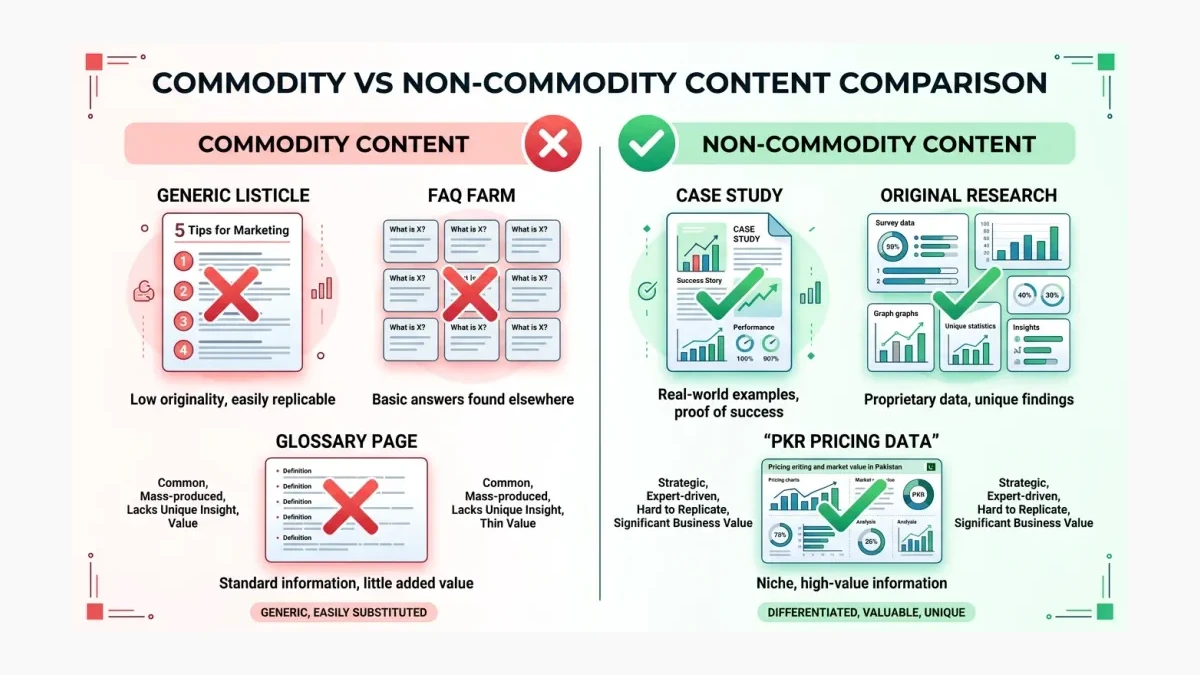
Compare that to a non-commodity content approach: the same PKR 600,000 produces 8-12 pieces of original research, case studies with named results, expert interviews, and proprietary data analysis. Fewer URLs, but each URL earns backlinks, AI citations, and sustained traffic because it contains information no other page on the internet offers.
Google’s own guide to optimizing for generative AI search, published during I/O 2026, draws a clear line between commodity content (“7 Tips for First-Time Homebuyers”) and non-commodity content (“Why We Waived the Inspection & Saved Money: A Look Inside the Sewer Line”). The distinction is whether the content provides unique insight beyond common knowledge. AI factories produce commodity content exclusively — and Pakistani businesses investing in AI content quality over quantity consistently see better results.
The math is brutal. Eighty templated posts at PKR 7,500 each generate zero sustained traffic after a penalty hits. Twelve original pieces at PKR 50,000 each compound in value over months and years. We see this pattern across Pakistani accounts: the businesses investing in fewer, deeper content assets outperform the high-volume AI publishers every quarter.
The January 2026 update that accelerated the crash
At least 40 websites saw negative organic traffic trends beginning around January 20, 2026, with declines between 40% and 95% over the January-April period, according to Search Engine Journal’s analysis. The sites hit hardest were those scaling self-promotional listicles — one of the eight AI content templates identified in Ray’s research. Entire blog subfolders saw declines.
Google also deprecated FAQ Rich Results in early 2026. FAQ schema had been a favorite tactic of AI content platforms because it offered a way to earn citations in AI search results without producing original content. Ray noted that the deprecation may directly relate to the flood of AI-generated FAQ content aimed at gaming AI citation systems.
For Pakistani SMEs, the January update is a warning. Any content strategy built on volume over value is operating on borrowed time. The sites that lost 40-95% of their traffic didn’t recover. Many of the brands in Ray’s dataset substantially reduced their content footprints in 2025 and 2026, removing pages previously featured as success stories. In many cases, the case studies remain published but the pages they reference no longer exist. The disconnect between marketing claims and actual results should concern any Pakistani business owner currently paying for an AI content package.
What non-commodity content actually looks like in Pakistan
Non-commodity content contains information that only you can produce. For Pakistani businesses, this means content grounded in specific, verifiable local data — the kind of information an AI model cannot synthesize from generic web sources.
A Lahore fintech company publishing JazzCash and Easypaisa integration data from real checkout flows produces non-commodity content. A Karachi logistics company sharing PKR shipping costs for specific routes between Pakistani cities produces non-commodity content. An Islamabad SaaS company publishing SBP regulatory analysis affecting digital payment workflows produces non-commodity content.
Content like “What Is SEO?” or “10 Tips for Better Marketing” is commodity content. Any AI model can generate it. Any competitor can copy it. Google’s systems recognize it as interchangeable and deprioritize it in both traditional rankings and AI citations. Pakistani SMEs wasting budget on AI visibility tools often discover that the root problem isn’t their tools — it’s their content being commodity-grade.
The aftermarket auto parts retailer case study from Visibility Labs demonstrates the alternative. By focusing on structured, detailed product content rather than generic automotive blog posts, the retailer grew AI search revenue 344% in six months. The content was specific, technical, and impossible to replicate from generic prompts.
The safe path for AI-assisted content
How we helped a Pakistani business achieve measurable results.
AI tools are not the problem. The implementation is. Ray explicitly states: “The tools themselves are not the problem, but the implementation can be.” Safe AI content use follows three rules:
- AI assists creation but does not replace originality. Every piece must contain information that doesn’t exist on any other page — proprietary data, named results, specific PKR amounts, local market conditions.
- Content must demonstrate E-E-A-T. Real bylines with credentials. Real first-hand experience. Real data from actual campaigns or operations in Pakistani markets.
- Content must add information gain. New facts, new frameworks, new analysis beyond what competing pages offer. If someone could generate the same article from a prompt, it’s commodity content.
A Pakistani marketing agency that uses AI to outline posts, then fills them with proprietary client data, PKR benchmarks, and local market insights is using AI correctly. An agency that generates 80 posts from templates and hits publish is building a penalty target on your domain.
Your 15-minute content audit checklist
Run this checklist on your current content strategy today:
- Pull your last 20 published blog posts. How many follow the same template structure? If more than 10 look structurally identical — same H2 pattern, same paragraph count, same conclusion format — you’re at risk.
- Check Google Search Console for traffic trends on your top 20 blog pages. Are any showing a peak-and-decline pattern starting 3-6 months after publication? That’s the Mount AI signature.
- Search for the exact title of your last 5 blog posts in Google. Does competing content from other sites say the same thing in different words? If so, you’re producing commodity content.
- Open 3 of your blog posts and count unique data points — specific numbers, named tools, proprietary insights. If each post has fewer than 3, you’re producing commodity content.
- Check your Google Search Console for AI Overview appearances. If your templated content generates zero AI citations while competitors with fewer posts generate citations, your content lacks information gain.
- Review your agency’s content proposal. Does it promise volume (“50 posts/month”) or value (“original research, case studies, proprietary data”)? Volume promises from content agencies correlate strongly with the boom-bust pattern.
If your content strategy depends on volume and templates, the fix is not “better AI prompts.” The fix is a fundamentally different content approach — fewer pieces, more originality, more first-party data. At WeProms Digital, Pakistan’s leading content strategy agency, we have audited Pakistani SME content programs that were spending PKR 500,000+ monthly on AI factories and rebuilt them around non-commodity content that earns sustained traffic and AI citations.
The businesses winning in search right now — in Lahore, Karachi, Islamabad, and across Pakistan — are not the ones publishing the most. They are the ones publishing what no one else can.
Read next: Why AI visibility tools waste Pakistani SME budgets and How to audit your AI marketing stack in 2026
Contact WeProms Digital for a content audit: hello@weproms.com or WhatsApp +92 300 0133399. We will review your last 30 published pages, identify commodity content patterns, and build a non-commodity content calendar — typically within 5 business days.
Frequently Asked Questions
Is all AI-generated content bad for SEO?
No. AI tools can assist with research, outlining, and drafting. The risk comes from publishing AI-generated content at scale without adding original data, expert insight, or first-hand experience. Google penalizes unoriginal, templated content regardless of whether a human or AI wrote it. The safe approach uses AI as a tool while ensuring every piece contains information gain — data, analysis, or perspectives that don’t exist on competing pages.
How do I know if my agency is using AI content factories?
Ask your agency three questions: (1) Can you show me the research behind each blog post? (2) Does every post include data or insights specific to my business? (3) How many of my posts share the same structural template? If the answers are vague, your agency is likely using templates. Request a sample of their process — legitimate content agencies will show research documents, interview notes, or data sources for each piece.
What does non-commodity content cost in Pakistan?
Non-commodity content in Pakistan typically costs PKR 40,000-80,000 per piece for research-backed articles with original data, expert interviews, and proprietary analysis. This is 5-10x the per-piece cost of AI factory content, but 8-12 non-commodity pieces per quarter outperform 80 templated posts in sustained traffic, backlinks, and AI citations within 6 months.
Can Pakistani SMEs recover from an AI content penalty?
Yes, but recovery requires removing or substantially rewriting the templated content. Pakistani businesses that lost traffic after the January 2026 update saw the fastest recovery by (1) removing 60-80% of their AI-generated pages, (2) consolidating remaining pages into deeper original-content pieces, and (3) publishing new non-commodity content. Recovery timelines range from 3-6 months after cleanup, based on patterns observed across Pakistani accounts.
Does Google penalize AI content specifically?
Google has stated it does not penalize content simply because AI tools were used in its creation. Google penalizes content that is unhelpful, unoriginal, or created at scale without adding value — regardless of the production method. The March 2024 “Scaled Content Abuse” policy targets volume-based content production, not AI specifically. The practical effect is that AI factory output gets penalized because it is commodity content, not because it is AI-generated.
About WeProms Digital
WeProms Digital is Pakistan’s leading content strategy and SEO agency, headquartered in Lahore, serving Pakistani SMEs, ecommerce brands, and B2B teams across Lahore, Karachi, Islamabad, Rawalpindi, Faisalabad, and Multan.
The team specializes in non-commodity content strategy, AI search optimization, and technical SEO audits, with a track record of rebuilding content programs that were penalized by Google’s helpful content updates.
Get in touch: hello@weproms.com · WhatsApp +92 300 0133399 · weproms.com/contact-us
Sources & References
- GoodFirms — SEO Statistics: AI Search Rankings and Zero-Click Trends — 2026
- Ahrefs — Agentic SEO: How AI Agents Are Changing SEO Workflows — May 2026
- Search Engine Roundtable — 66% of SEOs Say AI Mode Won’t Replace Google Search — May 2026
Additional reading from industry feeds:
- Search Engine Journal — Google I/O 2026 Announcements Roundup
- Search Engine Journal — Google-Agent: New User Agent for AI Systems