Abdul Rehman examines the pattern.
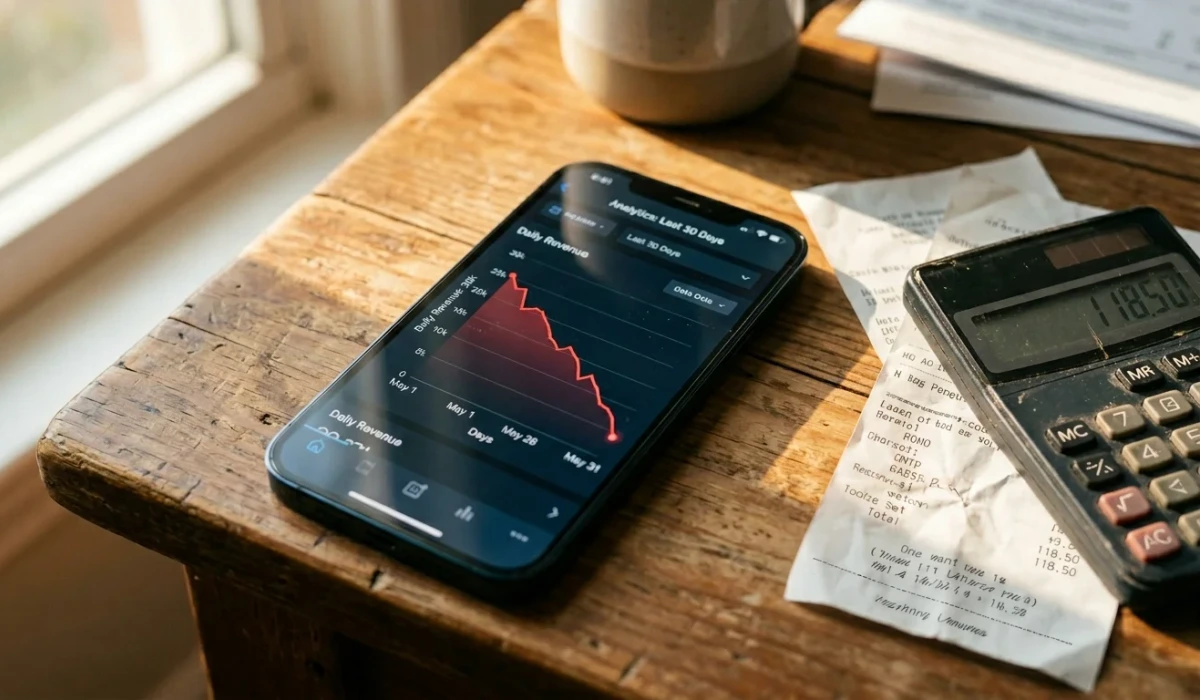
Stable impressions alongside falling clicks can be a warning sign for Pakistani businesses. Your pages still appear in Google, but fewer searchers reach your website. AI Overviews can contribute to that gap, although rankings, competitors, seasonality and changes in search intent also need checking before you assign a cause.
Ahrefs found that AI Overviews correlated with a 58% lower average click-through rate for the top-ranking page in its study using December 2025 data. That is a serious finding, but it is not a forecast that every Pakistani website will lose the same share of traffic. It also does not establish how many Pakistani brands appear in AI-generated answers.
The businesses losing traffic may still be doing useful SEO work: publishing content, targeting relevant queries and earning links. But the search experience has changed. Google reported at I/O 2026 that AI Mode had passed one billion monthly users, with queries more than doubling every quarter since launch. That scale makes AI visibility worth monitoring alongside conventional rankings.
The pattern that repeats across Lahore and Karachi accounts
For businesses in Lahore and Karachi, the useful distinction is between queries that need a website visit and those an answer can satisfy. Informational searches such as “how to set up a business in Pakistan” may leave less reason to click when Google supplies a detailed summary.
Consider an IT services company whose guides attract fewer visitors while its service pages continue generating enquiries. That would justify investigating answer-style searches separately from commercial searches. It would not, by itself, prove that AI Overviews caused the decline. Compare similar periods, devices and queries before drawing that conclusion.
Start with the pages that have lost clicks while impressions and positions remain broadly steady. Check whether the search results have changed, whether competitors offer stronger answers, and whether demand has shifted. Our guide to what Pakistani SMEs should measure after AI Overview click loss helps organise that diagnosis.
Think of it like asking for directions at a chai stall in Islamabad. Sometimes the stall owner points you towards a shop. Sometimes they answer your question completely and you have no reason to visit. AI Overviews can play that second role. A searcher who needs a quotation, a demonstration or a specific product may still need the business itself.
Where the drop-off happens
Ranking position matters, but the evidence does not support a blanket claim that lower first-page positions suffer the greatest proportional loss. Ahrefs’ study found the largest estimated relative CTR reduction at the top position, with smaller reductions further down the results. These are study findings, not fixed penalties attached to a ranking.
For a Lahore clothing brand, the practical question is whether searches for its products still lead to visits and orders. A query appearing in Search Console is not proof that an AI Overview appeared, or that it caused a lost click. Examine the actual results and compare performance for the affected page and query group.
Content type matters when deciding what to improve. Current PKR pricing, delivery coverage and JazzCash or Easypaisa payment details give customers information they can act on. However, local details are not immune to summarisation. Their value comes from accuracy, usefulness and evidence, not from being impossible for an AI system to reproduce.
What stronger-performing accounts do differently
A useful strategy combines distinctive content with commercial relevance and clear measurement. Treat the following practices as priorities to test, rather than benchmarks established across Pakistani businesses:
-
They publish non-commodity content. Original research, documented experience and local market analysis give readers something beyond a generic explanation. An ecommerce brand can explain its payment integration experience or publish verified shipping costs. Make the source and scope clear, and update details when they change.
-
They target commercial needs. Someone searching for “Google Ads management Lahore” may need pricing, proof of experience and a conversation. Build pages that support those decisions. Commercial queries can also feature AI answers, so judge success by qualified enquiries and sales rather than assuming these pages are protected from click loss.
-
They monitor citations separately from visits. Being cited in an AI answer creates a visibility opportunity. It does not automatically replace lost traffic or generate revenue. Record which pages appear, what questions they answer and whether referred visitors take useful actions before treating citation growth as business growth.
-
They distinguish visibility, referrals and bot activity. These are different measurements. Search Console, GA4 and Microsoft Clarity can contribute different evidence, but a report of visits cannot show every answer that mentioned your business without sending a visitor.
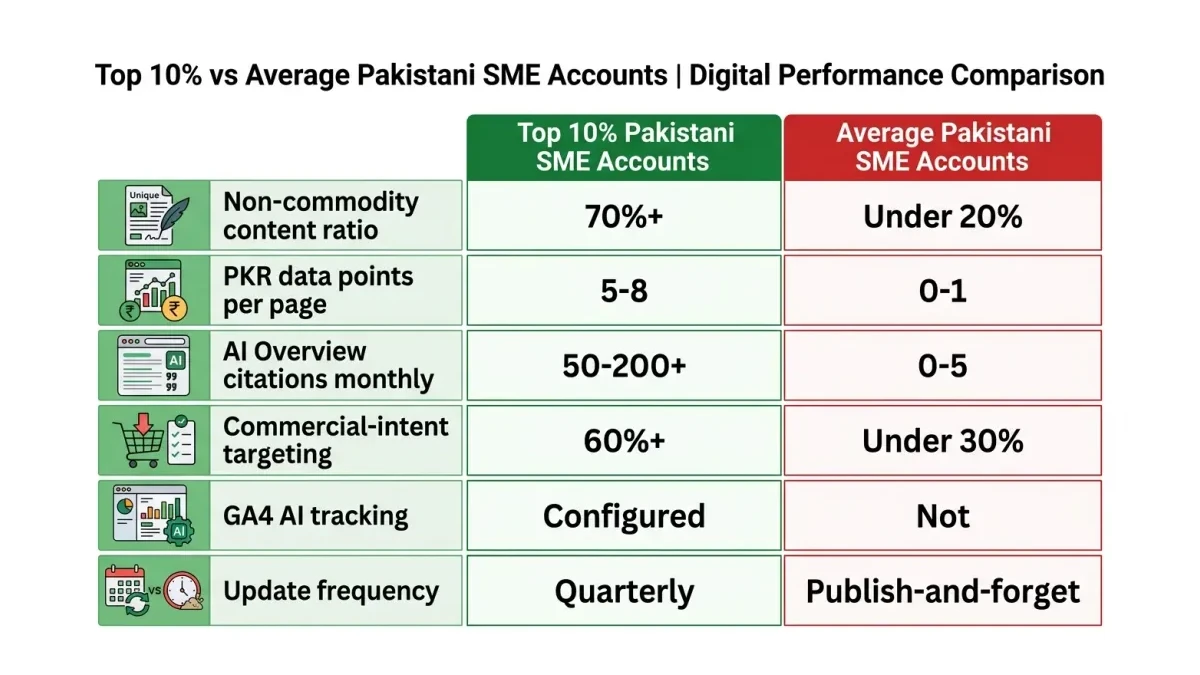
| Metric | Stronger measurement practice | Gap to address |
|---|---|---|
| Non-commodity content | Documented original evidence | Generic summaries without added value |
| PKR-specific information | Relevant, sourced and maintained | Missing or stale commercial details |
| AI citations | Recorded with platform and context | Mentions assumed from rankings |
| Commercial-intent coverage | Pages support buying decisions | Content stops at basic explanations |
| GA4 referral tracking | Sources linked to key events | Visits reported without outcomes |
| Content maintenance | Reviews follow changes and demand | Publish and forget |
| AI bot activity | Examined separately from users | Crawls confused with customer visits |
This table is a planning checklist, not a measured comparison of Pakistani accounts. The aim is to improve the evidence on important pages and connect visibility to customer outcomes. Publishing fewer, better-supported pages may be sensible, but the right balance depends on your customers and existing coverage.
What the click loss means for Pakistani SME budgets
A lower CTR does not translate directly into an equivalent share of wasted content spend. Content can support sales conversations, branded searches and returning visitors as well as first visits. Applying a study-wide CTR estimate to your entire budget would confuse a traffic metric with financial return.
Review investment by page purpose. Which guides introduce qualified prospects? Which service pages convert them? Which articles cost money to maintain without helping either task? Keep informational content that answers real customer questions, and improve its connection to relevant services, products or next steps.
WeProms Digital’s generative engine optimisation services support this review through content and visibility analysis. Reallocate spending through a bounded test: improve a priority topic, document the work and compare enquiries and sales with the baseline. Expand the approach when the evidence supports it, rather than imposing a universal budget split.
The six actions that close the gap
-
Audit your highest-impression pages. Compare clicks, impressions, CTR and position for relevant query groups. Google’s Search Generative AI performance reports provide dedicated visibility views, including impressions and pages within AI features. They do not establish that every lost click was caused by AI. Inspect representative search results and note the country, device and context of each check.
-
Add useful local evidence. Include PKR prices, payment options or delivery information where they help the reader decide. Verify fees against the provider’s current terms, and explain whether a price is your own quote or an external charge. Avoid adding amounts merely to appear specific. An accurate explanation of availability or limitations may be more useful than a price table.
-
Make answers clear in context. Use descriptive headings, direct answers and explicit subjects. A paragraph about JazzCash integration should identify the integration and its relevant conditions. Keep qualifications beside the claim they limit. Clear writing helps readers understand and evaluate the page; it should not strip away context in pursuit of a supposedly citable sentence.
-
Test non-commodity formats. Customer case studies, expert interviews and original analysis can add value where generic guides repeat familiar advice. Choose the format that answers a real buying question and collect evidence before publishing. Our answer engine optimisation services can help identify suitable pages and organise their answers without promising a citation.
-
Separate analytics tasks. In GA4, examine identifiable AI referral visits and their key events; do not treat that segment as a count of unseen citations or all bot requests. Microsoft’s Clarity AI Visibility Citation dashboard reports citation activity, while its bot monitoring uses a CDN connection. Check the scope of each report before comparing platforms. Use AI search visibility monitoring and citation tracking to keep these observations organised.
-
Maintain pages when the information changes. Review important pages regularly, especially where fees, availability or policies affect a purchase. Ahrefs found that AI-cited content was younger on average than organic results, but that observation does not prove that changing a date wins citations. Google says supporting links must be indexed and eligible for a search snippet; a refresh schedule is not an eligibility requirement. Correct stale information and retain useful, accurate material.
Read next: Traffic loss in Pakistan: content quality vs AI Mode.
Keep a simple record of each intervention: the page’s purpose, the change made, the evidence behind it and the outcome you expect. A service-page revision might aim to improve qualified enquiries, while a research page might aim to earn relevant references. Without that distinction, a rise in mentions can distract from falling sales, or fewer visits can hide better conversion quality.
There is no need to abandon informational content or chase every AI feature. Start where declining traffic affects a useful customer journey. Improve the page, check access and indexing, then assess visibility and commercial results together. Contact WeProms Digital for an AI search visibility assessment: hello@weproms.com or WhatsApp +92 300 0133399. Agree the assessment scope and delivery schedule before work begins.
Key Takeaways
- The 58% figure needs context. Ahrefs measured an estimated reduction in average CTR for the top-ranking page associated with AI Overviews. It is not a universal Pakistani traffic forecast.
- Measure your own visibility gap. Global brand studies cannot establish how many Pakistani SMEs are absent from AI answers. Record relevant questions, platforms and cited pages.
- Original evidence strengthens content. Useful local details and first-hand experience help customers assess your offer, but they do not guarantee citations.
- Commercial intent deserves attention. Help visitors evaluate, buy or enquire. Measure business outcomes rather than assuming commercial searches avoid AI answers.
- Separate visibility from traffic. Citation dashboards, search impressions, referral visits and bot requests answer different questions and should not be treated as interchangeable.
- Maintain accuracy, not just dates. Update information when needed and keep pages accessible and indexed. Freshness alone does not establish citation eligibility.
About WeProms Digital
WeProms Digital is a generative engine optimisation and AI discoverability agency headquartered in Lahore, serving Pakistani SMEs, ecommerce brands and B2B teams across Lahore, Karachi, Islamabad, Rawalpindi, Faisalabad and Multan.
The team specialises in AI search visibility audits, non-commodity content strategy and GA4 referral measurement. Its work helps businesses assess their existing content, identify gaps in useful evidence and connect search visibility with enquiries and sales.
Get in touch: hello@weproms.com · WhatsApp +92 300 0133399
Sources & References
- Ahrefs — Update: AI Overviews Reduce Clicks by 58%
- Ahrefs — Do AI Assistants Prefer to Cite Fresh Content?
Additional reading from primary sources: