Last updated: May 2026. Written by Sara Khan, Content Strategist at WeProms Digital.
Most Pakistani business owners believe that ranking first on Google means winning search, and that belief costs them more revenue every month than they spend on SEO itself.
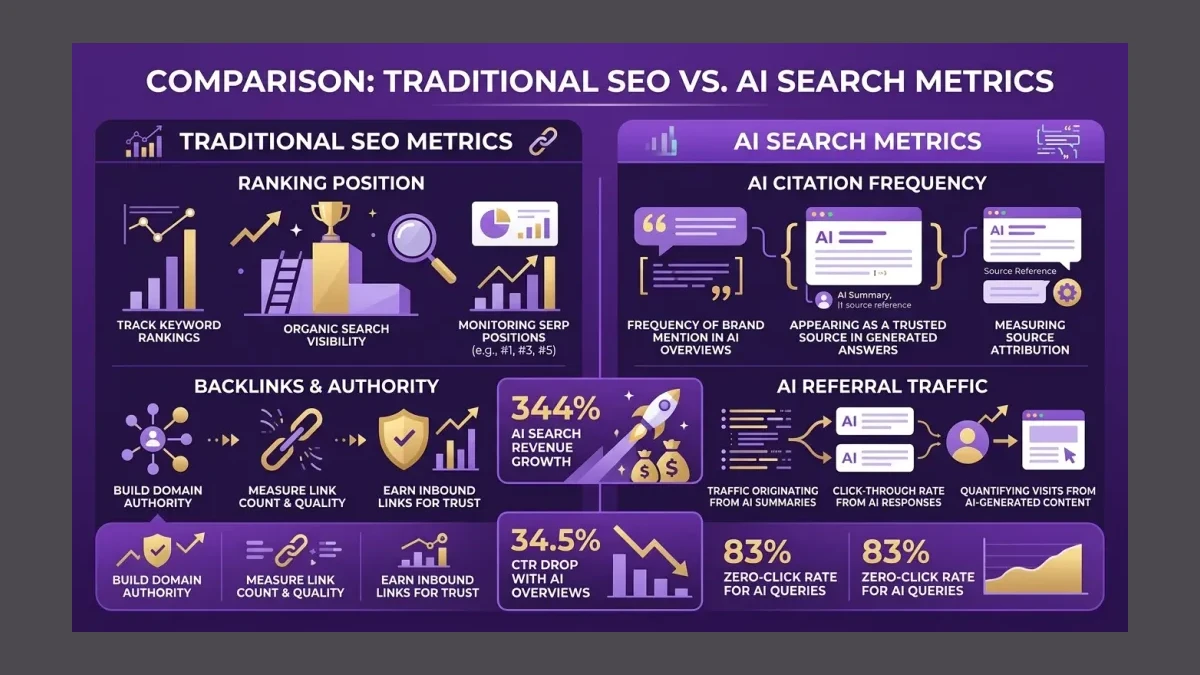
One aftermarket auto parts retailer in the United States grew its AI search revenue by 344 percent in six months after implementing a targeted GEO strategy — Generative Engine Optimization — according to a Visibility Labs case study published by MarTech Series. That business did not climb from page two to page one. It was already ranking well. The revenue growth came from appearing in AI-generated answers — the space above the organic results where Google AI Mode, ChatGPT, and Gemini now answer user questions directly. The pattern repeats across industries: visibility in AI responses generates revenue that traditional rankings alone cannot deliver.
The ranking report is a vanity metric now
Every month, Pakistani SEO agencies deliver ranking reports to their clients. Page one positions, keyword movement charts, competitive positioning maps. These reports look impressive; they feel like proof of progress. But in 2026, roughly 25 to 40 percent of Google queries trigger an AI Overview, and when that AI Overview appears, the click-through rate on the top organic result drops by an average of 34.5 percent, according to SEER Interactive’s 2026 analysis.
The math is specific. If a Lahore clothing brand ranks first for “unstitched lawn suits online” and that query triggers an AI Overview, the brand receives approximately 65 percent of the clicks it would have received two years ago. The ranking did not change. The traffic did.
What actually drives this is the zero-click content trap — a term describing how platforms increasingly show AI-generated answers directly in search results without linking out to source websites. Google’s AI Mode, ChatGPT, and Gemini provide answers in the search interface without requiring users to visit any website. The zero-click search rate now sits at 58.5 percent globally, according to SparkToro data analyzed by Workshop Digital. When a query triggers an AI Overview specifically, that rate climbs to 83 percent — meaning more than four out of five users never click through to any website at all. A Pakistani SME paying PKR 100,000 per month for SEO that optimizes only for click-driven rankings is optimizing for a shrinking share of search behavior.
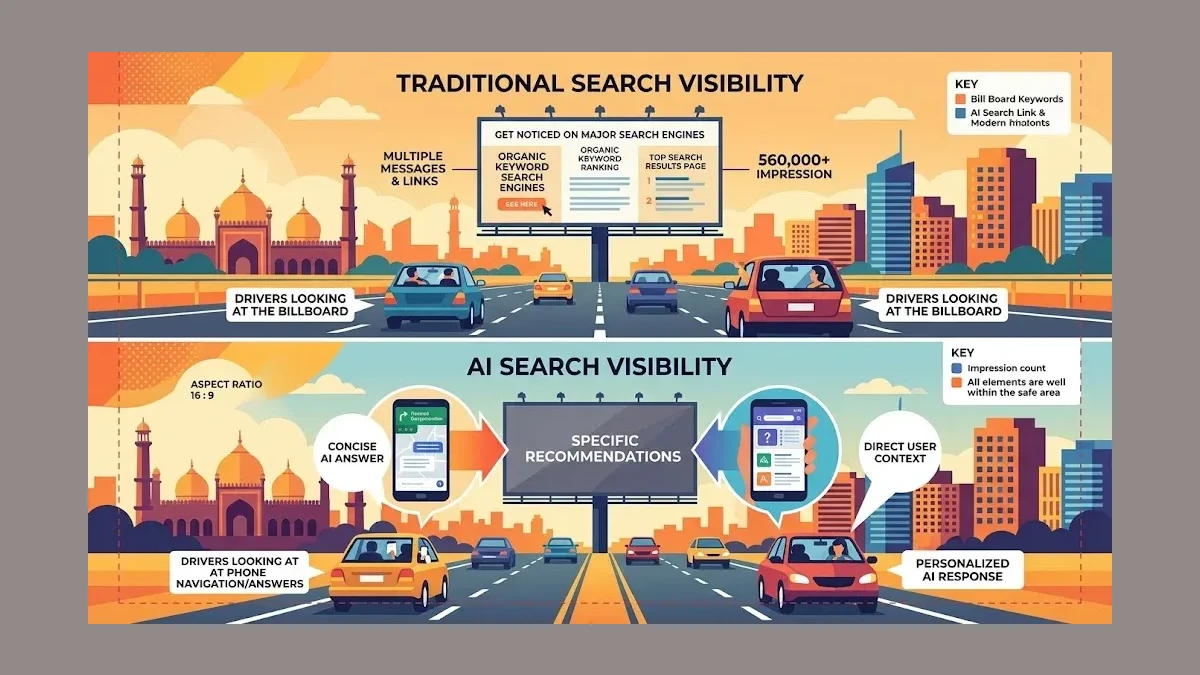
The analogy is direct. Paying for a billboard on Lahore’s Mall Road was sound marketing when drivers looked out the window. When those same drivers started using Google Maps navigation on their phones, the billboard became invisible to them — still physically present, still paid for, but no longer seen. AI Overviews are the navigation overlay for search results. The rankings are still there. The users are looking elsewhere.
The AI citation economy runs on different rules
Here is the structural shift that most ranking-focused SEO strategies miss: AI engines do not rank websites. They cite passages. When ChatGPT answers a question about “best digital marketing agencies in Karachi,” it does not return a numbered list of websites ordered by authority. It generates a prose answer that names specific businesses, selecting those businesses based on citation-worthiness — the specificity, structure, and authority of the content on their pages.
This means a Pakistani business can dominate traditional search results and remain entirely invisible when potential customers ask AI assistants for recommendations. The zero-click content pattern documented across Pakistani brands is not theoretical. It is a measurable shift in how discovery happens.
Google reinforced this shift in early 2026 by publishing its first official resource for optimizing content for generative AI in Search — an acknowledgment that AI-generated answers require specific optimization beyond traditional SEO fundamentals. The guide signals that Google sees AI-generated responses as core to the search experience, not an experimental feature.
Rankings still matter, but they are not sufficient
Book a free strategy call - we'll audit your current setup and identify the highest-impact fixes.
Google’s own position, as reported by Search Engine Journal, is that AEO (Answer Engine Optimization) and GEO (Generative Engine Optimization) are “still SEO.” This framing captures an important reality: traditional SEO is not dead. Keyword research, technical health, backlink profiles, and content quality remain foundational. Google itself confirms that these fundamentals continue to matter.
But “still SEO” does not mean “only SEO.” Google’s AI Mode now includes direct hotel booking links inside AI-generated responses, creating transaction paths that bypass traditional organic listings entirely. The search engine is building a new layer of commerce on top of AI answers, and businesses that appear only in organic results — not in AI-generated responses — are excluded from that layer.
For Pakistani SMEs, the implication is direct. A Karachi real estate agency that ranks well for “2-bedroom apartment for rent in DHA Karachi” is visible to users who scroll past the AI Overview. Users who find their answer in the AI response — the location, the price range, the recommended agencies — never scroll. The business loses that impression entirely, and the monthly ranking report does not capture the loss.
Google has also removed FAQ rich results from search listings, as Search Engine Journal documents, eliminating a structured data tactic that many Pakistani businesses relied on for enhanced visibility. Schema markup alone no longer guarantees prominent placement. Businesses need content that AI engines want to quote, not just structured data that Google used to display.
The Pakistani market amplifies the gap
Pakistan’s internet behavior intensifies the AI search shift in ways that global statistics understate. Pakistan has approximately 90 million social media users, 64 percent of whom are under 30, according to DataReportal. This young, mobile-first demographic adopts AI tools faster than the global average. When a 24-year-old in Faisalabad asks ChatGPT where to buy affordable electronics, they are not opening Google and scanning page one. They are reading the AI-generated answer and acting on it.
The cost sensitivity of Pakistani consumers makes AI citations even more consequential. A buyer comparing prices between Daraz and a local store will ask an AI assistant for recommendations. If the AI does not cite a specific business, that business does not enter the consideration set. The ranking report says page one. The revenue says zero from AI-mediated searches.
At the same time, the questions Pakistani brands face about AI search are no longer theoretical. They are operational. Businesses that treat ranking reports as the final word on search performance are making decisions based on incomplete data. The full picture requires measuring both where you rank and whether AI engines cite you — two different metrics that require two different optimization approaches.
What revenue-first search optimization looks like
The businesses winning search in 2026 do not ignore rankings. They treat rankings as one metric in a broader visibility framework that includes AI citation frequency, AI referral traffic, and AI-mediated conversion rates. The aftermarket auto parts retailer that achieved 344 percent AI search revenue growth did not abandon traditional SEO; it added a GEO layer on top of existing SEO fundamentals.
For a Pakistani SME spending PKR 80,000 to 150,000 monthly on SEO, the practical shift is straightforward: allocate 20 to 30 percent of the SEO budget toward AI-specific optimization — citation-worthiness audits, AI visibility tracking, content restructuring for passage-level extraction, and competitor AI benchmarking. The remaining 70 to 80 percent continues to fund the SEO fundamentals that Google still rewards.
The falsifiable claim is this: a Pakistani SME that adds GEO to its existing SEO program will see measurable AI citation improvements within 90 days and revenue impact within six months. The businesses that dispute this are, almost without exception, the ones that have not tried it.
The businesses that adapt to AI search do not spend more. They spend differently. And the ones that treat ranking reports as the final word on search performance will continue to watch their traffic slowly erode — page one position intact, month after month, while the AI answers above them redirect customers to competitors who invested in being cited, not just ranked.
At WeProms Digital, Pakistan’s leading SEO agency, we help Pakistani SMEs and ecommerce brands build search strategies that cover both traditional rankings and AI search visibility. The team audits AI citation rates, tracks Google-Agent traffic in GA4, and restructures content for passage-level extraction across Lahore, Karachi, Islamabad, Rawalpindi, Faisalabad, and Multan.
Get in touch: hello@weproms.com · WhatsApp +92 300 0133399 · weproms.com/contact-us
Read next: How Pakistani Brands Can Get Cited by AI Search Engines · Why Zero-Click Content Changes Pakistani Marketing · AI Search Revenue Playbook for Pakistani Ecommerce
Sources & References
How we helped a Pakistani business achieve measurable results.
- SEER Interactive — AI Overview Impact on Google CTR 2026 Update — 2026
- Workshop Digital — Rise in Zero-Click Searches Deep Dive — 2026
- Google Search Central Blog — Optimizing Content for Generative AI in Search — 2026
- DataReportal — Pakistan Digital Report 2026 — 2026
Additional reading from industry feeds:
- Search Engine Roundtable — 66% of SEOs Say AI Mode Won’t Replace Google Search
- Digiday — The Economist Prepares for a Two-Track Internet