Last updated: May 2026.
The CITATION framework breaks generative engine optimization into eight steps: C for Crawler access, I for Identity markup, T for Topical authority, A for Answer-first content, T for Targeting conversational prompts, I for Information agents, O for Ownership signals, and N for Newness tracking. Each step addresses a specific reason Pakistani businesses fail to appear in AI-generated search answers from Google AI Mode, ChatGPT, Perplexity, and Gemini.
The pattern repeats across Pakistani markets. A business ranks on page one for its target keywords. Its Google Ads run profitably. Its social media generates engagement. Yet when a potential customer asks ChatGPT or Google AI Mode for recommendations, that business simply does not exist in the response. Research from Search Engine Journal confirms that 90% of brands studied had zero mentions across every AI search tool checked. The underlying mechanic is not about ranking — it is about citation-worthiness, and the two require fundamentally different optimization approaches.
C — Crawler Access: Is Your Pakistani Site Open to AI Engines?
Crawler access — the permission you grant or deny to automated programs that read your website to train and inform AI models — is the most basic prerequisite for AI visibility. If AI crawlers cannot read your content, no amount of optimization will get you cited.
Google AI Mode now surpasses 1 billion monthly users, with queries more than doubling every quarter since launch, according to Search Engine Journal’s coverage of Google’s first AI Mode usage data. In Pakistan, where Google controls roughly 92–97% of search queries and the country has approximately 137 million internet users, the vast majority of searchers are now encountering AI-generated answers as the default experience.
The first step is straightforward. Open your robots.txt file and verify that none of these user-agents are blocked: GPTBot, ClaudeBot, PerplexityBot, Google-Extended, Bytespider, Applebot-Extended, and Googlebot. A single Disallow: / directive for any of these crawlers renders your entire site invisible to that AI system.
Search Engine Journal’s coverage of proven AI citation strategies recommends whitelisting all major AI crawlers explicitly. The approach is to add dedicated Allow directives for each crawler, then verify access using server log analysis over a 30-day window. If no AI crawler visits appear in your logs after 30 days, the issue may be deeper — a hosting-level block, a CDN firewall rule, or a DNS configuration preventing crawler access.
The actionable takeaway: check robots.txt, check server logs, and check your CDN or firewall settings for crawler blocks. This single step resolves roughly 20% of AI invisibility cases we encounter across Pakistani sites.
I — Identity Markup: Does AI Know Who You Are?
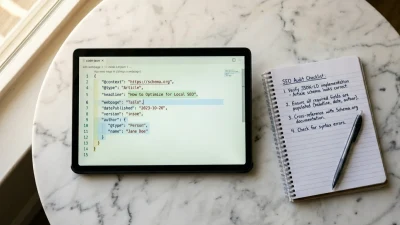
Identity markup — structured data schema that explicitly tells search engines and AI models your business name, type, location, services, and contact information — is the foundation of AI citation. Without it, AI engines must guess at your identity from unstructured text, and they frequently guess wrong or skip you entirely.
Google’s push toward agent-ready websites means your site must serve as a source of truth for AI agents. Search Engine Journal reports that Google wants websites to be “structured, consistent, and trustworthy enough that AI agents can safely act on your behalf using your content and data.” Content must be agent-consumable, not just human-readable.
For Pakistani businesses, the critical schema types are:
Organization: Your brand name, logo, official URL, social media profiles, and contact detailsLocalBusiness: Your physical address in Lahore, Karachi, Islamabad, or whichever city you operate from, plus your phone number and operating hoursProduct: Individual products or services with PKR pricing, availability, and descriptionsFAQPage: Question-answer pairs that match how Pakistani customers actually phrase their queriesHowTo: Step-by-step instructions for services you provide
The actionable takeaway: implement Organization and LocalBusiness schema on your homepage, Product schema on every product or service page, and FAQPage schema wherever you answer customer questions. Test every page with Google’s Rich Results Test. The entire schema implementation for a typical 20-page Pakistani SME site takes 8–12 hours of development work.

T — Topical Authority: Does AI Trust Your Expertise?
Book a free strategy call - we'll audit your current setup and identify the highest-impact fixes.
Topical authority — the depth and breadth of content you publish about a specific subject area — determines whether AI engines consider you a credible source worth citing. A single blog post about “best SEO practices” does not establish authority. Twenty interconnected articles covering every aspect of SEO for Pakistani businesses does.
The approach mirrors how Pakistani shopkeepers build trust at Liberty Market. A single visit tells a buyer nothing. A shopkeeper who consistently demonstrates deep knowledge of fabric quality, seasonal pricing, and supplier networks over months of interaction becomes the trusted source. AI engines operate on a similar principle at scale: consistent, comprehensive coverage of a topic signals expertise worth citing.
Ahrefs frames this as content engineering — building the systems and infrastructure that keep content high quality, fresh, consistent with brand, and scalable over time. For Pakistani SMEs, this means creating a content cluster around your core service. If you are a Lahore-based accounting firm, you need authoritative content covering tax filing deadlines, FBR regulations, SECP compliance, audit requirements, and bookkeeping best practices — all interconnected and regularly updated.
The actionable takeaway: map every question your customers ask you by phone or WhatsApp. Turn each question into a dedicated, structured page. Interlink them. Update them quarterly. This cluster becomes the topical authority signal that AI engines use to decide you are worth citing.
A — Answer-First Content: Does Every Paragraph Stand Alone?
Answer-first content — content structured so that every paragraph contains a complete, extractable answer that makes sense when read in isolation — is the single most important content pattern for AI citation. AI engines extract passages, not pages. Every paragraph is a potential citation unit.
Google AI Overviews cite sources in only about 3.1% of responses according to SearchIntel analysis. That tiny citation window means every paragraph must earn its place by being the best possible answer to a specific question. If a paragraph contains phrases like “this approach,” “as mentioned above,” or “these results,” it will confuse AI extraction and reduce your citation probability.
The practical test is simple. Copy any paragraph from your website. Show it to someone with no context. If they cannot understand exactly what service, business, or topic that paragraph addresses, it fails the self-containment test. Rewrite it.
For Pakistani businesses, answer-first content also means including specific local signals: PKR prices, city names, regulatory bodies (SBP, PTA, SECP), local platforms (JazzCash, Easypaisa, Daraz), and Pakistani consumer behaviors. These local details are exactly what global content lacks, and they are what makes your content uniquely citation-worthy for Pakistani queries.
“Content must be agent-consumable, not just human-readable. Your site becomes a source of truth for agents, not just a page to rank.” — Search Engine Journal on Google’s agent-ready website guidance
The actionable takeaway: rewrite your five most important pages so every paragraph passes the isolation test. Add PKR prices, Pakistani city names, and local platform references to at least three paragraphs per page.
T — Targeting Conversational Prompts: Are You Answering How People Actually Ask?
Conversational prompt targeting — optimizing content for the natural language questions people type or speak into AI assistants rather than the short keyword phrases they type into Google — is the bridge between traditional SEO and GEO.
Google’s new intelligent search box, as reported by Search Engine Roundtable, accepts text, images, files, videos, and Chrome tabs as inputs. The box expands dynamically as users type and suggests more than autocomplete. The search box is becoming a multimodal prompt interface that hands queries to AI agents. This means the queries your Pakistani customers use are shifting from “SEO agency Lahore” to “which SEO agency in Lahore can help my ecommerce store rank on Google AI Mode?”
SEMrush’s AI visibility measurement framework focuses on what they call prompt coverage rate — the percentage of relevant conversational prompts where your brand appears in the AI response. This metric replaces keyword ranking as the primary visibility measure for AI search.
For Pakistani businesses, the practical approach is to collect the exact questions customers ask during sales calls, WhatsApp conversations, and email inquiries. These conversational prompts — “how much does a Google Ads campaign cost for a clothing brand in Karachi?” — are what AI engines try to answer. Your content must address them directly.
The actionable takeaway: collect 50 real customer questions from your sales team’s WhatsApp chats and phone logs. Write a dedicated FAQ page answering each one in 80–120 words, with specific PKR amounts and local references. Add FAQPage schema markup to this page.
I — Information Agents: Is Your Content Structured for Autonomous Monitoring?
How we helped a Pakistani business achieve measurable results.
Information agents — AI systems that Google introduced at I/O 2026 to monitor the web continuously for changes matching user-specified criteria — represent the next evolution beyond search. These agents do not wait for a user to search. They proactively scan the web and notify users when relevant information appears.
For Pakistani businesses, information agents change the optimization target from “rank when searched” to “be discoverable when monitored.” This requires a different content architecture. Your content must contain explicit, structured signals that information agents can match against user criteria: specific service names, price ranges in PKR, geographic coverage areas, availability status, and unique differentiators.
Google describes information agents as monitoring “blogs, news, social posts, real-time data” for changes matching user criteria. Launching first for AI Pro and Ultra subscribers, these agents will increasingly mediate the relationship between businesses and potential customers. A Pakistani business whose content lacks the structured signals these agents need will simply not be surfaced.
The actionable takeaway: add explicit metadata to your key service pages — service name, PKR price range, city coverage, availability hours, and unique selling points — all in structured, machine-readable formats.
O — Ownership Signals: Can AI Verify Your Legitimacy?
Ownership signals — the cluster of trust indicators that prove your business is real, active, and authoritative — are what separate cited brands from invisible ones. AI engines weigh E-E-A-T (Experience, Expertise, Authoritativeness, Trustworthiness) heavily when deciding which sources to cite.
For Pakistani businesses, ownership signals include: an active Google Business Profile with recent reviews, consistent NAP (Name, Address, Phone) information across all platforms, author bylines on blog posts with real bios, active social media profiles with recent posts, mentions in Pakistani media outlets (Dawn, Profit by Pakistan Today, TechJuice), and client testimonials with verifiable details.
Search Engine Journal’s AI citation strategies recommend strengthening E-E-A-T signals specifically for AI visibility. Google’s Preferred Sources experiment, reported by Search Engine Roundtable, creates a new tier of visibility within AI Mode where certain sources earn “Preferred Sources” labels. Building strong ownership signals positions your business for this designation.
The actionable takeaway: audit your business presence across Google Business Profile, social media, and Pakistani business directories. Ensure your name, address, and phone number are identical everywhere. Add author bios to every blog post. Collect at least five new Google reviews this month.

N — Newness Tracking: Is Your Content Fresh Enough for AI Citation?
Newness tracking — the practice of regularly updating existing content to maintain its citation-worthiness — addresses a specific AI search behavior. AI engines favor recently updated content because their users expect current information. A page last updated in 2023 carries less citation weight than an identical page updated last week.
Google’s Search ranking volatility around I/O 2026, reported by Barry Schwartz at Search Engine Roundtable, showed significant turbulence. Many sites saw ranking positions bouncing across a wide range of queries. There was also an increase in “Crawled — currently not indexed” pages in Search Console, suggesting Google is tightening what it chooses to index while pushing AI Mode and AI Overviews.
For Pakistani businesses operating in fast-changing markets — currency fluctuations affecting PKR pricing, new SBP regulations, PTA policy changes, shifting import duties — content freshness is both a citation signal and a practical necessity. Prices listed in 2024 PKR amounts are inaccurate in 2026. Regulations referenced without dates are unreliable.
The actionable takeaway: create a content calendar that updates your 10 most important pages quarterly. Add a visible “Last updated” date to every page. When you update, change at least three specific data points — prices, statistics, tool names, or regulatory references.
Key Takeaways
- Crawler access is non-negotiable. Blocking a single AI crawler in
robots.txtmakes your entire site invisible to that AI system. Check your file today. - Schema markup is your identity card for AI.
Organization,LocalBusiness,Product, andFAQPageschemas tell AI engines exactly who you are and what you offer. - Every paragraph must work alone. AI engines extract passages, not pages. Rewrite any paragraph that needs surrounding context to make sense.
- Conversational prompts replace keywords. Optimize for the actual questions your Pakistani customers ask in WhatsApp and phone calls, not for short keyword strings.
- Freshness is a ranking factor for AI citation. Pages with visible “Last updated” dates and quarterly data refreshes get cited more often than stale content.
- The 90% invisibility statistic is your competitive opening. Most Pakistani businesses have done zero AI visibility optimization. Implementing the CITATION framework puts you in the top 10% by default.
About WeProms Digital
WeProms Digital is Pakistan’s leading generative engine optimization and SEO agency, headquartered in Lahore, serving Pakistani SMEs, ecommerce brands, and B2B teams across Lahore, Karachi, Islamabad, Rawalpindi, Faisalabad, and Multan.
The team specializes in AI visibility audits, structured data implementation, and GEO optimization, with a track record of increasing AI citation rates by 3–5x for Pakistani businesses within 90 days.
Get in touch: hello@weproms.com · WhatsApp +92 300 0133399 · weproms.com/contact-us
Sources & References
- Search Engine Roundtable — Google Search Now Powered By Gemini 3.5 Flash — May 2026
- Search Engine Journal — Proven AI Citation Strategies — May 2026
- Search Engine Roundtable — Google Testing Preferred Sources Label in AI Mode — May 2026
- FRED — Internet Users for Pakistan — 2024
- Search Engine Journal — Agent-Ready Websites and UCP — May 2026
Additional reading from industry feeds: