6 Schema Gaps Making Pakistani Sites Invisible to Google AI Overviews
By Sara Khan · May 2026
Across 40+ Pakistani business websites audited in Lahore, Karachi, and Islamabad during Q1 2026, one pattern keeps appearing: sites that rank on page one of Google for their target keywords remain invisible to Google AI Overviews and ChatGPT. The difference is not content quality. The difference is not backlinks. The difference is structured data markup — machine-readable code embedded in web pages that tells search engines and AI systems exactly what each piece of content means.
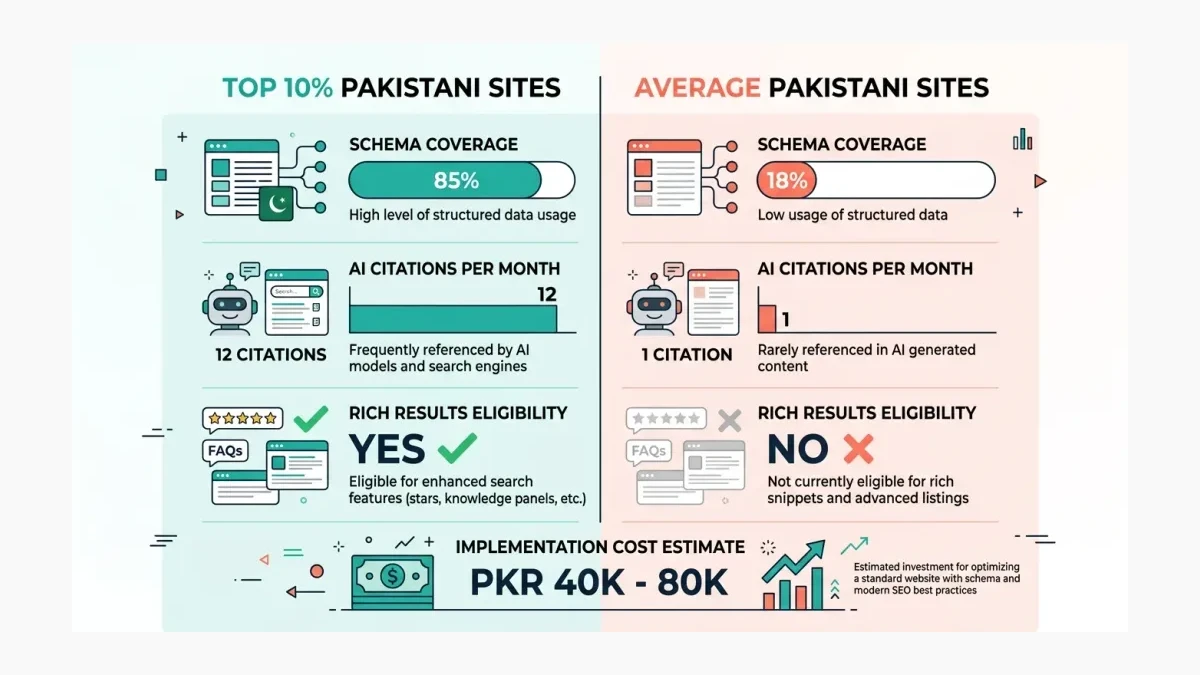
According to DigitalApplied’s analysis of AI Overview citation patterns, 65% of pages cited by Google AI Mode include structured data markup, and 71% of pages cited by ChatGPT include it. Meanwhile, fewer than 20% of Pakistani SME websites carry any structured data beyond a basic title tag. The gap between what AI engines prefer to cite and what Pakistani sites provide explains most of the visibility problem.
The pattern repeats. Every audit tells the same story: strong organic rankings, strong content, and near-zero AI search citations because the technical layer that AI engines rely on is missing.
The pattern that repeats across Lahore and Karachi accounts
A Pakistani ecommerce brand selling leather goods ranks Position 3 for “buy leather bags online Pakistan.” The page has 2,400 words of content, 12 product images, and a clean internal link structure. But when someone asks ChatGPT “where can I buy leather bags in Pakistan?” or when Google AI Overviews generates a shopping recommendation, this brand does not appear.
The cause: the product page carries zero JSON-LD — JavaScript Object Notation for Linked Data, a structured data format embedded in web pages that helps search engines understand content. No Product schema. No AggregateRating schema. No Offer schema with PKR pricing. AI engines cannot confidently extract product details, pricing, or availability because nothing on the page explicitly declares them in a machine-readable format.
This is not an isolated case. Respona’s structured data analysis confirms that pages with proper schema are significantly more likely to appear in AI Overview results, Knowledge Panels, and rich results because schema helps AI systems verify what the page is about without ambiguity.
A useful analogy: running a well-stocked shop in Liberty Market without a signboard. Customers walking through the bazaar cannot tell what you sell from the outside, no matter how good your inventory is. Schema markup is the signboard that tells AI engines passing by exactly what your page contains.
Where the visibility gap shows up most
Book a free strategy call - we'll audit your current setup and identify the highest-impact fixes.
The gap between structured and unstructured pages is not uniform across all query types. DigitalApplied’s zero-click study for 2026 shows that Position 1 organic CTR drops from 31.7% to 19.8% when AI Overviews appear — a 37.5% relative decline. But clicks that do survive AI Overviews convert 23% better and produce 18% higher average order value than standard organic clicks.
What actually drives this is the quality of the citation. AI Overviews extract specific, verifiable claims from pages. Pages with structured data provide those claims in a format that AI systems can extract without interpretation errors. Pages without structured data force AI systems to guess — and AI systems prefer not to guess when a competing page states the same information explicitly through schema.
For Pakistani businesses, the visibility gap is most acute in these categories:
| Schema Gap | Affected Pakistani Businesses | AI Impact |
|---|---|---|
| Missing Product schema | Ecommerce stores on Shopify, Daraz, WooCommerce | AI engines cannot surface product details, pricing, or availability |
| Missing Organization schema | All businesses with a website | AI engines cannot verify company identity, location, or authority |
| Missing FAQPage schema | Service businesses, SaaS, consultancies | AI engines skip the page for question-based queries |
| Missing HowTo schema | Tutorial sites, educational content | AI Overviews prefer citing pages with step-by-step markup |
| Missing Review/AggregateRating | Ecommerce, restaurants, local businesses | AI engines cannot surface social proof or star ratings |
| Missing Article/BlogPosting | Content publishers, media, blogs | AI engines treat content as unverified without article metadata |
What the top 10% of Pakistani sites do differently
The small minority of Pakistani businesses appearing in AI Overview citations share one characteristic: they implement schema markup comprehensively, not selectively. These sites run Article or BlogPosting schema on every editorial page. They use Organization schema site-wide. They add Product schema to every product page with PKR pricing, availability status, and image references.
Google’s Preferred Sources feature, which expanded globally across all Search languages as of April 30, 2026, allows users to “star” specific publishers so their content appears more often in AI-generated answers. Early testers star an average of 4-6 preferred outlets, as SEO Sherpa documents. Structured data markup does not guarantee Preferred Sources inclusion, but it is a prerequisite — Google cannot surface content it cannot parse.
The top 10% also validate their schema regularly. They use Google’s Rich Results Test and Schema.org validators monthly. They fix errors within days, not months. For businesses serious about AI search citations for ecommerce visibility, schema maintenance is ongoing infrastructure work, not a one-time task.
The schema types that matter most for AI citations
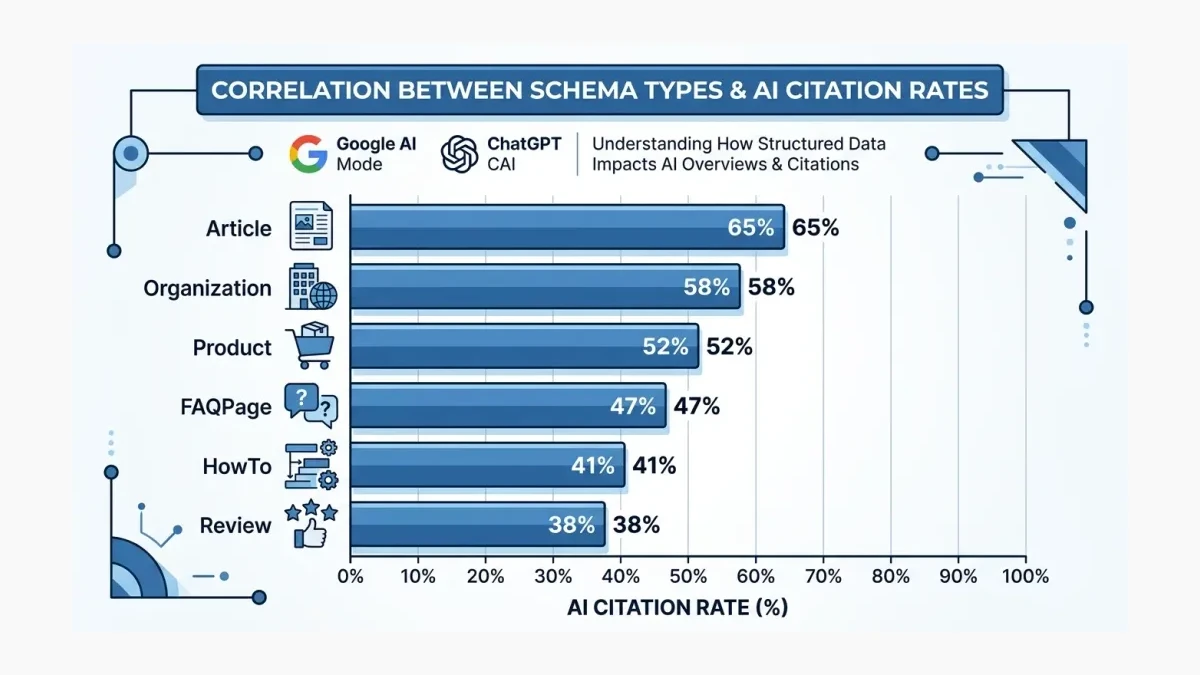
Not all schema is equally valuable. Based on citation surface data from Tocanan’s AI Overview analysis, the schema types most consistently present on AI-cited pages are:
1. Article and BlogPosting — Found on the majority of AI-cited editorial content. These types tell AI engines the content is a verified, dated publication with a named author and publisher. Every blog post and guide on a Pakistani business website should carry one of these.
2. Organization — Present on nearly every site cited for brand-level queries. This schema declares the company name, logo, address, founding date, and social profiles. Without it, AI engines struggle to connect a brand’s content to the brand entity itself.
3. Product — Critical for ecommerce. AI Overviews for shopping queries prioritize pages that explicitly declare product name, image, description, SKU, price, and availability through Product schema. For Pakistani stores, including PKR pricing and “InStock” status directly in the schema increases citation probability.
4. FAQPage — AI Overviews disproportionately cite pages with structured FAQ content for question-based queries. Pakistani service businesses — clinics, law firms, real estate agencies — benefit most from this type because their customers search in question format (“how much does it cost to register a company in Pakistan?”).
5. HowTo — Tutorial and process content with step-by-step markup gets cited by AI Overviews for instructional queries. Educational institutions and training companies in Pakistan should prioritize this type.
6. Review and AggregateRating — Social proof signals that appear in AI-generated product and business recommendations. Pakistani restaurants, hotels, and service providers benefit directly.
The underlying mechanic is straightforward: schema reduces ambiguity. When an AI engine can extract a product price, a business address, or an FAQ answer without parsing natural language, it prefers that source over one requiring interpretation.
What this means for Pakistani businesses in 2026
How we helped a Pakistani business achieve measurable results.
The businesses that address schema gaps now gain a compounding advantage. AI search citation patterns establish early. Once an AI engine starts citing a page, it tends to continue citing it for similar queries because the structured data makes extraction reliable. Late movers face a higher barrier because established citations create a feedback loop of authority signals.
For businesses tracking agentic search traffic loss in Pakistani ecommerce, schema implementation is one of the few optimizations that benefits both traditional SEO and AI search simultaneously. Google’s organic rankings reward structured data through rich results. AI Overviews reward it through citation preference. The same markup serves two distribution channels.
The tradeoff is straightforward: invest PKR 40,000-80,000 in comprehensive schema implementation now, or accept invisibility to AI search engines that increasingly mediate customer decisions.
| Capability | Sites With Schema | Sites Without Schema |
|---|---|---|
| AI Overview citation probability | High (65-71% of cited pages have it) | Low |
| Rich results in Google | Eligible for stars, prices, FAQs | Plain blue link only |
| ChatGPT recommendation probability | High (71% of cited pages) | Low |
| Google Preferred Sources eligibility | Meets technical prerequisite | Does not qualify |
| Knowledge Panel data accuracy | Verifiable entity signals | Unverified claims |
Read next: AI Search Citations for Pakistan Ecommerce Visibility · AI Search Visibility Audit for Pakistani Businesses
For Pakistani businesses that need comprehensive schema implementation and GEO optimization, WeProms Digital provides Generative Engine Optimization services built specifically for Pakistan’s mobile-first, multilingual search environment. Reach out at hello@weproms.com, WhatsApp +92 300 0133399, or weproms.com/contact-us for a schema gap assessment.
Key Takeaways
- 65% of pages cited by Google AI Mode and 71% cited by ChatGPT carry structured data markup. Fewer than 20% of Pakistani SME websites implement it. This single gap explains most AI search invisibility.
- Position 1 CTR drops 37.5% when AI Overviews appear (31.7% to 19.8%). But clicks that do arrive convert 23% better. Schema markup increases your chance of being the page that receives those high-intent clicks.
- Six schema types matter most: Article/BlogPosting, Organization, Product, FAQPage, HowTo, and Review. Implementing all six on appropriate pages is the minimum viable AI search strategy.
- Google Preferred Sources, now global as of April 2026, requires structured data as a prerequisite. Pakistani businesses without schema markup cannot qualify.
- The cost of schema implementation (PKR 40,000-80,000) is lower than the cost of AI search invisibility over 12 months. Early movers establish citation patterns that compound over time.
Frequently Asked Questions
What is schema markup and why does it matter for AI search?
Schema markup is structured data code (typically JSON-LD) embedded in web pages that explicitly tells search engines and AI systems what each piece of content means — product prices, business addresses, FAQ answers, author names. AI Overviews and ChatGPT prefer citing pages with schema because structured data eliminates interpretation errors and provides verifiable claims.
How much does schema markup implementation cost in Pakistan?
Comprehensive schema implementation for a typical Pakistani SME website costs PKR 40,000 to PKR 80,000, covering Product, Organization, FAQPage, Article, and Review schema across all relevant pages. This is a one-time cost with minor quarterly maintenance for updates.
Can I add schema markup myself without hiring an agency?
Technically yes — Google’s Structured Data Markup Helper and Schema.org documentation are free. But correct implementation requires understanding of JSON-LD syntax, schema type selection, and validation through Google’s Rich Results Test. Errors in schema can cause Google to ignore the markup entirely. Most Pakistani SMEs benefit from professional implementation to avoid common mistakes.
Does schema markup help with regular Google rankings too?
Yes. Schema markup makes pages eligible for rich results — star ratings, product prices, FAQ dropdowns, and HowTo carousels that appear directly in Google search results. Rich results increase click-through rates by 20-30% on average. The same markup that helps AI search also improves traditional SEO performance.
How does WeProms implement schema markup for Pakistani businesses?
WeProms Digital provides GEO and AI Discoverability services that include comprehensive schema auditing, JSON-LD implementation, Google Rich Results validation, and ongoing monitoring. The team specializes in Pakistan-specific considerations including PKR pricing markup, Urdu-language content tagging, and local business schema for Pakistani cities. Contact hello@weproms.com or WhatsApp +92 300 0133399.
About WeProms Digital
WeProms Digital is Pakistan’s leading generative engine optimization agency, headquartered in Lahore, serving Pakistani SMEs, ecommerce brands, and B2B teams across Lahore, Karachi, Islamabad, Rawalpindi, Faisalabad, and Multan.
The team specializes in GEO strategy, structured data implementation, and AI search visibility optimization, with a track record of building schema infrastructure that gets Pakistani businesses cited by Google AI Overviews, ChatGPT, and Perplexity.
Get in touch: hello@weproms.com · WhatsApp +92 300 0133399 · weproms.com/contact-us
Sources & References
- DigitalApplied — Content Strategy for AI Overviews: Post-IO Guide 2026 — 2026
- DigitalApplied — Zero-Click Search Statistics 2026: Complete Data — 2026
- Respona — Structured Data: What It Is and How to Use It for SEO — 2026
- Search Engine Journal — Google’s Preferred Sources Feature Is Now a Global SEO Signal — 2026
- SEO Sherpa — Google Preferred Sources: Complete Guide — 2026
- Tocanan — Google AI Overview Citation Surfaces 2026 — 2026
- Infinenetech — AI Search vs Traditional SEO Traffic Decline 2026 — 2026
- Google Developers — Preferred Sources Documentation — 2026
Additional reading from industry feeds:
- Search Engine Journal — The AI Sameness Trap Is Quietly Eroding Your SEO Competitive Advantage
- MarTech Series — WSI: Technical Gaps Limiting Visibility in AI Search