Pakistani Traffic Loss Is a Content Problem, Not an AI Mode Problem
By Sara Khan. Last updated: June 2026.
The common belief holds that Google AI Mode is a traffic thief intercepting visitors before they reach Pakistani business websites, and the data appears to confirm it with clicks down, sessions declining, and revenue at risk, but the real mechanic is more uncomfortable: 58.5% of Google searches ended without a click before AI Mode existed (SparkToro/Datos, 2024), and the pages losing traffic to AI Overviews were rarely earning genuine customer interest in the first place.
The pattern repeats across industries. A Karachi services company publishes 2,000-word articles targeting “best [service] in Karachi” and watches traffic erode month after month. The content ranks because it matches a keyword template. It fails to earn citations from AI engines because it offers nothing that ten other pages don’t already say in the same generic language. When AI Mode synthesizes an answer from the web, it has no reason to cite the seventh identical article on the same topic.
The zero-click baseline predates AI Mode
Before AI Overviews entered the picture, more than half of Google searches already ended without a website visit. Featured snippets, knowledge panels, local packs, and People Also Ask boxes were answering questions directly for years. The shift toward zero-click search began around 2020 and accelerated steadily through 2024. AI Mode is the latest and most aggressive expression of a trend that was already well established.
What changed is the scope and finality. AI Overviews now appear in roughly 20% of Google searches according to SeoProfy’s 2026 analysis, and when they appear, the top-ranked organic result loses about 58% of its clicks based on Ahrefs data reported by BitMedia. But here is the part most analyses overlook: the pages that retain clicks despite AI Overviews are the ones with original data, specific expertise, or unique perspective that the AI engine chooses to cite rather than paraphrase.
Brands cited inside AI Overviews receive 35% more organic clicks and 91% more paid clicks than competitors who don’t get cited, according to BitMedia’s 2026 research. The cited brand doesn’t lose traffic to AI. It gains traffic because of AI. The difference between losing and winning in AI Mode is whether your content gives AI engines something worth citing, something that cannot be generated from the consensus of existing pages.
This distinction matters for Pakistani businesses because it reframes the entire response to AI search disruption. Instead of asking how to defend against AI Mode, the question becomes: what would make an AI engine name your brand specifically in its answer? The answer is never “publish more keyword-targeted blog posts.”
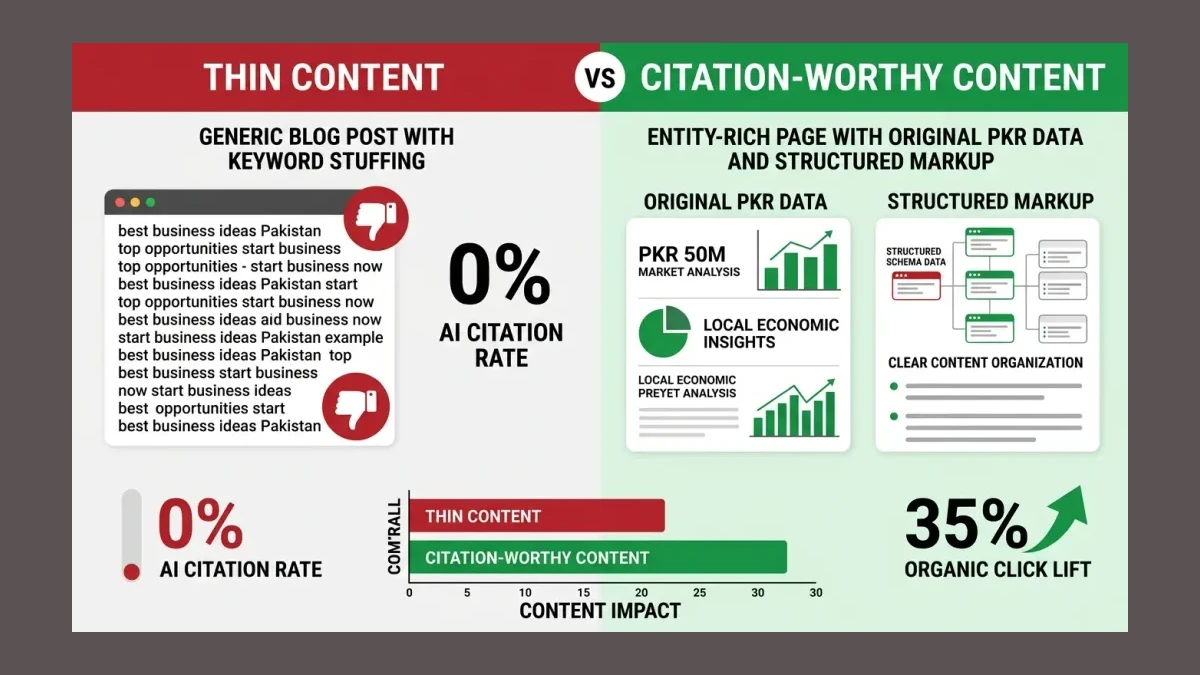
What thin content actually costs Pakistani businesses
Book a free strategy call - we'll audit your current setup and identify the highest-impact fixes.
Thin content — material that rephrases what many other pages already say without adding original data, local context, or identifiable expertise — is not just short content. A 2,000-word blog post can be thin if it rephrases what fifteen other pages already say. Thin means interchangeable. It means an AI engine can summarize your page in one sentence without losing any information value. It means a reader who lands on your page from a search result learns nothing they couldn’t find on the first three Google results.
The cost of thin content in the AI Mode era extends beyond lost clicks. The real cost is lost citation opportunity. When Google’s AI generates an answer about “best accounting software for Pakistani SMEs,” it synthesizes information from multiple sources and names the ones that provide verifiable, specific, original data. Pages that offer generic pros-and-cons lists get summarized without citation. Pages that provide PKR pricing comparisons, SBP compliance notes, and JazzCash integration details get named and linked.
Many marketers still treat AI search optimization as separate from their core content strategy. The practical risk is not a precise adoption percentage; it is that teams keep producing keyword-first, interchangeable pages while search experiences increasingly reward useful, specific, well-attributed source material.
This is the uncomfortable truth for Pakistani businesses paying PKR 50,000 to PKR 150,000 monthly to content agencies that produce ten blog posts per month on topics already covered by dozens of competitors. The content ranks. The content gets impressions. The content never gets cited by AI because it adds nothing new to the web. The investment produces the illusion of progress while the business becomes progressively less visible in the only search surface that matters: the AI-generated answer at the top of the page.
The judgment Pakistani businesses need right now is the ability to look at their own content and ask: if this page disappeared from the web, would any searcher or AI answer system miss it? Would any searcher miss it? For most Pakistani business websites, the honest answer is no. That absence of consequence is the real traffic problem.
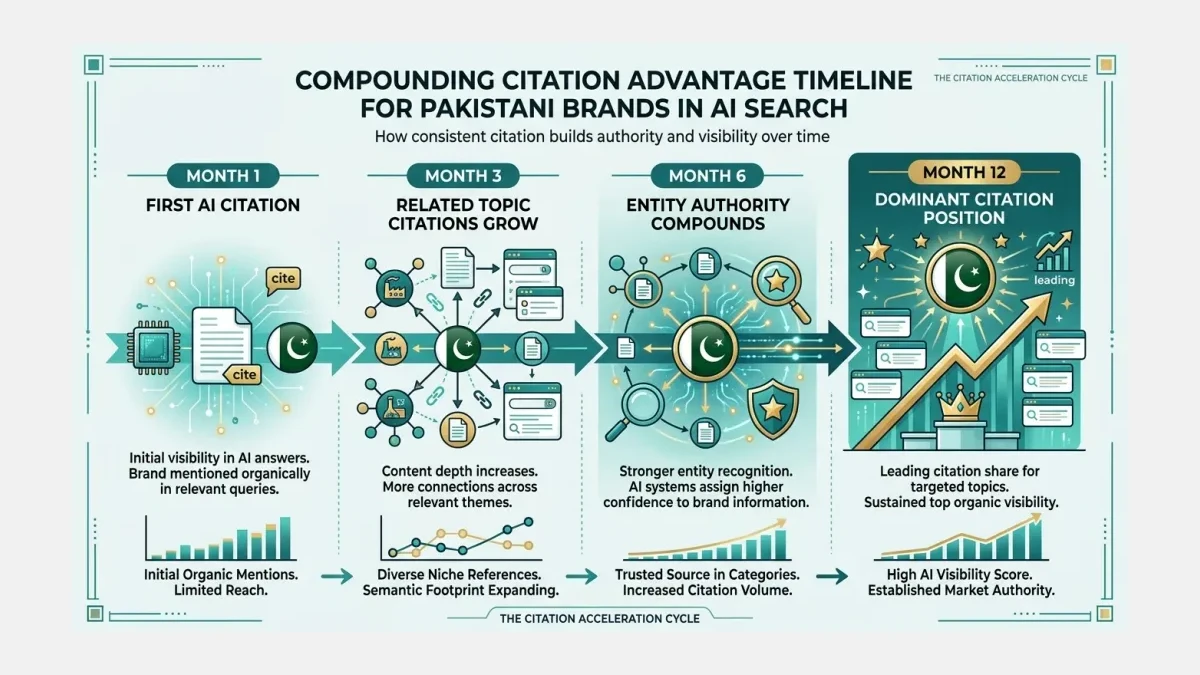
The citation advantage compounds over time
What most Pakistani businesses miss about AI search is the compounding mechanic behind citation. AI engines learn from what they cite. When Google AI Mode cites a page, it learns to associate that brand with the topic. Future queries on related topics are more likely to surface the same brand. Citation builds on citation. Brands that get cited early develop an advantage that becomes expensive to displace.
The underlying mechanic is entity authority — the strength of a brand’s identity in Google’s knowledge graph. Google’s AI does not just match keywords. It understands entities like companies, people, products, and concepts, and the relationships between them. A page that clearly identifies its author by name, links to verified professional profiles, includes structured data markup with Organization and Person schema, and provides original research or Pakistan-specific analysis builds entity authority with every indexed page. A page that targets a keyword and paraphrases competitor content builds none.
BFJ Digital’s 2026 analysis confirms that traditional SEO fundamentals — technical performance, crawlability, structured data — remain the foundation for AI visibility (BFJ Digital). The fundamentals haven’t changed. What has changed is the ceiling. Good fundamentals get your pages indexed and ranking. Original, entity-rich, citation-worthy content gets your brand named in the AI answer.
The entity optimization work that Pakistani brands need for AI search visibility is not optional anymore. It is the difference between being a source that AI engines cite by name and being a source that AI engines summarize without credit. The compounding nature of citation authority means that every month of delay widens the gap between cited brands and invisible brands.
Why Pakistani content agencies keep producing thin pages
The reason most Pakistani content agencies continue producing interchangeable blog posts is structural, not malicious. The agency’s reporting dashboard shows keyword rankings, impressions, and published word count. None of these metrics capture whether the content is citation-worthy. The client sees “15 keywords improved” and pays the invoice. Nobody measures whether any AI engine would have reason to name the brand in a generated answer.
This reporting gap creates a perverse incentive. Agencies that produce thin but rankable content look successful on traditional SEO dashboards. Agencies that produce fewer but citation-worthy pieces look less productive, even though their content generates more actual business outcomes in the AI search era. The metrics haven’t caught up to the reality of how AI Mode values content.
Google CEO Sundar Pichai explicitly stated he is OK with AI Mode replacing classic search (Search Engine Journal). This is not a trial period. This is not an experiment that might be reversed. AI Mode is Google’s strategic direction, confirmed at the highest level. The search experience will continue moving toward AI-generated answers, and the role of individual web pages will continue shifting from destination to source material.
For Pakistani businesses, this strategic confirmation means the content strategy must shift from producing pages that attract clicks to producing content that serves as authoritative source material for AI answers. The shift is not from SEO to something else entirely. It is from thin SEO to substantive SEO. From keyword-first to entity-first. From interchangeable to irreplaceable.
Moz’s 2026 guide on optimizing for AI visibility emphasizes that content with verifiable authorship, original data, and strong entity signals significantly outperforms generic content in AI citation frequency (Moz). The AI readability fixes that Pakistani websites need are the first step. The deeper work is building a content library that no AI engine could synthesize without citing your brand by name.
The GEO-AEO playbook separates signal from noise
How we helped a Pakistani business achieve measurable results.
Generative Engine Optimization and Answer Engine Optimization, often abbreviated as GEO and AEO, are the frameworks that bridge traditional SEO and AI citation strategy. GEO focuses on structuring content so AI engines reference your brand in generated answers. AEO focuses on formatting content so answer engines extract your information accurately. Both require the same foundation: content that says something original.
The GEO-AEO playbook for service businesses applies directly to Pakistani companies producing content for AI search. The core principle is that AI engines cite content that provides information unavailable elsewhere. Pakistani pricing data in PKR, SBP regulatory context, JazzCash and Easypaisa payment integration details, city-specific service coverage, and identifiable Pakistani expert opinions all qualify as information that generic global content cannot replicate.
The content that wins in AI Mode is the content that would be missed if it disappeared from the web. Most Pakistani business content would not be missed. That is the problem worth solving, and no amount of keyword optimization fixes it.
The principle Pakistani businesses should adopt
Stop asking “how much traffic did AI Mode steal?” and start asking “does my content give AI engines any reason to cite me?” The first question leads to defensive budget cuts and frustration with Google. The second leads to offensive content investment that builds compounding citation authority. The businesses that gain from AI Mode are the ones producing content worth citing: original PKR pricing data, Pakistan-specific regulatory analysis, product comparisons with verified local availability, and expert commentary from identifiable Pakistani professionals whose names and credentials appear in structured data markup. Everything else is wallpaper that ranks but doesn’t resonate.
Read next: Fix AI Readability on Your Pakistani Website · Entity Optimization for Pakistani Brand AI Visibility
A content audit that identifies thin, interchangeable pages and replaces them with original, entity-rich, citation-worthy material is one of the highest-leverage SEO investments a Pakistani business can make in 2026. At WeProms Digital, Pakistan’s leading content marketing agency, we run content audits that map every page on your site against AI citation potential and rebuild pages to earn citations. Contact us at hello@weproms.com or reach out on WhatsApp at +92 300 0133399.
Sources & References
- SparkToro/Datos — 2024 Zero-Click Search Study — 2024
- BitMedia — Google AI Search Organic Traffic Impact — 2026
- SeoProfy — Google AI Overviews Statistics — 2026
- Google Search Central — AI features and your website — 2026
- Google Search Central — Creating helpful, reliable, people-first content — 2026