Google Says AI Search Sends Billions of Clicks. Pakistani Brands Cannot See a Single One.
Last updated: July 2026. By Abdul Rehman, SEO and AI Search Visibility, WeProms Digital.
Pakistani brands are losing organic traffic to Google AI Overviews, ChatGPT, and Perplexity, and Google’s only response is a “billions of clicks” headline with no data attached. The brands that survive this shift are not the ones waiting for clarity — they are the ones building their own AI visibility measurement before the next traffic drop. Here is what an AI search attribution gap actually looks like, why the numbers stay hidden, and how to track the traffic Google refuses to count.
Start here. A Pakistani electronics retailer in Karachi watches its top-ranking “best laptop under PKR 150,000” page lose 38% of its organic clicks in one quarter, even though the page still ranks. The traffic did not vanish — it was intercepted by an AI Overview that answers the question on Google’s page and never sends the visitor through. Google calls this a healthy search experience. The retailer calls it a revenue problem. This guide walks through how AI search attribution actually works, why the numbers are hidden, and what a Pakistani brand can measure on its own.
What does Google actually mean when it says AI search sends “billions of clicks”?
Google’s spokesperson confirmed in July 2026 that AI search features send “billions of clicks to websites each week,” according to Search Engine Land’s July 17, 2026 reporting. The headline sounds reassuring — until you read the fine print. Google provides no breakdown of which features generate which clicks, no per-publisher data in Search Console, and no way to distinguish a click that leaves Google from a click that simply expands an AI Overview on the same page.
Which means the “billions” figure lumps together outbound visits to publisher websites and internal interactions inside the AI answer itself. For a Pakistani brand trying to budget its SEO spend, that distinction is everything. A click that stays on Google’s page is worth zero to your business, but it counts toward Google’s reassuring total. Treat the headline as marketing, not measurement.
Why can Pakistani brands not see AI search clicks in GA4 or Search Console?
Book a free strategy call - we'll audit your current setup and identify the highest-impact fixes.
Google does not surface AI Overviews and AI Mode click data in Search Console, and GA4 only captures what it can attribute through referral strings — which AI answers often strip out. The result is a measurement black box. Pakistani brands without dedicated GA4 expertise are flying blind, unable to tell whether a traffic drop is an algorithm change, a ranking loss, or AI interception.
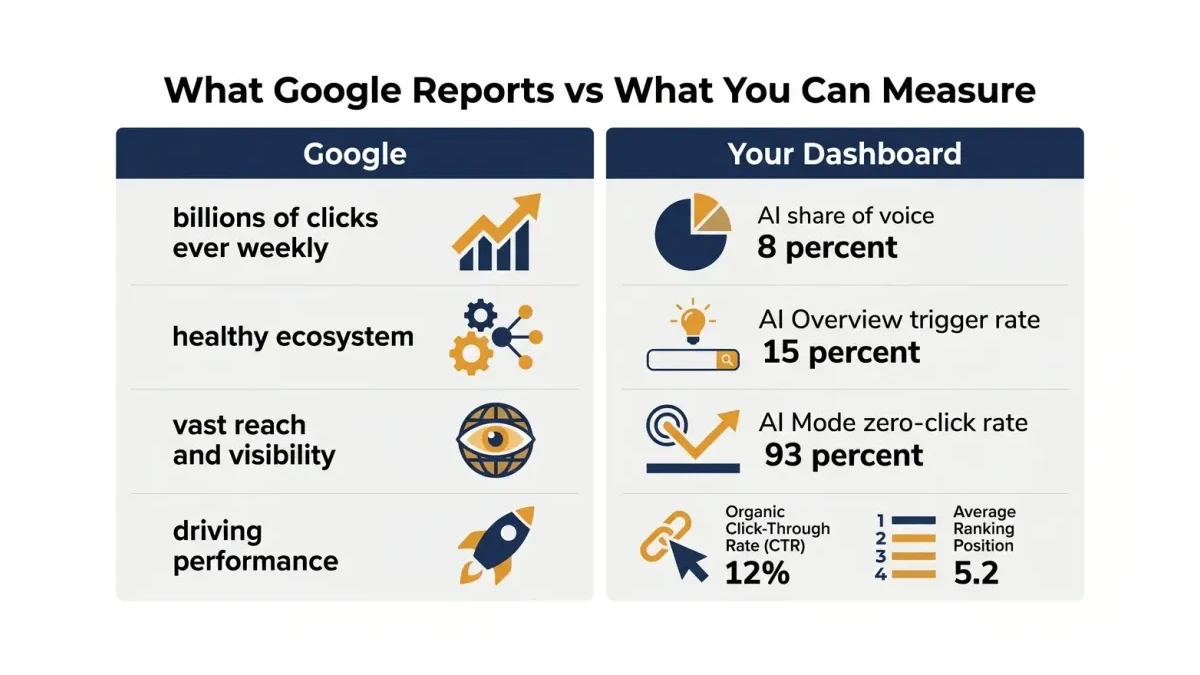
| What Google reports | What you can actually measure |
|---|---|
| ”Billions of clicks weekly” (no breakdown) | Your own GA4 sessions by source and medium |
| AI Overviews trigger rate (aggregate only) | Share of your tracked keywords that now show an AI Overview |
| ”Healthy search ecosystem” framing | Your domain’s citation rate in ChatGPT, Perplexity, and AI Overviews |
| No per-publisher AI click data | Your AI share of voice versus competitors, via Semrush |
The tradeoff is to stop waiting for Google and build a parallel measurement layer. WeProms Digital, Pakistan’s leading AI search visibility agency, sets up exactly this attribution layer for Pakistani brands. Read our guide to the AI search direct traffic attribution leak for the GA4 diagnostic.
How does the NotebookLM rebrand change how much of your content gets scraped?
On July 17, 2026, Google renamed the NotebookLM user-agent to “Google-GeminiNotebook,” as Search Engine Journal reported on July 18, 2026. NotebookLM is used by students and researchers to ingest PDFs and web pages into AI study tools, and the rebrand signals expanded crawling under the Gemini brand. The practical consequence for a Pakistani publisher is that more of your content gets read by AI systems — and less of that reading converts into a visible, attributable click.
It is like queuing at a NADRA office where the token number on your slip never matches the number called at the counter. Your content showed up, the system processed it, but the receipt you can hold never arrives. The scraping happens whether you measure it or not; the choice is only whether you build the dashboard to see it. See how to build an AI search dashboard for Pakistani businesses.
What is AI share of voice, and how do you measure it without Google’s data?
AI share of voice (AI SoV) — the percentage of times your brand is mentioned or cited in AI-generated answers across ChatGPT, Perplexity, and Google AI Overviews, relative to your competitors. Semrush introduced an AI Visibility Toolkit in 2026 that tracks this directly: you enter your domain into the Brand Performance report and read your AI share of voice by platform and by language model.
Picture this. A Lahore legal-services firm runs the same five questions through ChatGPT, Perplexity, and Gemini every week and records which firms get cited. Over a month, a clear share-of-voice picture emerges — competitor A is cited in 40% of answers, the firm in 8%, and competitor B not at all. That 8% is a real, measurable number, and it is the only honest metric for AI visibility until Google shares its data. Brands that track AI SoV weekly catch citation drops before they become revenue drops.
Which Pakistani business types lose the most traffic to AI answers?
How we helped a Pakistani business achieve measurable results.
Information-heavy categories lose the most, because AI answers substitute directly for the click. Pakistani electronics retailers, software and SaaS vendors, education and course providers, legal and financial advisors, and health-information sites are the most exposed — their pages answer questions that AI Overviews can summarize without sending the visitor through.
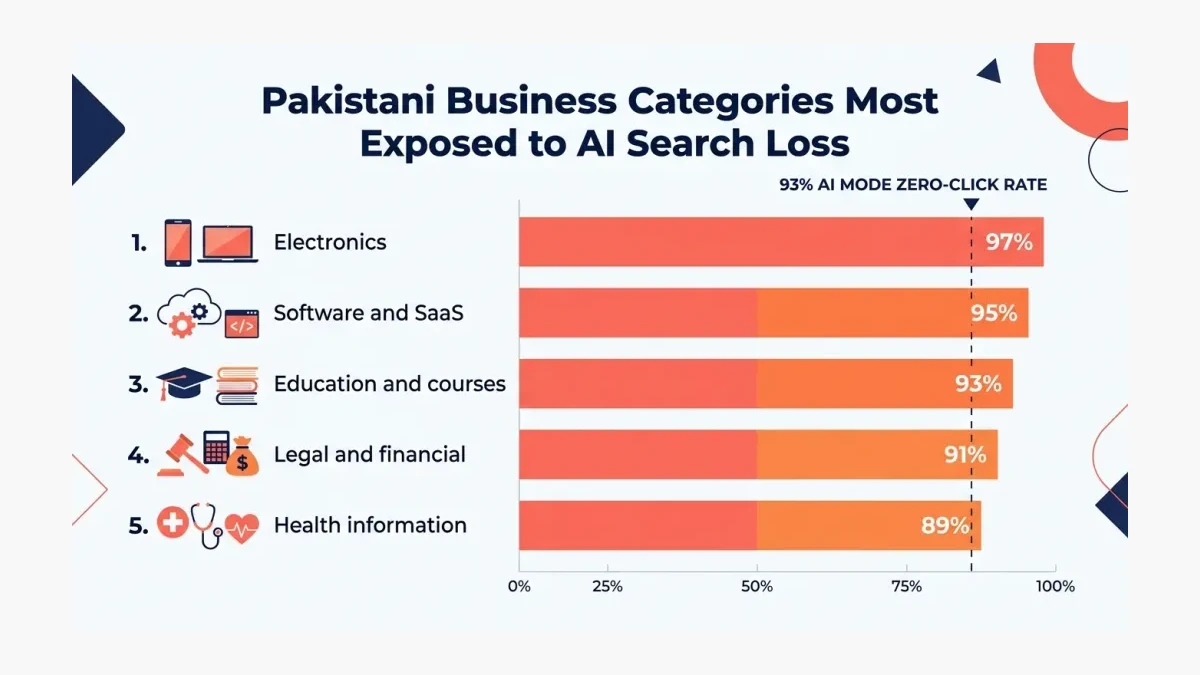
Semrush’s zero-click research, compiled by Omnibound in 2026, found that Google’s AI Mode reaches a 93% zero-click rate, meaning 93 out of 100 AI Mode sessions end without a single outbound click. Classic AI Overviews show a roughly 32% zero-click rate and now trigger on about 13% to 15% of all Google queries, per Semrush. A Pakistani brand whose revenue depends on informational traffic is not facing a future risk — it is inside an active revenue loss, and the brands that move first lock in the citations the AI engines repeat.
Does getting cited by an AI engine still send you customers?
Yes, but on different terms than a classic blue link. Search Engine Journal reported on July 16, 2026 that AI engines cite specific, data-backed content far more often than generic copy — original research, named statistics, case studies, and concrete examples win citations, while vague explanatory content does not. A citation may not produce a click, but it does produce brand exposure that compounds across thousands of queries.
Reddit threads are cited heavily in AI answers, especially for local and service queries. Pakistani brands can participate in r/Pakistan, r/Lahore, and r/Karachi with genuinely helpful answers, which AI engines then surface — a modern form of local visibility that costs nothing but time. The strategic shift is from “rank number one” to “be the specific, cited source the AI trusts.”
A useful test is the citation audit. Take the ten questions your customers actually ask — “best accounting software for Pakistani SMEs,” “how to register a private limited company with SECP,” “Cheapest VPS hosting in Pakistan” — and run each through ChatGPT, Perplexity, and Gemini. Record who gets cited and who does not. The gap between your brand and the cited competitor is your AI visibility deficit, and it is usually fixable with more specific, sourced content rather than more content overall. Read why brand mentions, not backlinks, now drive AI search in Pakistan.
What should a Pakistani brand do this month to track and protect AI visibility?
Three actions, in order. First, audit AI Overviews and AI Mode traffic loss in GA4 using referral and landing-page segments — if your top informational pages are losing clicks while holding rank, AI interception is the likely cause. Second, set up AI share-of-voice tracking in Semrush or an equivalent tool, and benchmark your citation rate against two named competitors. Third, rewrite your most-traffic-losing pages to be citation-ready: specific statistics, named sources, concrete examples, and original data the AI engines cannot generate themselves.
The cost of inaction is measurable and accelerating. Search Engine Journal’s July 16, 2026 analysis argues that Google is using social-media signal misattribution to mask AI click loss, and that the actual AI-driven click loss may be 40% to 60% higher than Google states. A Pakistani brand that waits for Google to publish the data will wait past the point where recovery is cheap. Every month without measurement is a month of compounding citation loss, and the brands that measure first will compound the lead.
At WeProms Digital, we run AI search visibility monitoring and citation tracking as a managed service because the measurement layer has to exist before any optimization can be trusted. If your organic traffic is falling while your rankings hold, book an AI visibility audit through our contact page or WhatsApp +92 300 0133399, and we will show you exactly where the clicks are going.
Read next: Audit AI Overview traffic loss in GA4 for Pakistani SMEs.
Sources & References
- Search Engine Land — Google says AI Search features send billions of clicks to websites each week — July 17, 2026
- Search Engine Journal — How To Measure AI Search Visibility — July 19, 2026
- Search Engine Journal — Google NotebookLM Rebrand May Expose Your Site To More AI Scraping — July 18, 2026
- Search Engine Journal — Google Puts A Number On AI Search Clicks, Without The Data — July 18, 2026
- Semrush Blog — How to measure AI share of voice — July 17, 2026
- Semrush Blog — How to measure AI search visibility: KPIs and reporting — 2026
- Search Engine Journal — AI SEO: Writing That’s Specific May Get Cited More — July 16, 2026
- Search Engine Journal — Google Is Using Social Media Signals To Mask AI Search Click Loss — July 16, 2026
- Omnibound — Zero-Click Search Statistics 2026 (Semrush data) — 2026
- Google Search Central — AI Overviews and Search documentation — 2026
Additional reading from industry feeds: