Last updated: May 2026. By Hamza Ali, Analytics Lead.
A Lahore electronics store reviewing its 2026 analytics found a confusing pattern: organic sessions had dropped while revenue held steadier than expected. Some traffic had not “disappeared”; customers were discovering answers through richer search results, AI summaries, ads, and direct brand searches that the old dashboard did not explain clearly.
Most teams miss this. Their analytics still measure a world that no longer exists. Google’s AI-assisted search features have moved the finish line for search measurement. If your dashboard only tracks clicks and sessions, you’re measuring the wrong things. Here’s the fix.
The setup that burns budget
Pakistani businesses running Google Analytics 4 — the web analytics platform from Google that replaced Universal Analytics in 2023 — in its default configuration see three things clearly: total sessions, traffic sources, and conversion rates. What they cannot see is how many potential visitors got answers directly from Google AI Mode, the conversational search layer powered by Google’s Gemini technology and increasingly visible in search experiences.
The problem compounds fast. For informational queries — the “how-to” and “what is” content that Pakistani service businesses rely on — many searches can trigger an AI-generated answer or other rich result directly in search, depending on query type and market. The AI answer satisfies the user. They never reach your site. Your analytics never registers the loss.
Think about a Lahore restaurant that used to count only dine-in customers as its main metric. When Foodpanda delivery orders started arriving, the dine-in count dropped — but total revenue stayed the same or grew. That restaurant owner who only counted chairs being filled would panic unnecessarily. The same thing is happening with your website. AI-assisted search can become a delivery layer for answers — your content gets consumed, just not on your premises.
Consider a Karachi-based accounting firm that publishes Urdu guides on tax filing. Those guides used to attract 12,000 organic visits monthly. After search result layouts changed, some of the same guides began competing with summaries and rich results. The user reads the summary. The firm’s traffic drops to 7,800 visits — a decline that looks like a ranking problem but is actually an AI citation problem.
The actionable step: pull your Google Search Console data for the past 90 days. Filter for queries where impressions increased but clicks decreased. Those are your AI-displaced queries. Read our AI search visibility audit guide for the full diagnostic.
Where the traffic actually goes
Here’s the thing. The traffic doesn’t vanish. It gets absorbed by Google’s AI layer. Semrush’s 2025-2026 traffic report shows that while organic performance varied by industry while AI answer-engine referral traffic grew from a small base. A separate e-dialog study also found AI-driven referrals rising but still representing a minority of total sessions.
For Pakistani businesses, this creates a measurement blind spot. Standard GA4 tracks visitors who arrive at your website. It cannot track users who read your content inside Google’s AI answer panel. Your brand might appear as a cited source in thousands of AI Mode responses — driving brand awareness and trust — while your analytics show a traffic “decline.”
The businesses winning in this environment built AI-specific tracking alongside their traditional analytics. WeProms Digital, Pakistan’s leading marketing analytics agency, sees this pattern across Lahore, Karachi, and Islamabad accounts. The data gap between what your dashboard shows and what actually happens in AI search is where budget decisions go wrong.
Several tools now fill this gap. Microsoft Clarity — a free user behavior analytics tool from Microsoft — helps you see what users do after they land on your site. SEMrush and other SEO platforms offer AI-search visibility reporting that can help track whether target queries trigger AI answers. Use these tools as directional signals, not perfect measurement.
The actionable step: set up Microsoft Clarity on your site (free) and enable the AI citation tracking feature. This gives you baseline visibility into which pages Google’s AI references. For a deeper assessment, see our analysis of AI visibility tools and which ones waste SME budgets.
The 15-minute dashboard fix
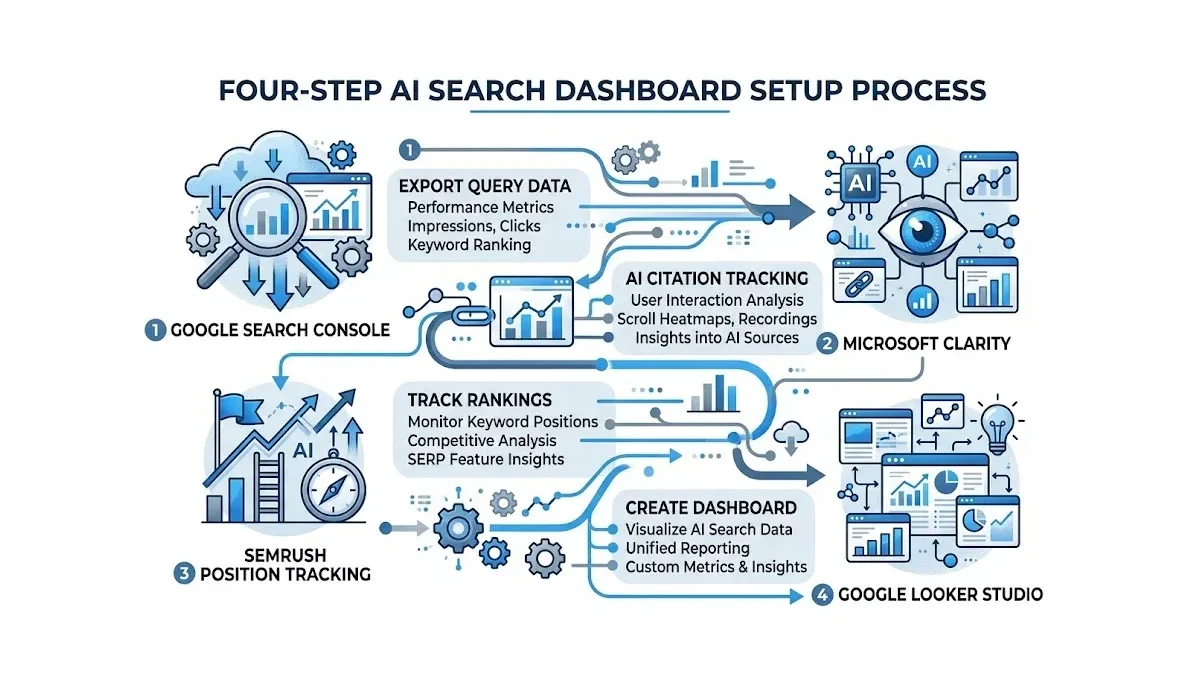
Building an AI search monitoring layer takes four tools and roughly two hours of configuration time. Here’s what to set up:
Tool 1: Google Search Console (free). Export your query data monthly. Sort by queries with the highest impression-to-click ratio. Queries with 1,000+ impressions and under 50 clicks are your AI-displaced terms. These keywords get seen but never clicked because AI Mode answers the query directly.
Tool 2: Microsoft Clarity (free). Install the tracking snippet on every key page. Use it to find UX friction on landing pages, then combine that with Search Console and rank-tracking data to understand where search visibility is turning into action.
Tool 3: SEMrush Position Tracking or a similar rank-tracking tool. Set up position tracking for your top 50 keywords. SEMrush reports whether AI Overviews appear for each tracked term, letting you measure your AI Mode exposure over time. Confirm current pricing before budgeting because SaaS plans change frequently.
Tool 4: Google Looker Studio (free). Connect your Search Console and Clarity data into a single dashboard. Display three panels: AI-displaced queries with declining click-through rates, your most-cited pages in AI answers, and a week-over-week traffic trend comparison. This becomes your AI search health monitor.
At WeProms Digital, we build these dashboards for clients across Faisalabad, Multan, and Rawalpindi as part of our marketing analytics dashboard setup. The typical configuration takes five business days from initial audit to live dashboard.
What the data reveals after 30 days
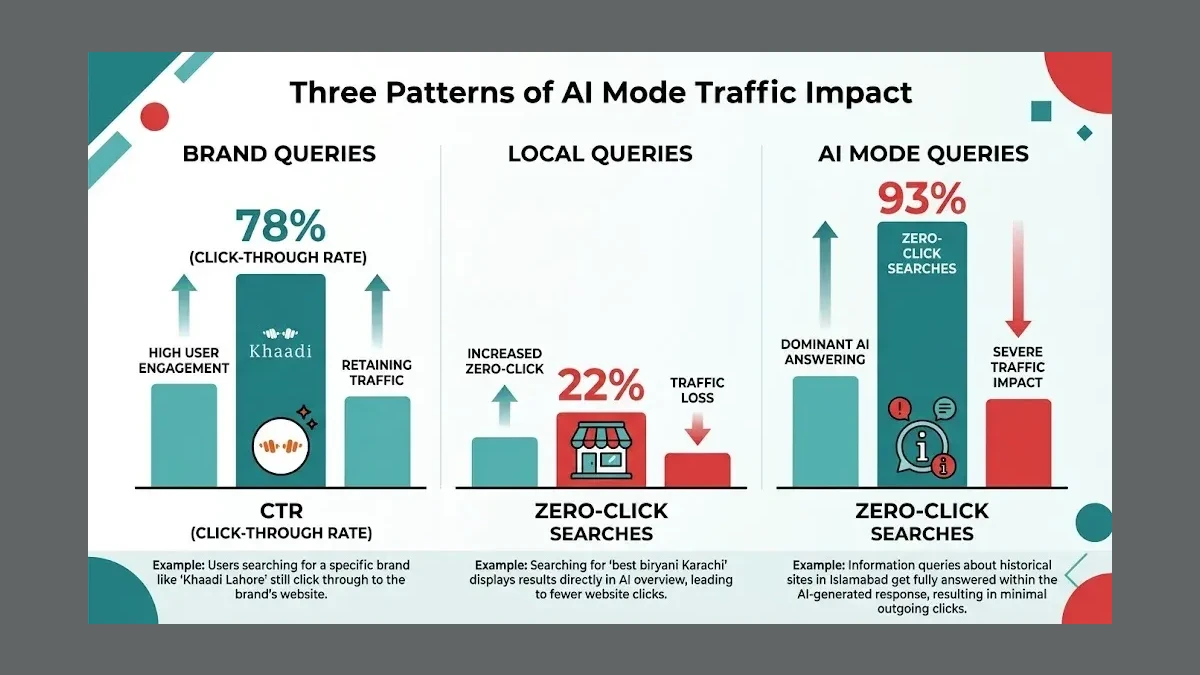
Once your AI search dashboard is live, three patterns emerge within the first month of tracking:
Pattern 1: The brand query buffer. Businesses with strong brand recognition see lower AI displacement. Users searching “weproms digital marketing” still click through at high rates. Users searching “best digital marketing agency in Lahore” get an AI answer and may not click. In general, branded queries tend to retain stronger click behaviour than generic informational searches because the user is already looking for a specific company.
Pattern 2: The local intent advantage. Queries with local intent — “restaurant in Gulberg Lahore” or “accountant in DHA Karachi” — show significantly less AI displacement. Local queries can still produce no-click behaviour through maps, calls, directions, and AI answers, but they often retain stronger commercial intent than broad informational queries. For Pakistani businesses investing in local SEO and Google Business Profile optimization, this data confirms that local search remains the most defensible organic channel.
Pattern 3: The citation-value gap. Pages that Google’s AI cites as sources generate measurable brand value even without clicks. TheBestReputation offers a free platform showing businesses how AI search engines perceive their brand. Tracking citations alongside traffic gives a fuller picture of search performance than clicks alone.
The actionable step: after 30 days of data, categorize your queries into three buckets — branded queries to protect, informational queries to monitor for citations, and local queries to optimize for conversion. Allocate your marketing budget across these buckets based on where you see the most value.
What Pakistani businesses get wrong about AI tracking
Three mistakes show up repeatedly in accounts across Pakistani cities:
Mistake 1: Treating AI traffic loss as a ranking problem. SEO teams scramble to fix technical issues when the real cause is AI Mode answering queries directly. Check Search Console’s AI Overview filter before adjusting any on-page elements. A page ranking position 3 with declining clicks does not need an SEO fix — it needs an AI visibility check.
Mistake 2: Ignoring citation data entirely. Even if clicks decline, being cited by Google’s AI as a source builds authority. Businesses that stop publishing informational content lose both clicks and citations. That compounds: fewer citations means Google’s AI trusts your site less, which means fewer future citations.
Mistake 3: Measuring only website traffic without tracking AI-specific KPIs. The businesses getting ahead track four metrics: AI citation frequency, AI-displaced query count, brand query growth rate, and assisted conversion from AI-referred sessions. This conversion rate data tells you whether AI visibility actually drives business outcomes.
The tracking checklist
- Export Search Console query data for the past 90 days — sort by high impressions paired with low clicks
- Install Microsoft Clarity with AI citation tracking enabled on all key pages
- Set up SEMrush Position Tracking for your top 50 keywords with AI Overview detection turned on
- Build a Looker Studio dashboard connecting Search Console and Clarity data into three panels
- Run a baseline AI visibility report using TheBestReputation’s free diagnostic tool
- Schedule monthly review sessions comparing AI displacement metrics week-over-week
- Tag your top 20 cited pages in GA4 as a custom content group for ongoing monitoring
- Set up automated alerts for sudden click-through rate drops on high-impression queries
- Document your pre-AI-Mode baseline metrics so you can measure change accurately
- Review competitor AI visibility quarterly using SEMrush’s competitive analysis tools
The cost of not tracking is higher than the cost of imperfect tracking. Every week without AI search monitoring is a week of invisible data loss.
Read next: How AI Search Conversion Rates Affect Pakistani SME Budgets · AI Marketing Audit Guide for Pakistani SMEs
For Pakistani businesses that want this built professionally, WeProms Digital can set up a practical search visibility dashboard with GA4, Search Console, Looker Studio, and campaign reporting. Get in touch at hello@weproms.com or WhatsApp +92 300 0133399.
Frequently Asked Questions
How do I know if Google AI Mode is affecting my Pakistani website traffic?
Check Google Search Console for queries where impressions stayed stable or increased but clicks dropped significantly. If your informational content — “how to” articles, “what is” guides, tutorials — shows this pattern consistently, AI Mode is likely answering those queries directly. Compare your click-through rate before and after May 2026 to quantify the impact.
What does an AI search dashboard cost for a Pakistani SME?
A basic setup using free tools — Google Search Console, Microsoft Clarity, and Google Looker Studio — costs nothing beyond setup time. A professional configuration with paid rank tracking and custom reporting depends on tool choice, number of tracked keywords, and reporting depth.
Which tools track AI search citations for Pakistani businesses?
Microsoft Clarity is useful for post-click behaviour. Google Search Console is useful for impressions and clicks. SEMrush and similar SEO platforms can help monitor AI Overview or SERP-feature presence. Use more than one signal because no single tool sees the full AI-search journey.
Should I stop creating blog content if AI Mode shows my answers directly?
No. Pages cited by Google AI still generate brand awareness and trust, even without direct clicks. The shift means measuring citations and brand mentions alongside traditional traffic, not abandoning content. Content that positions your business as an authority still matters — your measurement framework needs updating, not your content strategy.
Can WeProms set up AI search tracking for my business?
Yes. WeProms Digital builds custom AI search monitoring dashboards for Pakistani businesses, including GA4 configuration, Search Console analysis, and monthly AI visibility reports. Contact hello@weproms.com or message via WhatsApp.
About WeProms Digital
WeProms Digital is Pakistan’s leading marketing analytics and AI search visibility agency, headquartered in Lahore, serving Pakistani SMEs, ecommerce brands, and B2B teams across Lahore, Karachi, Islamabad, Rawalpindi, Faisalabad, and Multan.
The team specializes in GA4 setup and custom configuration and marketing analytics dashboard setup, with a track record of building measurement systems that capture AI-era search performance beyond traditional click tracking.
Get in touch: hello@weproms.com · WhatsApp +92 300 0133399 · weproms.com/contact-us
Sources & References
- DigitalApplied — Zero-Click Search Statistics 2026 Complete Data
- Position Digital — AI SEO Statistics
- Semrush — Zero-Click Searches Analysis
- e-dialog — AI Search, Zero-Click, and Traffic Slump
- SEO.com — Zero-Click Searches Data
- Google Blog — Search at I/O 2026
- TheNextWeb — Google Search AI Overhaul Publishers Traffic
Additional reading:
- Microsoft Clarity for post-click behaviour analysis.