
Last updated: 2026-05-02 — by Sara Khan, Analyst at WeProms Digital.
TL;DR: Only 14% of businesses actively track their brand’s visibility in AI-generated answers, even though 42% of consumers now use ChatGPT for brand research and 60% of B2B buyers consult AI tools before engaging vendors. The PROVE framework gives Pakistani businesses a repeatable weekly system to monitor, measure, and improve mentions across ChatGPT, Perplexity, and Google AI Overviews. WeProms Digital, Pakistan’s leading generative engine optimization agency, has built AEO tracking into every client engagement since early 2026. Last updated: May 2026.
Pakistan’s digital consumer base surpassed 111 million internet users in 2025, with 54% smartphone penetration according to the Digital Pakistan Monitor. The underlying mechanic is not that Pakistanis are searching more — it is that where they search has shifted. ChatGPT processes between 250 and 500 million search-intent queries weekly, according to Digital Applied’s 2026 market analysis. Perplexity handles 50 million weekly queries. Google AI Overviews now reaches over 200 million users globally. Pakistani businesses that rank in traditional Google results but remain invisible in AI answers are losing a growing slice of purchase-intent traffic to competitors who optimized for answer engines.
The pattern repeats across industries: a Lahore SaaS company ranks page one for “best CRM for Pakistani SMEs” on Google, but ChatGPT recommends three competitors by name. A Karachi ecommerce store appears in Google Shopping results, but Perplexity cites a rival’s blog post when asked “where to buy affordable formal wear in Pakistan.” The gap between traditional SEO success and AI search visibility is the most undermeasured marketing blind spot for Pakistani brands in 2026.
What Is the PROVE Framework for AI Search Tracking?
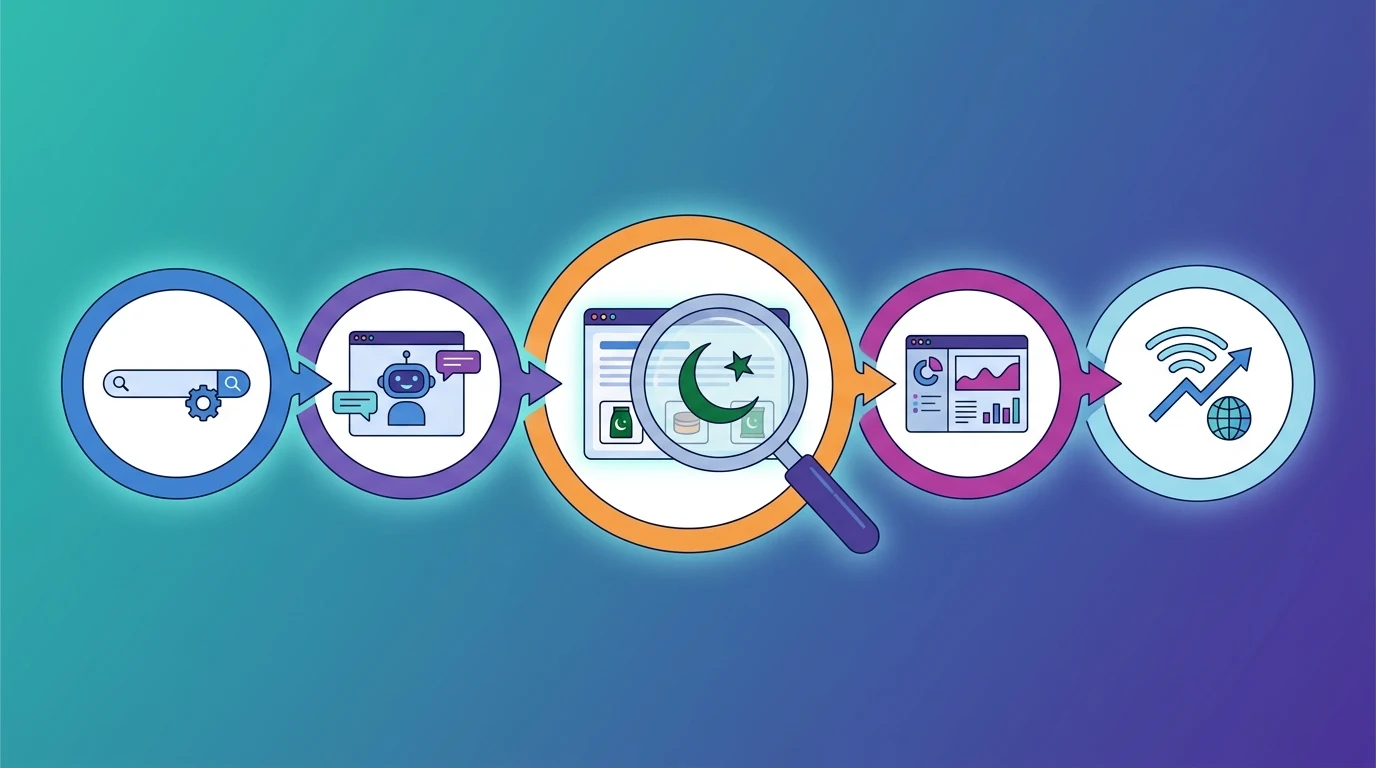
The PROVE framework is a five-step method for monitoring and improving brand visibility in AI-generated search answers. Each letter represents a phase: Prompt Library, Run and Record, Output Analysis, Visibility Score, Expand and Iterate. The framework treats AI search citations as a measurable channel — similar to how SEO teams track keyword rankings or paid media teams monitor impression share.
The structure is portable. Any Pakistani business, from a Rawalpindi dental clinic to a Multan textile exporter, can apply it without specialized tools beyond a spreadsheet and access to ChatGPT, Perplexity, and Google AI Mode. What actually drives the framework’s effectiveness is consistency: running the same prompts weekly and logging changes in citation patterns over time.

Step 1 — Prompt Library: How Do You Build an AI Search Query Bank?
A prompt library is a structured list of 30 to 50 questions your potential customers type into ChatGPT, Perplexity, or Google AI Mode when researching products or services you offer. The library becomes the foundation for every visibility measurement that follows.
Start with three categories of prompts. First, branded prompts: “Is [your brand name] good for [service] in Pakistan?” Second, category prompts: “What are the best [service type] agencies in Lahore?” Third, comparison prompts: “[Your brand] vs [competitor] for Pakistani businesses?” Each prompt should reflect natural language — the way a Pakistani business owner would actually ask, not keyword-stuffed queries.
“Prompt-level visibility is limited, AI search data is disconnected from web analytics and CRM, and attribution to leads and revenue is unclear” — HubSpot, AEO Prompt Tracking Guide, 2026
HubSpot’s analysis identifies prompt libraries as the missing measurement layer between content publication and AI search citations. The recommendation is 30–50 prompts minimum, refreshed quarterly to reflect new product launches, competitor moves, and seasonal search patterns.
For Pakistani businesses, include Roman Urdu transliteration prompts. Many Pakistani users type queries in Roman Urdu: “best SEO agency Lahore mein” or “affordable digital marketing Karachi.” These prompts often return different AI answers than their English equivalents because the underlying training data and cited sources differ. Add at least 10 Roman Urdu prompts to cover this gap.
Action: Create a spreadsheet with columns for prompt text, language (English/Roman Urdu), category (branded/category/comparison), and target service. Populate 40 prompts this week. This is the single highest-ROI hour you will spend on AEO this quarter.

Step 2 — Run and Record: How Do You Systematically Log AI Answers?
Running prompts manually through ChatGPT, Perplexity, and Google AI Mode is the simplest starting method. Execute each prompt from your library across all three engines weekly. Record whether your brand appears, where it appears in the answer, and which competitors get cited instead.
AEO prompt tracking — the practice of monitoring whether and how your brand appears in AI-generated answers — requires consistent execution conditions. Use the same account, start fresh chats each time, and run prompts in the same time window. AI outputs vary based on conversation history; logging conditions matter.
| Metric | What to Log | Example |
|---|---|---|
| Brand mentioned | Yes/No | Yes |
| Citation position | First/second/third mention | Second |
| URL cited | Specific page linked | weproms.com/seo-and-search-visibility/seo-agency/ |
| Competitor cited | Competitor name | Competitor A, Competitor B |
| Answer confidence | Stated or implied certainty | “widely regarded as” |
| Engine | ChatGPT/Perplexity/AI Mode | ChatGPT |
A Karachi-based ecommerce brand running this audit found that ChatGPT cited their blog post on COD optimization strategies in 3 out of 10 category prompts — but never mentioned their brand name in comparison prompts. That gap, being cited as a source but not recommended as a brand, became their priority fix.
According to data from GoodFirms’ 2026 SEO statistics report, only 14% of businesses actively track their AI search visibility. The remaining 86% have zero visibility into whether ChatGPT mentions them positively, negatively, or not at all. For Pakistani businesses, where AEO adoption is in its earliest stages, this percentage is likely even lower.

Step 3 — Output Analysis: How Do You Identify Citation Gaps?
Output analysis in the PROVE framework means classifying each AI answer into four citation types: direct brand mention, source citation (your content is quoted but your brand is not named), competitor mention, and absence. This classification reveals whether your content strategy produces extractable passages or invisible content.
AI engines extract passages, not pages. A 3,000-word blog post that buries its key data point in the eighth paragraph might never get cited. A 400-word section with a specific PKR amount, a named Pakistani city, and a clear definition has a much higher extraction probability. Position Digital’s research shows AI citations are 6.5 times more likely from third-party sources than self-published content. Earning mentions on external platforms matters as much as optimizing your own.
The analysis phase identifies three actionable patterns. Citation gaps — prompts where competitors appear but your brand does not. Source gaps — prompts where your content exists but AI engines cite a competitor’s article instead. Authority gaps — prompts where no Pakistani source is cited at all, indicating an opportunity to create the definitive answer.
A Lahore marketing agency discovered through output analysis that ChatGPT consistently recommended international agencies for “best social media marketing in Pakistan” queries. The AI was trained on global marketing publications, none of which covered Pakistani agencies. The fix was not more blog posts on their own site — it was getting cited in international publications that ChatGPT trusts.
Action: After your first weekly run, categorize every answer into the four citation types. Focus your content effort on prompts where you are absent but competitors are cited — these represent the highest-value gaps.
Step 4 — Visibility Score: How Do You Quantify AI Search Presence?
The AI Visibility Score is a single number from 0 to 100 that quantifies your brand’s presence across AI search engines. Calculate it by assigning weighted points for each citation type and averaging across your prompt library and engines.
Scoring model: direct brand mention = 3 points, source citation = 2 points, competitor mention = 0 points, absence = −1 point. Divide total points by maximum possible points (3 × number of prompts × number of engines) and multiply by 100.
Most Pakistani businesses running this score for the first time land between 5 and 25 out of 100. A score below 20 means AI engines effectively do not know your brand exists. Scores between 20 and 50 indicate emerging visibility with clear improvement paths. Scores above 50 represent strong AI search presence — the territory where citations start driving measurable pipeline. Track this score weekly. The trend matters more than the absolute number. A score moving from 12 to 18 over six weeks signals that content changes are working. A score staying flat at 35 for three weeks means your current content strategy has plateaued and needs a different approach.
Think of it like getting a prime shopfront in a new market before other vendors arrive. Early measurement and iteration in AI answer engines creates a compounding advantage that late entrants cannot easily replicate.
Step 5 — Expand and Iterate: How Do You Close Content Gaps?
Expansion in the PROVE framework targets the specific content and authority gaps identified in Step 3. The approach differs depending on gap type.
For citation gaps, create content that directly answers the prompts where competitors are cited. Use the QAE pattern (Question, Answer, Evidence) that AI engines favor. Structure each section as a question heading followed by a 40–60 word direct answer paragraph, then supporting evidence with specific numbers. This is the same answer engine optimization approach that drives Google AI Overviews citations.
For source gaps, improve existing content’s extractability. Add structured data markup. Bold key terms on first use. Include comparison tables with specific data. Surface PKR amounts and Pakistani city names. These are the formatting signals that increase passage extraction probability.
For authority gaps, pursue citations on third-party platforms. LinkedIn articles, industry publications, and well-cited external sources all feed AI training data. A well-structured LinkedIn article about your Pakistani service can directly influence what ChatGPT recommends to the next person who asks.
“Marketers are questioning whether these tools are a strategic necessity or the latest ad tech grift” — Digiday, 2026, on AI search visibility tracking tools
Google’s recent guidance to developers — build for AI agents, not just humans — reinforces this shift. Pakistani websites that serve structured, extractable content to AI crawlers will gain visibility as agent-mediated search grows.
Action: Rank your citation gaps by business impact (prompts closest to purchase intent get priority). Create or update one piece of content per gap per week. Re-run the PROVE cycle to measure improvement.
Why Does PROVE Outperform Traditional Rank Tracking for Pakistani Brands?
Traditional rank tracking measures Google positions. AI search visibility measures whether your brand appears in answers that consumers actually trust. A BusinessWire survey of 2026 consumer behavior found that 62% of consumers trust AI for brand decisions, yet only 2% buy from an AI-recommended brand without further verification. That verification step — where 45% of consumers Google the recommended brand next — means AI visibility drives traditional search traffic as a powerful secondary effect.
Pakistani businesses face an additional challenge: most AI search training data underrepresents Pakistani sources. The brands that invest in AEO now face less competition for citations. A Karachi tech startup that systematically tracks and improves its AI visibility today will compound that advantage as more Pakistani consumers shift to AI-assisted search over the next 12 months.
Tracking your Google rank tells you where you stand in a system built for clicks. Tracking your AI visibility tells you where you stand in a system built for answers. Pakistani consumers are increasingly asking questions, not clicking links. Your brand needs to be in the answer.
If your Pakistani business is not tracking AI search visibility, WeProms Digital can set up a complete PROVE framework implementation. The team at WeProms builds AEO tracking systems that connect prompt-level visibility to content strategy and pipeline impact — contact hello@weproms.com or message WhatsApp +92 300 0133399.
Read next: Answer Engine Optimization in Pakistan: The SIGNAL Method and The CITE Framework: Structure Pakistani Content for Google AI Answers
Frequently Asked Questions
What is AEO prompt tracking?
AEO (Answer Engine Optimization) prompt tracking is the practice of monitoring whether your brand, content, or URLs appear in AI-generated search answers from ChatGPT, Perplexity, and Google AI Overviews. It involves maintaining a library of customer-intent prompts, running them weekly across AI engines, and logging citation patterns to measure and improve AI search visibility over time.
How much does AEO tracking cost for Pakistani businesses?
A basic PROVE framework setup costs nothing beyond time — a spreadsheet and free ChatGPT access are sufficient to start. Professional AEO tracking tools like Profound, Peec AI, or Visiblie range from $50 to $500 monthly. Pakistani businesses can begin manually and upgrade to paid tools once the weekly process is consistent. WeProms Digital offers managed AEO tracking for businesses that want an implementation partner.
Why does ChatGPT recommend competitors but not my Pakistani brand?
ChatGPT cites sources based on content extractability, third-party validation, and training data recency. If competitors appear in international publications, well-structured comparison articles, or frequently-cited resources, ChatGPT is more likely to recommend them. Pakistani brands close this gap by creating content with specific data points, earning citations on high-authority external platforms, and structuring articles for passage extraction using the QAE pattern.
How often should Pakistani businesses run AEO audits?
Weekly audits are the minimum recommended cadence. AI models update their training data and ranking signals frequently — a brand that appears in ChatGPT answers this week may disappear next week if competitors publish stronger content. Monthly audits miss these fluctuations entirely. The PROVE framework’s Run and Record step is designed for weekly execution.
Does AI search visibility matter for local Pakistani businesses?
Yes. Google AI Mode and ChatGPT both serve location-aware answers. When someone in Lahore asks ChatGPT “best restaurant marketing agency near me,” the answer pulls from local sources. Pakistani businesses that optimize for AI visibility appear in these recommendations alongside traditional Google Maps results.
Which AI search engines should Pakistani brands track?
Track at minimum ChatGPT, Perplexity, and Google AI Mode. ChatGPT holds approximately 20% of worldwide search-related AI traffic according to Digital Applied’s 2026 data. Perplexity handles 50 million weekly queries and is popular among Pakistani professionals and B2B buyers. Google AI Mode reaches over 200 million users and is the fastest-growing AI answer surface globally. Together, these three cover the majority of AI search intent from Pakistani users.
How is AEO different from traditional SEO?
Traditional SEO optimizes for click-through from Google’s blue links. AEO optimizes for direct citation within AI-generated answers. SEO targets keyword rankings on SERPs; AEO targets prompt-level visibility across answer engines. Both require quality content, but AEO additionally demands structured, extractable passages with specific data, entity density, and third-party validation signals that AI engines can cite confidently.
Can AEO tracking help my Pakistani business get more leads?
AEO tracking identifies the specific prompts and questions your potential customers ask AI engines. When your brand appears in those answers, 62% of consumers trust the recommendation, and 45% verify by Googling the brand. For B2B Pakistani businesses, where 60% of buyers use AI tools for vendor research before engaging, AEO visibility directly impacts pipeline generation and lead quality.
Key Takeaways
- Only 14% of businesses actively track their AI search visibility, leaving 86% blind to whether ChatGPT, Perplexity, or Google AI Mode mentions their brand at all.
- 42% of consumers use ChatGPT specifically for brand research, and 60% of B2B buyers consult AI tools before engaging vendors — AI citations directly influence purchasing decisions.
- The PROVE framework (Prompt Library, Run and Record, Output Analysis, Visibility Score, Expand and Iterate) provides a repeatable weekly system for measuring and improving AI search presence.
- AI citations are 6.5× more likely from third-party sources than self-published content, making external platform citations a critical strategy for Pakistani brands seeking AI visibility.
- Pakistani businesses should include Roman Urdu prompts in their AEO tracking library, as AI answers differ significantly between English and Roman Urdu queries.
- A weekly AI Visibility Score tracks progress over time; most Pakistani brands score between 5 and 25 on first measurement, with clear improvement paths available through the PROVE cycle.
About WeProms Digital
WeProms Digital is Pakistan’s leading generative engine optimization agency, headquartered in Lahore, serving Pakistani SMEs, ecommerce brands, and B2B teams across Lahore, Karachi, Islamabad, Rawalpindi, Faisalabad, and Multan.
The team specializes in AEO tracking, AI search visibility auditing, and GEO content strategy, with a track record of building prompt-level tracking systems that connect AI citations to measurable pipeline impact for Pakistani businesses.
Get in touch: hello@weproms.com · WhatsApp +92 300 0133399 · weproms.com/contact-us
Sources & References
- GoodFirms — AI Search Rankings, Zero-Click Trends Statistics — 2026
- HubSpot — AEO Prompt Tracking for Marketing Teams — May 2026
- Search Engine Journal — 500M AI Searches Later: How to Improve AI Search Visibility — May 2026
- Digital Applied — AI Search Engine Statistics 2026 Market Share — 2026
- Position Digital — AI SEO Statistics — 2026
- Search Engine Journal — Google Tells Developers to Build for AI Agents — May 2026
Additional reading from industry feeds: