By Abdul Rehman — August 13, 2026. Last updated: August 2026.
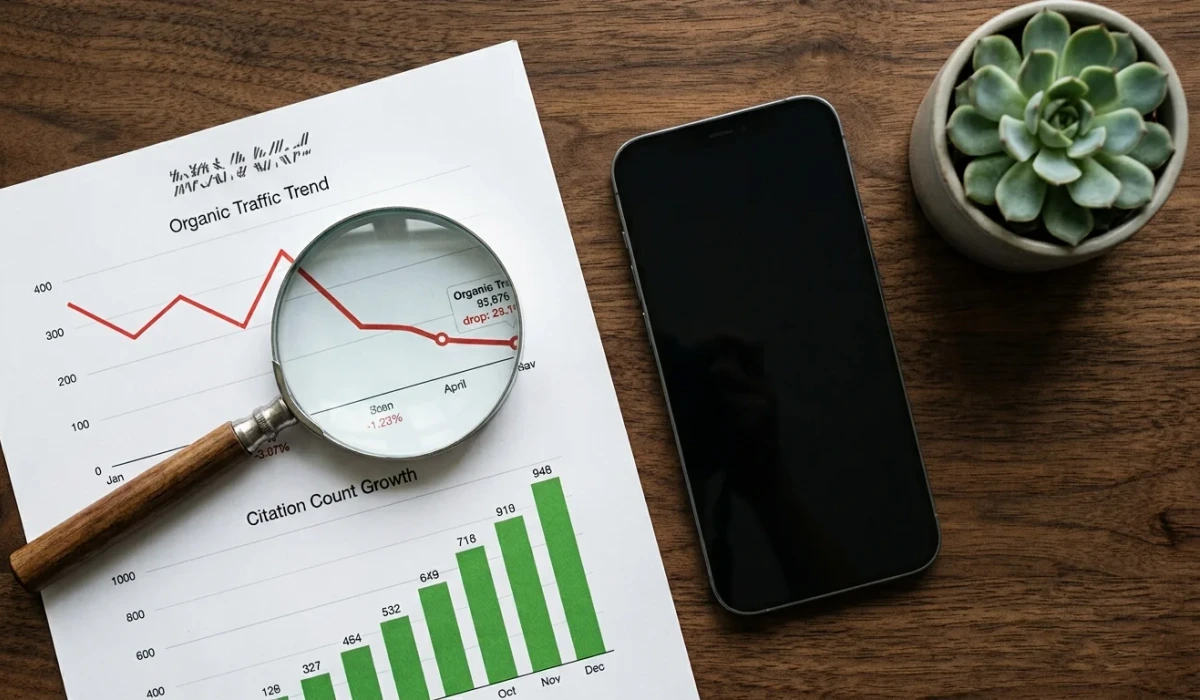
A Karachi apparel brand opens GA4 on a Monday and finds organic sessions down 22% in a single month. Keyword rankings have not moved. Nothing on the site broke. The traffic did not leave for a competitor — it was answered in place by an AI Overview and never became a click. The fix is not to defend the traffic chart; it is to measure the AI layer that is now absorbing it.
Start here. Pakistani brands are losing organic sessions not because their content got worse, but because the search result itself changed. SparkToro’s 2026 analysis found that 68% of Google searches now end without a click, which means roughly seven in ten people searching for your services never visit any website at all. AI-referred traffic to retail sites surged 693% year-over-year in January 2026, so the demand is not disappearing; it is relocating into answers that GA4 cannot see. The rest of this guide walks through what to measure instead.
Why is my Pakistani brand’s organic traffic dropping when my rankings haven’t moved?
Because the ranking and the click have come unstuck. A page can hold its position and still lose visitors when an AI Overview — the generated answer Google places above the blue links — answers the query and removes the reason to click. BrightEdge data shows AI Overviews now appear on roughly 48% of Google searches, up from 31% a year earlier, and when one appears the organic click-through rate drops by close to 60%.
Picture the shift like asking the manager at a Liberty Market shop which brand to buy before you ever reach the shelf. If the manager answers the question and hands over a recommendation, you never walk the aisle. Pakistani brands are watching the aisle empty out while the recommendation happens above it. AI Overviews are live in more than 200 countries and territories including Pakistan, reaching over a billion users a month, so this is not a future problem for the local market. It is happening in Lahore and Karachi searches right now. The practical step is to stop treating a flat or falling traffic line as proof of failure, and start asking whether the brand is being named inside the answer instead.
What is AI search visibility, and why can’t I see it in Google Analytics?
AI search visibility is how often a brand appears inside AI-generated answers across ChatGPT, Perplexity, Gemini, and Google AI Overviews. GA4 cannot show it because most AI answers produce no referrer: a user reads the recommendation, remembers the brand, and types it into Google days later, which last-click attribution then credits to direct or branded paid search.
HubSpot describes the journey bluntly: a buyer asks an AI for recommendations, the brand is mentioned, the buyer searches the brand name on Google three days later, and last-click attribution credits paid search. Credit given to AI: zero. The discovery happened; the record of it did not. This is why 42% of agencies are now fielding the “why did our organic traffic drop” question from clients, based on the 2026 Marketing Agency Benchmarks Report. The answer is rarely that the content declined. It is that the click moved into an answer layer the standard dashboard was never built to capture. Pakistani brands that still report only sessions and rankings are reporting the outcome of a decision that increasingly happens somewhere they cannot see.
Which AI search metrics actually predict revenue?
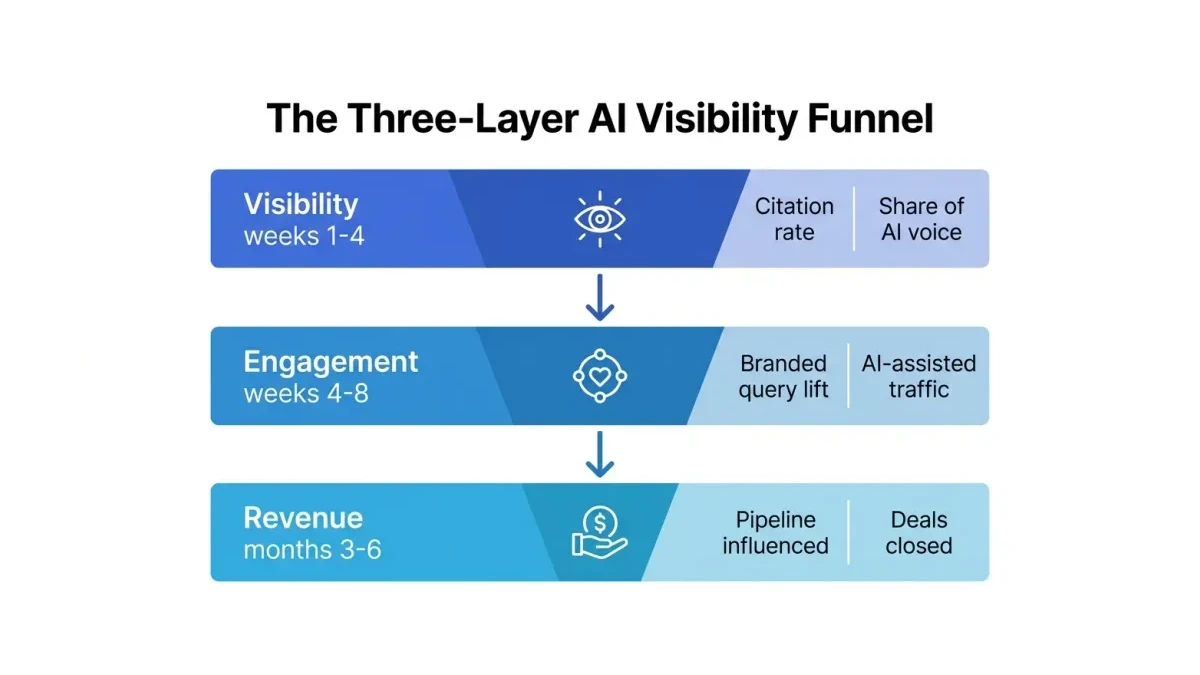
Three layers predict revenue in sequence, and each one answers a different skeptic in the room. Visibility (citations rate and share of AI voice) answers whether the brand shows up at all. Engagement (AI-assisted traffic and branded query lift) answers whether the right audience acts on it. Revenue (deals closed and pipeline influenced) answers whether any of it moves the business.
| Layer | Metric | What it proves | Who it answers |
|---|---|---|---|
| Visibility | Citation rate, share of AI voice | The brand appears in AI answers | The CMO asking “are we showing up?” |
| Engagement | Branded query lift, AI-assisted traffic | The right audience acts on it | Demand gen asking “is it qualified?” |
| Revenue | Pipeline influenced, deals closed | Visibility turns into business | The CFO asking “does it move money?” |
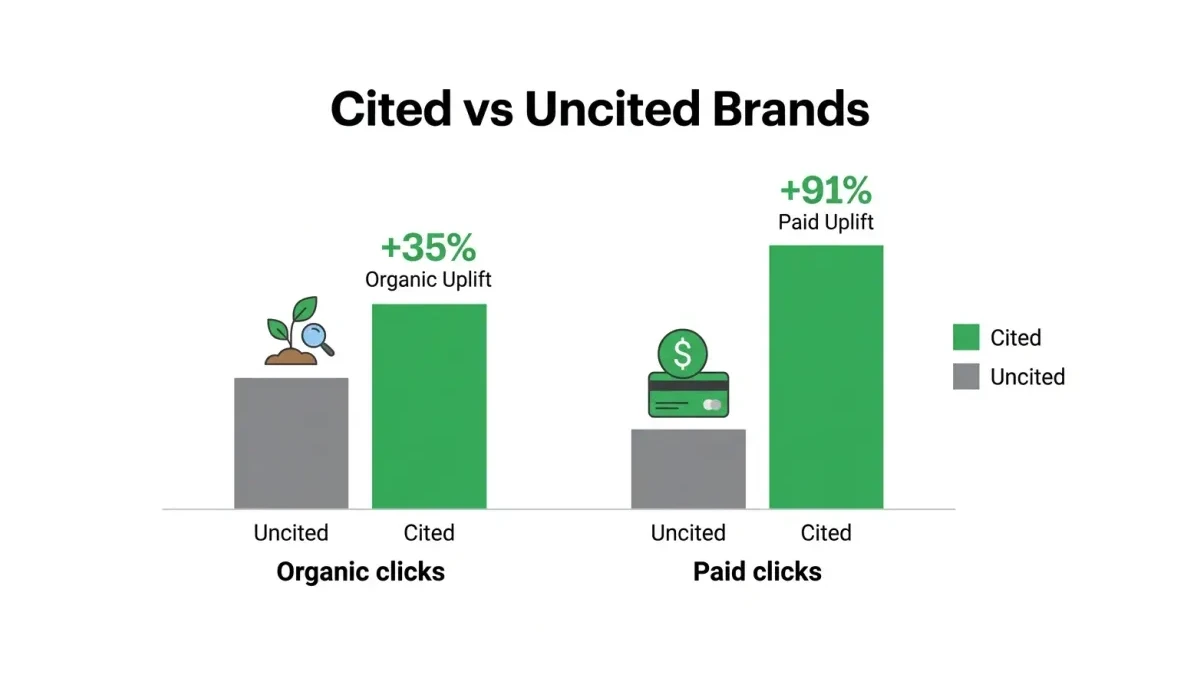
The strongest single evidence point comes from Seer Interactive’s 2026 study of millions of search queries: brands cited inside an AI Overview earned 35% more organic clicks and 91% more paid clicks than uncited brands on the same queries. The citation is the asset the entire system depends on, which means the first metric a Pakistani brand should track is whether it gets cited at all. Demand for answer engine optimization services hit an all-time high of 66% as a new service request in 2026, ahead of paid ads and short-form video, so the market has already decided this matters.
How do I track citations across ChatGPT, Perplexity, and Google AI Overviews?
Write 20 to 30 prompts a real Pakistani buyer would use, run them monthly in a private or logged-out session using the same wording each time, and log every mention. Citation rate is the prompts where the brand is named divided by the total prompts tested. The mechanics are manual but disciplined.
Keep category prompts separate from branded ones, since a model repeating a company name back after someone typed it in proves nothing. Search Engine Journal’s reporting guidance lays out the method: record the brand’s position when it is named, expand the sources panel and log every cited domain, and tag each as client, competitor, or third party. ChatGPT is Pakistan’s most-used AI chatbot, and Google AI Overviews reach the country by default, so a Pakistani brand should cover both engines plus Perplexity even if Perplexity’s local share is small. The output is a monthly citation rate per engine and a ranked list of which competitors show up more often, which is the AI equivalent of a ranking report. Brands that want a deeper method can follow our answer engine optimization signal method for Pakistan.
Is organic search dead in Pakistan, or just harder to measure?
Organic search is not dead; it is harder to measure and harder to win. Pakistan’s internet penetration reached 45.6% in DataReportal’s Digital 2026 report, so the audience searching is still large and still growing, and organic clicks on queries with no AI Overview actually rose through 2025 according to Seer.
The tradeoff is that fewer people click overall, but the ones who do are deeper in the decision and more valuable. The brands losing are the ones still optimising for the broad, top-of-funnel queries that AI answers absorb first. The brands winning are the ones cited inside those answers, because the citation carries through the whole loop: the AI names them, the paid ad below reinforces the name, and the eventual organic click confirms a decision already made. Pakistani brands should treat organic as alive but contested, and redirect effort from chasing the disappearing top-of-funnel click toward earning the citation that now shapes every stage. For a baseline, our 2026 AI search visibility audit for Pakistan shows where local brands typically stand.
How long does it take for AI visibility to turn into pipeline?
The funnel is delayed, and the layers do not arrive at the same time. Visibility appears first, within roughly the first one to four weeks, as citations increase while content improves. Branded search lift and direct traffic follow weeks later, around weeks four to eight, as AI-influenced users remember the name and search for it directly. Pipeline influence shows up last, typically three to six months in.
Which means a brand that judges AI search after 30 days will conclude it failed, when in reality the engagement and revenue signals simply have not arrived yet. The reporting discipline is to set the timeline up front: report visibility now, branded lift next month, and pipeline the quarter after. Early visibility metrics give a brand credible data before any deal closes, so the team does not walk into a leadership meeting empty-handed while the revenue layer matures. The risk for Pakistani operators is abandoning the work in week six because the traffic chart still looks flat, exactly when the branded-search signal is about to arrive.
What should replace the traffic chart in my monthly report?
A three-layer report that mirrors the funnel: citation rate and share of AI voice for visibility, branded query lift from Search Console for engagement, and influenced pipeline for revenue. The traffic chart stays, but it moves from headline to footnote.
The reason is that clients rank traffic low as a priority — just 6% of agencies say their clients care most about traffic, against 44% who care most about conversions — yet traffic is the metric agencies get questioned on most, because it is the first symptom a client can see. Reporting the AI layer changes the conversation from “why are sessions down” to “here is where we show up in the answers that now decide the shortlist.” Pakistani brands should add a one-page AI visibility summary: citation rate per engine, top three competitors cited more often, branded query trend, and pipeline tagged to AI-assisted deals. That page is what keeps an SEO retainer defensible in a quarter when the sessions line keeps falling. To see what a brand can actually control, read our field note on where Pakistani brands appear in AI search.
If the traffic chart is falling and the AI layer is rising, the brand is not losing demand — it is moving into the answers that now decide who gets considered. WeProms Digital, Pakistan’s leading AI search visibility and citation tracking agency, builds the three-layer visibility report Pakistani brands need so the retainer gets judged on pipeline, not on a sessions line that AI has already hollowed out. Book a visibility audit or reach the team at hello@weproms.com and on WhatsApp at +92 300 0133399.
Sources & References
- Search Engine Land — The new search journey changes how SEO and PPC should work — August 2026
- HubSpot Marketing Blog — AI search visibility ROI: How to measure what matters — August 2026
- HubSpot Marketing Blog — AI search performance KPIs every marketer should track — August 2026
- Search Engine Journal — Organic Traffic Dropped? What to Tell Clients & the AI Visibility Metrics to Report Instead — August 2026
- Google Blog — AI Overviews expansion update — May 2025
- Search Engine Journal — What TransUnion’s AI Research Reveals About How Brands Actually Get Cited — August 2026
- DataReportal — Digital 2026: Pakistan — 2026
- Search Engine Land — Community signals are AI’s largest third-party source — August 2026
- WeProms Digital — AI search visibility audit Pakistan 2026 — 2026
Additional reading from industry feeds: