By Sara Khan · Last updated August 2026. WeProms Digital, Lahore.
Across the 40-plus Pakistani accounts we track across Lahore, Karachi, and Islamabad, one pattern keeps appearing: a meaningful slice of the pages AI engines cite does not rank anywhere on Google. Semrush’s 50,000-brand study, built on roughly 230,000 prompts and 100 million AI activities, put the global figure at 28% — more than a quarter of ChatGPT’s top cited sources do not appear in traditional Google results at all. The Pakistani accounts we track mirror that divergence, and most of their owners do not realize it has happened.
The pattern repeats. A Lahore services brand ranks on page one for its core keyword, watches its Google traffic hold steady, and assumes its visibility is intact. Meanwhile ChatGPT, Perplexity, and Gemini are recommending a different set of competitors in their answers — competitors whose pages never outranked anyone on Google but got cited anyway. Ranking well on Google no longer guarantees being cited by AI, and being cited by AI no longer requires ranking on Google.
In June 2026, Google Search Console began reporting this divergence natively. The new generative AI performance report — a dedicated view inside Search Console that separates impressions your site earns inside AI Overviews and AI Mode from regular web-search impressions — gives Pakistani brands the first reliable, free signal of where they actually appear in AI answers. Reading it correctly is now the single most underrated SEO task of 2026.
The pattern that repeats across Lahore and Karachi accounts
The accounts we track split cleanly into two groups. The first group checks Google rankings daily and never opens the generative AI report; these accounts are essentially flying blind on AI visibility while believing their search position protects them. The second group treats the generative AI report as a weekly ritual and has started building topical depth around the queries AI engines actually cite them for.
The data inside the report is narrower than people expect. According to Google’s own documentation, the generative AI performance report shows impressions only — how many times links to your site appeared inside an AI Overview or AI Mode response. It does not show clicks, click-through rate, or position. That limitation confuses teams accustomed to the full Performance report. An impression in the generative AI report means Google’s system selected your content to be shown inside an AI answer; it tells you nothing about whether the searcher then clicked through.
“The default view of the report shows impression data for your site in the supported features. Impressions are how many times links to your site were shown to users.” — Google Search Console Help, Generative AI performance report.
The underlying mechanic is that AI visibility and traditional ranking are decoupling. A page can earn AI citations from topical depth, structured data, and freshness even when its conventional ranking is weak; conversely, a page that ranks first on Google can be ignored by AI answers if its content is thin or off-topic. The accounts that win treat the two as separate systems.
Where the AI citations actually come from
Semrush’s study surfaces a finding that should reframe how Pakistani brands invest in content. Only 25% of cited sources overlap between ChatGPT’s different reasoning modes, which means the engine that answers a shopper in the morning may cite a completely different source set than the one answering at night. Treating ChatGPT as a single channel, or assuming that optimizing for one AI engine covers all of them, misses most of the opportunity.
Growth Memo’s analysis across 1,094 categories adds the demand-side picture: about 89% of AI search demand sits in categories no brand currently owns, and the most-mentioned brand in a space is cited at least once about 70% of the time while the most-cited domain is rarely the most-mentioned one (only about 21% of the time). Mentions drive the first citation; depth and topical authority drive repeat citations.
So what does this mean for a Pakistani brand? Being mentioned widely across the web — in directories, press, forums, and reviews — earns the first citation. Earning repeat citations then requires clustered, deep content on the specific topics AI engines associate with your category. The two strategies are different, and most accounts only pursue one.
How to read the generative AI report properly
Book a free strategy call - we'll audit your current setup and identify the highest-impact fixes.
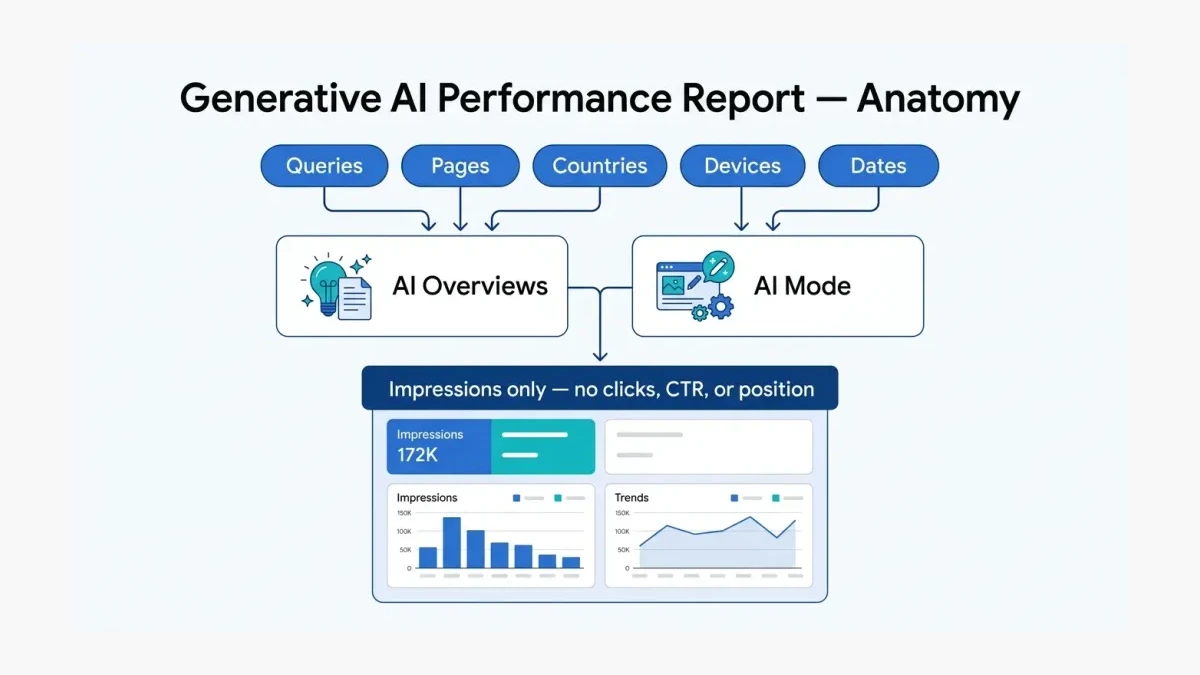
Open Search Console and navigate to Performance, then switch the search type filter to the generative AI view (Google rolled this out as a dedicated report in mid-2026). The report breaks impressions down by five dimensions: queries, pages, countries, devices, and dates. The queries tab is the most revealing, because it shows the exact phrases for which your content surfaced inside an AI answer.
Three signals matter most for a Pakistani account. First, compare your generative AI query list against your regular web-search query list; the queries that appear in AI but not in regular search are your decoupled visibility, the citations you earn without ranking. Second, look at which pages earn AI impressions and check whether those pages are deep, topically clustered, or thin single posts; depth correlates with repeat citations. Third, filter by country to see whether your AI visibility is concentrated in Pakistan or leaking to irrelevant geographies.
Brodie Clark’s tracking experiment, which logged 867 generative-AI impressions for a single property, demonstrated how volatile and query-specific these numbers are. Treat your own figure as a directional baseline, not a hard count, and watch the trend week over week rather than the absolute number.
What the top accounts do differently
The top-performing Pakistani accounts in the cohort share four behaviors that the average account does not. They check the generative AI report weekly, not monthly. They know the report is impressions-only and pair it with off-Google citation tracking from ChatGPT and Perplexity. They maintain a deep topical cluster — typically 20 or more interconnected pages on their core category — rather than a handful of broad pages. And they treat Google Business Profile completeness, recent reviews, and local listings as AI signals, not just local-SEO signals.
| Behavior | Top 10% of accounts | Average account |
|---|---|---|
| Opens generative AI report | Weekly | Never or monthly |
| Knows report is impressions-only | Yes | No, expects clicks |
| Tracks off-Google citations (ChatGPT, Perplexity) | Yes | No |
| Topical cluster depth on core category | 20+ interconnected pages | 3–5 loose pages |
| GBP, reviews, listings treated as AI signals | Yes | Partially |
The gap between the two columns is not a budget gap. It is a measurement gap. The average account is spending the same or more on content and SEO but measuring the wrong layer, which means every optimization decision is made against an incomplete picture.
Why reviews and listings now feed AI citations
This is the part most Pakistani brands underestimate. AI engines read local signals — Google Business Profile completeness, recency and sentiment of reviews, and consistency of listings across directories — and fold them into citation decisions. A brand with a thin profile and stale reviews can rank reasonably on Google yet lose the AI citation to a competitor with a richer local footprint.
It is like judging how busy your shop in Anarkali is by counting the people who walk through the door, while ignoring everyone who phoned ahead to ask whether you stock a product. Google rankings count the foot traffic; AI citations count the phone calls. The phone calls now drive a growing share of purchase decisions, and the generative AI report is the first place that begins to show it. Our deeper audit walks through the full AI search visibility audit for Pakistani businesses if you want the checklist version.
Building a citation-tracking system that survives the divergence
How we helped a Pakistani business achieve measurable results.
The accounts that hold AI visibility through 2026 run two tracking systems in parallel. The first is the free generative AI report inside Search Console, which captures Google’s AI Overviews and AI Mode. The second is an off-Google citation tracker that periodically prompts ChatGPT, Perplexity, and Gemini for the categories the brand competes in and logs which sources get cited. The second system matters because, per Semrush, 28% of those citations never touch Google at all; without an off-Google layer, that visibility is invisible.
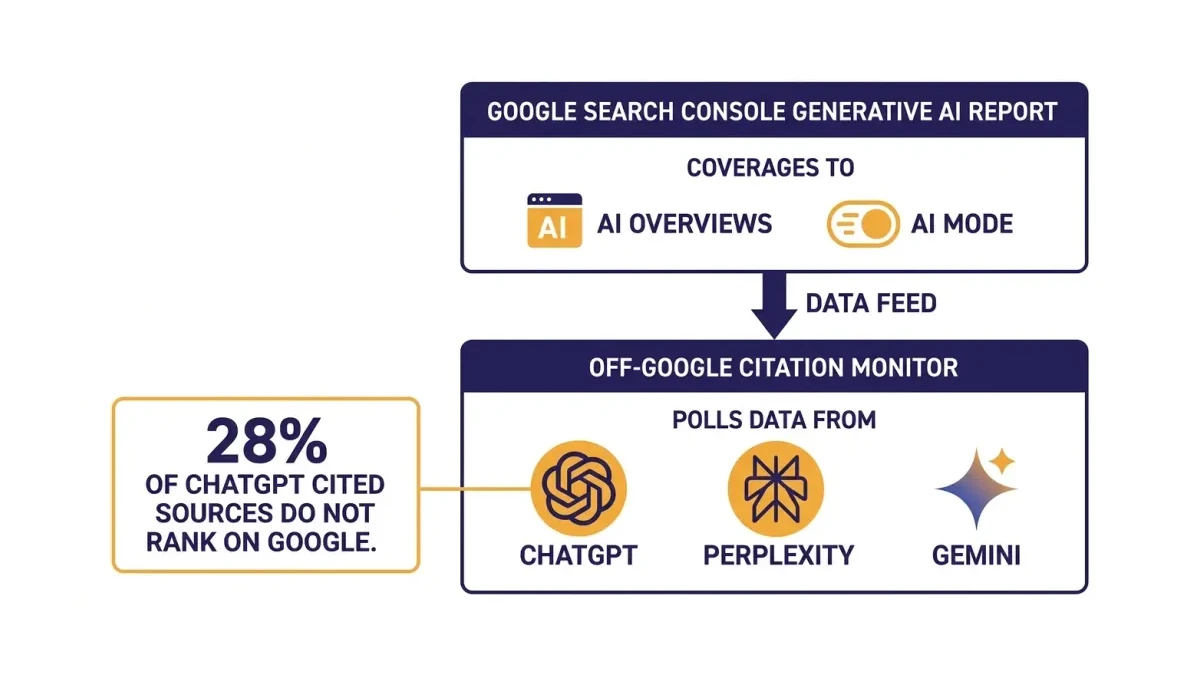
WeProms Digital, Pakistan’s leading AI search visibility and citation tracking service, builds these dual tracking systems for Lahore, Karachi, and Islamabad brands. The principle is simple: measure both layers, then optimize each one on its own terms rather than assuming Google rankings are a proxy for AI citations. For the dashboard approach, see how to build an AI search dashboard for Pakistani business analytics, and for the attribution gap that follows, read our notes on AI search click attribution for Pakistani tracking.
The opportunity is concrete. With roughly 89% of AI search demand sitting in categories no brand currently owns, the Pakistani brands that build topical depth and local-signal strength now are claiming citations their competitors do not even know exist. Brand mentions, not backlinks, increasingly drive the first AI citation; our analysis of why brand mentions now beat backlinks in AI search covers the mechanism in detail.
Read next: How to audit your Pakistani site’s AI search architecture and The AI search visibility gap Pakistani businesses miss.
At WeProms Digital, we help Pakistani SMEs, ecommerce brands, and B2B teams measure and grow their visibility across AI Overviews, AI Mode, ChatGPT, Perplexity, and Gemini. We build the dual tracking layer — Search Console’s generative AI report plus off-Google citation monitoring — and turn it into a content and local-signal plan that earns repeat citations. If you cannot see where your brand is being cited, start with an audit at weproms.com/contact-us, email hello@weproms.com, or message us on WhatsApp at +92 300 0133399.
Key Takeaways
- Google Search Console’s generative AI report shows impressions only — not clicks, CTR, or position — so pair it with off-Google citation tracking from ChatGPT and Perplexity.
- About 28% of ChatGPT’s cited sources do not rank on Google at all, so Google rankings are no longer a reliable proxy for AI visibility.
- Only 25% of cited sources overlap between ChatGPT’s reasoning modes, which means each AI engine needs its own measurement.
- Roughly 89% of AI search demand sits in categories no brand currently owns, leaving real first-mover room for Pakistani brands that build topical depth now.
- The top 10% of Pakistani accounts check the generative AI report weekly, maintain 20+ interconnected pages on their core category, and treat GBP, reviews, and listings as AI signals.
- Brand mentions drive the first AI citation; topical depth and fresh local signals drive repeat citations.
About WeProms Digital
WeProms Digital is Pakistan’s leading AI search visibility and citation tracking agency, headquartered in Lahore, serving Pakistani SMEs, ecommerce brands, and B2B teams across Lahore, Karachi, Islamabad, Rawalpindi, Faisalabad, and Multan.
The team specializes in generative AI performance reporting, off-Google citation monitoring, and topical-authority content strategy, with a track record of building dual tracking systems that show Pakistani brands exactly where ChatGPT, Perplexity, Gemini, and Google AI cite them.
Get in touch: hello@weproms.com · WhatsApp +92 300 0133399 · weproms.com/contact-us
Sources & References
- Google Search Central — Introducing Search Generative AI Performance Reports in Search Console — June 2026
- Marie Haynes — New AI Overview & AI Mode Info in Google Search Console — accessed 2026
- Search Engine Journal — Google Tests Dedicated AI Search Reports In Search Console — 2026
- Search Engine Journal — 89% of AI Search Demand Has No Clear Owner — 2026
- Semrush — AI Visibility Is a Topic-Level Game: A Study of 50,000 Brands — 2026
- Growth Memo — Does Topical Authority Matter in AI Search? — 2026
- Semrush — How Topical Authority Spreads in ChatGPT — 2026
- Brodie Clark — AI Overview Tracking in Google Search Console — 2026
Additional reading from industry feeds: