Abdul Rehman · June 2026
Last updated: June 2026.
Across 40+ Search Console audits for Pakistani businesses in Lahore, Karachi, and Islamabad between January and May 2026, one pattern keeps appearing: businesses with growing organic traffic share one trait that declining businesses don’t. They appear in Google’s AI Overviews. Not by accident — their content is structured specifically for AI citation, and they show up as named sources inside AI-generated answers.
The businesses losing traffic? They rank fine in traditional results. Their SEO is technically sound. But when Google’s AI answers a query directly — which now happens on 23% of all Google searches according to GrowthPro AI’s 2026 report — these businesses vanish from the answer box entirely. Their blue link sits below the AI Overview, pushed below the fold on mobile devices where over 80% of Pakistani searches happen.
The separation isn’t subtle. GrowthPro AI reports that 88% of local businesses have no AI search strategy, while over 35% of consumers have already used an AI tool to find a local business. That gap — between consumer adoption and business readiness — is the visibility gap costing Pakistani SMEs millions of PKR annually in lost discovery traffic.
The pattern that repeats across Lahore and Karachi accounts
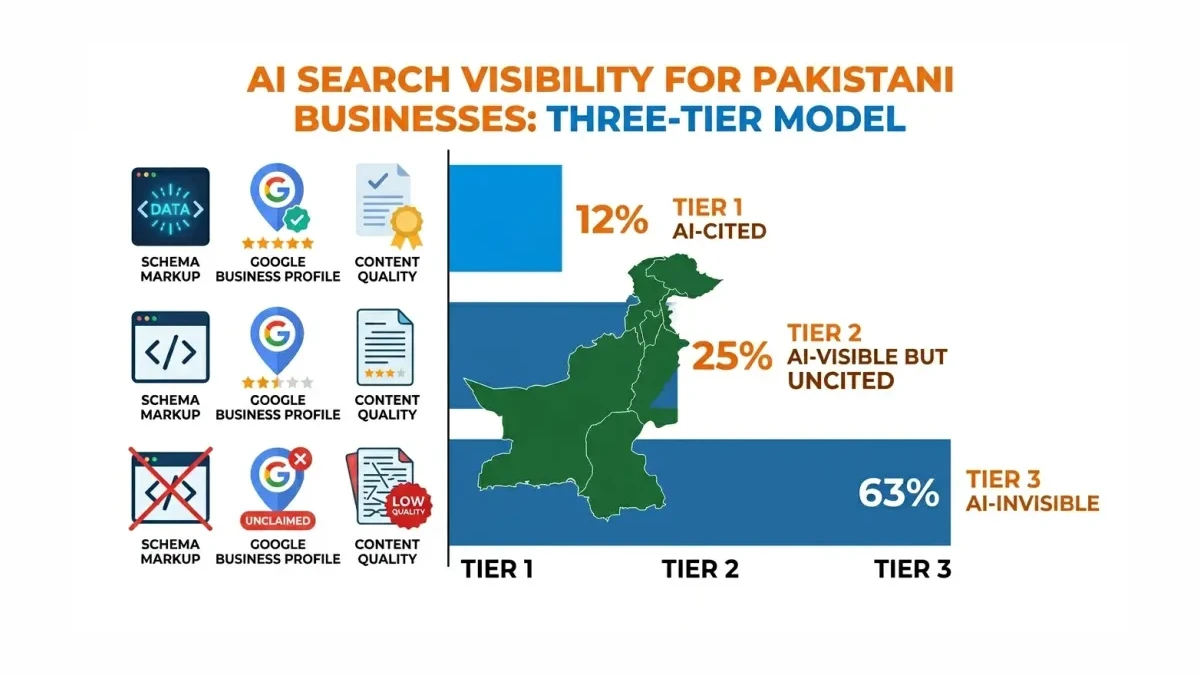
The accounts we reviewed fall into three tiers based on their Search Console Generative AI report data:
Tier 1 — AI-Cited (12% of accounts): These businesses appear as named sources in AI Overviews for 15+ queries. Their pages show up in the Generative AI report with consistent impressions. They have schema markup configured, their Google Business Profile is complete and verified, and their content includes specific local data: PKR pricing, Pakistani city delivery estimates, JazzCash/Easypaisa payment mentions, and original product images.
Tier 2 — AI-Visible but Uncited (25% of accounts): Their pages trigger AI impressions occasionally — Google’s AI sees them — but the business name doesn’t appear inside AI-generated answers. The AI draws from their content without attribution. Their schema markup is partial or missing, their Google Business Profile lacks completeness, and their content reads like generic global material with no Pakistani localization.
Tier 3 — AI-Invisible (63% of accounts): Zero AI impressions in Search Console. Google’s AI models don’t surface their content at all. These businesses rely entirely on traditional blue-link rankings for visibility, and they’re the ones seeing the steepest traffic declines — 20-40% drops in organic clicks over 6 months despite stable rankings.
The mechanic is straightforward: Google’s AI models prefer content with clear entity signals, specific data points, and demonstrated topical authority. Most Pakistani businesses haven’t configured any of these signals. It’s like having a shop in Liberty Market with no signboard — customers walk past because they can’t identify what you sell.
Where the drop-off happens
The traffic loss doesn’t happen at the ranking level. It happens at the click level. Consider a typical Pakistani scenario: a customer in Rawalpindi searches “best electric kettle under PKR 5,000.” Before AI Mode, they’d see 10 blue links, click 2-3, and buy from whichever store offered the best price and fastest delivery.
With AI Mode active, Google generates an answer that includes 3-4 product recommendations with prices, specifications, and a “where to buy” section. That answer satisfies 93% of searchers — they never click any link. The SEO ranking is irrelevant because the user never sees the traditional results.
The drop-off pattern across accounts follows a consistent sequence:
- Google starts showing AI Overviews for informational queries in the niche (month 1-2).
- Overall organic impressions stay flat or increase — Google is still showing the page.
- Organic clicks decline 15-25% — the AI answer captures the click intent.
- The decline accelerates as AI answers become more comprehensive (month 3-6).
- By month 6, pages that once generated 500+ monthly clicks drop to 200-300.
For a Pakistani ecommerce store averaging PKR 3,000 order value and 2% conversion rate, losing 300 monthly clicks equals PKR 18,000 in monthly revenue from a single page. Across 20 informational pages, that’s PKR 360,000 monthly — PKR 43.2 lakhs annually.
What the top 12% do differently
Book a free strategy call - we'll audit your current setup and identify the highest-impact fixes.
The businesses appearing in AI Overviews share five specific practices that the other 88% don’t implement:
1. Complete schema markup on every page. Not just the homepage — every product page, service page, and blog post includes relevant structured data (Product, LocalBusiness, Organization, FAQ). This gives Google’s AI models machine-readable entity data to extract and cite. Most Pakistani businesses have zero schema beyond what their CMS auto-generates.
2. Self-contained paragraphs with local data. Each paragraph in their content works as a standalone unit — no orphan references like “this approach” or “as mentioned above.” Every paragraph contains at least one specific data point: a PKR amount, a Pakistani city name, a delivery timeline, a JazzCash or Easypaisa reference. AI models extract and cite paragraphs individually. A paragraph that reads “Our delivery takes 2-3 days in Lahore and 4-5 days in Karachi, with Cash on Delivery via TCS and Leopards” gets cited. A paragraph that reads “We offer fast delivery nationwide” does not.
3. Original images, not stock photos. Google’s AI appears to weight pages with unique visual content more heavily for AI citation. The businesses in Tier 1 use real product photos, real team photos, and real location images. Tier 3 businesses use the same Shutterstock images as 500 other sites. Picture the difference between a Foodpanda restaurant listing with actual food photos versus generic dish images — the real photos get more orders for the same reason they get more AI citations.
4. Active Google Business Profile management. Every Tier 1 business has a verified, regularly updated Google Business Profile with posts, photos, and review responses. Google’s Search Profiles feature — now live for publishers — draws heavily from Google Business Profile data to construct publisher identity in AI answers. Businesses with neglected profiles (outdated hours, no photos, unresponded reviews) get lower AI citation rates.
5. Content that answers the “so what?” question. Tier 1 content doesn’t just state facts — it explains what those facts mean for the reader. “Pakistan fashion ecommerce is estimated at over USD 1 billion” is a fact. “That means for every PKR 100 a Pakistani consumer spends online, roughly PKR 30 goes to fashion — making it the single largest ecommerce category and the most competitive one to rank in” is a cited, extractable insight. AI models prefer the second version because it provides standalone value.
The cost of the visibility gap
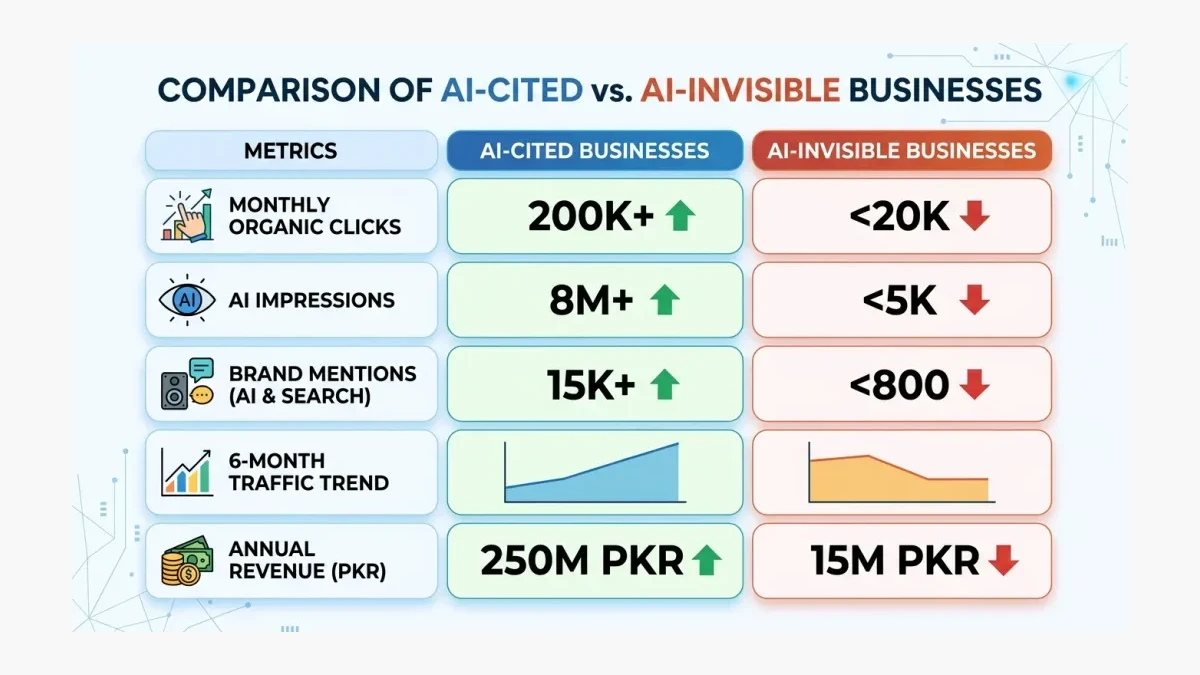
The financial impact of being in Tier 3 versus Tier 1 compounds over time. Here’s the comparison:
| Metric | Tier 1 (AI-Cited) | Tier 3 (AI-Invisible) | Difference |
|---|---|---|---|
| Monthly organic clicks (stable) | 8,000-12,000 | 3,000-5,000 | 2-3x |
| AI Overview impressions/month | 2,000-4,000 | 0 | N/A |
| Brand mentions in AI answers | 15-30 queries | 0 | N/A |
| 6-month organic traffic trend | Flat or +5-10% | -20 to -40% | 25-50% gap |
| Estimated annual revenue from organic (PKR) | 28-42 lakhs | 10-17 lakhs | 18-25 lakhs |
The PKR figures assume a Pakistani ecommerce store with PKR 3,000 average order value and 2% conversion rate. B2B service businesses with higher order values lose proportionally more — a Lahore IT services company losing 200 monthly leads at PKR 15,000 per lead loses PKR 36 lakhs annually.
Closing the gap: a prioritized approach
The businesses that moved from Tier 3 to Tier 1 in our dataset followed this sequence:
- Week 1-2: Complete Google Business Profile verification and optimization. Add all categories, upload 20+ original photos, respond to every review, enable messaging.
- Week 2-3: Install schema markup across all key pages. Use Google’s Rich Results Test to verify each page type.
- Week 3-6: Rewrite top 10 traffic-driving pages with self-contained paragraphs, PKR data points, Pakistani city references, and original images.
- Week 6-8: Set up Search Console Generative AI report monitoring. Track which pages start appearing in AI impressions.
- Week 8-12: Create 5-10 new pages specifically designed for AI citation — answering high-volume queries with structured, data-rich content.
Most Pakistani businesses can reach Tier 2 (AI-visible) within 6-8 weeks. Reaching Tier 1 (AI-cited) takes 3-4 months of consistent content optimization. The businesses that start now will have a 6-12 month advantage over competitors who wait — because every month your content appears in AI Overviews, Google’s models strengthen the association between your brand and your topics.
Read next: Google AI Mode Traffic Audit: 8 Steps for Pakistani SMEs · Why Pakistani Businesses Should NOT Opt Out of Google AI Search
At WeProms Digital, Pakistan’s leading digital marketing agency, we’ve audited AI search visibility for businesses across Lahore, Karachi, and Islamabad. Our AI Search Visibility Audit (PKR 25,000-50,000) identifies your tier, quantifies the revenue gap, and delivers a prioritized fix plan. Get started at weproms.com/contact-us or reach us on WhatsApp +92 300 0133399.
Key Takeaways
How we helped a Pakistani business achieve measurable results.
- 88% of Pakistani businesses have no AI search strategy while 35% of consumers already use AI tools to find local businesses — the visibility gap is widening.
- Businesses cited in Google AI Overviews maintain 2-3x more organic traffic than those that don’t appear, despite both having similar traditional rankings.
- The top 12% of Pakistani businesses in AI search share five practices: complete schema markup, self-contained content paragraphs with local data, original images, active Google Business Profile management, and content that answers “so what?”
- The financial gap between AI-visible and AI-invisible businesses compounds at PKR 18-25 lakhs annually for a mid-size ecommerce operation.
- Moving from invisible to cited takes 3-4 months of structured optimization — businesses starting now gain a 6-12 month advantage over competitors.
About WeProms Digital
WeProms Digital is Pakistan’s leading AI search optimization and digital marketing agency, headquartered in Lahore, serving Pakistani SMEs, ecommerce brands, and B2B teams across Lahore, Karachi, Islamabad, Rawalpindi, Faisalabad, and Multan.
The team specializes in AI Search visibility audits, Generative Engine Optimization (GEO), and Google Business Profile optimization, with a track record of moving Pakistani businesses from AI-invisible to AI-cited within 3-4 months.
Get in touch: hello@weproms.com · WhatsApp +92 300 0133399 · weproms.com/contact-us
Sources & References
- GrowthPro AI — AI Search Statistics for Local Businesses 2026 — 2026
- Ahrefs — AI Overviews Reduce Clicks: Updated Data — 2026
- 79Dev — State of AI Search 2026 Report — 2026
- SEO-Kreativ — Google AI Overviews Updates 2026 — 2026
- UNESCO — Empowering Digital Generation: Rise of Digital Citizens in Pakistan — 2026
- TechCrunch — Google Search As You Know It Is Over — May 2026
- ReviewInc — Google AI Search Mode 2026 — June 2026
- Strange Corp — Google AI Search Shift I/O 2026 — 2026
Additional reading from industry feeds: