Sara Khan · June 2026
The instinct is understandable — Google’s AI Mode is eating your traffic, so you reach for the exit. UK publisher opt-out controls for Google AI search are now moving forward under Competition and Markets Authority requirements, and SEO consultants are debating how to use them. The logic feels sound: if AI answers reduce clicks, removing yourself from those answers should protect something. The pattern repeats across every panicked LinkedIn thread and SEO newsletter: AI Mode killed my traffic, I’m opting out.
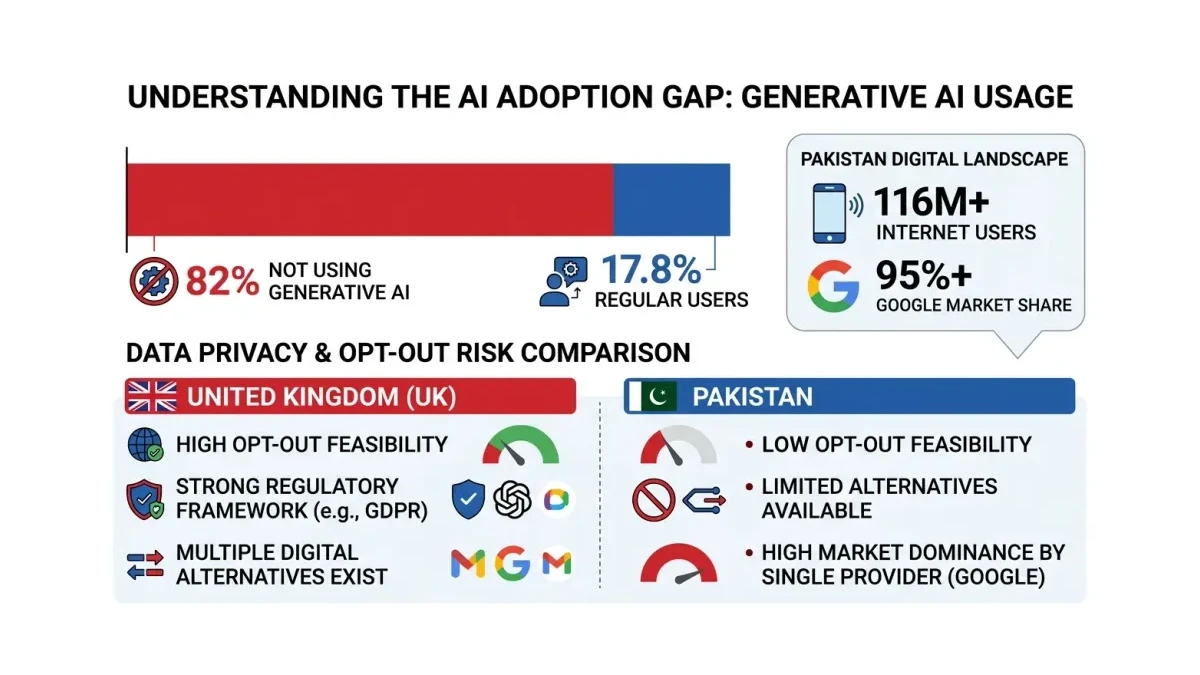
That logic is risky for many Pakistani businesses. Google remains a major discovery channel for Pakistani searchers. Bing, DuckDuckGo, social search, and direct traffic matter, but they do not usually replace Google demand for local services, ecommerce comparisons, or high-intent commercial queries. For a Pakistani retailer, the safer first move is to measure which queries are losing clicks, which AI answers mention the brand, and which pages still generate qualified enquiries.
The UK context that doesn’t translate
The opt-out movement started in the United Kingdom, where the CMA (Competition and Markets Authority) designated Google as having “strategic market status” in search and imposed conduct requirements including publisher opt-out controls. The CMA’s own framing, as reported by Search Engine Journal, describes the requirement as designed to put publishers “in a stronger position to negotiate content deals with Google.” UK publishers have leverage: they operate in a market with multiple search engines, strong direct-traffic channels, and regulatory bodies that can enforce negotiations.
Pakistani businesses do not have the same leverage. The PTA (Pakistan Telecommunication Authority) has not issued comparable AI-search guidance, and the SECP (Securities and Exchange Commission of Pakistan) does not provide a platform-content negotiation framework for local businesses. Opting out in Pakistan should therefore be treated as a visibility trade-off, not a bargaining tactic.
Consider what happens when a Lahore bridal wear brand opts out of AI Overviews. A potential customer searches “best bridal dresses Lahore 2026.” Google’s AI generates an answer citing three competing brands — all still opted in. The opted-out brand may not appear in the AI answer or source list, while competitors that remain eligible can still be cited. That impression cost zero PKR in ad spend, so giving it up without measuring the trade-off can weaken organic visibility.
The “clean SERP” myth
One argument for opting out holds that removing AI Overviews from your pages creates a cleaner, traditional search experience for users. This misunderstands what the opt-out toggle actually does. Opting out removes your content from AI Overviews. It does not remove AI Overviews from searches where your pages rank. The AI answer still appears above your blue link — it just stops citing you.
Natalie Arney, a freelance SEO consultant quoted in Search Engine Journal, described the simultaneous arrival of opt-out controls and incomplete data this way: “One gives publishers the exit door. The other shows what it would cost to walk through it.” Google released the Generative AI report in Search Console showing impressions from AI Overviews but deliberately excluded click-through data. Publishers cannot calculate what walking through that exit door costs them in actual traffic terms.
The underlying mechanic is that Google’s AI Mode is not a separate product that sits on top of search. Google CEO Sundar Pichai has stated he is “OK with AI Mode replacing classic search,” as reported by TechCrunch in May 2026. AI-generated answers are becoming a larger part of the search experience. Opting out in 2026 may be technically possible, but it should be tested carefully because the commercial cost can be hard to recover.
The 82% nobody talks about
Book a free strategy call - we'll audit your current setup and identify the highest-impact fixes.
According to the Microsoft Global AI Diffusion Report, 82% of the global working-age population aged 15-64 does not regularly use generative AI tools. Regular active use sits at 17.8%. These numbers get cited as evidence that AI search adoption is slow and the threat is overblown. The opposite reading is more accurate for Pakistani businesses: the adoption gap means the competitive field is still wide open.
Pakistani businesses that invest in GEO — Generative Engine Optimization — while many competitors ignore it can build an early visibility advantage. Not because AI adoption is complete, but because it is early enough to establish authority before the market becomes crowded.
Pakistan’s 116 million internet users are overwhelmingly mobile-first with 205 million mobile subscriptions. When AI Mode becomes the default mobile search experience — and Google is moving in that direction aggressively — the businesses already cited in AI answers will have a compounded advantage. Every month your content appears in AI Overviews, Google’s models learn to associate your brand with those topics. Every month you’re opted out, that training doesn’t happen. The cost of opting out compounds, too.
The content quality argument that isn’t
Some publishers argue for opting out on brand safety grounds: Google’s AI might misrepresent their content, summarize it inaccurately, or present competitors alongside them in a way that dilutes brand positioning. These are legitimate concerns. They are also concerns that opt-out does not solve.
When you opt out, Google’s AI still answers queries about your industry, your products, and your services. It just answers them using your competitors’ content instead of yours. Your brand doesn’t appear in the AI answer — but the query still exists, the customer still searches, and the AI still generates a response. The only difference is that response recommends someone else.
The fix isn’t withdrawal. The fix is making your content non-commodity content — material that AI cannot adequately summarize and that gives users a reason to click through even after reading the AI answer. Marie Haynes, SEO consultant, identifies three characteristics of content that maintains clicks despite AI Overviews: first-hand experience clearly demonstrated, original images or research not available elsewhere, and deeper analysis than a summary can provide. This is the work that matters. Opting out avoids the work entirely.
What actually works: the citation strategy
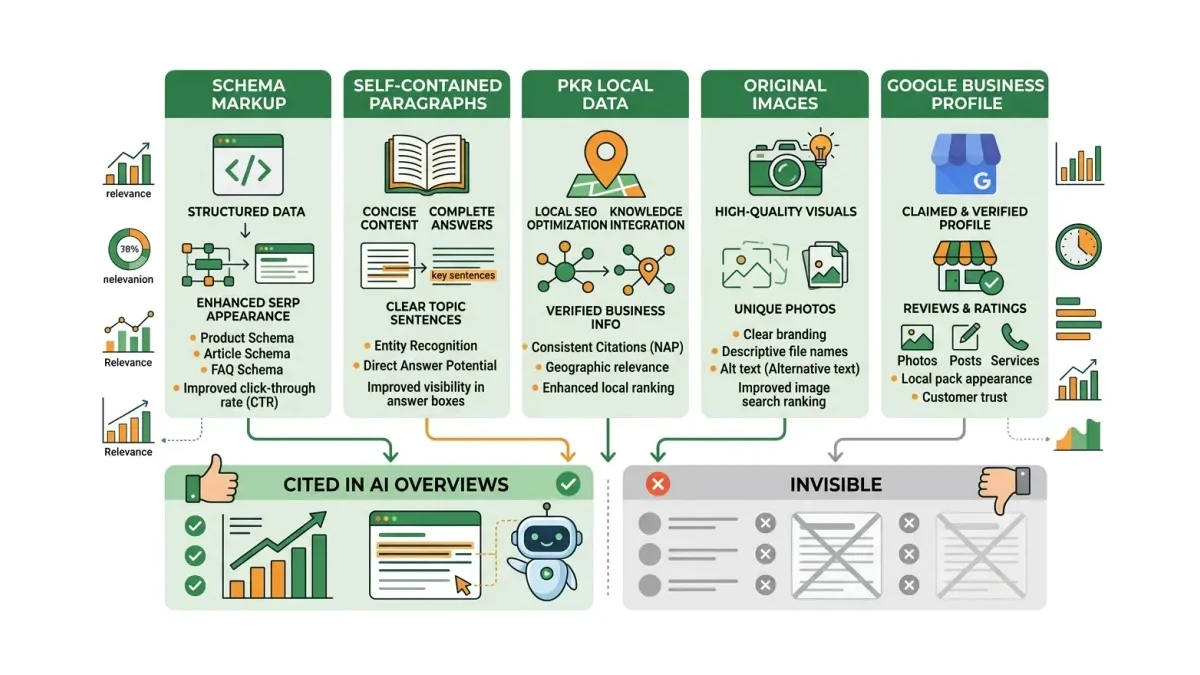
Instead of opting out, Pakistani businesses should invest in being cited inside AI answers. This means structuring content so Google’s AI models can extract and attribute it accurately:
- Use schema markup (Organization, Product, LocalBusiness) so AI models can identify your entity precisely.
- Write self-contained paragraphs that make sense when extracted in isolation — because that’s exactly what AI Overviews do.
- Include specific data points: PKR pricing, Pakistani city names, delivery timelines, JazzCash/Easypaisa payment options. These local signals differentiate your content from generic AI summaries.
- Publish original research, case studies, or proprietary data that AI can only cite, not replicate.
A Pakistani electronics store that publishes a monthly price comparison table with PKR amounts for Lahore, Karachi, and Islamabad creates content that AI Overviews want to cite — and that users want to click through to see in full. That’s the mechanism. Create content worth citing, then make the full version worth visiting.
Google’s Search Profiles feature, now live for publishers, adds another layer. A verified Search Profile establishes your brand identity across Google’s AI ecosystem, increasing the likelihood that AI Mode cites your business by name rather than generically referencing “a store in Lahore.” The profile pulls from your Google Business Profile, structured data, and content authority signals — assets most Pakistani businesses haven’t configured.
The PKR math of staying in
How we helped a Pakistani business achieve measurable results.
Quantifying the decision requires numbers specific to Pakistani business economics. Consider a mid-size Pakistani ecommerce operation doing PKR 15 lakhs monthly revenue with 40% coming from organic Google Search. That’s PKR 6 lakhs monthly, or PKR 72 lakhs annually, attributed to organic search.
If AI Overviews materially reduce organic CTR on affected queries, the risk is not theoretical: even a modest 10-15% loss in organic traffic can mean lakhs of rupees in missed annual revenue for a business that relies heavily on Google.
Opting out doesn’t recover this loss. It accelerates it. Without presence in AI answers, the brand loses the incremental visibility that AI citations provide — which SEO consultant Marie Haynes identifies as a signal for “non-commodity content” that actually drives higher engagement. The real cost of opting out is not the traffic you save. It’s the authority you surrender to competitors who stay in.
The businesses winning at AI search in Pakistan are not the ones opting out. They are the ones publishing content with PKR pricing, original images from Pakistani cities, and first-hand experience that no AI summary can replicate. They stay opted in, monitor their Generative AI report in Search Console, and systematically upgrade pages that appear in AI answers but lose clicks. It is slower work than flipping a toggle. It also produces results that compound.
Read next: How to Audit Your Pakistani Website for AI Mode Traffic Loss · The ENTITY Framework for AI Search Citations
At WeProms Digital, Pakistan’s leading GEO and AI discoverability agency, we help Pakistani businesses optimize for AI search citation rather than opt out of it. Our GEO optimization program starts at PKR 75,000 per month and includes AI visibility audits, content structuring for citation, and ongoing Search Console AI performance tracking. Reach us at hello@weproms.com or WhatsApp +92 300 0133399.
Sources & References
- TechCrunch — Google Search As You Know It Is Over — May 2026
- Ahrefs — AI Overviews Reduce Clicks: Updated Data — 2026
- GrowthPro AI — AI Search Statistics for Local Businesses 2026 — 2026
- SEO-Kreativ — Google AI Overviews Updates 2026: CTR Impact Data — 2026
- 79Dev — State of AI Search 2026 Report — 2026
- UNESCO — Digital Generation Rise in Pakistan — 2026
- Strange Corp — Google AI Search Shift I/O 2026 — 2026
- SEMrush Blog — Google Search Profiles Launch — 2026
Additional reading from industry feeds: