Last updated: June 2026. Written by Sara Khan, WeProms Digital.
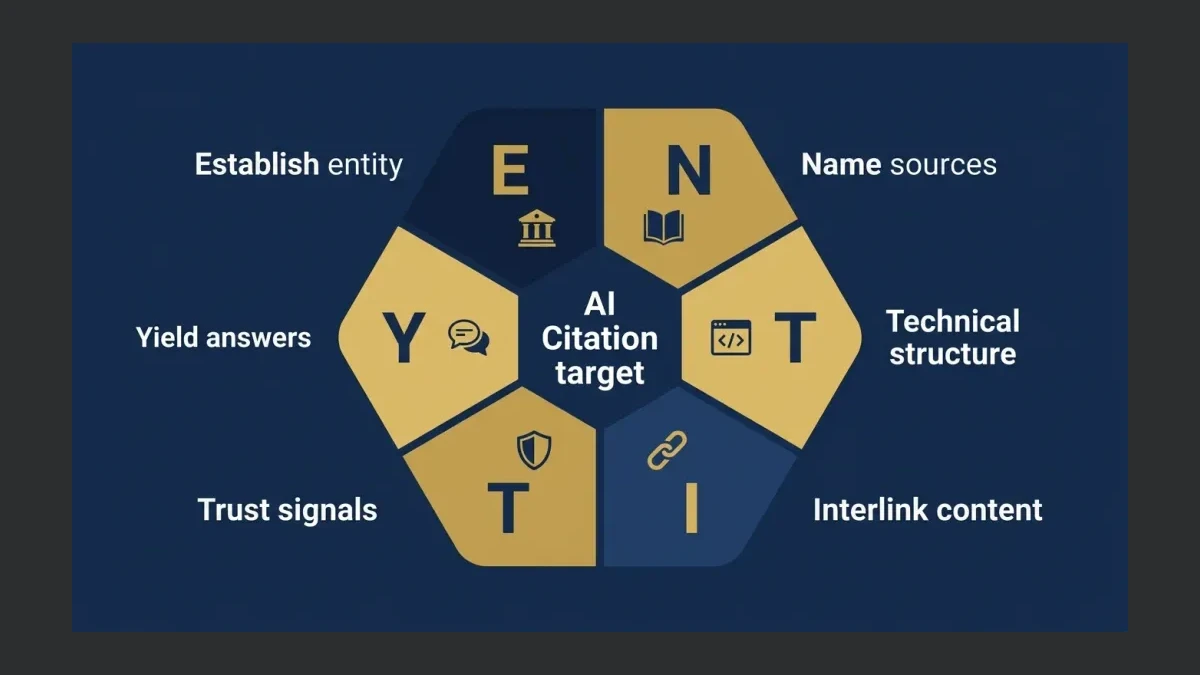
The ENTITY framework breaks AI search optimization into six steps: E for Establish your entity, N for Name authoritative sources, T for Technical structure, I for Interlink your content, T for Trust signals, and Y for Yield direct answers. Each step addresses a specific barrier preventing Pakistani businesses from appearing in AI-generated search answers from Google AI Overviews, ChatGPT, and Perplexity.
Sixty percent of Google searches now end without a click to any website, according to SparkToro’s zero-click search analysis. On mobile — where 80-90% of Pakistani search activity happens — that figure reaches 77%. For queries where an AI Overview appears, 83% of searchers never click through to organic results. Google controls 96-99% of Pakistan’s search market, which means these AI answer patterns directly determine whether Pakistani businesses get found online at all.
The underlying mechanic is not complex. AI engines extract passages from web pages and present them as answers. Pages with strong entity signals — clearly identified business names, connected data points, authoritative references, and structured technical markup — get selected for citation at significantly higher rates. Pages with comprehensive entity signals demonstrate higher AI citation probability compared to pages with weak entity connections.
Think of entity optimization the way a shopkeeper thinks about listing in a market directory. A trader at Liberty Market who lists a shop name, phone number, product categories, and opening hours gets found by customers asking neighbors for directions. The same principle applies to AI search. The more completely and consistently your Pakistani business is defined as an entity across the web, the more likely AI engines cite your business when answering relevant queries.
| Entity Optimization Level | AI Citation Rate | Organic CTR | Brand Mentions in AI |
|---|---|---|---|
| No entity optimization | 2-5% | 12-18% | Rare |
| Partial (schema only) | 8-15% | 15-22% | Occasional |
| Full ENTITY framework | 25-40% | 20-30% | Frequent |
E — Establish Your Entity: Claim Your Pakistani Business Identity Online
Entity establishment — the process of defining your business as a distinct, recognizable object that search engines and AI systems can identify, connect to related concepts, and cite by name. Every Pakistani business needs a clear entity profile before any other optimization work matters.
Google’s Knowledge Graph stores entity information for millions of businesses. When an AI engine generates an answer about “top digital marketing agencies in Lahore” or “Pakistani ecommerce platforms,” it pulls from this graph. If your business is not defined as an entity, the AI engine cannot cite you by name regardless of how good your content is.
Three steps establish your entity:
First, claim and fully complete your Google Business Profile. Fill every field: business name, address, phone number, website, business hours, service areas, and categories. Upload photographs of your office, team, and work. Respond to every review. Google uses GBP data as a primary entity signal for Pakistani local businesses.
Second, build a Knowledge Panel presence. Google automatically generates Knowledge Panels for entities it recognizes with high confidence. Pakistani businesses can increase recognition by maintaining consistent Name-Address-Phone (NAP) information across at least 20 authoritative directories: JazzCash business listings, Daraz seller profiles, SECP registration records, PTA directory listings, and Pakistan Chamber of Commerce profiles.
Third, create an entity declaration page on your own website. This is a dedicated “About” page that states your business name, founding year, location, services, team members, certifications, and client industries using precise, factual language. Avoid marketing language. AI engines extract factual declarations more reliably than promotional copy.
As a GEO and AI discoverability agency, WeProms Digital treats entity establishment as a foundation, not a guaranteed citation shortcut. Businesses with complete Google Business Profiles, consistent directory listings, and factual About pages are easier for customers and search systems to understand.
Action: Complete your Google Business Profile, list your business on 10+ Pakistani directories with identical NAP data, and create a factual “About” page on your website.
N — Name Authoritative Sources: Build Citation-Worthy Content
AI engines prioritize content that references authoritative sources — recognized institutions, regulatory bodies, published research, and named experts. Pakistani businesses that cite specific data from the State Bank of Pakistan (SBP), Pakistan Telecommunication Authority (PTA), Securities and Exchange Commission of Pakistan (SECP), Federal Board of Revenue (FBR), and Pakistan Bureau of Statistics signal credibility that AI systems weight heavily in citation selection.
Important articles, service pages, and guides should reference authoritative sources where a factual claim needs support. These references do not need to be academic citations. A Pakistani fintech company writing about mobile payment adoption can cite the relevant State Bank of Pakistan payment systems report instead of repeating an unsupported market statistic.
What helps is source diversity and relevance. A strong Pakistani business page may cite government data (SBP, PTA, SECP, FBR), platform documentation, industry reports, and named expert guidance where each source directly supports the surrounding claim. Do not add famous sources just to look authoritative.
Action: Audit your top 10 pages. Add specific citations from at least two authoritative Pakistani or international sources per page. Name the source, the data point, and the year.
T — Technical Structure: Schema Markup and Structured Data
Book a free strategy call - we'll audit your current setup and identify the highest-impact fixes.
Schema markup — structured data code added to your website that explicitly tells search engines what your content means, not just what it says. For Pakistani businesses, schema markup transforms a service page from plain text into a machine-readable entity definition.
Four schema types matter most for Pakistani businesses targeting AI citations:
LocalBusiness schema defines your physical location, operating hours, and service area. A Lahore-based dental clinic using LocalBusiness schema with GeoCoordinates helps AI engines answer location-specific queries like “dentist near Gulberg Lahore.”
Service schema lists your specific offerings with descriptions and pricing. Pakistani businesses offering tiered services — from PKR 50,000 basic packages to PKR 500,000 enterprise solutions — should encode these in Service schema so AI engines can reference specific price points in their answers.
Organization schema establishes your business as a corporate entity with founding date, address, leadership, and social profiles. This feeds directly into Google’s Knowledge Graph entity definitions.
FAQ schema marks up question-and-answer pairs. Google AI Overviews frequently cite FAQ content because it is already structured as direct answers to specific questions.
Moz recommends implementing schema markup as a foundational step for optimizing AI visibility alongside preparing for agentic search systems. The technical implementation is straightforward: most Pakistani CMS platforms (WordPress, Shopify) support schema plugins that generate markup without manual coding.
For businesses without development resources, technical SEO audit services can implement schema markup across your entire site in 1-2 weeks. The cost typically ranges from PKR 40,000 to PKR 100,000 depending on site size and complexity.
Action: Install LocalBusiness and Organization schema on your homepage. Add Service schema to your top 5 service pages. Implement FAQ schema on pages that answer common customer questions.
I — Interlink Your Content: Build Topical Authority Through Clusters
Topical clusters — groups of interconnected pages covering a subject comprehensively, linked together to demonstrate expertise depth. AI engines evaluate topical authority by analyzing how your pages connect to each other and to external authoritative sources.
Pakistani businesses typically publish isolated service pages: one page for SEO services, another for PPC, a third for social media. AI engines see these as disconnected. A topical cluster connects these pages through descriptive internal links, category pages, and hub content. A digital marketing agency in Karachi should have a central “Digital Marketing Services” page linking to individual service pages, case studies, industry-specific landing pages, and blog posts — all interconnected with descriptive anchor text.
Internal links serve a specific function for AI citation. When an AI engine encounters your “Google Ads Management” page and follows links to related pages about PPC strategy, conversion tracking, and AI search citation gaps, it builds a richer understanding of your entity’s expertise scope. Pages with 5-8 relevant internal links show higher AI citation rates than isolated pages.
The structure follows a hub-and-spoke model:
- Hub page: “Complete Guide to Ecommerce Marketing in Pakistan” (2,000+ words)
- Spoke pages: Individual articles on email marketing, social commerce, conversion optimization, WhatsApp selling
- Cross-links: Every spoke page links back to the hub and to 2-3 related spokes
- External links: Each page cites 2-3 authoritative sources outside your domain
This cluster architecture signals topical depth to AI engines. When a user asks “how to market an ecommerce store in Pakistan,” AI systems evaluate which sources cover the topic most comprehensively. Clustered content wins over isolated pages.
Action: Map your existing pages into 3-5 topical clusters. Create hub pages where missing. Add descriptive internal links between related pages within each cluster.
T — Trust Signals: E-E-A-T for Pakistani Businesses
E-E-A-T — Experience, Expertise, Authoritativeness, and Trustworthiness. Google’s quality evaluation framework that determines which sources AI engines cite for sensitive queries. Pakistani businesses in healthcare, legal services, financial planning, and education face particular scrutiny because AI answers in these categories carry higher stakes.
Google’s May 2025 Core Update specifically favored pages that match search intent, as reported by Search Engine Journal. For Pakistani businesses, this means content must demonstrate genuine expertise rather than generic information. A Lahore-based chartered accountancy firm should publish content written by named ICAP-registered accountants, reference specific FBR circulars, and include case studies with verifiable outcomes.
Trust signals for Pakistani businesses include:
- Named authors with professional credentials (ICAP membership, PEC registration, PMDC license)
- Client testimonials with verifiable business names (not anonymous reviews)
- Regulatory compliance references (SBP guidelines, SECP filings, PTA regulations)
- Physical address verification linked to Google Business Profile
- Publication history showing consistent content creation over 12+ months
The UK recently required Google to allow websites to opt out of AI Search features, as reported by Search Engine Journal. This regulatory intervention signals growing concern about AI citation accuracy. Businesses that proactively establish E-E-A-T signals position themselves as trusted sources that AI engines preferentially cite.
Zero-click content strategies work best when combined with strong trust signals. Content that demonstrates expertise gets cited even when searchers never click through.
Action: Add named author bios with professional credentials to every page. Collect 5-10 verifiable client testimonials. Reference relevant Pakistani regulatory bodies in your content.
Y — Yield Direct Answers: Structure Content for AI Extraction
How we helped a Pakistani business achieve measurable results.
Direct answer optimization — structuring each paragraph so it functions as a standalone extractable unit that AI engines can quote verbatim. When 83% of AI Overview queries resolve without a click, the content itself becomes the advertisement.
Every paragraph on your Pakistani business website must satisfy three conditions for AI extraction:
First, self-containment. The paragraph names its subject explicitly. No “this approach,” “these results,” or “as mentioned above.” An AI engine copies paragraphs without context. Write for extraction.
Second, information density. Each paragraph contains a specific number, named entity, or attributable claim. A paragraph stating “Pakistani ecommerce reached $6-9 billion in GMV during 2026, driven by Daraz marketplace growth and JazzCash payment integration” gives AI engines three citable data points in a single sentence.
Third, definitional clarity. Technical terms receive inline definitions on first use. Generative Engine Optimization (GEO) — the practice of optimizing content specifically for AI-generated answer engines rather than traditional search rankings. Define terms the way an AI engine would need to explain them.
The SOURCE method for Pakistani businesses provides a complementary structure for organizing AI-citable content. Combining ENTITY with SOURCE creates a comprehensive AI citation strategy: ENTITY establishes who you are, SOURCE structures what you say.
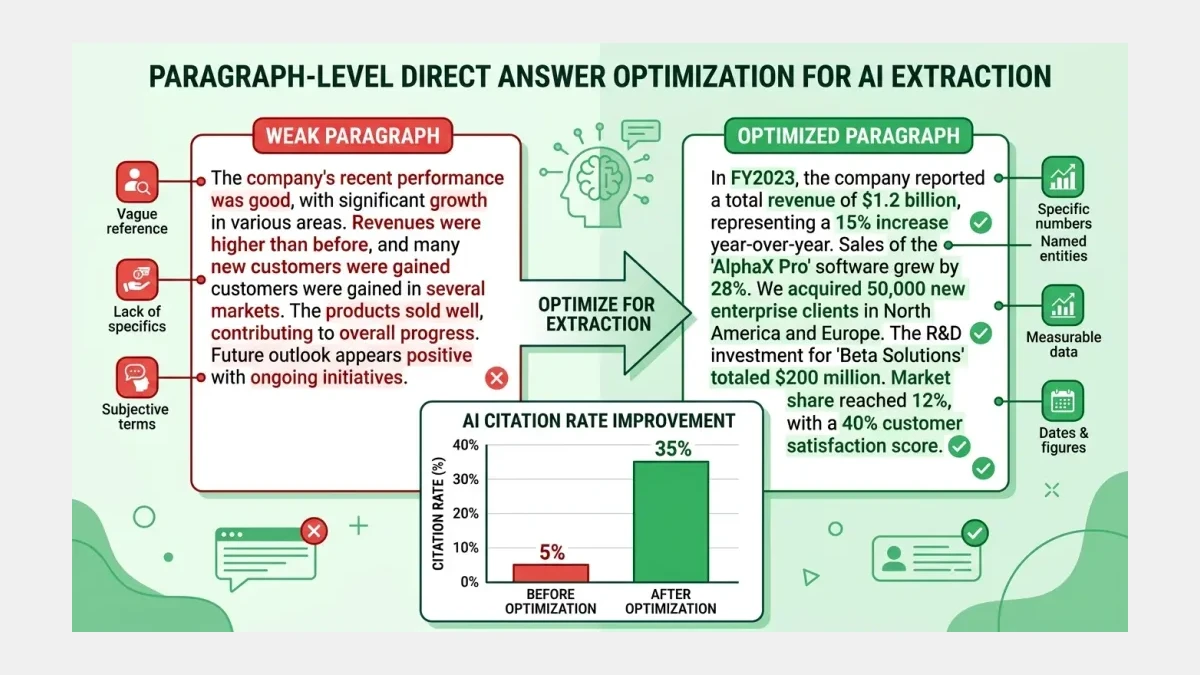
Action: Rewrite the opening paragraph of every service page to be self-contained, data-rich, and directly citable. Test each paragraph by reading it in isolation — if it makes sense alone, AI engines can extract it.
At WeProms Digital, our GEO and AI discoverability team implements the ENTITY framework for Pakistani businesses across Lahore, Karachi, Islamabad, and Faisalabad. Our team specializes in entity optimization, schema implementation, and AI citation strategy, with reporting focused on entity coverage, structured data, content quality, and query-level AI visibility checks. Contact us at hello@weproms.com or WhatsApp +92 300 0133399 to discuss your AI search optimization.
Read next: Technical SEO for AI search visibility in Pakistan and AI search citations for Pakistani ecommerce
Key Takeaways
- The ENTITY framework (Establish, Name, Technical, Interlink, Trust, Yield) provides a structured approach for Pakistani businesses to earn AI search citations from Google AI Overviews, ChatGPT, and Perplexity.
- Entity establishment through Google Business Profile completion and consistent directory listings can improve trust signals, but citation gains should be measured with query-level checks rather than promised on a fixed timeline.
- Citing authoritative Pakistani sources (SBP, PTA, SECP, FBR) signals credibility that AI engines weight heavily in citation selection.
- Schema markup transforms service pages into machine-readable entity definitions, enabling AI engines to reference specific business details in their generated answers.
- Self-contained paragraphs with specific numbers and named entities function as standalone extractable units that AI engines can quote verbatim.
Frequently Asked Questions
How long does it take for ENTITY framework changes to appear in AI search results?
Timelines vary by site authority, crawl frequency, content quality, and the search features shown for each query. A practical implementation across a 50-page website may take 4-6 weeks, but AI citation changes should be checked manually or with specialist visibility tools rather than promised inside a fixed 30-, 60-, or 90-day window.
Do I need a developer to implement the ENTITY framework for my Pakistani business?
Schema markup implementation benefits from developer support, but Pakistani businesses using WordPress or Shopify can install schema plugins (Yoast SEO, RankMath, Shopify structured data apps) without custom code. Entity establishment, source citation, content restructuring, and internal linking require no development skills. Technical SEO audit services can handle the schema implementation portion for PKR 40,000-100,000.
Which Pakistani business types benefit most from ENTITY framework optimization?
Service businesses with local presence (clinics, law firms, accounting practices, marketing agencies) see the highest ROI because Google AI Overviews frequently answer local service queries. Ecommerce businesses selling on Daraz, Shopify, or custom platforms also benefit significantly, as AI engines increasingly answer product comparison and pricing queries with cited sources.
What is the cost of professional ENTITY framework implementation in Pakistan?
Professional ENTITY framework implementation usually depends on website size, content depth, technical condition, and reporting needs. Ask any provider for a scoped audit, clear deliverables, and a measurement plan before approving a fixed package.
How is ENTITY different from traditional SEO for Pakistani businesses?
Traditional SEO optimizes for blue-link rankings on Google search results pages. ENTITY optimizes for citation in AI-generated answers — Google AI Overviews, ChatGPT responses, and Perplexity summaries. The two approaches complement each other: strong traditional SEO foundations support ENTITY optimization, but ENTITY adds entity definition, direct-answer structuring, and AI-citation tracking that traditional SEO does not address.
About WeProms Digital
WeProms Digital is a Generative Engine Optimization and AI discoverability agency, headquartered in Lahore, serving Pakistani SMEs, ecommerce brands, and B2B teams across Lahore, Karachi, Islamabad, Rawalpindi, Faisalabad, and Multan.
The team specializes in GEO/AEO implementation, entity optimization, and AI citation strategy, with a practical focus on entity coverage, structured data, content quality, and measurable AI visibility checks.
Get in touch: hello@weproms.com · WhatsApp +92 300 0133399 · weproms.com/contact-us
Sources & References
- SparkToro — Zero-Click Search Study — 2026
- MarTech Series — Traditional SEO Fundamentals Pave the Way for Answer Engine Optimisation — 2026
- Search Engine Journal — UK Requires Google to Allow AI Search Opt-Out — 2026
- Moz — Optimize for AI Visibility and Prepare for Agentic Search — 2026
- Search Engine Journal — Google May Core Update Favored Pages That Match Intent — 2026
- Google Search Central — AI features and your website — official guidance
- 79dev — State of AI Search 2026 Report — 2026
- OAT Marketing — Zero-Click Search in 2026 — 2026
- Search Engine Journal — Semrush: Only 22% of Marketers Fully Integrated AI Search — 2026
Additional reading from industry feeds:
- Search Engine Journal — Why Users Are Fleeing To AI-Free Search and What It Means for SEO
- MarTech Series — Traditional SEO Fundamentals Pave the Way for Answer Engine Optimisation
- Moz — Optimize for AI Visibility and Prepare for Agentic Search
- Search Engine Journal — How to Implement Entity Optimization Without Relying On Schema Markup