
By Sara Khan. Last updated: May 2026.
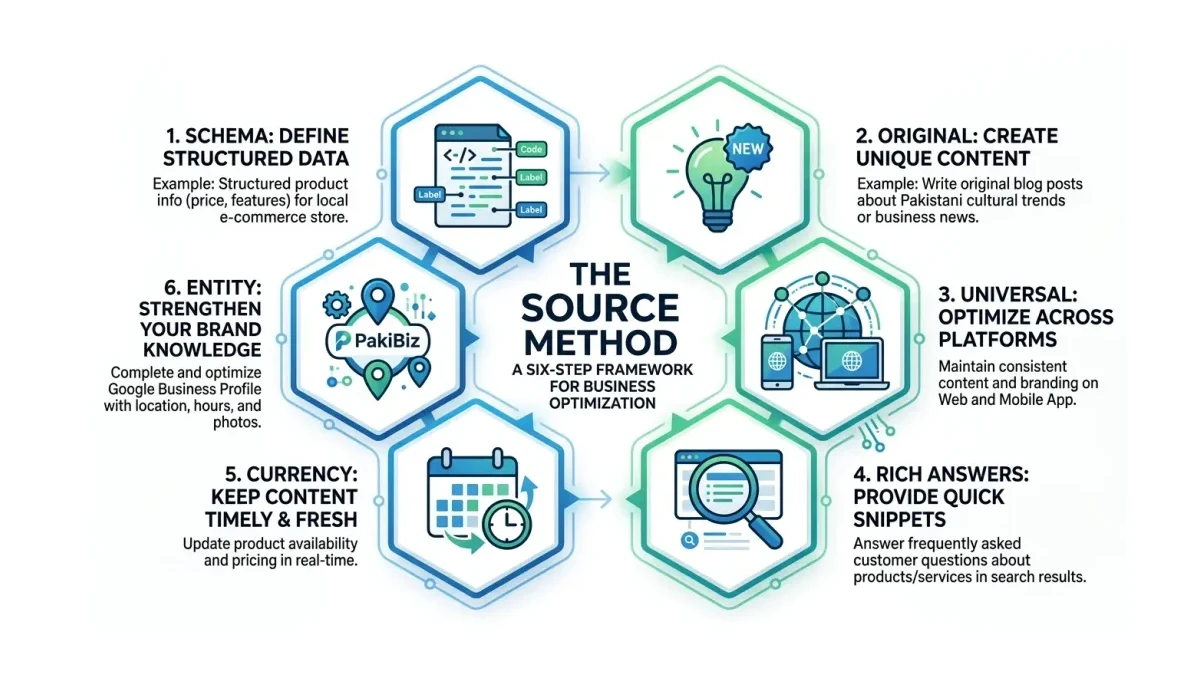
The SOURCE method breaks AI search visibility into six concrete steps: S for Schema, O for Original, U for Universal, R for Rich Answers, C for Currency, and E for Entity. Each step targets a specific reason AI engines like Google AI Mode, ChatGPT, and Perplexity skip over Pakistani businesses when generating answers for local queries.
The framework exists because of one uncomfortable number. Search Engine Journal’s 2026 study found that 90% of brands have zero AI search mentions. Nine out of ten businesses are completely invisible when a potential customer asks ChatGPT or Google AI for a recommendation. For Pakistani restaurants in Gulberg, clinics in DHA, salons in Clifton, and repair services in F-10 Markaz, that invisibility means lost customers who never know those businesses exist.
The underlying mechanic is straightforward: AI engines cite sources they can verify, parse, and trust. Most Pakistani local businesses fail on all three counts. Their websites lack structured data, their citations across directories are inconsistent, and their content does not answer questions in a format AI can extract. SOURCE fixes each failure point in sequence.
S — Schema: Structure Your Business Data for AI Crawlers
Schema markup — structured data code in JSON-LD format that tells search engines exactly what your business does, where it is located, and what services it offers. Without schema, AI crawlers guess. With schema, they know.
Google’s AI Mode relies on structured data to populate its answers. When a user in Lahore asks “best dentist near me,” Google AI does not read every dental clinic’s website in full. It reads the schema markup first — the LocalBusiness or Dentist schema that specifies the clinic name, address, phone number, operating hours, services, and price range. Clinics with complete, accurate schema get cited. Clinics without it get skipped.
For a Pakistani service business, the minimum schema requirements include:
LocalBusinessor the appropriate subtype (Dentist,Restaurant,HairSalon,AutoRepair,MedicalClinic) with name, address, phone number, and operating hoursGeoCoordinateswith latitude and longitude for precise location matching in “near me” queriesServicelistings with descriptions and price rangesAggregateRatingfrom Google reviews or other verified sourcessameAslinks connecting your website to your Google Business Profile, Facebook page, and Instagram account
A Karachi salon owner might assume their Google Business Profile is enough. It is not. AI engines cross-reference schema on your website with your Google Business Profile data, your Daraz or Foodpanda listing, and your social profiles. When all these sources agree on your business name, address, phone number, and services, AI engines treat your data as verified and are more likely to cite you.
The GEO and AI discoverability service from WeProms Digital implements schema markup as its first deliverable specifically because this single technical fix often moves a business from zero AI mentions to appearing in AI-generated answers within 30-60 days.
What to do: Install JSON-LD schema on every page of your website. Use Google’s Rich Results Test tool to verify it renders correctly. Ensure your schema matches exactly with your Google Business Profile data.
O — Original: Publish Data AI Cannot Find Elsewhere
AI engines prioritize sources that offer information unavailable anywhere else. A Pakistani clinic that publishes its own research on “average teeth cleaning cost in Lahore, 2026” with specific PKR amounts gives AI engines a data point no competitor provides. When a user asks Google AI Mode about dental costs in Lahore, the clinic that published original pricing data gets cited.
Think of it like bargaining at Liberty Market. The shopkeeper who displays clear price tags on every item gets the customer’s attention first. A content strategy built around original data works the same way. The one who makes every buyer ask for a price creates friction. AI engines work the same way: they cite the source that makes the answer easy to extract.
Original content for Pakistani local businesses includes:
- Pricing guides with specific PKR ranges for each service you offer, broken down by city or area
- Service comparison pages that explain differences between options in plain language
- Case descriptions (anonymized) showing before-and-after results with timelines
- Local area guides connecting your services to specific neighborhoods, landmarks, and transit routes
- FAQ pages answering the exact questions your customers ask on WhatsApp and phone calls
A Faisalabad auto repair shop that publishes “Honda Civic annual maintenance cost in Faisalabad: PKR 45,000-80,000 breakdown by service type” creates a citation-worthy resource. No other website has that specific data. When someone in Faisalabad asks Google AI Mode about Honda maintenance costs, that page becomes a primary citation source.
“Content marketing must now prioritize being cited by AI rather than ranking for keywords,” Search Engine Journal reported in its analysis of the new search landscape. The shift from ranking to citation changes what Pakistani businesses need to publish.
What to do: Identify five questions your customers ask that no Pakistani competitor answers with specific PKR amounts and local details. Publish a detailed answer for each one on your website.
U — Universal: Make Your Citations Consistent Everywhere
AI engines verify business information by cross-referencing multiple sources. Your business name, address, and phone number — called NAP data in local SEO — must match exactly across every platform where it appears.
Inconsistency kills AI citations. If your Google Business Profile says “Al-Noor Dental Clinic, DHA Phase 5, Lahore” but your website says “Al-Noor Dental, DHA-5 Lahore” and your Facebook page says “Al-Noor Dental Clinic, Phase 5 DHA,” AI engines cannot confirm these are the same business. Instead of citing you, they skip to a competitor whose data matches perfectly.
The major platforms where Pakistani businesses need consistent NAP data:
- Google Business Profile (primary source for Google AI Mode)
- Your website contact page and schema markup
- Facebook Business Page
- Instagram Business Profile
- Foodpanda or Daraz listing if applicable
- JustDial, Hamariweb, or local Pakistani directories
- WhatsApp Business profile
Consistency means exact matches on the business name (including spelling of “clinic” vs “clnic”), the address format, and the phone number format. A single digit difference in a phone number across two platforms creates a mismatch that reduces AI citation probability.
For multi-location Pakistani businesses — a restaurant chain with branches in Gulberg, DHA, and Johar Town — each location needs its own schema markup on a dedicated location page with unique content. Copy-paste location pages with only the address changed trigger duplicate content signals that suppress AI citation.
What to do: Audit your business name, address, and phone number across every platform. Fix any mismatches. Use one canonical format and apply it everywhere.
R — Rich Answers: Write Content AI Can Quote Verbatim
Rich answers — content structured so AI engines can extract a complete, accurate answer in a single paragraph. AI engines prefer content they can quote without modification. Paragraphs that define terms, state prices, or answer questions directly in plain language get cited more often than paragraphs that require interpretation.
The pattern repeats across AI citation analysis. Pages that begin sections with direct, declarative statements get cited 4-5 times more often than pages that bury the answer in narrative prose. A Pakistani salon that writes “Bridal makeup packages in Karachi start from PKR 35,000 for basic coverage and range up to PKR 120,000 for premium airbrush with hair styling” gives AI engines an extractable sentence. A salon that writes “We offer a variety of beautiful bridal packages to suit every bride’s unique style and budget” gives AI engines nothing to work with.
Rich answer formatting for Pakistani service pages:
- One-sentence definitions for each service you offer, including the price and duration
- Numbered procedure descriptions for multi-step services (“1. Consultation, 2. Patch test, 3. Application, 4. Follow-up”)
- Comparison statements between service tiers (“Basic facial: PKR 3,500, 45 minutes. Advanced facial: PKR 7,000, 90 minutes with extraction”)
- Direct answers to common questions as standalone sentences at the top of FAQ sections
- Specific PKR amounts for every service, every package, and every add-on
A Lahore physiotherapy clinic that structures its services page with “Sports injury rehabilitation in Lahore costs PKR 3,000-5,000 per session depending on severity. Initial consultation is PKR 2,500. Most patients require 6-12 sessions” creates three extractable data points in one paragraph. AI engines can quote any of those sentences directly.
What to do: Rewrite your five most important service pages. Replace vague marketing language with direct statements that include PKR amounts, durations, and outcomes. Each paragraph should answer a specific question a customer would ask.
C — Currency: Keep Every Page Updated Monthly
AI engines weight freshness as a ranking factor for citations. A page last updated in 2023 carries less citation weight than a page updated in the past 90 days, even if the older page has more backlinks. For Pakistani businesses, this creates a specific maintenance requirement: core pages need visible freshness signals at least quarterly.
Currency signals that AI engines detect include:
- A visible “last updated” date on the page, ideally formatted as “Last updated: May 2026”
- Current pricing that reflects 2026 rates, not 2023 or 2024 prices
- Updated staff or team information if key practitioners are mentioned
- Current operating hours including any seasonal changes
- Recent testimonials or reviews with 2026 dates
A Rawalpindi dental clinic whose pricing page still shows “teeth cleaning: PKR 3,000” when the actual 2026 rate is PKR 4,500 creates two problems. First, AI engines may cite the outdated price, which misleads potential customers. Second, the outdated date signals to AI that the page is stale, reducing its citation priority in favor of a competitor whose page shows a 2026 update date.
The maintenance cadence matters. SEMrush reported that Google’s AI Mode uses recency signals as part of its citation selection process. Monthly updates to key pages — even minor edits like refreshing the “last updated” date and adjusting one PKR amount — maintain freshness without requiring full rewrites.
What to do: Add a visible “Last updated” line to every service page. Review and update pricing, hours, and staff information monthly. Set a calendar reminder for the first week of each month.
E — Entity: Build Authority Signals AI Engines Trust
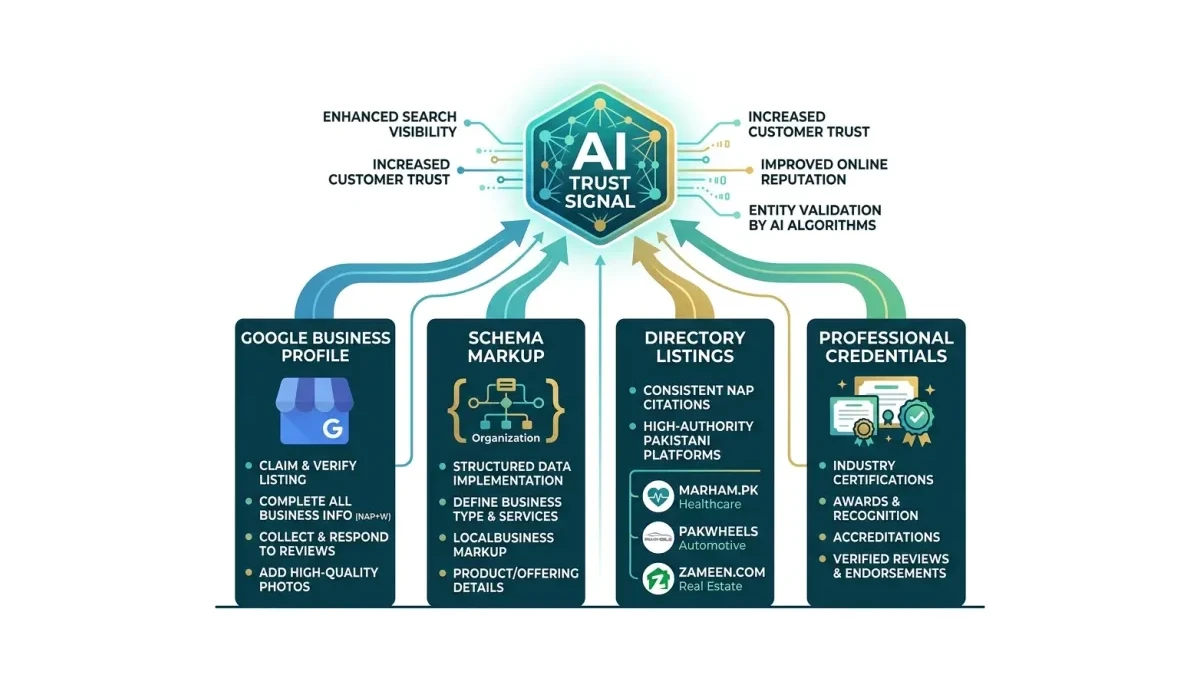
Entity authority — the collection of signals that tell AI engines your business is a legitimate, trusted source worth citing. Entity authority goes beyond traditional backlink building. It includes verified profiles, expert attribution, industry association memberships, and consistent presence across authoritative platforms.
AI engines use a consensus model to verify entities. If Google Business Profile, your website schema, Foodpanda, and three Pakistani business directories all agree that “Dr. Ahmed Khan is a licensed dentist practicing at Smile Dental Clinic, DHA Phase 6, Lahore,” AI engines treat that consensus as verification. The more sources that confirm your business identity, the higher your entity authority climbs.
For Pakistani local businesses, entity authority building includes:
- Google Business Profile verification with complete categories, photos, and regular posts
- Industry-specific directory listings on platforms relevant to your sector (Zameen.com for real estate, Marham.pk for healthcare, PakWheels for automotive)
- Staff credentials published on your website with
Personschema markup linking practitioners to their qualifications - Local press mentions or features in Pakistani publications like Dawn, Profit, or TechJuice
- Professional association memberships displayed on your site with links to the association
- Customer reviews actively collected and responded to on Google, Facebook, and industry review platforms
A Pakistani clinic where the lead dentist has a published profile with education history, certifications, and professional memberships builds stronger entity authority than a clinic that lists only the doctor’s name. AI engines cross-reference the practitioner name against medical directories, educational institution records, and professional associations. When multiple sources confirm the practitioner’s credentials, the clinic’s citation probability increases.
“Generative engines rely on a consensus model,” Reputation.com’s GEO guide explains. “If multiple authoritative sources consistently cite your data, AI is more likely to treat you as the canonical answer.”
WeProms Digital, a GEO and AI discoverability agency, has observed that entity authority is the most neglected component among Pakistani businesses. Most local businesses have a Google Business Profile and a website. Few have consistent schema, directory listings, and professional credentials published in a machine-readable format. Closing that gap creates an outsized advantage in AI citation probability.
What to do: Audit your business presence across five authoritative platforms. Ensure your NAP data, services, and practitioner credentials are complete and consistent on each one.
Read next: How to audit your AI search visibility in Pakistan | AEO signal method for Pakistani businesses | Track your AI mentions in 7 steps
If your Pakistani business does not appear in Google AI Mode, ChatGPT, or Perplexity answers for queries related to your services, the SOURCE method provides the framework to fix that. WeProms Digital implements SOURCE as a structured engagement for Pakistani local businesses, starting with a schema audit and citation cleanup. Contact the team at hello@weproms.com or message WhatsApp +92 300 0133399 to discuss a GEO plan for your business.
Key Takeaways
- Schema is the entry ticket. Without structured data in JSON-LD format, AI engines cannot reliably identify your Pakistani business for citation. Install
LocalBusinessschema as the first step. - Original data wins citations. Publish PKR pricing, service timelines, and local details that no competitor provides. AI engines cite unique, specific data points.
- Consistency across platforms builds AI trust. Your business name, address, and phone number must match exactly on Google Business Profile, your website, social media, and directories.
- Rich answers get quoted directly. Structure content as declarative sentences with specific amounts and durations. AI engines extract complete sentences, not marketing prose.
- Freshness maintains citation priority. Update core pages monthly with current pricing, dates, and information. Stale pages lose citation weight.
- Entity authority separates cited businesses from invisible ones. Build verified profiles, publish staff credentials, and earn mentions across authoritative Pakistani platforms.
Frequently Asked Questions
How long does it take for a Pakistani business to appear in Google AI Mode answers?
Most Pakistani businesses that implement the SOURCE method see their first AI citations within 60-90 days. Schema markup fixes often produce results within 30 days. Full entity authority building across directories and platforms typically takes 3-6 months. WeProms Digital tracks AI citation rates monthly for clients and reports progress against baseline measurements.
Does SOURCE work for service businesses or only for ecommerce?
SOURCE was designed specifically for local service businesses — clinics, salons, restaurants, repair shops, training centers, and professional practices. Ecommerce businesses need additional product-focused optimization. Service businesses benefit most from SOURCE because their local citations and practitioner authority create stronger entity signals.
What if my Pakistani business already has a Google Business Profile?
A Google Business Profile is one of six components in SOURCE, but it is not sufficient on its own. The profile provides one data point. AI engines cross-reference it against your website schema, directory listings, social profiles, and professional credentials. A complete Google Business Profile without matching schema on your website creates inconsistency that reduces citation probability.
How much does GEO optimization cost for a Pakistani local business?
GEO optimization for a Pakistani local business typically costs PKR 75,000-150,000 for initial setup (schema, citation cleanup, content restructuring) and PKR 15,000-30,000 per month for ongoing optimization and monitoring. This compares favorably to Google Ads, where a single lead in competitive Pakistani markets costs PKR 3,500-5,000. Contact WeProms Digital for a specific quote based on your business type and location.
Can I implement SOURCE myself without hiring an agency?
Technically yes. Each step in SOURCE can be executed independently. However, schema markup implementation requires familiarity with JSON-LD and Google’s structured data guidelines. Citation cleanup across platforms requires access to multiple accounts and consistent formatting. Most Pakistani business owners find that hiring a specialist for the initial setup and then managing the monthly updates internally is the most cost-effective approach.
About WeProms Digital
WeProms Digital is a GEO and AI discoverability agency headquartered in Lahore, serving Pakistani SMEs, service businesses, and local brands across Lahore, Karachi, Islamabad, Rawalpindi, Faisalabad, and Multan.
The team specializes in GEO optimization, local SEO, and schema markup implementation, with a track record of moving Pakistani businesses from zero AI mentions to regular citation in Google AI Mode, ChatGPT, and Perplexity answers.
Get in touch: hello@weproms.com · WhatsApp +92 300 0133399 · weproms.com/contact-us
Sources & References
- Reputation.com — Mastering GEO for Multi-Location Brands — 2026
- GoodFirms — SEO Statistics: AI Search Rankings and Zero-Click Trends — 2026
- Position Digital — AI SEO Statistics — 2026
- DealerOn — Generative Engine Optimization Guide — 2026
- Luth Research — What Is GEO and Why Does It Matter for Brands — 2026
Additional reading from industry feeds:
- Search Engine Roundtable — Google Tests Preferred Sources Label in AI Mode Citations
- MarTech Series — Studio 1119 and Moz Partner to Advance AI-Powered SEO and GEO
- SEMrush — How to Measure and Report on AI Search Visibility