Last updated: May 2026. By Abdul Rehman, WeProms Digital.
TL;DR: This walkthrough shows how to write and structure content so ChatGPT, Google AI Mode, and Perplexity cite your Pakistani business by name. Budget roughly PKR 45,000-90,000 monthly for a complete GEO program, or start free with manual checks. Expect first AI citations within 60-90 days of consistent execution.
If you run a business in Lahore, Karachi, or Islamabad, your potential customers are no longer just Googling you. They are asking ChatGPT “Which is the best digital marketing agency in Pakistan?” and trusting the answer. Pakistan has over 110 million internet users, and more than 70% of searches happen on mobile devices, according to WeProms market data. When a customer types “best Pakistani clothing brand for eid” into ChatGPT or Google AI Mode, your brand either appears in the answer or it does not. There is no page two.
First, understand what AI engines actually cite
Generative Engine Optimization (GEO) — the practice of writing and structuring content so AI engines like ChatGPT, Google AI Mode, and Perplexity cite your brand in their generated answers.
AI engines do not rank pages the way Google does. Google shows ten blue links. AI engines read content across the web, synthesize an answer, and name specific brands, products, or sources inline. The difference is fundamental. Google rewards keyword placement and backlinks. AI engines reward clear definitions, specific data, structured entity mentions, and content that directly answers questions.
Google published an official resource for optimizing content for generative AI in 2025, confirming that GEO is now part of the search ecosystem, not a separate discipline. A 2024 Princeton University GEO study found that pages packed with named statistics, dated sources, and direct quotations get cited up to 40% more often than equivalent pages without them, as reported by MediaPlus. Fact density is not optional for AI citations — it is the primary lever.
Start here: search for your own brand in ChatGPT, Google AI Mode, and Perplexity. Ask “What are the best [your industry] companies in [your city]?” Note whether your name appears. If it does not, the next six steps will fix that.
Then, audit what AI engines already see about you
Before writing new content, find out what AI engines can access about your business. Open ChatGPT and type: “What do you know about [your brand name]?” Then try the same in Perplexity and Google AI Mode.
Check three things. Does the AI know your brand exists? Does it accurately describe your services? Does it mention your location — Lahore, Karachi, Islamabad? If the answer to any of these is no, the problem is not your Google ranking. It is your entity presence. AI engines build their knowledge from publicly available web content, structured data, and knowledge graphs. If your business has weak structured data, no schema markup, or thin content on third-party platforms, AI models may not recognize you as a distinct entity.
Consider a Lahore clothing brand with a Shopify store, an Instagram page with 50K followers, and no blog. ChatGPT may know the Instagram exists, but it cannot cite a brand it cannot verify. Without written content that describes who you are, what you sell, and where you operate, AI engines have nothing to cite.
A platform called AIEthos launched specifically to measure brand visibility across ChatGPT, Claude, and Gemini. Running an audit through a GEO measurement tool gives you a baseline score — your starting point before optimization.
Next, write content that answers specific questions
Book a free strategy call - we'll audit your current setup and identify the highest-impact fixes.
AI engines cite content that directly answers questions with specific, verifiable information. Generic marketing copy gives AI nothing to extract. Factual, structured answers give AI engines extractable passages.
Write content in this pattern. Define your business clearly in the first paragraph of any page, including your city, industry, and service type. Use exact-match entity names — if your registered name is “Al-Karam Textiles,” use that name consistently across every platform, not “AlKaram” or “Al Karam.” Answer questions directly instead of burying the answer in a 500-word paragraph; put the answer in the first two to three sentences, then expand.
Moz published seven tips for writing content with AI tools that maintain quality while being AI-citation-friendly. The key principle: write for extraction, not just for reading. Every paragraph should make complete sense if an AI engine quoted it alone.
Picture a customer at a Liberty Market fabric shop in Lahore. They ask the shopkeeper “Which online store has the best lawn suits for summer?” and the shopkeeper names one brand confidently because that brand gave the clearest, most specific answer. That is exactly how AI citation works. Your content needs to be the answer the AI confidently names.
After that, build entity pages for each service and location
AI engines struggle with ambiguous references. If your website has one services page listing twenty different offerings, the AI cannot confidently cite you for any single one. Create dedicated pages for each major service and each major city you serve.
Structure each entity page with a clear H1 that names the service and location, such as “Google Ads Management in Lahore, Pakistan.” Add a definition paragraph in the first 100 words that names your business, the service, and the city. Include specific data — pricing ranges in PKR, client count, years of experience, platforms you work with. Link internally to related services on your site.
For Pakistani businesses serving multiple cities, create location-specific content. A restaurant chain in Karachi, Lahore, and Islamabad should have distinct content for each location — different addresses, different specialties, different local references. AI engines treat each city-specific page as a separate entity opportunity, which multiplies your citation potential.
This approach aligns with how GEO and AEO playbooks for service businesses structure content for AI search environments.
At this point, publish on platforms AI engines prioritize
AI engines do not only read your website. They read content across the web — industry publications, review platforms, knowledge bases, and social platforms. Publishing on external platforms increases the number of sources that mention your brand, which increases citation probability.
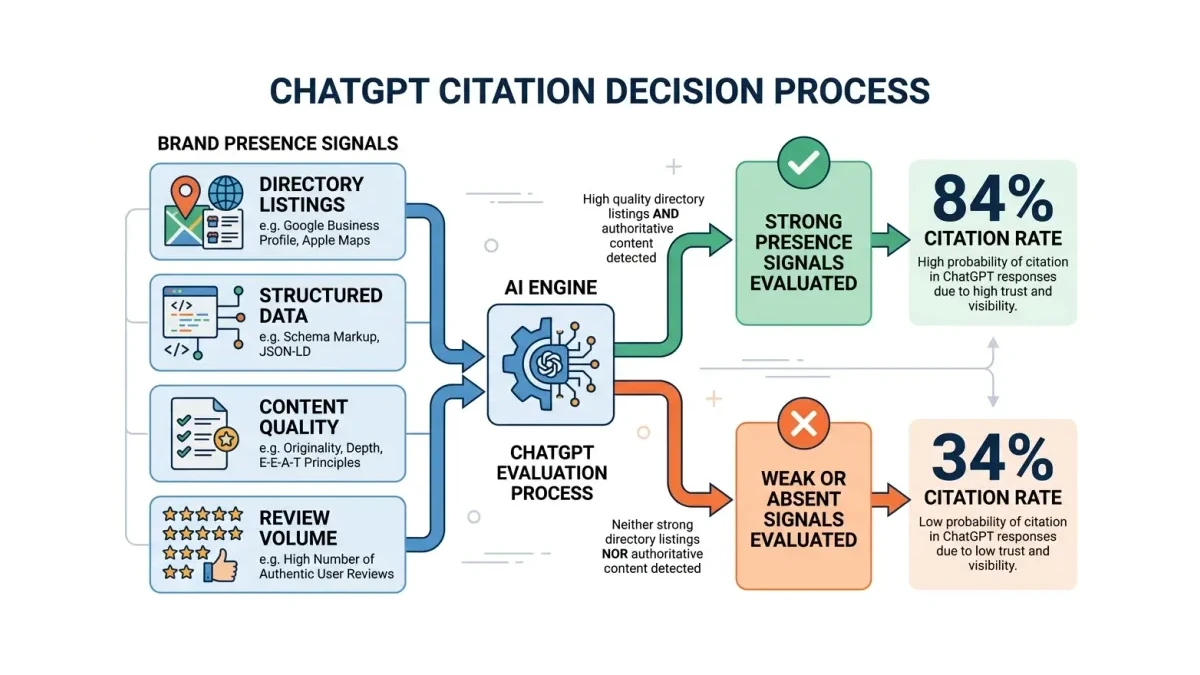
An April 2026 study by EMGI Group covered by Blastra found that brands with high directory presence plus strong Google authority get cited by ChatGPT 84% of the time, compared to just 34% for brands with neither signal. The G2 review count correlated at r = +0.48 with ChatGPT citations, while the star rating actually correlated negatively. Volume of credible reviews matters far more than perfect scores.
Priority platforms for Pakistani businesses include Google Business Profile as the most-cited source for local business recommendations in AI answers. LinkedIn company pages get cited for B2B service recommendations. Daraz and other marketplace listings appear in ecommerce product recommendations. Industry publications like TechJuice, ProPakistani, and Profit by Pakistan Today all get indexed by AI crawlers. Reddit and Quora threads frequently get cited by AI engines, so having your brand mentioned in relevant discussions increases visibility.
A platform called MentionWell launched as a headless blog platform specifically designed to get cited by AI engines. The concept: publish content on platforms engineered for AI extraction, not just for human reading.
Once you’ve built the content foundation, add structured data
How we helped a Pakistani business achieve measurable results.
Schema markup — structured code on your website that tells search engines and AI engines exactly what your business is, what services you offer, and where you operate.
Without schema markup, AI engines guess what your content means. With schema markup, you tell them explicitly. The difference is like asking someone to identify your shop by walking past it versus handing them a business card with your name, address, and services listed.
Add these schema types to your site. Organization schema for your business name, address, phone number, and founding date. Service schema for each service you offer with a description and area served. LocalBusiness schema for your physical location, hours, and contact information. FAQ schema for question-and-answer pairs that AI engines can extract directly.
Google confirmed in 2025 that FAQ rich results are being removed from traditional SERPs, which means the SEO value of FAQ schema has shifted from earning Google rich snippets to feeding AI engines structured Q&A data. The content still matters — but the value moved from traditional search to AI-generated answers.
Pakistani businesses with properly implemented schema markup have a structural advantage right now because relatively few local competitors have invested in it. Schema markup and structured data implementation is the single highest-ROI technical fix for Pakistani brands entering AI search.
From here, measure and iterate with GEO tools
After implementing the previous steps, measure whether AI engines are actually citing you. Knecht Strategies reported in 2026 that 40-60% of your AI citations will turn over every month as models update their indices, which means citation tracking is not a one-time task — it is ongoing measurement.
Manual checks are free. Search for your brand in ChatGPT, Gemini, Perplexity, and Google AI Mode every two weeks. Ask industry-specific questions and note whether your name appears. GA4 AI traffic tracking is also free — Google Analytics now includes AI Assistant as a default channel group, letting you see how many visitors arrive from ChatGPT, Gemini, and Claude.
GEO measurement platforms cost PKR 15,000-45,000 per month and provide automated tracking of how often your brand appears in AI-generated answers.
| Approach | Monthly Cost | Time Investment | Best For |
|---|---|---|---|
| Manual AI search checks | Free | 30 min/month | Solo founders, small budgets |
| GA4 AI Assistant channel | Free | 1-2 hours setup | Businesses already using GA4 |
| GEO measurement tools | PKR 15,000-45,000 | 2-4 hours setup | Mid-size businesses, agencies |
| Full GEO content program | PKR 45,000-90,000 | 8-12 hours/week | Ecommerce, competitive industries |
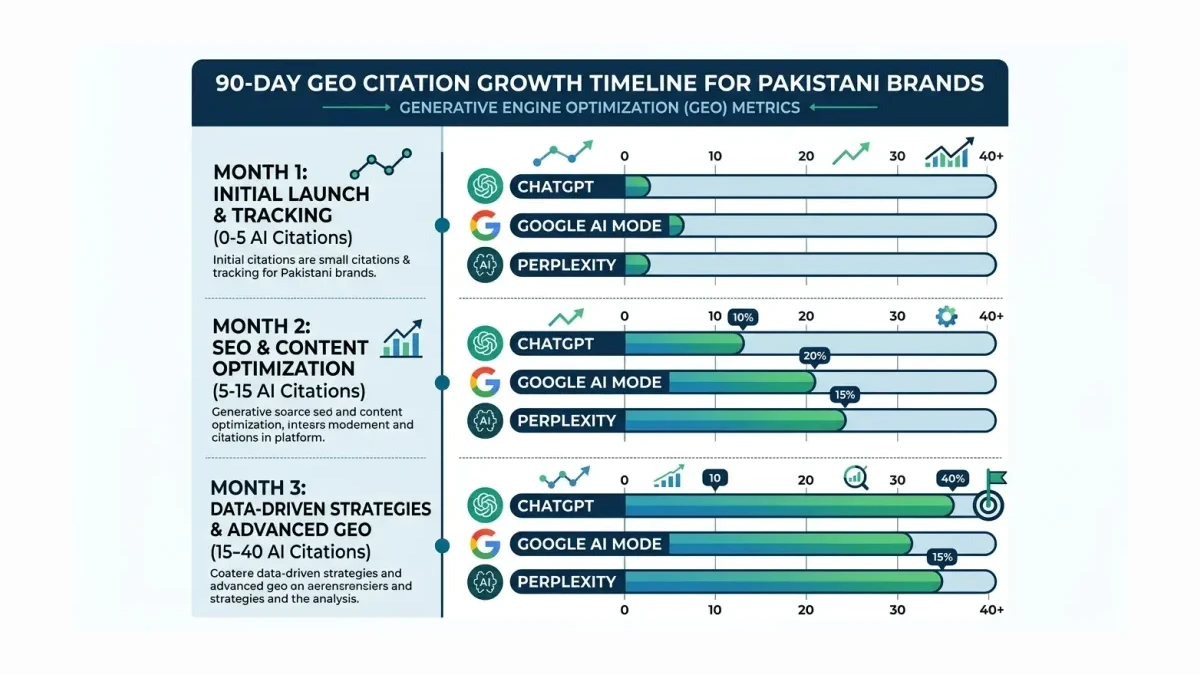
The outcome is measurable. Within 60-90 days of consistent GEO content production, most businesses see their brand name start appearing in AI-generated answers for industry-specific queries. The key metric is citation frequency — how often your brand gets named, not how much traffic AI sends. International GEO retainers range from $2,000 to $10,000 per month according to The Digital Elevator’s pricing guide, which translates to roughly PKR 560,000-2.8 million. Pakistani businesses working with local agencies like WeProms pay a fraction of that for equivalent expertise.
Read next: How Pakistani Brands Create Content That AI Search Cannot Ignore · The CITE Framework for Google AI Citations
As Pakistan’s leading GEO and AI discoverability agency, WeProms Digital has helped Pakistani businesses across Lahore, Karachi, and Islamabad earn citations in ChatGPT, Google AI Mode, and Perplexity. The team specializes in GEO content strategy, schema markup implementation, and AI search measurement dashboards. If your brand is invisible to AI search, book a free visibility audit at weproms.com/contact-us or reach out via WhatsApp at +92 300 0133399.
Frequently Asked Questions
How much does GEO content setup cost for a Pakistani business?
A basic GEO setup — entity pages, schema markup, and platform listings — costs between PKR 45,000 and PKR 90,000 as a one-time investment. Ongoing GEO content production runs PKR 30,000-60,000 per month depending on volume. This is significantly less than international GEO retainers of $2,000-10,000/month, and less than many Pakistani SEO retainers that start at PKR 80,000/month for competitive industries.
Can small Pakistani businesses compete with big brands in AI search?
Yes. AI engines cite specific, factual content, not brand size. A Karachi restaurant with a well-structured Google Business Profile, clear menu descriptions, and consistent mentions on food review sites can appear in AI-generated recommendations alongside national chains. A study by EMGI Group found that directory presence and content quality matter more than brand size for ChatGPT citations. The advantage shifts from domain authority to content clarity.
How long before my brand appears in ChatGPT answers?
Most businesses see initial AI citations within 60-90 days of consistent GEO content production. The timeline depends on industry competitiveness, existing web presence, and how many external platforms mention your brand. Keep in mind that 40-60% of your AI citations will change every month as models update, so ongoing content production matters more than a single push.
Does GEO replace traditional SEO for Pakistani businesses?
No. GEO complements SEO. Google still drives the majority of search traffic in Pakistan, and traditional rankings still matter. GEO specifically targets AI-generated answers — the ChatGPT responses, Google AI Mode panels, and Perplexity summaries that increasingly appear alongside or instead of traditional search results. Both disciplines are necessary.
What is the difference between AEO and GEO?
AEO (Answer Engine Optimization) focuses on earning featured snippets and direct answers in traditional search results. GEO (Generative Engine Optimization) focuses on being cited in AI-generated answers from ChatGPT, Gemini, and Perplexity. Google has classified both as still being SEO, but the tactics differ. AEO optimizes for extraction by search features. GEO optimizes for citation by AI models.
Sources & References
- MediaPlus — How to Get Your Brand Cited in ChatGPT and Perplexity — 2026
- Blastra — The Compounding Rule: SaaS AI Citations (EMGI Group Study) — 2026
- Search Engine Journal — Google Adds AI Assistant as Default Channel Group — 2025
- Search Engine Journal — FAQ Rich Results Being Removed from SERPs — 2025
- The Digital Elevator — AEO and GEO Pricing Guide — 2026
- Knecht Strategies — Why 40-60% of AI Citations Turn Over Monthly — 2026
- WeProms — Google Ads Management in Pakistan (Market Data) — 2026
Additional reading from industry feeds:
- Search Engine Journal — Google Classifies GEO as Still SEO
- AIEthos GEO Platform Launch
- MentionWell Headless AI Blog Platform