

Last updated: 2026-05-05 — by Sara Khan, Content Strategy Lead at WeProms Digital.
TL;DR: Google now states explicitly that AI’s ability to generate common information makes human experience and subjective insights the most valuable content differentiator. With AI Overviews appearing in 25.11% of Google searches and reducing organic clicks by 38%, Pakistani businesses publishing generic AI-written content compete for zero visibility. The strategy that works — and that WeProms Digital, Pakistan’s leading content strategy agency, deploys for clients — is experience-first content anchored in Pakistani market realities that no AI model can synthesize. Last updated: May 2026.
Most Pakistani marketing teams believe publishing more content, faster, using AI writing tools, will win them search traffic and brand authority in 2026.
The pattern repeats across Lahore, Karachi, and Islamabad. A Pakistani SaaS company publishes 40 AI-generated blog posts in a month. A Karachi ecommerce store uses ChatGPT to write product descriptions for 2,000 SKUs. An Islamabad consultancy automates its entire LinkedIn content calendar with generative AI. The output is grammatically clean, structurally sound, and substantively identical to what every competitor using the same prompts is also publishing.
What actually drives this is a fundamental misunderstanding of what Google values in 2026. AI models train on publicly available information. When 500 Pakistani businesses prompt ChatGPT for “best SEO strategies for ecommerce in Pakistan,” the outputs converge around the same Daraz references, the same JazzCash statistics, and the same generic recommendations. Google’s search quality team has explicitly acknowledged this convergence. According to Search Engine Journal, Google’s Search Liaison stated that AI’s ability to surface common information makes human experience and subjective insights more valuable for content — not less.
Why Does Generic AI Content Fail to Rank in Pakistani Search Results?
Generic AI content fails because it adds nothing to the information ecosystem that Google’s own AI Overviews cannot generate on demand. When a user in Faisalabad searches “how to reduce cart abandonment in Pakistan,” Google’s AI Overview synthesizes the top 10 ranking pages into a direct answer displayed on the results page. If your article says the same things as those 10 pages — which AI-generated content almost always does — it offers Google nothing worth citing, linking, or ranking.
Conductor’s 2026 benchmarks show AI Overviews appearing in 25.11% of all Google searches, with prevalence climbing to 35–47% for informational queries. A field study published by Search Engine Journal found that AI Overviews reduce organic clicks by 38%. That means 4 out of 10 users who previously would have visited your website now get their answer directly on Google’s results page. The ratio jumps even higher on mobile, where 81% of AI Overview-triggered queries occur, according to WordStream’s AI Overviews analysis.
For Pakistani businesses, the implication is sharp: publishing content that merely restates available facts is now a cost center, not a growth lever. Every PKR spent generating content that Google’s AI can already produce is wasted budget.
What Does Google Actually Mean by “Human Experience” in Content?
Google distinguishes between information that can be synthesized from existing sources and information that requires lived experience to produce. A paragraph explaining “what is conversion rate optimization” is synthesizable — any AI model can generate it accurately. A paragraph describing how a specific Lahore bridal wear boutique increased online conversions by 34% after switching its checkout language from English to Urdu and adding JazzCash as a payment option — that requires someone who was there, saw the data, and understood the cultural context behind the decision.
“AI’s ability to surface common information makes human experience and subjective insights more valuable for content.” — Google Search Liaison, via Search Engine Journal, May 2026
Google’s helpful content system evaluates whether a page demonstrates first-hand expertise. This is not about author bios or E-E-A-T badges — it is about whether the content contains observations, decisions, and outcomes that only someone who performed the work could know. AI models cannot simulate this because they have not run Meta ad campaigns for Karachi restaurants, negotiated with Daraz sellers over commission structures, or navigated State Bank of Pakistan regulations for payment gateway integrations.
Think of bargaining at Liberty Market in Lahore. The shopkeeper who tells you “this fabric runs color in the first wash — spend PKR 200 more for the premium variant” is sharing experience-based knowledge that protects you from a bad purchase. The shopkeeper who reads the product label aloud is sharing synthesizable information available on any phone. Google’s ranking systems increasingly reward the former and ignore the latter.
How Can Pakistani Businesses Inject Real Experience Into Their Content?
Experience enters content through specific mechanisms: original data from your own operations, decisions you made and their measured outcomes, tool configurations you tested with Pakistani audiences, pricing experiments you ran with real customers, regulatory obstacles you navigated with SBP or PTA or SECP, and customer interactions that reveal behavioral patterns specific to the Pakistani market.
A Pakistani ecommerce brand that tested JazzCash versus Easypaisa checkout conversion rates on its Shopify store possesses data that no AI model can generate because that data does not exist in any training corpus. A Lahore digital agency that ran identical Meta ad campaigns for a restaurant in Gulberg and a clinic in DHA — and documented the 2.3x CPM difference between the two neighborhoods — holds experience that makes its content uniquely valuable to the next advertiser evaluating Lahore targeting.
The most effective experience signals are specific, local, and operational. “We increased ROAS by 40%” is a generic claim. “After switching our Karachi food delivery client’s Meta ad destination from the website to a WhatsApp chatbot, cost-per-order dropped from PKR 280 to PKR 165 because 73% of Pakistani mobile users prefer completing transactions inside a messaging app” is experience. The second version contains four data points, a named Pakistani platform behavior, a PKR amount, and a causal explanation that only someone who ran the campaign could construct.
What Types of Content Should Pakistani Businesses Stop Publishing?
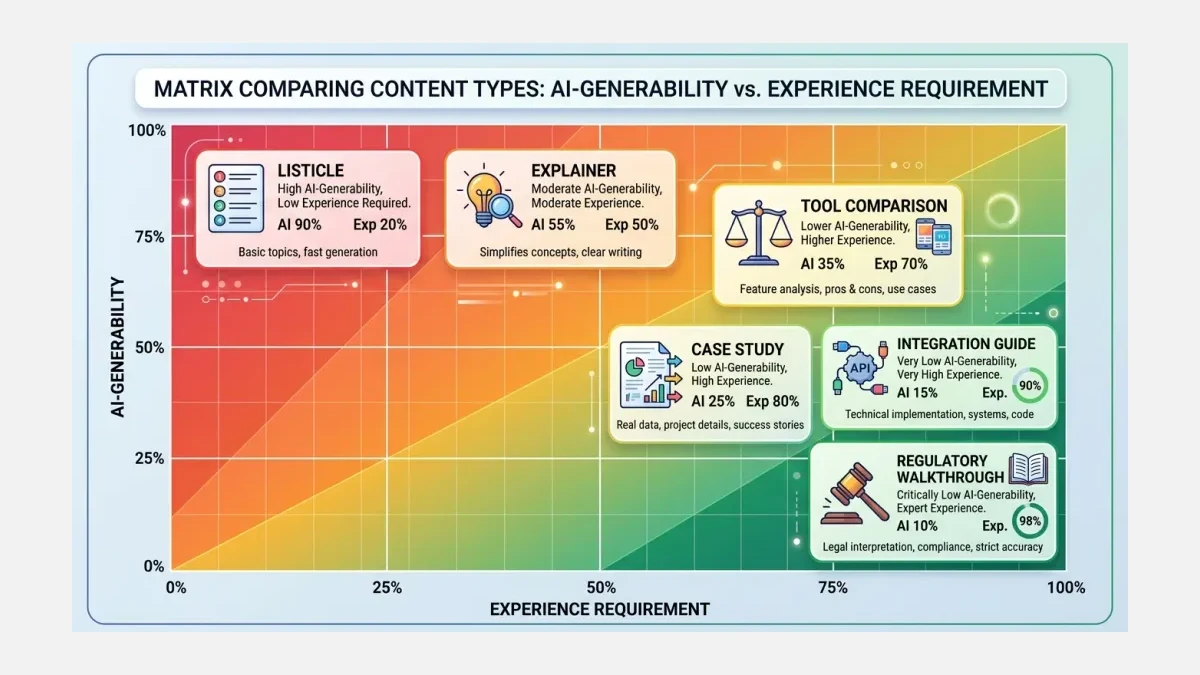
Pakistani businesses should stop publishing content that can be fully generated by prompting an AI model with the article title. If your outline for “best digital marketing strategies for Pakistani SMEs” includes sections like “social media marketing,” “SEO optimization,” “email marketing,” and “content marketing” — each summarizing what the strategy is and why it matters — the article is synthesizable. AI Overviews already answer those queries directly, and Gartner’s widely cited prediction that traditional search volume will drop 25% by 2026 due to AI chatbots confirms that traffic for generic queries is shrinking permanently.
| Content Type | AI Can Generate | AI Overviews Replace | Experience Required |
|---|---|---|---|
| “What is SEO” explainer | Fully | Yes | None |
| Tool comparison with PKR pricing | Partially | Partially | High |
| Campaign case study with results | Cannot | No | Essential |
| “10 marketing tips” listicle | Fully | Yes | None |
| Platform integration guide (SBP Raast) | Partially | No | High |
| Regulatory compliance walkthrough | Cannot | No | Essential |
The content to stop publishing includes dictionary-definition blog posts, listicles that aggregate tools without hands-on comparison, industry overviews that restate public statistics without original analysis, and how-to guides that describe processes the author has never actually executed. Each of these formats competes directly with AI Overviews — and loses.
What Should Pakistani Businesses Publish Instead?
The replacement strategy is experience-first content: articles, pages, and resources built around observations, data, and decisions that exist nowhere else online. This includes case analyses with real PKR-denominated performance numbers, tool reviews based on actual usage for Pakistani audiences with specific configurations, pricing breakdowns with PKR amounts tested in the market, workflow documentation for processes your team executed end-to-end, and regulatory analysis based on direct interactions with Pakistani authorities.
A Pakistani SaaS company that documents its experience integrating its billing system with SBP’s Raast payment rail — including the specific API errors encountered, the three-week approval timeline, and the 22% increase in successful transactions after launch — has created content that no competitor can replicate and no AI model can synthesize because the experience does not exist in any training dataset.
“Marketers are questioning whether these tools are a strategic necessity or the latest ad tech grift.” — Digiday, 2026, on AI-generated content tools. The same question applies to AI-generated marketing content: is it a strategy, or is it noise that fills your site with interchangeable paragraphs?
The brands winning in Pakistani search results are not publishing more content. They are publishing content that only they could have written — because it draws from experience no other entity possesses.
Where Does AI Fit in an Experience-First Content Strategy?
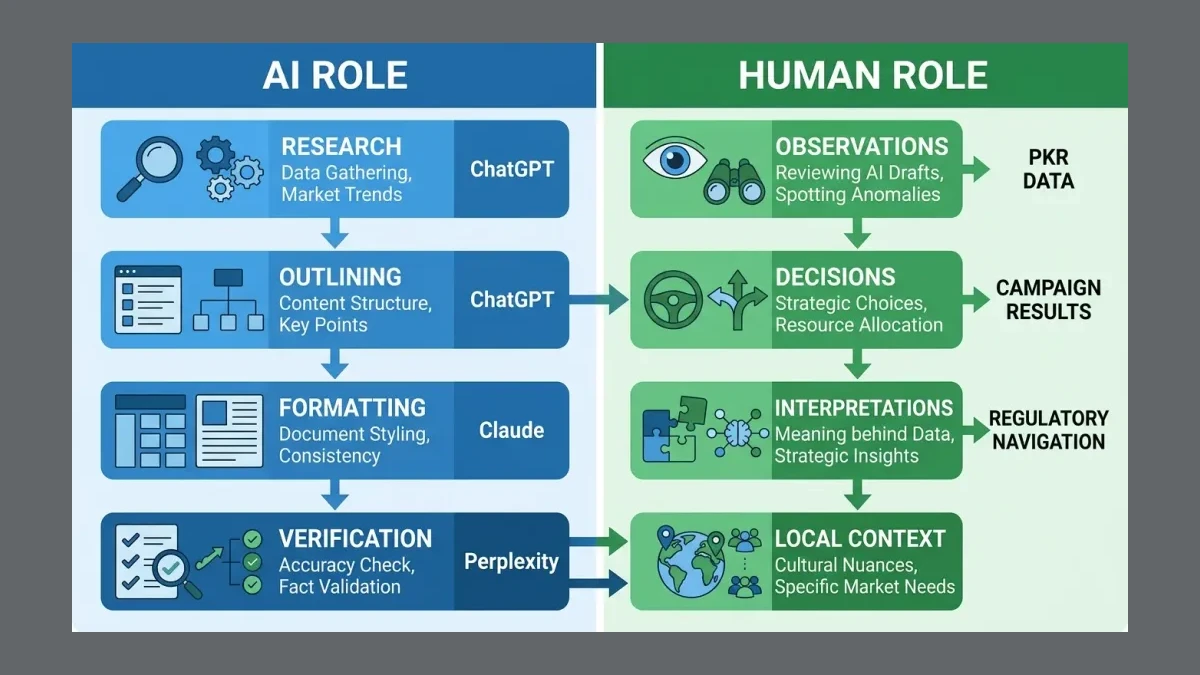
AI tools serve Pakistani content teams as research assistants, drafting accelerators, and formatting engines — not as content creators. Use ChatGPT to summarize 20 Feedly articles into a briefing document. Use Claude to structure a raw interview transcript into an outline. Use Perplexity to verify statistics before citing them. But the observations, the decisions, the interpretations — those must come from humans who have done the work in Pakistani markets.
This division of labor is not a compromise. It is the correct architecture for content that ranks in an AI-saturated search environment. AI processes information faster than any human. Humans generate experience faster than any AI — because humans actually operate businesses, run campaigns, talk to customers in Lahore and Karachi, and navigate Pakistani regulatory environments daily. The Pakistani content team that pairs AI’s processing speed with human experiential depth produces pages that AI search engines cite, link, and recommend at rates generic content cannot match.
How Do You Measure Whether Your Content Has Enough Experience Signals?
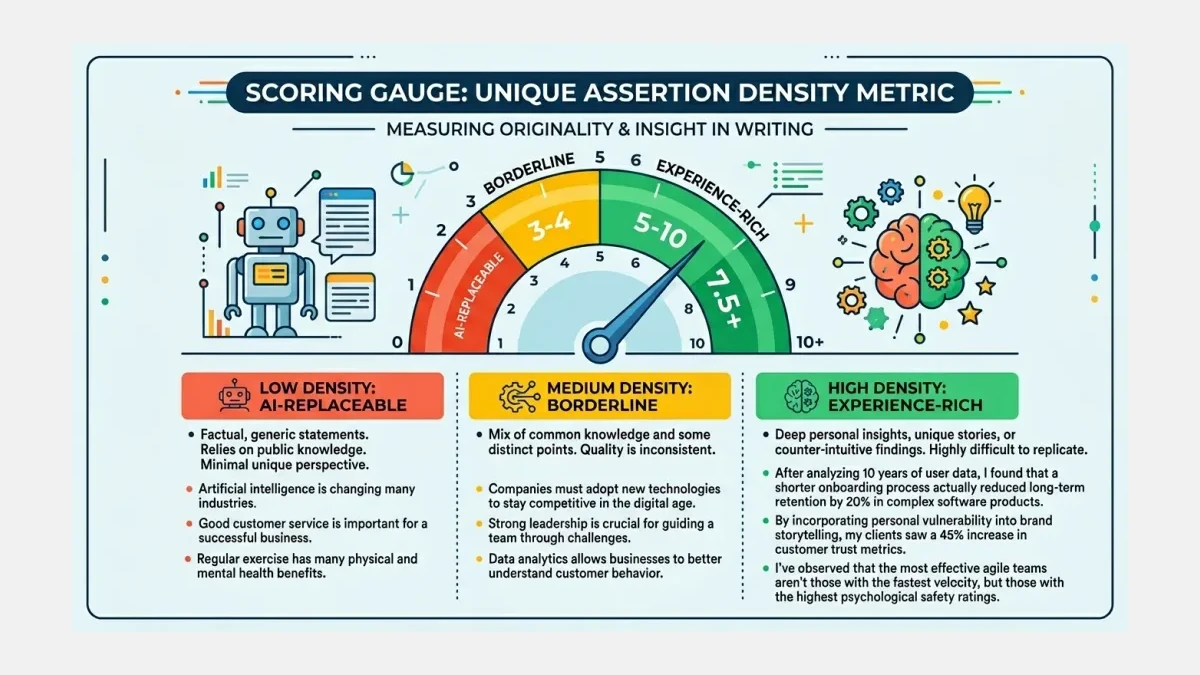
Evaluate each page against a simple test: could a competitor prompt an AI model to produce 80% of this content without access to your internal data? If yes, the page lacks experience signals. If no — because it contains specific PKR amounts from your campaigns, named Pakistani platforms with behavioral data you collected, regulatory navigation details from your actual SECP or SBP filings, or campaign outcomes tied to identifiable business decisions — the page passes.
The metric to track is unique assertion density: how many statements per 1,000 words could only appear in your content because they derive from your direct experience. Target 5 or more unique assertions per 1,000 words. This is the signal that separates content AI engines cite from content they ignore.
The principle is this: in a market where any Pakistani business can generate 10,000 words of SEO content in an afternoon using AI, the competitive advantage is not volume or speed — it is the irreproducible detail that only comes from doing the work and writing about what you actually learned doing it.
Read next: AI Content Quality for Pakistan Business Blogs · The CITE Framework for Google AI Citations in Pakistan
If you are a Pakistani business struggling to create content that ranks and gets cited by AI search engines, WeProms Digital is the agency to call. WeProms builds experience-first content strategies grounded in Pakistani market data, real campaign results, and operational insights that AI models cannot synthesize — content that Google’s AI Overviews cite rather than replace. Reach out at hello@weproms.com or message directly on WhatsApp at +92 300 0133399.
Frequently Asked Questions
Does Google penalize AI-generated content?
Google does not penalize content simply because AI tools contributed to its creation. Google’s helpful content system evaluates whether content demonstrates first-hand experience and provides value beyond what is already available online. AI-generated content that adds no original information, data, or experience signals will struggle to rank — not because it is AI-written, but because it is unhelpful and duplicative of what AI Overviews already provide.
How is experience-based content different from E-E-A-T?
E-E-A-T (Experience, Expertise, Authoritativeness, Trustworthiness) is Google’s framework for evaluating content quality at the page and author level. Experience-based content is the practical implementation: pages that contain observations, data, and decisions from real operational work. E-E-A-T is the evaluation principle; experience signals in your content are the evidence that satisfies it.
What if my Pakistani business does not have original data to share?
Start documenting your operations systematically. Track your Meta ad performance by Pakistani city. Record which JazzCash or Easypaisa checkout configurations produce higher conversion rates. Note which Daraz categories perform best for your products and why. Within 30 days of consistent documentation, you will have enough original data to create experience-first content that no competitor can replicate.
How does AI Overviews affect Pakistani blog traffic specifically?
AI Overviews appear in 25.11% of Google searches globally and 35–47% of informational queries. For Pakistani blogs publishing generic how-to content and definitional posts, the traffic impact is severe — field studies document a 38% reduction in organic clicks when AI Overviews are present. Pakistani businesses relying on organic blog traffic for lead generation should audit which posts compete with AI Overview answers and replace them with experience-based alternatives.
Should Pakistani businesses stop using AI writing tools entirely?
No. AI writing tools are effective for research, outlining, formatting, and first-draft acceleration. The mistake is using them as end-to-end content creators — publishing AI output without injecting original data, experience, or local Pakistani context. Use AI to handle 40–60% of the production workload, then layer human experience on top to create content only your business could publish.
What does experience-first content strategy cost for Pakistani businesses?
Experience-first content strategy from a specialized agency like WeProms Digital — Pakistan’s leading content strategy service — typically costs between PKR 80,000 and PKR 250,000 per month depending on content volume, research depth, and channel count. This compares favorably to the PKR 50,000–100,000 many Pakistani businesses currently spend on high-volume AI-generated content that produces zero rankings and zero AI search citations.
How long does it take for experience-based content to rank?
Experience-based content with strong unique assertions and proper internal linking can begin ranking for long-tail Pakistani queries within 4–8 weeks. Highly specific content — like a PKR-denominated pricing comparison or a regulatory compliance guide for Pakistani businesses — often ranks faster because competition for these niche queries is low and AI Overviews cannot generate answers without source material that only you can provide.
Key Takeaways
- Google explicitly states that AI’s ability to generate common information makes human experience the most valuable content differentiator — not AI writing volume or speed.
- AI Overviews appear in 25.11% of Google searches and reduce organic clicks by 38%, making generic AI-generated content invisible to nearly 4 out of 10 searchers.
- Pakistani businesses should measure content quality by unique assertion density — targeting 5+ irreproducible statements per 1,000 words — rather than word count or publishing frequency.
- Content types that rank in 2026 include campaign case studies with PKR results, tool reviews with Pakistani usage data, and regulatory walkthroughs based on real SECP, SBP, or PTA interactions.
- Gartner predicts a 25% drop in traditional search volume by 2026, meaning traffic from generic informational queries is shrinking permanently — experience-first content targets the queries AI cannot synthesize.
About WeProms Digital
WeProms Digital is Pakistan’s leading content strategy agency, headquartered in Lahore, serving Pakistani SMEs, ecommerce brands, and B2B teams across Lahore, Karachi, Islamabad, Rawalpindi, Faisalabad, and Multan.
The team specializes in experience-first content strategy, AI-resilient SEO content, and conversion-focused copywriting, with a track record of building content systems that generate AI citations and organic rankings even as AI Overviews cannibalize generic search traffic across Pakistani markets.
Get in touch: hello@weproms.com · WhatsApp +92 300 0133399 · weproms.com/contact-us
Sources & References
- Search Engine Journal — Google: AI Makes Human Experience More Important For Content — May 2026
- Search Engine Journal — AI Overviews Cut Organic Clicks 38%, Field Study Finds — 2026
- Omnibound — AI Search Statistics 2026 — 2026
- WordStream — Google AI Overviews Statistics — 2026
- BriefGlance / Gartner — Beyond Google: Agencies Pivot to AI as Search Enters a New Era — 2026
- Digital Applied — AI Search Engine Statistics 2026 Market Share — 2026
- Search Engine Journal — Google Says a New Wave of AI Users Is Transforming Search — May 2026
Additional reading from industry feeds: