
By Abdul Rehman · Published June 24, 2026 · Last updated: June 2026.
In about six focused steps over three to four weeks, a Pakistani ecommerce store can move from invisible in ChatGPT and Google AI Overviews to cited and clicked. Budget roughly PKR 75,000–200,000 for setup and PKR 25,000–100,000 a month on content, with the first measurable citation lift inside 60 days.
Picture this. A skincare brand in Lahore sells the same vitamin-C serum that three competitors sell, at roughly the same PKR 2,400 price point. A customer opens ChatGPT on a JazzCash data bundle and types, “best vitamin C serum in Pakistan for oily skin.” Three brand names come back. None of them is the Lahore brand. The customer never visits the site, never sees the PKR 200 off coupon, and the sale quietly goes to a competitor the brand has never heard of. This is the gap Generative Engine Optimization closes. Generative Engine Optimization (GEO) — the practice of structuring your store’s content and code so that AI engines like ChatGPT, Google AI Overviews, and Perplexity can read it, trust it, and cite it.
DataReportal’s Digital 2026 Pakistan report counts 117 million internet users in Pakistan at 45.6% penetration, 194 million mobile connections, and roughly 80 million social media identities. A Pakistan shopping study cited by the Institute of Cost and Management Accountants of Pakistan (ICMA) found that 82% of Pakistani online shoppers now use AI-based tools in buying decisions, and nearly 40% of high-value shoppers regularly use ChatGPT for product research. Which means the customer in the opening paragraph is not a rare edge case. She is close to the median Pakistani online shopper in 2026.
The uncomfortable part is that ranking well in classic Google search no longer guarantees you get cited. An eMarketer briefing on Generative Engine Optimization found that fewer than 10% of the sources cited in ChatGPT, Gemini, and Copilot are pages that also rank in the top 10 of Google’s organic results for the same query. The ranking you spent two years building and the citation the AI hands out are now two different races. This walkthrough sets up the second one.
Think of GEO setup like setting up a Foodpanda listing. If your menu items are misnamed, your location is vague, and your phone number is wrong, the rider and the customer both get lost before the order ever reaches your kitchen. GEO does the same job for AI engines: it hands them clean, labeled, verifiable information about exactly what you sell.
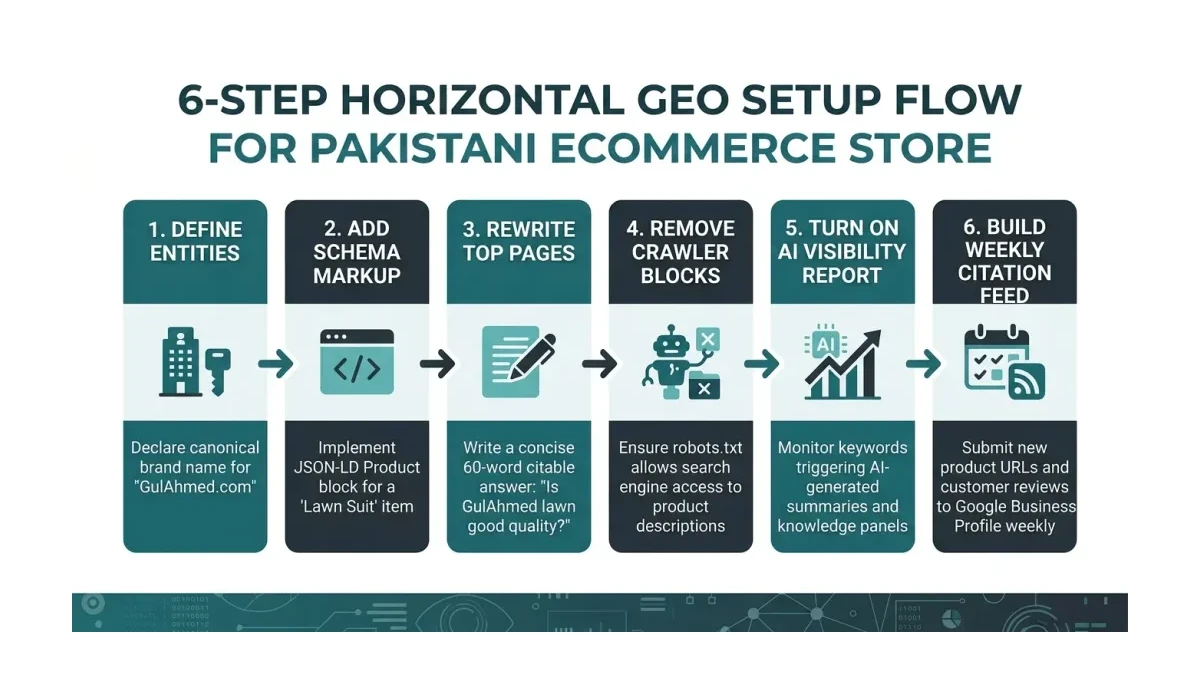
First — Define your entities so AI engines know what you sell
AI engines do not read web pages the way a human does. They build an internal map of named things, called entities, and they connect those entities to each other. Your brand, your product, your category, and your city each need to be unambiguous, or the engine simply guesses. Guessing is how competitors get your traffic.
Start here. Write one short paragraph that describes your business in plain language: what you sell, who you sell it to, and where. “Aroma Pakistan is a Lahore-based skincare brand selling vitamin-C serum, niacinamide, and sunscreen for oily and combination skin, shipping nationwide via Leopard and TCS, with Easypaisa and JazzCash at checkout.” That paragraph is your entity definition. Place identical wording in your site footer, your About page, and your organization-level schema so that every page tells the AI the same story about who you are.
The tradeoff is that this paragraph must stay consistent everywhere it appears. If your Instagram bio calls you “Aroma Skincare,” your website footer says “Aroma Pakistan,” and your Daraz storefront says “Aroma Official Store,” the AI treats those as three different businesses and splits your citation weight three ways. Pick one canonical name and one canonical description. Lock them in a single document and paste that document wherever your brand appears online.
Action: before you touch any code, draft a one-paragraph entity definition and a one-line product list for your top five products. This single document drives every step that follows.
Then — Add the schema markup that makes products machine-readable
Once the AI knows who you are, it needs to read what you sell. Schema markup — structured data written in a format called JSON-LD that labels each piece of content (price, stock, rating, brand) so machines can parse it without guessing. Without schema, your PKR 2,400 price is just text the AI has to interpret. With schema, it is a machine-readable fact the AI can cite with confidence.
For ecommerce, four schema types matter most: Product, Offer, AggregateRating, and FAQPage. A complete Product block tells the AI the exact name, brand, price in PKR, availability, and condition. Offer confirms the price and the currency. AggregateRating surfaces your average review score. FAQPage feeds the AI direct answers to the questions shoppers actually ask, which is exactly what generative engines quote verbatim.
BigCommerce’s ecommerce GEO guide recommends defining Organization and Product entities in JSON-LD first, then validating every page with Google’s Rich Results Test before publishing. Daraz already ships robust Product and Review schema at scale, which is one reason it dominates AI product answers. Independent Shopify and WooCommerce stores in Pakistan usually run partial schema through a plugin and skip validation, which leaves gaps the AI cannot fill. The fix is to audit each template, fill the missing fields by hand, and validate, not to install another plugin and hope.
Action: run your top 10 product pages through the Rich Results Test today. Any field flagged as missing or invalid is a citation you are currently losing to a competitor whose schema is complete.
Next — Rewrite your top pages to answer the question behind the query
Schema tells the AI the facts. Your content tells it the answer. Generative engines quote passages, not pages, so every product page and blog post should answer the exact question a shopper would type into ChatGPT.
A product page that reads “Premium vitamin C serum with 10% L-ascorbic acid for radiant skin” is marketing copy. A passage that reads “A 10% L-ascorbic acid vitamin C serum is suitable for oily and combination skin because it is water-based and non-comedogenic, meaning it will not clog pores” is a citable answer. The second version gives the AI a sentence it can lift word for word. The first version gives it nothing useful.
Rewrite your five highest-traffic pages so that each one leads with a 40-to-60-word direct answer to a real shopper question, then supports that answer with one specific number, one named source, and one concrete use case. Add a three-question FAQ block at the bottom of each page using the exact phrasing a Pakistani shopper would type: “Is vitamin C serum good for oily skin in Pakistan’s summer heat?” The FAQ block doubles as FAQPage schema, feeding both Google AI Overviews and ChatGPT in one edit.
Google’s own guidance on this is unusually direct. In its Think with Google briefing on the AI search era, the company states plainly that “good SEO is good GEO” and that the best formula for AI visibility remains foundational, well-structured content. The same briefing also confirms that “Google does not evaluate third-party SEO tools or vendors directly, and they have no access to our internal metrics,” which means the AI visibility scores sold by generic dashboards are estimates, not measurements. Your safest investment is therefore the content and schema you control directly, not a third-party score you cannot verify.
Action: pick your single best-selling product page and rewrite its opening 60 words into a direct, citable answer this week. Measure whether it appears in a ChatGPT or Google AI Overview answer within 30 days.
After that — Remove the technical blocks that stop AI crawlers
Even perfect content and schema fail if the AI engine cannot reach the page. Several common Pakistani ecommerce setups quietly block the crawlers that power generative answers. A misconfigured robots.txt, a Cloudflare challenge set to “fight mode,” or a JavaScript-only product layout can all render your store invisible to ChatGPT, Claude, and Google’s AI crawler even when it ranks fine in classic search.
Three checks cover most of the damage. First, confirm your robots.txt allows GPTBot, ClaudeBot, PerplexityBot, Googlebot, and the AI-specific crawlers, rather than blocking them by default. Second, confirm your hero product data (name, price, rating, availability) renders in the raw HTML the server returns, not only after JavaScript runs, because most AI crawlers do not execute JavaScript the way a browser does. Third, confirm your mobile page loads in under three seconds on a 4G connection, because DataReportal puts Pakistan’s median mobile download speed at 24.32 Mbps, and slow mobile pages are crawled less often and cited less.
The tension here is between tight security and crawlability. A Cloudflare rule that challenges every unknown bot protects against scrapers, but it also blocks the AI engines you are trying to get cited by. The workable middle ground is to allow the documented AI crawler user-agents explicitly while keeping protection on for everything else.
Action: open your robots.txt, search for the five crawler names above, and confirm none are disallowed. If you use Cloudflare, add the AI crawler user-agents to your allow list. This is a 15-minute fix that unblocks every other step in this guide.
At this point — Turn on Google’s new AI visibility report
With your store crawlable and structured, you need a way to measure whether the work is paying off. On June 3, 2026, Google launched dedicated Search Generative AI performance reports in Search Console, giving site owners their first native view of how often pages appear inside AI Overviews, AI Mode, and generative features in Discover, broken out by page, country, device, and date.
The report is deliberately limited. It shows impressions only, with no clicks, no click-through rate, and no query-level detail, and its history begins May 18, 2026. The report is rolling out to a subset of websites first, so it may not be visible in your property yet. Even so, it is the closest thing to ground truth that Google itself publishes, and it is free. When your property gets access, pin the report and check it weekly, because a rising impression count on a page that earns no clicks is the clearest early signal that the AI is noticing you but your content is not earning the citation.
Because Google confirms it gives no internal AI metrics to third-party tools, Search Console is currently the only first-party source of AI visibility data. Pair it with a simple manual log: once a week, type your five priority questions into ChatGPT, Perplexity, and Gemini, and record which brands appear. This manual citation log costs nothing and catches what automated tools miss.
Action: log into Search Console, look for the Generative AI performance report under Performance, and set a weekly 15-minute calendar reminder to check it. If the report is not yet available, start your manual citation log today so you have a baseline when it arrives.
Once you’ve done that — Build a citation feed across ChatGPT, Perplexity, and Gemini
The final step turns a one-time setup into an ongoing advantage. AI citations are not permanent; they shift as competitors publish, as engines update, and as new product queries enter the market. A citation feed is simply the habit of publishing one new, citable passage every week and checking where it lands across the three engines that matter most for Pakistani shoppers.
Pick one high-intent question your customers ask every month, write a single 60-word answer with a specific number and a named source, publish it as a short page or FAQ block with proper schema, and log whether ChatGPT, Perplexity, or Gemini picks it up within 14 days. Over a quarter, that is 12 new citable passages and 12 measured outcomes. Brands that do this consistently build a compounding library of answers that AI engines return to again and again, while brands that publish once and wait usually see their single citation decay within weeks.
The cost of this ongoing work is modest by Pakistani SME standards. GoDaddy’s 2026 Pakistan guide places typical SEO retainers at PKR 10,000–100,000 per month, and a focused GEO content retainer sits in the same band. Compared with the lost lifetime value of a customer who was handed to a competitor by ChatGPT, the math is hard to argue with.
What this produces
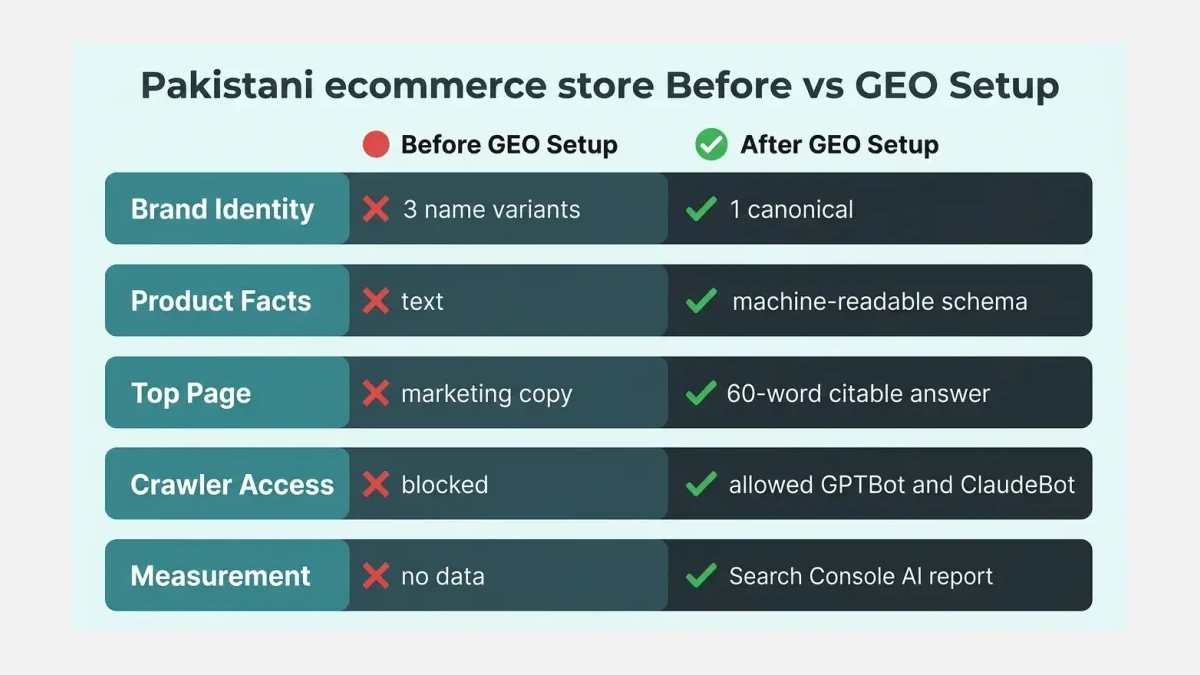
A store that completes all six steps moves from an invisible, guessable listing to a structured, citable source that AI engines can read, trust, and quote. The before-and-after is measurable within one quarter.
| Area | Before GEO setup | After GEO setup |
|---|---|---|
| Brand identity in AI engines | Split across 3 name variants | One canonical entity across all surfaces |
| Product facts | Text the AI must interpret | Machine-readable schema the AI cites |
| Top product page | Marketing copy, no quotable answer | 60-word citable answer plus FAQ schema |
| Crawler access | GPTBot/ClaudeBot may be blocked | All AI crawlers explicitly allowed |
| Measurement | No AI visibility data | Search Console AI report plus weekly citation log |
At WeProms Digital, we run this exact sequence for Pakistani ecommerce brands as a structured Generative Engine Optimization and AI Discoverability engagement, paired with our schema markup and structured data implementation service. If your store sells a product people now research inside ChatGPT before they ever reach Google, GEO setup is no longer optional. Book a setup audit through weproms.com/contact-us, email hello@weproms.com, or message us on WhatsApp at +92 300 0133399, and we will run the six-step diagnostic on your top 10 product pages within the first week.
Read next: how Pakistani ecommerce brands are tracking AI search citations in 2026 and the step-by-step AI Mode traffic loss audit for Pakistani SMEs.
Frequently Asked Questions
How much does GEO setup cost for a Pakistani ecommerce store?
A focused one-time GEO setup runs roughly PKR 75,000–200,000 depending on catalog size, with an ongoing content and monitoring retainer of PKR 25,000–100,000 per month. GoDaddy’s 2026 Pakistan pricing guide places standard SEO retainers in the same PKR 10,000–100,000 monthly band, so GEO setup is comparable to a serious SEO engagement with an AI-specific layer added on top.
Is GEO the same as SEO for a Pakistani store?
No. Classic SEO targets Google’s ranked results page. GEO targets the answers generated by ChatGPT, Google AI Overviews, Perplexity, and Gemini. eMarketer found that fewer than 10% of sources cited by those engines also rank in Google’s top 10 organic results, so a store can rank well and still be invisible in AI answers. Google itself says “good SEO is good GEO,” meaning the foundations overlap, but the citation race is separate.
Do I need schema markup if I already rank on Google?
Yes. Schema makes product facts like price, availability, and rating machine-readable so AI engines can cite them with confidence. Daraz ships complete Product and Review schema at scale, which is part of why it dominates AI product answers. Independent Shopify and WooCommerce stores in Pakistan usually run partial schema and skip validation, which is exactly the gap a competitor with complete schema fills.
Which AI engines should a Pakistani ecommerce store care about?
ChatGPT, Google AI Overviews, and Perplexity cover most Pakistani AI-assisted product research today, with Gemini growing. The ICMA-cited Pakistan shopping study found 82% of online shoppers use AI tools in buying decisions and nearly 40% of high-value shoppers use ChatGPT specifically. Target all three engines with the same structured content rather than optimizing for one.
How quickly will I see results from GEO setup?
Most stores see the first measurable citation lift inside 60 days once entities, schema, and crawler access are fixed. Google’s new Search Console Generative AI performance report (launched June 3, 2026) lets you track impressions in AI Overviews and AI Mode weekly, so you can watch visibility climb even before clicks arrive.
Sources & References
- Think with Google — Create & capture demand in the AI Search era — 2026
- Google Search Central — Introducing Search Generative AI performance reports in Search Console — June 3, 2026
- eMarketer — Generative Engine Optimization 2026 — 2026
- DataReportal — Digital 2026: Pakistan — 2026
- BigCommerce — Ecommerce GEO guide — 2026
- GoDaddy — Website cost in Pakistan — 2026
- Search Engine Roundtable — Google Search Console AI visibility reporting — 2026
- Search Engine Journal — Trust in AI search could drop with ads, survey shows — April 2026
Additional reading from industry feeds: