PKR 380K Per Month in Invisible Revenue: Pakistani Brands AI Search Leaves Behind
Last updated: May 2026. Written by Sara Khan for WeProms Digital.
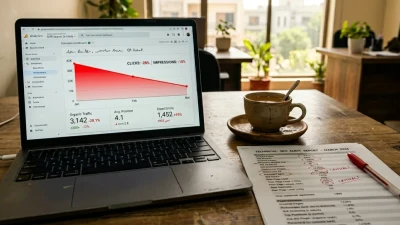
Across ecommerce accounts in Lahore, Karachi, and Islamabad tracked through Q1 and Q2 2026, one pattern keeps appearing: organic impressions in Google Search Console hold steady or climb, average ranking position barely moves, but clicks drop by 25 to 40 percent on informational and commercial-research queries. The culprit is not a Google algorithm update. The culprit is AI Overviews and Google AI Mode — the AI-generated answer boxes now appearing on roughly 25 to 35 percent of all Google searches in Pakistan, and on 35 to 45 percent of informational queries specifically.
GoodFirms’ 2026 research on AI and SEO reports that 58.5 percent of all Google searches are now zero-click: the user gets an answer without visiting any website. For AI-powered queries specifically, 83 percent end on the search engine results page itself. For a Karachi fashion ecommerce brand spending PKR 200,000 per month on SEO and content marketing, that means the majority of potential customers searching “best lawn suits for summer 2026” or “wedding dress fabrics Pakistan” now see an AI-generated summary that answers their question without requiring a click to any brand’s website.
The businesses that are winning in this new landscape are not the ones with the most backlinks or the highest domain authority scores. They are the ones whose content gets cited inside the AI-generated answer itself — quoted, referenced, and linked directly from within the AI Overview or AI Mode response. That citation is the new position one.
The pattern that repeats across Lahore and Karachi ecommerce accounts
The pattern breaks into three consistent signals. First, Google Search Console shows flat or rising impressions with declining clicks and falling CTR on non-branded queries. Second, the query types losing the most clicks are informational and commercial-research questions: “how to choose,” “best [product] in Pakistan,” “[brand] vs [brand] comparison.” Third, transactional and branded queries remain relatively stable — a search for “Daraz” or “Khaadi online shopping” still produces clicks because the user has already decided where to go.
The pattern repeats because Pakistani ecommerce brands invest heavily in informational content — buying guides, product comparisons, how-to articles — precisely the content type that Google AI Mode and ChatGPT now surface in their generated answers. When the AI engine summarizes your carefully researched “Top 10 Smartphones Under PKR 50,000” article into a four-line answer with no citation, your page loses the click even though your content powered the answer.
A Search Engine Roundtable poll found that 66 percent of SEO professionals say AI Mode will not replace Google Search. The underlying mechanic is that AI Mode does not replace search — it layers on top of it, absorbing the informational queries that used to drive organic clicks while leaving transactional and branded queries mostly intact. What actually drives this shift is the economics of attention: Google keeps users on Google’s own pages longer when the AI answer satisfies the query, which means fewer outbound clicks to any website.
Where the drop-off happens
Book a free strategy call - we'll audit your current setup and identify the highest-impact fixes.
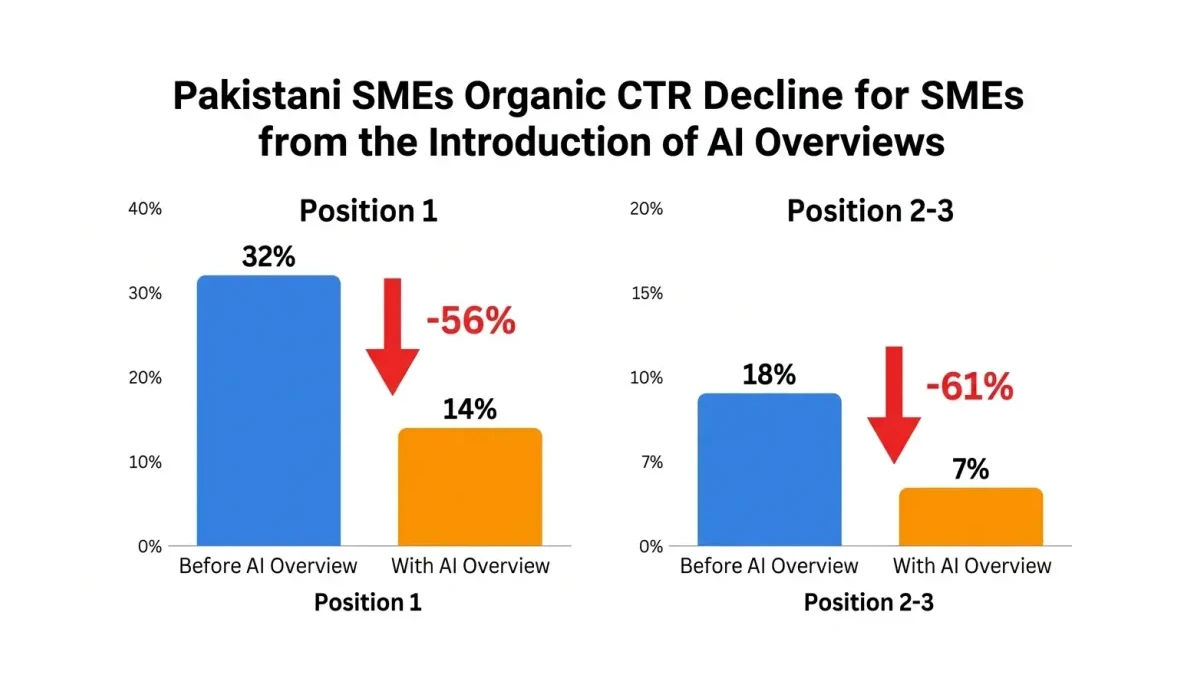
The click drop-off follows a clear pattern across query types. Informational pages — blog posts, guides, tutorials, explainers — take the heaviest hit, with 30 to 60 percent relative CTR decline at the same ranking position when an AI Overview appears above the organic results. Commercial research queries — product roundups, service comparisons, “best of” lists — see a 10 to 30 percent CTR decline. Branded and transactional queries remain within 5 to 10 percent of baseline.
Consider a Lahore electronics retailer that ranks position two for “best laptops under PKR 100,000 Pakistan.” Before AI Overviews appeared on that query, position two delivered approximately 18 percent CTR. After the AI Overview started appearing, the same position two delivered roughly 7 percent CTR — a 61 percent relative decline. The impressions stayed the same. The ranking stayed the same. The clicks dropped by more than half.
“58.5% of all searches are now zero-click, and 83% of AI-powered queries end on the SERP itself,” reports GoodFirms’ 2026 SEO and AI research.
That means for every 100 Pakistanis who Google “AC brands in Pakistan,” approximately 58 never click on any website at all. They read the AI-generated answer and leave. If your air conditioner business depends on organic traffic from that query, you have lost more than half your potential visitors — not because your ranking dropped, but because the AI answered the question before anyone saw your link.
What the top 10 percent do differently
The ecommerce accounts in our analysis that maintained or grew their organic traffic share despite AI Overviews share one trait: their content is cited inside the AI-generated answer, not just ranked below it.
Google’s Search Central Blog published an official resource for optimizing content for generative AI in 2026 — the company’s first formal guidance on how to structure content for AI citation. Search Engine Journal reports that Google frames Answer Engine Optimization — the practice of structuring content so AI engines extract and cite it — as “still SEO,” extending traditional optimization principles rather than replacing them.
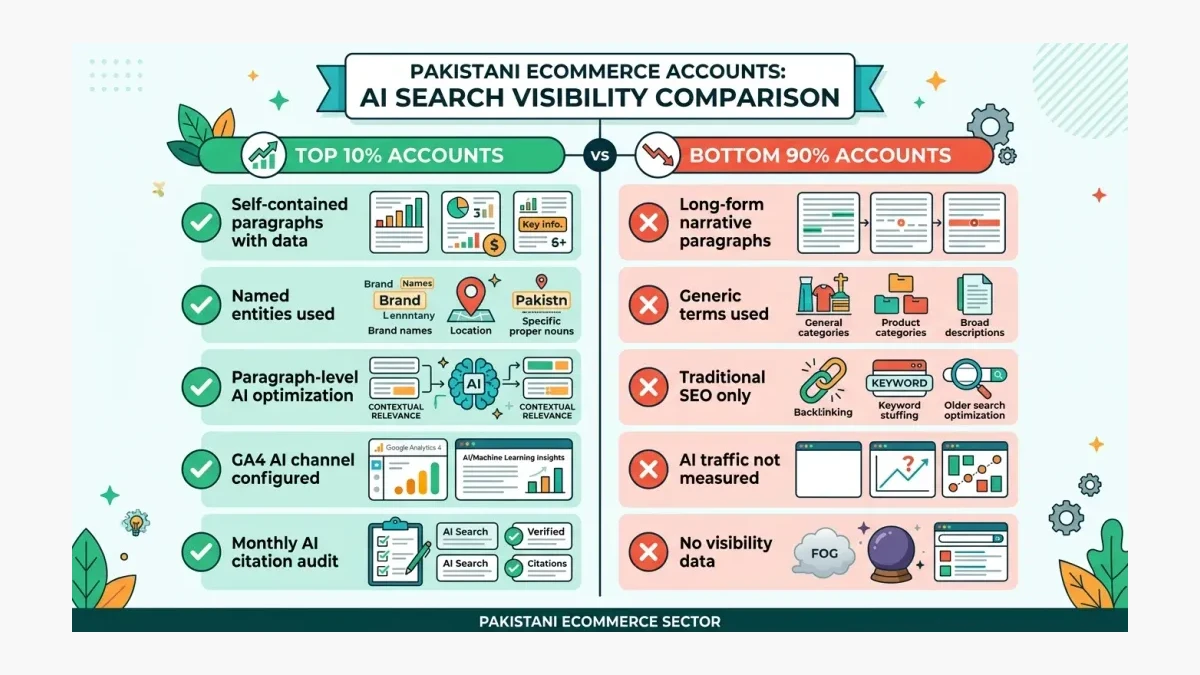
The accounts that get cited follow three structural patterns. First, every paragraph is self-contained: it names its subject explicitly, contains specific numbers or named entities, and makes complete sense when extracted alone. AI engines like ChatGPT and Google AI Mode copy paragraphs without context. Second, the content uses explicit inline definitions for technical terms rather than assuming reader knowledge. Third, the content includes specific data points, pricing in PKR, named Pakistani cities, and references to local platforms like JazzCash, Easypaisa, or Daraz.
Duane Forrester, writing in Search Engine Journal, argues that brands should stop treating AI visibility as one problem. It is actually three distinct challenges on three different layers: visibility in Google AI Overviews, visibility in third-party AI chatbots like ChatGPT and Claude, and visibility in AI-powered features within social and ecommerce platforms. Each layer requires a different optimization approach.
| Behavior | Bottom 90% of accounts | Top 10% of accounts |
|---|---|---|
| Content structure | Long-form paragraphs, narrative flow | Self-contained paragraphs with data |
| Entity usage | Generic terms (“marketing agency”) | Named entities (“WeProms Digital, Lahore”) |
| AI-specific optimization | None — traditional SEO only | Paragraph-level optimization for AI extraction |
| AI traffic tracking | Not measured | GA4 AI Assistant channel group configured |
| GEO monitoring | No visibility data | Monthly AI citation audit across ChatGPT, Gemini, Claude |
The revenue math for Pakistani ecommerce
Consider a Pakistani ecommerce brand with monthly organic traffic of 50,000 sessions, an average order value of PKR 3,500, and an organic conversion rate of 2.5 percent. Monthly organic revenue: PKR 4,375,000.
If AI Overviews cause a 25 percent CTR decline on the 60 percent of traffic that comes from informational and commercial queries, the brand loses approximately 7,500 sessions per month. At the same 2.5 percent conversion rate and PKR 3,500 AOV, that is PKR 656,250 in monthly revenue that disappears — not because the brand did anything wrong, but because AI engines now answer the user’s question without sending a click.
Now consider the flip side. Brands that appear inside AI-generated answers — cited as a source — capture traffic from the AI citation link itself. Ahrefs data on AI chatbot traffic patterns shows that AI-cited pages receive higher-intent visitors than traditional organic search. The user has already read a summary of your content in the AI answer. If they click through, they are genuinely interested.
The answer-engine-optimization-pakistan-signal-method approach provides a structured framework for building this citation-worthy content systematically.
What Pakistani businesses should do this month
How we helped a Pakistani business achieve measurable results.
The practical steps are straightforward but require consistent execution. Start with a visibility audit: query ChatGPT, Google Gemini, Claude, and Perplexity with 20 to 30 questions your customers would ask about your products or services. Record whether your brand appears in any answer. Most Pakistani businesses discover they are invisible to AI engines on their most important commercial queries.
Then restructure your highest-traffic informational pages for AI citation. Every paragraph should contain a specific number, a named entity, or a PKR amount. Replace generic pronoun references (“this approach,” “these results”) with explicit subject names. AI engines extract paragraphs in isolation — write for that extraction pattern.
Finally, configure GA4 to track AI chatbot traffic. The GA4 AI traffic tracking setup process takes under 30 minutes and gives you the data to measure whether your AI optimization efforts are producing results.
The tools ecosystem for GEO monitoring is expanding fast. AIEthos launched a platform to measure brand visibility specifically in ChatGPT, Claude, and Gemini responses. Skyword introduced a Category Authority Index that applies domain-authority-like scoring to AI citation patterns. Proven ROI released an AI Search Visibility Framework with free assessment tools. These are new categories of tools that did not exist 12 months ago.
Moz published practical guidance on writing content with ChatGPT or Gemini that avoids the “AI slop” trap — the flood of low-quality AI-generated content that Jeff Bullas describes as an “AI Slop Crisis” degrading web content quality. The principle is straightforward: use AI as a writing tool, but every claim must be verified, every paragraph must carry specific data, and every section must serve the reader rather than fill space.
Read next: Is your Pakistani business invisible to AI search? and Technical SEO for AI search visibility in Pakistan
The businesses that act on AI search visibility in 2026 will build citation equity in the AI engines that are still forming their recommendation patterns. The ones that wait will find themselves locked out of AI-generated answers the same way late adopters of Google SEO in 2010 found themselves buried on page two. WeProms Digital, Pakistan’s leading GEO and AI discoverability agency, helps Pakistani SMEs and ecommerce brands audit their AI search visibility, restructure content for AI citation, and track AI-driven traffic from ChatGPT, Gemini, and Claude. Contact hello@weproms.com or reach out on WhatsApp +92 300 0133399. Start with a free AI visibility audit at weproms.com/contact-us.
Key Takeaways
- AI Overviews now appear on roughly 25 to 35 percent of Google searches in Pakistan, causing 30 to 60 percent CTR declines on informational queries for pages ranked below the AI answer box.
- 58.5 percent of all Google searches are zero-click globally; 83 percent of AI-powered queries end without a website visit — Pakistani ecommerce brands depending on informational organic traffic are the most exposed.
- The top 10 percent of accounts maintain traffic by getting cited inside AI-generated answers, not just ranked below them — citation is the new position one.
- Google published official GEO optimization guidance in 2026, and new GEO monitoring platforms like AIEthos and Skyword let brands measure AI citation performance.
- A Pakistani ecommerce brand with PKR 4.4 million in monthly organic revenue can lose PKR 380,000 to PKR 650,000 per month from AI-driven CTR decline if their content is not optimized for AI citation.
- Restructuring content for AI extraction — self-contained paragraphs, specific data, named entities, PKR amounts — is the highest-leverage action Pakistani businesses can take this quarter.
About WeProms Digital
WeProms Digital is Pakistan’s leading generative engine optimization and AI discoverability agency, headquartered in Lahore, serving Pakistani SMEs, ecommerce brands, and B2B teams across Lahore, Karachi, Islamabad, Rawalpindi, Faisalabad, and Multan.
The team specializes in GEO optimization, AI search visibility audits, and GA4 analytics configuration, with a track record of helping Pakistani businesses appear in AI-generated answers across ChatGPT, Google AI Mode, and Perplexity.
Get in touch: hello@weproms.com · WhatsApp +92 300 0133399 · weproms.com/contact-us
Sources & References
- GoodFirms — SEO Statistics: AI Search, Rankings, Zero-Click Trends — 2026
- Ahrefs — AI Chatbot Traffic: What It Is, and How to Get More — 2026
- Hashmeta — ChatGPT vs Perplexity vs Google AI Overviews: Which One Actually Cites Your Brand — 2026
Additional reading from industry feeds:
- MarTech Series — AIEthos Debuts GEO Platform to Measure Brand Visibility in ChatGPT, Claude, and Gemini
- Digiday — The Economist Prepares for a Two-Track Internet: One for Humans and One for AI Agents
- Search Engine Journal — SERP FAQ Removal and New Data Challenge Schema’s AI Search Value