
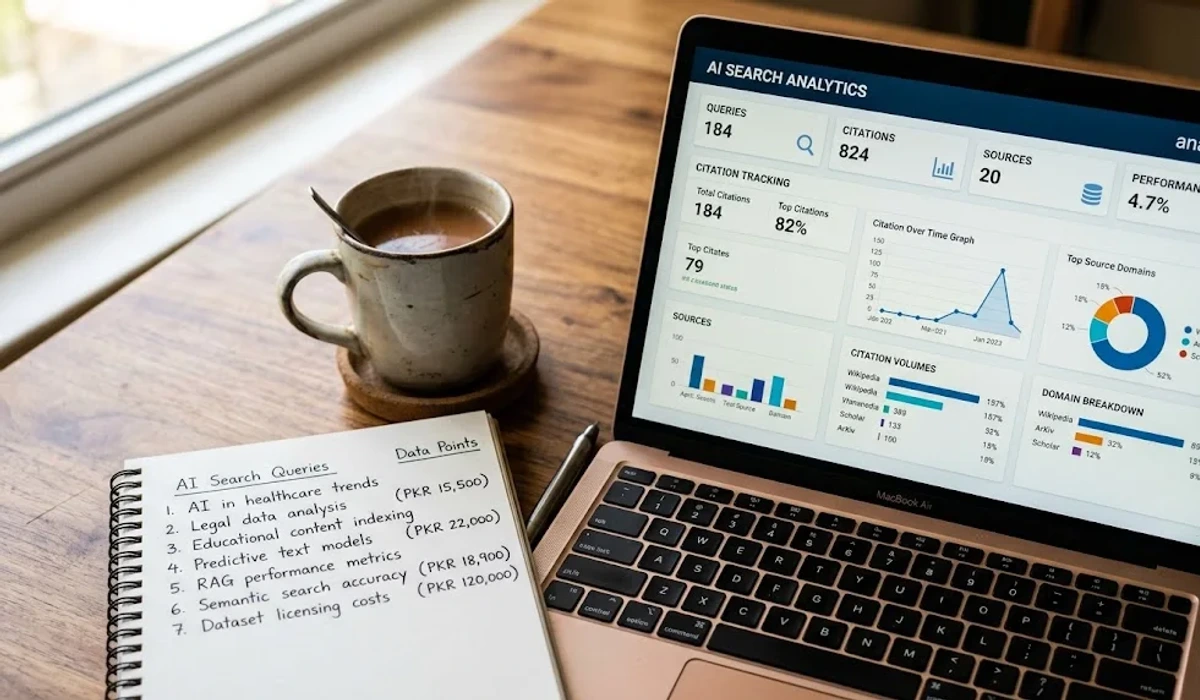
A Pakistani SME GEO audit guide by Hamza Ali. Last updated: May 2026.
A Lahore clothing brand spending PKR 180,000 monthly on SEO content discovered that ChatGPT, Perplexity, and Google AI Mode cited their competitor in 14 out of 20 target queries — and cited the Lahore brand zero times. The SEO rankings looked fine. The organic traffic looked fine. But AI engines had never heard of them.
GEO — Generative Engine Optimization, the practice of making your content citable by AI search engines like ChatGPT, Perplexity, and Google AI Mode — is now a separate discipline from traditional SEO. Rankings do not guarantee AI visibility. A page can rank #3 on Google and still never appear in an AI-generated answer.
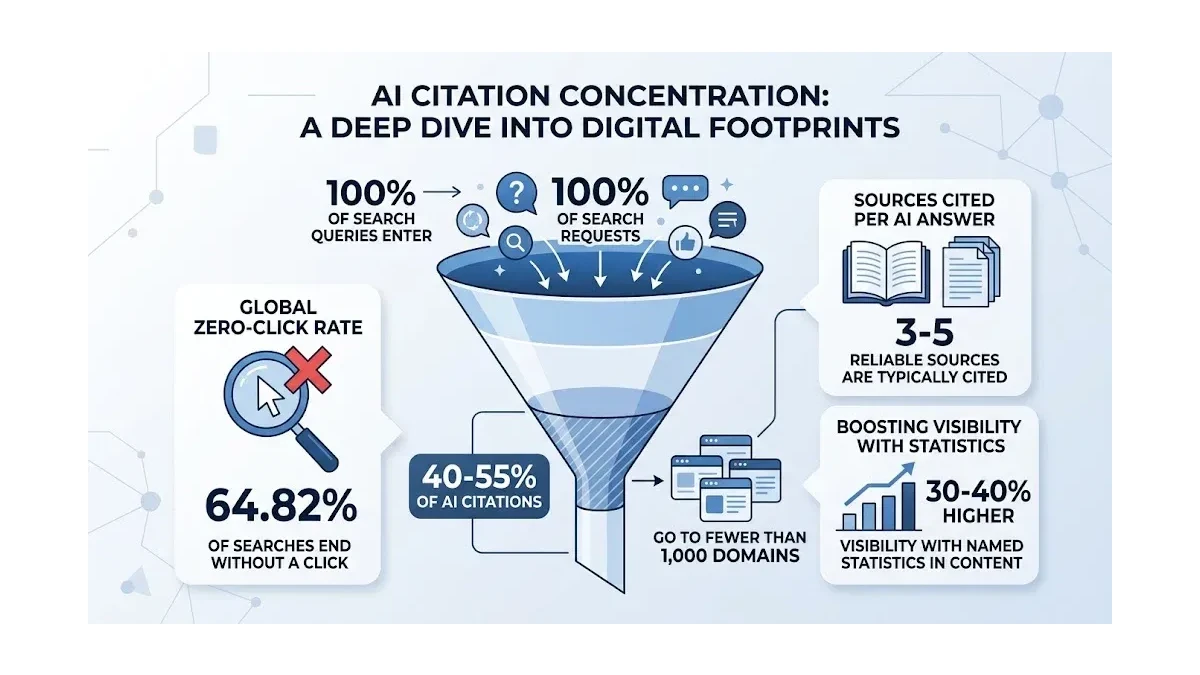
Zero-click searches and AI answers mean some people searching for your services never visit a website — they get enough information directly from the search results page. For Pakistani businesses operating in a mobile-first market, this matters because the first screen can be dominated by ads, maps, AI summaries, and rich results.
Here’s the thing. Most teams miss this.
The visibility gap traditional SEO ignores
Traditional SEO audits check rankings, backlinks, page speed, and technical crawl errors. These metrics measure how Google’s index sees your site. AI search engines — ChatGPT with web search, Perplexity, Google AI Mode and other AI-assisted search experiences — operate on a different selection mechanism. These engines synthesize answers from multiple sources, and citation counts vary by platform, query, and interface.
AI citations often concentrate around trusted, well-known, and clearly structured sources. In Pakistan’s ecommerce and services market, where Daraz, JazzCash, Easypaisa, large publishers, and official sites dominate many category queries, local SMEs need clearer evidence and entity signals.
A Karachi SaaS company can rank for classic keywords and still be absent from AI-generated answers if its pages lack concise definitions, pricing context, proof, and comparison-ready sections. That is why AI visibility checks should sit beside traditional rank tracking.
The fix is simple. You need a GEO audit — a structured check of whether AI engines see, cite, and correctly represent your business across the queries your customers actually use.
Where the citation data lives
Running a GEO audit does not require expensive tools. The core data comes from three sources.
First, use Google Search Console as an impression-and-click diagnostic. It can show pages and queries where impressions are stable or rising while clicks fall. That does not prove an AI answer caused the change, but it identifies query groups worth manually checking in Google Search, AI-assisted search experiences, and competitor results.
Conductor and other SEO platforms have reported that AI Overview coverage varies sharply by query type and market. Treat global datasets as directional, then test the actual Pakistani queries that drive leads for your business.
Second, manual testing across AI engines provides ground truth. Open ChatGPT with web search enabled, Perplexity, and Google AI Mode. Type 20–30 queries your customers use. For each query, record: does an AI answer appear? Is your business cited? Is your brand mentioned without a link? Which competitors appear instead?
This manual test takes 15–20 minutes and costs nothing. Think of it like checking your Foodpanda restaurant listing — you open the app, search your own restaurant name, and verify the menu, photos, and reviews are correct. A GEO audit does the same thing for your AI search presence.
Third, specialized GEO tools scale the tracking. Beamtrace offers a free Google AI Mode Rank Tracker that monitors rankings, citations, and competitors inside Google AI Mode. HubSpot’s AI Search Grader benchmarks your brand across ChatGPT, Perplexity, and Gemini at no cost. Semrush’s AI Visibility Toolkit provides market analysis and share-of-voice data at approximately $99 per month per domain.
The content patterns AI engines actually cite
Once you have the data, the next step is understanding what AI engines select for. Three patterns dominate.
Answer-first structure. AI engines extract passages, not pages. Each paragraph must directly answer the query it targets. The first sentence of any section should contain the core answer. Background information belongs after the answer, not before. Research cited by Lumar’s GEO optimization guide confirms that content organized in clear, self-contained sections with one main idea per chunk gets selected significantly more often than mixed-topic paragraphs.
Consider how different a Pakistani user’s search for “best courier for COD in Pakistan” looks in AI Mode versus traditional search. Traditional search returns a list of links — the user clicks, reads, compares. AI Mode generates a synthesized answer comparing TCS, Leopards, Trax, and M&P with delivery times, COD fees, and coverage areas. If your logistics comparison page structures each courier as a self-contained answer block with specific PKR rates and city coverage, AI engines can extract those passages directly.
Named sources and specific data. Content that cites specific statistics with named, authoritative sources is more trustworthy than generic claims like “studies show digital payments are growing.” Use official sources such as SBP, PTA, Google documentation, or platform help pages when making factual claims.
Every paragraph in your service pages and blog posts should include at least one specific number, a named entity (company, tool, regulatory body), or a PKR amount. AI engines prefer extractable, verifiable claims over vague assertions.
Entity clarity. Avoid pronouns like “it” and “they” when referring to key subjects. Write “Daraz charges sellers a 2–5% commission depending on category” instead of “they charge a commission.” AI engines extract paragraphs in isolation — a paragraph full of “this platform” and “their service” loses all meaning when quoted without context.
Pages that name specific entities — companies, platforms, tools, cities, regulatory bodies — throughout their content show higher AI selection rates. For Pakistani businesses, entity-rich content means naming Daraz, JazzCash, Easypaisa, Foodpanda, SBP, PTA, specific cities, and specific PKR amounts throughout your pages. This is not about keyword stuffing. It is about making every paragraph self-contained and machine-readable.
The technical foundation AI crawlers need
Content quality alone will not earn citations if AI crawlers cannot access your pages. Three technical checks form the GEO audit’s backbone.
Robots.txt and crawler access. Many Pakistani business sites inadvertently block AI crawlers. Check your robots.txt file for lines disallowing GPTBot, PerplexityBot, ClaudeBot, GoogleOther, or important search crawlers. If you intentionally block a crawler, document why; if you block it by accident, fix the rule. The AI Labs Audit 2026 AEO checklist documents this as one of the most common — and most easily fixed — visibility blockers.
Structured data markup. Implement JSON-LD schema on your key pages: Article or BlogPosting for content pages, Product for ecommerce listings, FAQPage for FAQ sections, and Organization for your homepage. Include datePublished, dateModified, author, and sameAs links to your social profiles. Schema does not guarantee citations, but it gives AI engines structured signals about what each page contains and who wrote it.
Core Web Vitals and mobile performance. Google’s AI Mode runs on mobile for most Pakistani users. Pages with LCP (Largest Contentful Paint) above 2.5 seconds on mobile connections — common on Pakistani 4G networks — may be deprioritized. Test your pages using Google PageSpeed Insights with a mobile connection simulation to identify performance issues that could reduce crawl frequency.
Your 15-minute GEO audit checklist
-
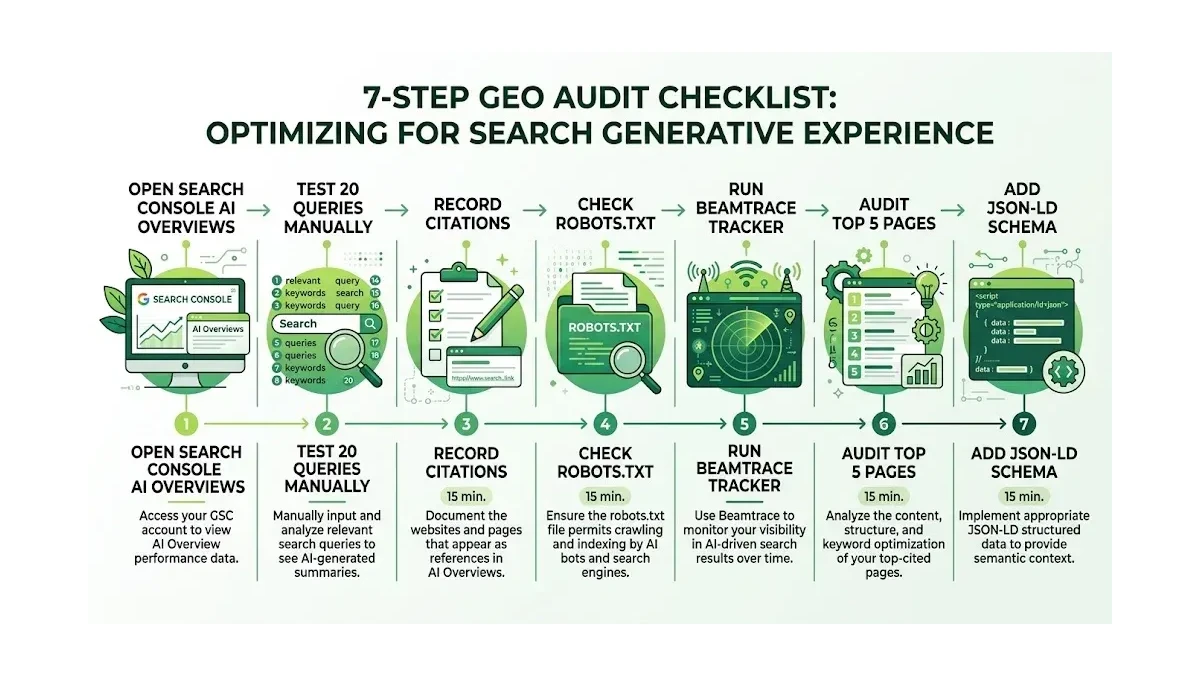
Open Google Search Console → Performance → Search Type → “AI Overviews.” Export the data. If zero impressions appear, your content is not being used in AI-generated answers.
-
Test 20 queries manually across ChatGPT (with web search), Perplexity, and Google AI Mode. Use queries your customers actually type: “best [your service] in [your city],” “how much does [your service] cost in Pakistan,” “[your brand] vs [competitor].”
-
Record citations per query. Mark each query as: cited (your URL appears), mentioned (your brand appears without a link), or absent. Calculate your citation rate: cited queries divided by total queries.
-
Check robots.txt for AI crawler blocks. Search for “GPTBot,” “PerplexityBot,” “ClaudeBot,” “GoogleOther” in the file. Remove any disallow rules for these bots on your content pages.
-
Run Beamtrace’s free AI Mode Rank Tracker or HubSpot’s AI Search Grader to get a baseline AI visibility score for your domain.
-
Audit your top 5 pages for answer-first structure, named sources with specific numbers, and entity clarity. Rewrite any paragraph that starts with “this approach” or “these results” to name the subject explicitly.
-
Add JSON-LD schema to your top 5 pages:
ArticleorFAQPagemarkup with author, datePublished, dateModified, and sameAs fields.
If a competitor appears in AI answers where you do not, study their cited page. Copy the structural patterns — not the content — into your own pages.
As a Pakistani digital marketing agency, WeProms Digital runs GEO audits as part of every SEO engagement. Pakistani businesses that rely on organic search for leads cannot afford to ignore AI visibility. When an AI answer or rich result appears above classic listings, some searches will produce fewer clicks even if rankings remain stable.
Read next: AI Search Visibility Audit for Pakistani Businesses · Stop Hiring SEO Agencies for Google AI Mode in Pakistan
If your Pakistani business needs a structured GEO audit with monthly tracking, WeProms Digital can scope an AI search visibility audit after reviewing site size, query set, and reporting needs. Contact hello@weproms.com or message WhatsApp +92 300 0133399 to schedule a review. Visit weproms.com/contact-us to get started.
Frequently Asked Questions
What is a GEO audit and how is it different from an SEO audit?
A GEO audit checks whether AI search engines — ChatGPT, Perplexity, Google AI Mode — cite your content in their generated answers. A traditional SEO audit checks rankings, backlinks, and technical crawl issues. The two audits measure different things: SEO measures your position in Google’s link-based results, while GEO measures your presence in AI-generated responses. Pakistani businesses running both audits gain a complete picture of how customers find them in the AI Mode era.
How much does a GEO audit cost in Pakistan?
A professional GEO audit for a Pakistani SME depends on site size, the number of target queries tracked, and how much implementation support is included. The free manual version — testing 20 priority queries across AI-assisted tools available to your team — costs nothing and can be completed in a short working session.
Can I run a GEO audit myself without paying an agency?
Yes. Open Google Search Console and look for queries where impressions are stable or rising while clicks fall. Then manually test 20–30 customer queries across ChatGPT with web search, Perplexity, and Google AI Mode where available. Record which queries cite your business, which mention your brand, and which ignore you entirely. Use any reputable AI-visibility tool as a directional baseline only. Manual query checks, source review, and page improvements are still needed before making budget decisions.
How long does it take for AI engines to start citing my content after optimization?
Timelines vary by crawl frequency, competition, platform, and query type. Some fixes can be indexed quickly, but a safer review window is 60–90 days with repeated checks against the same query set.
Does WeProms Digital offer GEO audits for Pakistani businesses?
Yes. WeProms Digital, a GEO and AI discoverability agency, offers structured GEO audits that can cover AI citation checks across available tools, competitor comparisons, and a content restructuring plan to improve clarity and source quality. Contact hello@weproms.com or WhatsApp +92 300 0133399 to schedule.
About WeProms Digital
WeProms Digital is a Pakistani AI search visibility and digital marketing agency, headquartered in Lahore, serving Pakistani SMEs, ecommerce brands, and B2B teams across Lahore, Karachi, Islamabad, Rawalpindi, Faisalabad, and Multan.
The team specializes in GEO audits, AI Mode visibility tracking, and generative engine optimization, with a track record of identifying AI citation gaps and building content structures that earn citations across ChatGPT, Perplexity, and Google AI Mode for Pakistani businesses.
Get in touch: hello@weproms.com · WhatsApp +92 300 0133399 · weproms.com/contact-us