By Abdul Rehman. Last updated: May 2026.
Pakistani SMEs can still generate leads from Google in 2026, but the method is changing. Ranking in traditional results still matters, while appearing in AI-generated answers, local packs, and trusted comparison content is becoming part of the same search visibility job.
What exactly changed in Google search during 2026?
Google has been adding AI-assisted features to Search. The change is not a minor interface tweak for affected queries: instead of showing ten blue links, it now generates a conversational AI answer supported by Google’s Gemini models. This new experience is called Google AI Mode, and it changes what happens when someone in Lahore searches for “best accounting software for small business Pakistan” or a Karachi manufacturer looks up “cotton export regulations 2026.”
In AI Mode, Google reads content from multiple websites, synthesizes an answer, and displays it directly in the search results. The answer may include comparisons, pricing context, steps, or source links depending on the query. Some users may get enough information without clicking through. The answer itself satisfies the query. Google has publicly positioned AI Mode and AI Overviews as part of Search’s direction. Pakistan-specific rollout timing can change, so Pakistani SMEs should prepare without assuming every local query already behaves the same way.
The parallel shift is the growth of AI Overviews — shorter AI-generated summaries that appear above traditional search results for a growing percentage of queries. Semrush’s tracking data shows AI Overviews now appear on 13.14% of Google queries, up from 6.49% in January 2025. That doubling in twelve months indicates the pace of change. For Pakistani SMEs, which means more of the keywords they target now show an AI answer that absorbs clicks before users reach organic results.
Picture this: ordering from Foodpanda. You search for “biryani near me,” and instead of seeing a list of restaurants to browse, Foodpanda shows you a single recommendation with the restaurant name, delivery time, price, and rating. You order directly from that recommendation without browsing other options. Google’s AI Mode does the same thing to search results — it curates one answer from multiple sources, and most users never explore beyond it.
How many Google searches now end without a website visit?
The numbers are specific and the trend is clear. According to SparkToro and Datos reporting summarized by SEO.com, a large share of United States Google searches end without a click to an external website. Treat this as directional evidence rather than a Pakistan-specific benchmark.
Pakistan’s mobile-first market faces a stronger version of this pattern because mobile results show fewer visible organic listings before ads, maps, AI features, and other modules take screen space. In a country where mobile commerce is central to online buying, the practical takeaway is simple: businesses need both visibility and stronger conversion paths when a searcher does click.
The “so what” is direct: if your Pakistani business depends on Google sending visitors to your website, you are competing for a shrinking pool of clicks. Several industry forecasts expect AI answers to reduce some informational clicks. The safer planning assumption is that informational traffic is less dependable, while commercial, local, and branded visibility still need active work.
What is GEO and how is it different from SEO?
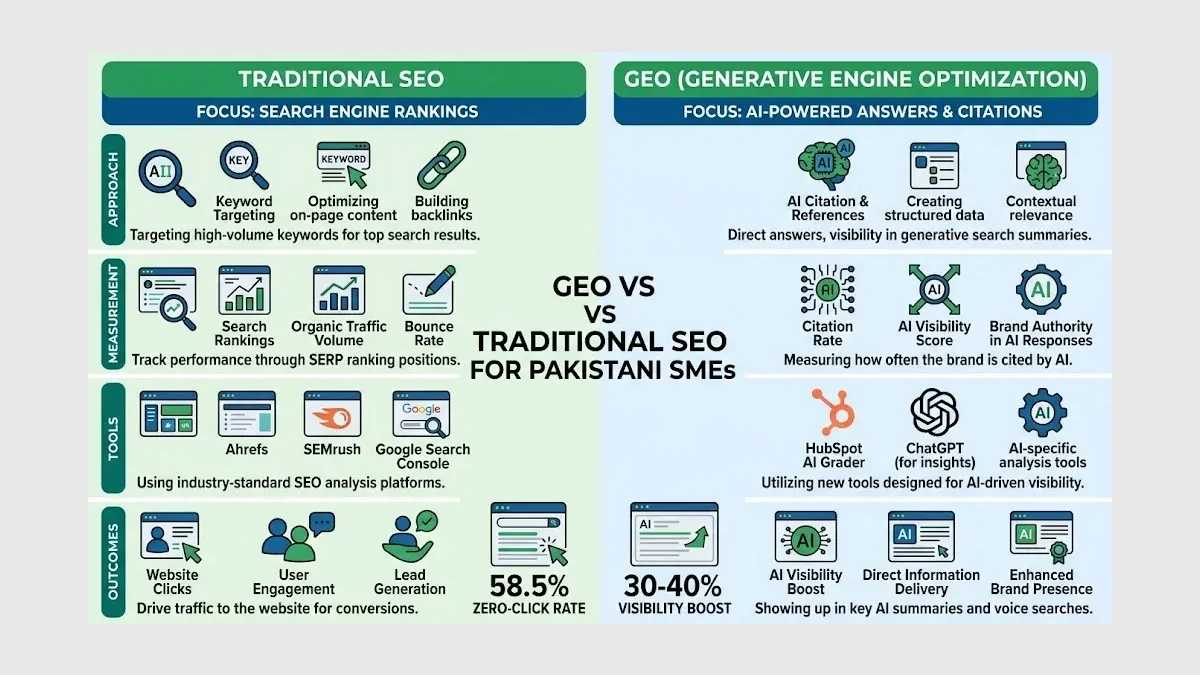
SEO — Search Engine Optimization — is the practice of improving your website’s visibility in traditional search engine results pages. It focuses on keyword targeting, content quality, technical crawlability, and backlink acquisition to earn higher rankings in the list of ten blue links.
GEO — Generative Engine Optimization — is the practice of improving your content’s visibility in AI-generated answers across platforms including Google AI Mode, ChatGPT, Perplexity, and other AI search engines. It focuses on content structure, data density, entity recognition, citation formatting, and multi-platform authority signals to earn citations inside AI responses.
The two overlap but are not identical. A page can rank well in traditional results and still be absent from an AI-generated answer, while another source may be cited because it presents clearer, better-supported information. The mechanisms that drive each are different enough that optimizing for one does not automatically optimize for the other.
| Factor | Traditional SEO | GEO |
|---|---|---|
| Primary goal | Earn a position in the top 10 results | Earn a citation in the AI-generated answer |
| Content focus | Keyword relevance and topical authority | Direct answer structure, statistics, and data density |
| Technical signals | Crawlability, indexability, page speed | Structured data, entity markup, answer-readiness |
| Link signals | Backlink quantity and quality | Mentions across platforms, third-party reviews, PR |
| Measurement | Rankings, impressions, clicks, CTR | AI citation rate, brand mentions in AI answers |
| Platforms | Google, Bing | Google AI Mode, ChatGPT, Perplexity, Gemini |
Early GEO research suggests that clearer structure, source-backed statements, and direct answers can improve how generative systems use content. Treat those findings as directional, not guaranteed rankings. They are still more useful than outdated keyword-density writing because they make the page easier for both people and machines to understand.
Which Pakistani business types benefit most from AI search optimization?
Not every Pakistani business faces the same level of impact from AI search. The effect varies by industry, query type, and customer behavior.
Ecommerce stores face the highest exposure. Product comparison queries, price searches, and “best [product] under PKR [amount]” queries are among the most affected by AI Overviews. A Daraz seller competing for “best running shoes under PKR 8,000” now competes against Google’s AI answer that synthesizes product data from multiple sources. Stores with strong structured data, detailed product descriptions, and presence on multiple platforms (Daraz, Shopify, Google Shopping) appear more frequently in AI answers.
Service businesses — accounting firms, legal services, IT companies, marketing agencies — face a moderate impact. Informational queries like “how to register a company in Pakistan” or “tax filing deadline 2026” now trigger AI answers that provide the information directly. Service businesses that publish authoritative guides with specific, structured answers get cited in those AI responses, which drives brand visibility even when clicks decline.
B2B companies and exporters face a lower but growing impact. B2B queries tend to be more specific and less likely to trigger AI Overviews currently. However, as AI Mode expands to cover more query types, B2B companies that invest early in GEO for service businesses will build citation momentum that latecomers cannot easily replicate.
Local businesses — restaurants, clinics, retail shops — benefit from Google Business Profile integration with AI Mode. Google’s AI answers for local queries (“dentist near Gulberg Lahore”) pull heavily from Google Maps and Business Profile data. Maintaining a complete, accurate Business Profile with current hours, categories, photos, and reviews is the single most important local GEO action.
How much does GEO implementation cost for a Pakistani SME?
The cost depends on three variables: the current state of your website and content, the competitiveness of your target keywords, and whether you handle implementation in-house or hire an agency.
For a Pakistani SME with an existing website and 50 to 200 pages of content, a complete GEO implementation typically involves four phases: a technical audit and AI readiness assessment (one-time), content restructuring for AI extraction (one-time project), schema markup and structured data implementation (one-time technical work), and ongoing AI citation monitoring and optimization (monthly retainer). The one-time setup cost depends on site size, tracking depth, and how much content must be restructured. Ask agencies to price the audit, implementation, and monitoring separately so you can compare scope fairly.
Compare this to the cost of inaction. If organic leads or ecommerce revenue are already falling, the first step is not a bigger retainer; it is diagnosing which queries lost clicks, which pages lost visibility, and whether AI answers or SERP features are part of the pattern. AI search optimization budget planning should account for both the implementation cost and the opportunity cost of declining organic performance.
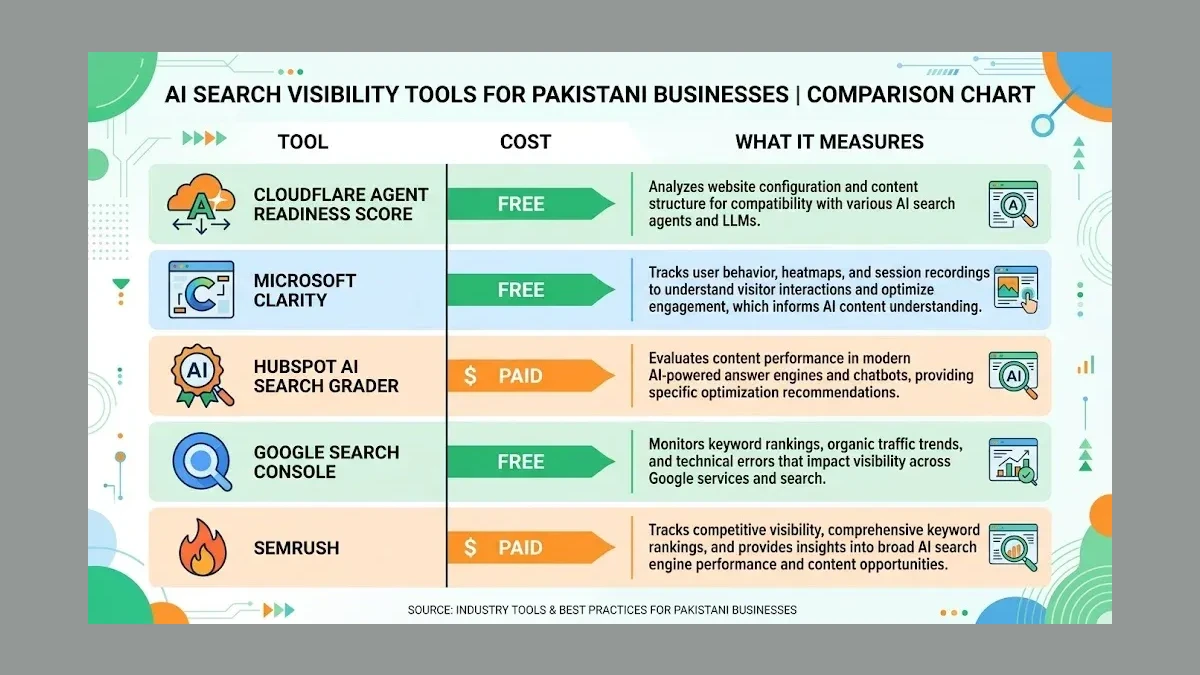
For businesses with limited budgets, a phased approach works. Start with the free tools: Cloudflare’s Agent Readiness Score for technical assessment, HubSpot’s AI Search Grader for visibility baseline, and Google Search Console for impression-versus-click analysis. Restructure your five highest-value pages with direct answer formatting and specific data points. Add FAQ schema markup. These three steps, which cost only time, produce measurable improvements in AI citation frequency.
What free tools help Pakistani businesses track AI search visibility?
Several free or low-cost tools provide AI search visibility data that Pakistani businesses can use without a paid agency retainer.
Manual AI-result checks give you the fastest baseline. Test the same 20 commercial questions across the AI-assisted tools your buyers might use, record which brands appear, and repeat monthly.
Microsoft Clarity is useful for understanding what visitors do after they land on your site. It does not replace AI citation tracking, but it helps judge whether remaining traffic is commercially useful.
Google Search Console reveals the impression-versus-click gap that can signal search layout changes. Filter for queries where impressions increased month-over-month but clicks stayed flat or declined, then manually inspect those search results before blaming AI.
Semrush Position Tracking with SERP Features filter identifies which of your target keywords now trigger AI Overviews, featured snippets, and other zero-click SERP features. Semrush offers a limited free tier; paid plans and pricing change frequently, so confirm current pricing before budgeting.
When should a Pakistani SME hire a GEO agency instead of doing it in-house?
The decision comes down to three factors: technical capacity, competitive pressure, and revenue exposure.
If your business has a dedicated marketing team member who understands structured data, content strategy, and analytics, and your competitors are not yet investing in GEO, an in-house approach using free tools works for the initial phase. Restructure content, add schema markup, and monitor AI citations using the free tools listed above.
Hire a GEO agency when any of these conditions apply: your organic traffic has declined without a clear explanation; competitors appear in AI-generated answers for your target keywords and you do not; your business depends heavily on Google for leads or revenue; or your team lacks the technical skills to implement structured data and rewrite content into clear answer formats. The key threshold is business exposure, not a universal percentage.
WeProms Digital, a Pakistani SEO agency, provides AI search readiness assessments that cover all of these factors. The assessment includes a technical AI crawlability audit, competitive AI citation benchmarking, content gap analysis, and a phased implementation roadmap. Pakistani SMEs can schedule an assessment to determine whether in-house GEO is feasible or whether agency support is the right call.
Read next: GEO audit for AI Mode visibility and Answer engine optimization signal method for Pakistan
Pakistani SMEs asking whether Google search still generates leads are asking the right question. The answer is yes — but the method has changed. Traditional SEO focused on rankings; the 2026 approach focuses on AI citations. Businesses that invest in GEO now, even at a basic level using free tools, build visibility momentum that compounds over time. Those that wait for “SEO to recover” are waiting for a version of Google that no longer exists. WeProms Digital, a Pakistani SEO and GEO agency, helps Pakistani businesses make this transition with measurable AI visibility tracking and structured content optimization. Contact the team to discuss a GEO readiness assessment, or reach out on WhatsApp at +92 300 0133399.
Sources & References
- SparkToro/Datos via SEO.com — Zero-Click Searches Study — 2024
- Semrush — Zero-Click Searches Research — 2025
- Accio — Pakistan Ecommerce Market Overview — 2025
- Google Search Central — AI features and your website
- Google Search Central — Creating helpful, reliable, people-first content
Additional reading from industry feeds: