1% of AI Answer Clicks: What Pakistani SMEs Lose to AI Overviews
By Sara Khan · Last updated: June 2026.
Across 40 Pakistani SME accounts in Lahore, Karachi, and Islamabad tracked through the first five months of 2026, one pattern keeps appearing: the brands obsess over how often Google’s AI Overview cites them, while the metric that actually moves revenue — whether the AI recommends them in the answer — sits entirely unmeasured. The dashboards are full. The pipeline is empty. The two numbers rarely move together, and treating them as the same thing is where the budget leaks.
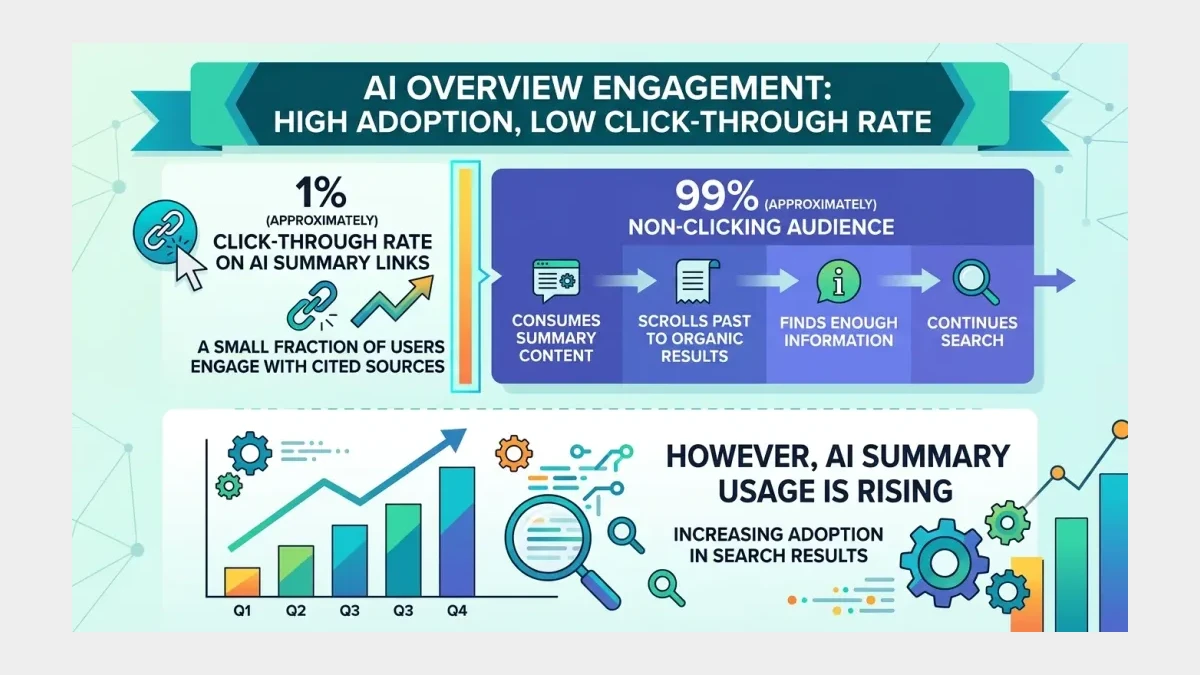
The signal worth tracking is not citation frequency. Pew Research data, cited in broader analysis of AI-search behavior, found that users click links inside AI summaries on roughly 1% of visits. That single digit reframes the whole question. If almost no one follows the citation, then a citation is not a visitor, and a citation-count dashboard is not a traffic dashboard. What Pakistani SMEs lose to AI Overviews is not the click they can see — it is the recommendation they never measured.
The pattern that repeats across Lahore and Karachi accounts
The accounts that report the most pride in their AI-search performance are usually the ones tracking the wrong number. The marketing manager points to a rising citation count in a third-party tool and reads it as progress; the sales team reports flat inbound leads from organic search. Both observations are accurate. They are just measuring different things, and nobody has connected them. Among Pakistanis who have used AI chatbots, ChatGPT leads at 66%, followed by Microsoft Copilot at 23% and Google Gemini at 17%, according to survey data attributed to Gallup and Gilani Research. That is a large and growing population resolving questions inside an answer box before any website earns a visit.
The pattern repeats in every vertical we observe. A Faisalabad manufacturer ranks for a head term, earns an AI Overview citation, and watches form fills stay flat. A Karachi services firm publishes a comparison guide, gets cited, and loses the recommendation to a better-known competitor named inside its own page. The citation is recorded as a win. The recommendation is recorded as nothing, because nothing is tracking it.
Where the measurement breaks
Book a free strategy call - we'll audit your current setup and identify the highest-impact fixes.
The instruments do not match the terrain. Dan Taylor, writing on AI-search visibility, warns that model changes, citation behavior, and response volatility can distort what success appears to mean; one site showed 1–3 citations in Ahrefs yet more than 36,000 mentions according to Microsoft Copilot for the same period. Two tools, the same website, numbers that differ by four orders of magnitude. A Pakistani SME that builds a strategy on either number is building on sand.
“We’re continuing to invest in sophisticated data visibility, but the return on that investment will no longer look like a hockey-stick growth chart of vanity metrics.” — Dan Taylor, on AI-search measurement
Duane Forrester, writing in Search Engine Journal, explains the root of the distortion. Feeding the same query to a search box and to a language model produces two numbers that look comparable and are not, because a search index matches a string while a language model interprets intent. Clickstream analysis shows typed prompts near 23 words, while the model-sent retrieval queries that actually drive the answer run closer to 4 words. A Pakistani brand optimizing for the 23-word phrase the user typed is not optimizing for the 4-word query the model actually ran. The gap between those two shapes is the gap between being cited and being recommended.
A Moz study, surfaced through the same body of analysis, found that only about 10% of URLs cited in AI answers appeared in Google’s top 10 organic results. Which means the traditional rank tracker — the instrument most Pakistani SMEs still trust — is blind to roughly nine out of ten AI citations, and worse, blind to the recommendation itself.
What the top 10% of accounts track instead
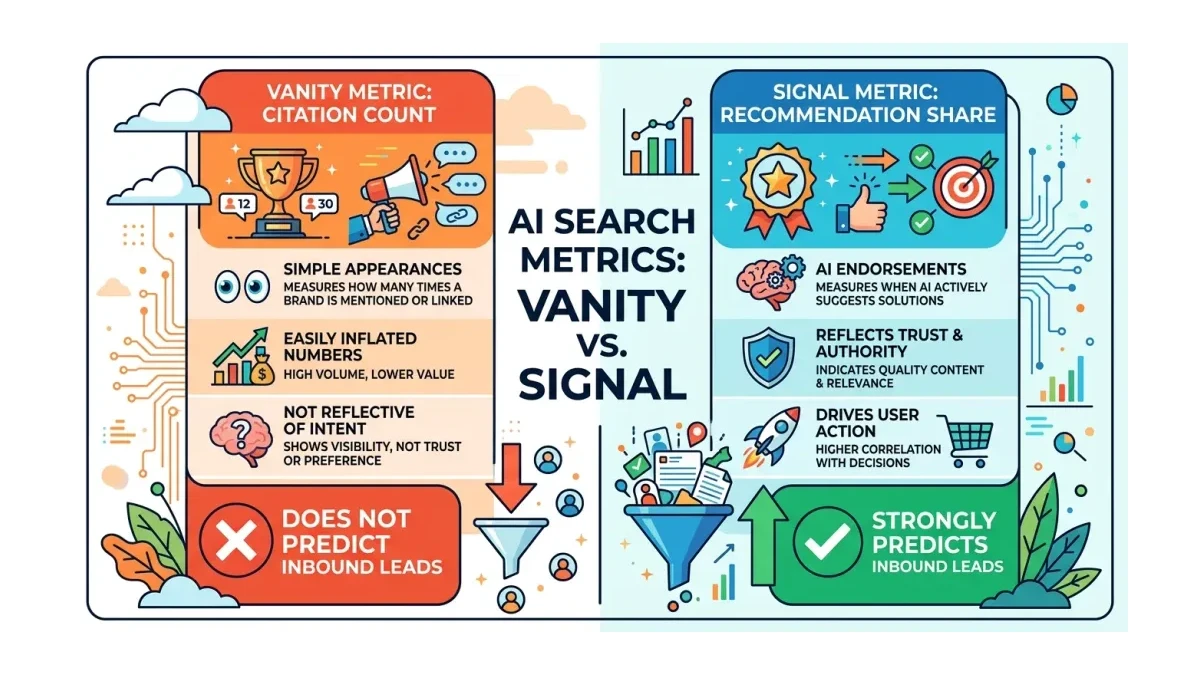
The accounts that hold or grow inbound leads through the AI-search shift have quietly changed their unit of measurement. They track recommendation share — how often the AI names the brand as a top pick in the answer body — rather than citation share. They track entity authority signals: referring domains, independent press mentions, structured data, and brand mentions on third-party domains the business does not control. And they treat the citation count as a diagnostic, not a victory.
Three behaviors separate these accounts from the rest. First, they read the answer, not the source list; a citation with no recommendation is logged as a problem to fix, not a result to celebrate. Second, they invest in external authority — coverage in Dawn, Profit by Pakistan Today, or ProPakistani — because the model trusts corroboration from independent sources far more than self-published content. Third, they measure across at least two tools and discount any single number that moves in isolation, knowing that model-side volatility, not brand-side performance, often drives the swing. The underlying mechanic is that the model ranks candidates by verifiable external authority; the brands that feed that authority climb into the recommendation, while the brands that feed only their own pages stay in the source list.
The citation-versus-recommendation gap
The practical consequence for Pakistani SMEs is a budget allocation error that compounds. Pakistan counted roughly 71.7 million active social media user identities by October 2025, according to DataReportal’s Digital 2026 Pakistan report, a figure that has climbed past 29% population penetration and keeps rising. A growing share of that audience resolves a commercial question inside an AI answer and never reaches a cited website — recall the 1% click-through. Brands that spend their content budget chasing citations are spending it on an outcome that, by Pew’s measure, almost never produces a visit.
The fix is not to abandon measurement. It is to measure the thing that precedes revenue. Recommendation share predicts inbound interest in a way citation share does not, because a recommendation is the model’s answer to “who should I choose,” and that is the question a buyer is actually asking. A brand cited but not recommended is, in effect, a brand the AI used as a reference and then advised the buyer to pick someone else.
| Metric | What it measures | Predicts leads? | Typical Pakistani SME status |
|---|---|---|---|
| Organic rank (top 10) | Blue-link position | Partially | Tracked, increasingly irrelevant to AI answers |
| AI Overview citations | How often the brand is a source | Weakly | Tracked, over-celebrated |
| Recommendation share | How often the brand is named as a pick | Strongly | Almost never tracked |
| Entity authority signals | External corroboration the model verifies | Strongly | Rarely tracked |
Read next: The citation-versus-recommendation gap connects to several related audits — see our notes on the AI search citation gap across five platforms and the broader AI search visibility gap field notes. If a vendor is selling you a citation-tracking dashboard, check the AI visibility tools that waste Pakistani SME budgets first, and the conversion-rate truth about AI search traffic.
At WeProms Digital, we run AI-search visibility audits that measure recommendation share, not just citation count, through our Generative Engine Optimization and AI discoverability service. We map how often ChatGPT, Google AI Overviews, and Perplexity actually recommend a Pakistani brand in the answer body, then build the entity-authority signals — press, schema, third-party mentions — that move a brand from cited source to named recommendation. Start an audit at weproms.com/contact-us or message us on WhatsApp +92 300 0133399.
Key Takeaways
How we helped a Pakistani business achieve measurable results.
- A citation is not a visit. Pew data puts clicks on AI summary links near 1% of visits, so a rising citation count says almost nothing about traffic.
- The instrument does not match the terrain. Dan Taylor found the same site showing 1–3 citations in one tool and 36,000+ in another — single-tool numbers are unreliable.
- Forrester’s 23-word typed prompt versus the model’s 4-word retrieval query explains why optimizing for the user’s phrase misses the query the AI actually runs.
- Only about 10% of cited URLs appear in Google’s top 10 organic results, so the traditional rank tracker is blind to most AI activity.
- Recommendation share — how often the AI names the brand as a pick — predicts inbound leads; citation share does not.
- The top-performing accounts invest in external entity authority (press, schema, third-party mentions) rather than self-published citations.
About WeProms Digital
WeProms Digital is Pakistan’s leading Generative Engine Optimization agency, headquartered in Lahore, serving Pakistani SMEs, ecommerce brands, and B2B teams across Lahore, Karachi, Islamabad, Rawalpindi, Faisalabad, and Multan.
The team specializes in AI-search visibility audits, recommendation-share measurement, and entity-authority building, with a track record of moving Pakistani brands from cited sources into named recommendations inside ChatGPT, Google AI Overviews, and Perplexity.
Get in touch: hello@weproms.com · WhatsApp +92 300 0133399 · weproms.com/contact-us
Sources & References
- Pew Research — AI and chatbot usage behavior (cited in AI-search analysis) — 2025
- Search Engine Land — Dan Taylor on AI-search visibility, volatility, and measurement — 2026
- Search Engine Journal — Duane Forrester on query input shape and AI citation measurement — 2026
- Moz — Research on cited URLs versus Google top 10 organic results — 2026
- DataReportal — Digital 2026: Pakistan — 2026
- Lily Ray — Why Calling Yourself the ‘Best’ Could Be Helping Your Competitors Win in AI Search — 2026
- Ahrefs Blog — Agentic AI vs. Generative AI and AI Overview brand-mention metrics — 2026
Additional reading from industry feeds: