
Last updated: July 2026. By Sara Khan, WeProms Digital.
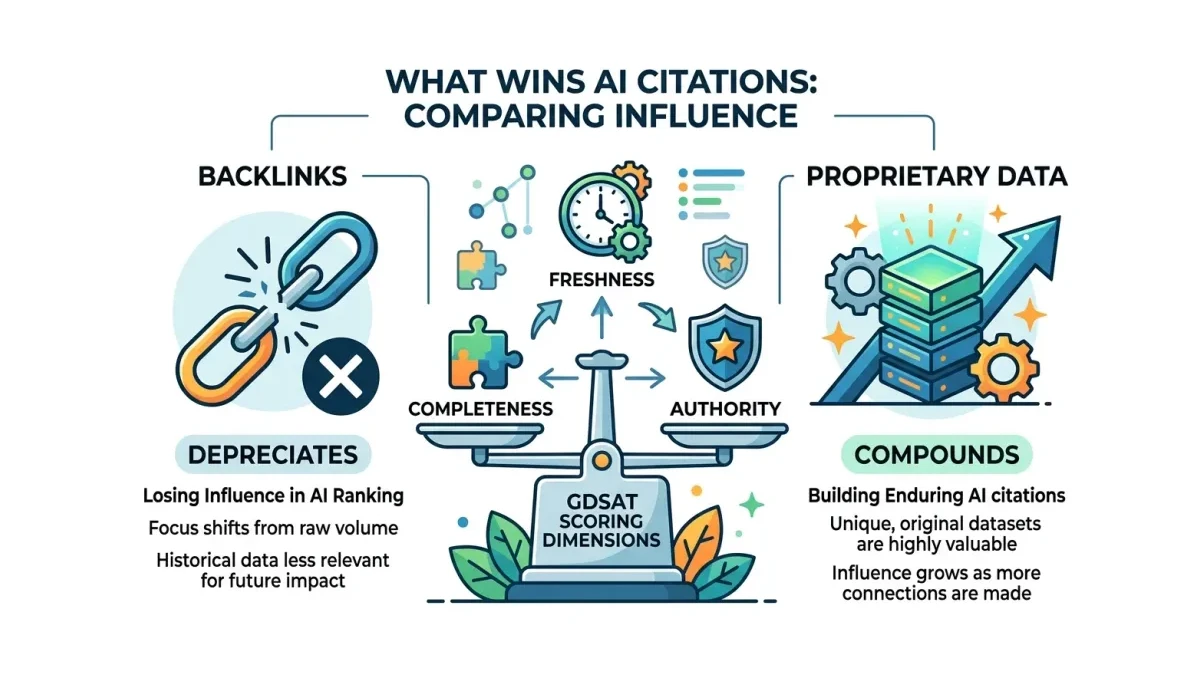
The working assumption across Pakistani marketing teams in 2026 is that the way to win citations inside ChatGPT, Perplexity, and Google AI Mode is to publish more pages, build more backlinks, and layer more schema onto existing content until the engines finally notice the brand. The assumption is half-right about the destination and entirely wrong about the asset, because Microsoft’s Web IQ now scores cited passages on grounding satisfaction across completeness, freshness, and authority, and none of those three dimensions rewards a page that simply repeats what every other page already says. Original numbers are the one input an engine cannot synthesize, and a Pakistani brand that publishes them becomes the source rather than one of ten paraphrases.
The backlink reflex that no longer answers the question
The pattern repeats across Lahore and Karachi marketing decks. A brand loses visibility in AI answers, the agency prescribes more content and more links, the team ships thirty blog posts and pays for forty domains, and six months later the brand is still absent from the answer ChatGPT gives a buyer. The reflex treats AI citation as a louder version of ranking, when it is closer to the opposite. Search engines ranked the page with the most authority pointing at it; answer engines cite the passage with the most specific grounding inside it.
A backlink tells an engine that other humans found your page useful. A citation tells an engine that your passage was the most complete, fresh, and authoritative answer it could find to ground a response. Those are different currencies, and the second one is not bought with domain authority. This is why a Pakistani brand can hold a strong backlink profile and still disappear from AI answers while a competitor with a single original dataset gets cited on every related question.
What actually drives this is the engine’s need for a verifiable, extractable unit of truth. Proprietary data — original survey results, PKR pricing benchmarks, platform-specific behavior, regulatory findings — is exactly that unit, and it is the asset most Pakistani brands are not building. We unpack the broader shift from links to mentions in our note on why brand mentions, not backlinks, drive AI search in Pakistan, and the same logic explains why raw content volume stops producing AI citations past a certain point.
Why a passage wins and a page does not
Generative engine optimization — the practice of shaping content so AI systems cite it — succeeds or fails at the passage level, not the page level. Microsoft built Web IQ to return passage-level evidence objects rather than ranked documents, scoring each passage on a measure the company calls GDSAT, which weighs completeness, freshness, and authority. A page can rank beautifully and still have every useful section passed over because a paragraph does not stand alone when an engine lifts it out of context.
The consequence for a Pakistani brand is concrete. A five-hundred-word blog post that contains one original statistic inside a self-contained paragraph is more cite-worthy than a two-thousand-word guide that paraphrases ten competitors, because the engine extracts the paragraph, checks whether it answers the question completely, verifies it is fresh, and confirms it carries authority. The paraphrased guide fails all three tests. The single data point passes two of three and is quoted directly.
The underlying mechanic is extraction, not ranking. Engines do not send a reader to your domain the way Google used to; they lift a passage and present it as the answer, which means the passage must carry its own subject, its own number, and its own attribution. A paragraph that begins with “our research found” and states a specific PKR figure survives extraction. A paragraph that begins with “as discussed above” dies the moment it leaves the page.
Original numbers are the one thing an engine cannot fabricate
Here is the asset most Pakistani brands are leaving on the table. A generative model can paraphrase a product description, summarize a service offering, or rewrite a competitor’s guide in seconds, and buyers increasingly discount that output because they have seen too much of it. What a model cannot do is invent your proprietary numbers and present them as yours, because invented numbers fail grounding checks and because the engine has a strong incentive to cite a real source rather than fabricate one.
“Proprietary data is your most defensible AI citation asset,” Search Engine Land concluded in its 2026 analysis of what generative engines actually cite.
A Pakistani textile exporter who publishes real per-yard costing across cotton, linen, and blends becomes the source every AI answer quotes on pricing. A Lahore real-estate firm that releases monthly PKR price-per-marla data by neighbourhood owns the citation on every property question. A fintech that documents JazzCash and Easypaisa transaction behavior from its own ledgers becomes the reference on wallet adoption. None of these assets are expensive to produce for the company that already holds the data; they are simply never packaged for citation.
The analogy is the shop in Anarkali or Liberty Market that posts today’s wholesale rate on a chalkboard. Competitors and customers quote that rate all day because it is the freshest, most specific number in the market, and the shop that publishes it gets cited by default. Proprietary data works the same way inside an answer engine, except the citation reaches 33% of connected Pakistanis who already use AI tools, according to a population-normalized tracking study published on arXiv in late 2025.
The query got longer, and your content got thinner
Google’s own AI Mode report, published in May 2026, confirms that the average AI Mode query is now roughly triple the length of a traditional search query, and that follow-up queries have grown more than forty percent per month on average. The buyer no longer types “best running shoes”; the buyer writes “I am training for my first race in Islamabad and I have never bought running shoes, which pair should I start with.” That is a person narrating context, and it demands an answer grounded in specifics.
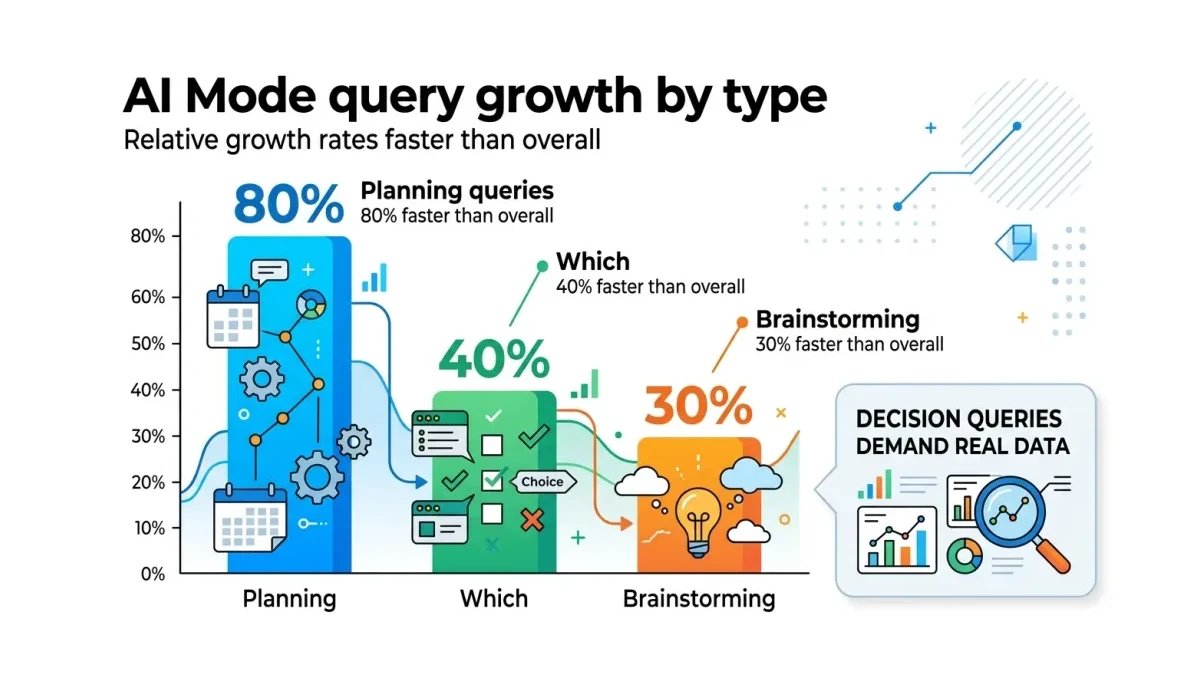
The decision-stage questions are where proprietary data wins most cleanly. Google’s report shows “which” queries growing about forty percent faster than overall AI Mode queries, planning queries growing roughly eighty percent faster, and brainstorming queries growing about thirty percent faster. Every one of those query types — which option, how to plan, what to consider — is a request for a comparison or a recommendation that an engine can only ground with real data. Generic content cannot answer “which” anything, because “which” demands a differentiated number.
So what does this mean operationally? It means the content a Pakistani brand should ship is not another definition of SEO; it is a comparison table built from the brand’s own observed performance, a benchmark drawn from its own client base, or a finding from its own internal review. Engines cite the brand that owns the comparison, and the brand that owns the comparison owns the “which” query.
What a Pakistani brand with real data should actually publish
The publishing decision is where strategy meets execution, and most brands stall here because they confuse data with reports. A citable data asset is narrow, specific, and refreshable. It is one table, one chart, or one finding that an engine can extract and attribute, not a forty-page PDF buried behind a form. State Bank of Pakistan figures on remittances, PTA data on mobile penetration, and a brand’s own sales data by city all qualify, and each becomes more cite-worthy every time it is refreshed with a new date.
A practical starting point is a single Pakistan-specific benchmark the brand can defend. A digital agency can publish real cost-per-lead ranges by industry; an ecommerce brand can publish return rates by product category; a SaaS company can publish activation rates by signup source. Each asset is a paragraph that names its subject, states its number, names its source, and carries a date — the exact shape a passage needs to survive extraction. We explore the systems behind this in our piece on content versus marketing infrastructure for Pakistani brands, because the goal is a repeatable asset, not a one-off post.
The discipline that makes this compound is refresh cadence. An engine rewards freshness as one of its three grounding dimensions, which means a benchmark updated monthly outranks a one-time study indefinitely. A brand that ships one defensible benchmark and updates it for twelve consecutive months builds an asset that gets cited in every related answer, while competitors who published once and moved on slowly lose the citation to the fresher source.
The compounding asset nobody is pricing in
The strategic conclusion is uncomfortable for an industry built on volume. Backlinks depreciate as citation signals because engines discount what they can synthesize, while proprietary data appreciates because every refresh makes it harder to displace. A Pakistani brand that reallocates even a fifth of its content budget from paraphrased posts into one defensible, refreshed dataset will own more citations in a year than a competitor spending five times as much on generic production — and the same logic is why AI content factories quietly cost Pakistani SMEs organic traffic they were trying to protect.
The principle is simple enough to state in one line. Engines do not reward the brand that said the most; they cite the brand that owns a number nobody else can produce, and in the Pakistani market of 2026 that number is the only citation asset that compounds.
Read next: our field method for answer-engine optimization signals in Pakistan, and why the AI search panic is the wrong emergency for Pakistani SMEs.
At WeProms Digital, we run this as a content marketing engagement that identifies the one proprietary dataset a Pakistani brand can defend, structures it as extractable, dateable passages, and builds the refresh cadence that turns it into a compounding citation asset. If you want to find your number before a competitor does, reach us at hello@weproms.com or on WhatsApp at +92 300 0133399, or start at weproms.com/contact-us.
Sources & References
- Microsoft — Web IQ grounding APIs and GDSAT scoring — 2026
- Search Engine Land — Proprietary data is your most defensible AI citation asset — 2026
- Google — How People Are Using AI Mode in the U.S. (May 19, 2026 report) — May 2026
- Search Engine Journal — Greg Jarboe on AI Mode behavioral shift — 2026
- arXiv — A Population-Normalized Metric for Tracking Global AI Usage — November 2025
- Microsoft Bing Webmaster Tools — AI Performance and Citation Share — 2026
- Gallup Pakistan — AI chatbot usage in Pakistan — 2025
- DataReportal — Digital 2025: Pakistan — February 2025
Additional reading from industry feeds: