Pakistan’s AI Citation Rankings Are Mostly Statistical Noise
By Sara Khan · Last updated: July 2026.
Pakistani brands are spending real money on tools that promise to track where they rank inside ChatGPT, Perplexity, and Google AI Overviews, treating a single weekly screenshot of citations the way an older generation of marketers treated a Google rank-tracker dashboard.
The instinct is reasonable; the instrument is broken. When researchers at Search Engine Journal examined repeat runs of the same prompt sets across engines, the citation lists moved so much between runs that most of the movement registered as statistical noise rather than signal. A brand can drop from “cited” to “absent” on a Tuesday and recover on a Thursday for no reason connected to its marketing. Reading a single AI visibility score is like checking the dollar-rupee rate at one Liberty Market exchange shop at one moment and calling it the national rate; the number exists, but it does not mean what the dashboard implies.
The pattern repeats every quarter a new AI visibility tool launches in Pakistan. A Lahore fashion label receives a slick report showing it ranks third for “best unstitched lawn suits,” pays a retainer to climb to first, and three weeks later the same tool reports it has fallen to ninth against a completely different competitor set. The brand fires the agency; the agency reshuffles the deck; nobody asks whether the ranking was measuring anything stable in the first place. What actually drives this is not volatility in the brand’s reputation but a measurement layer built on an inherently stochastic retrieval process.
Why a single AI citation ranking cannot be stable
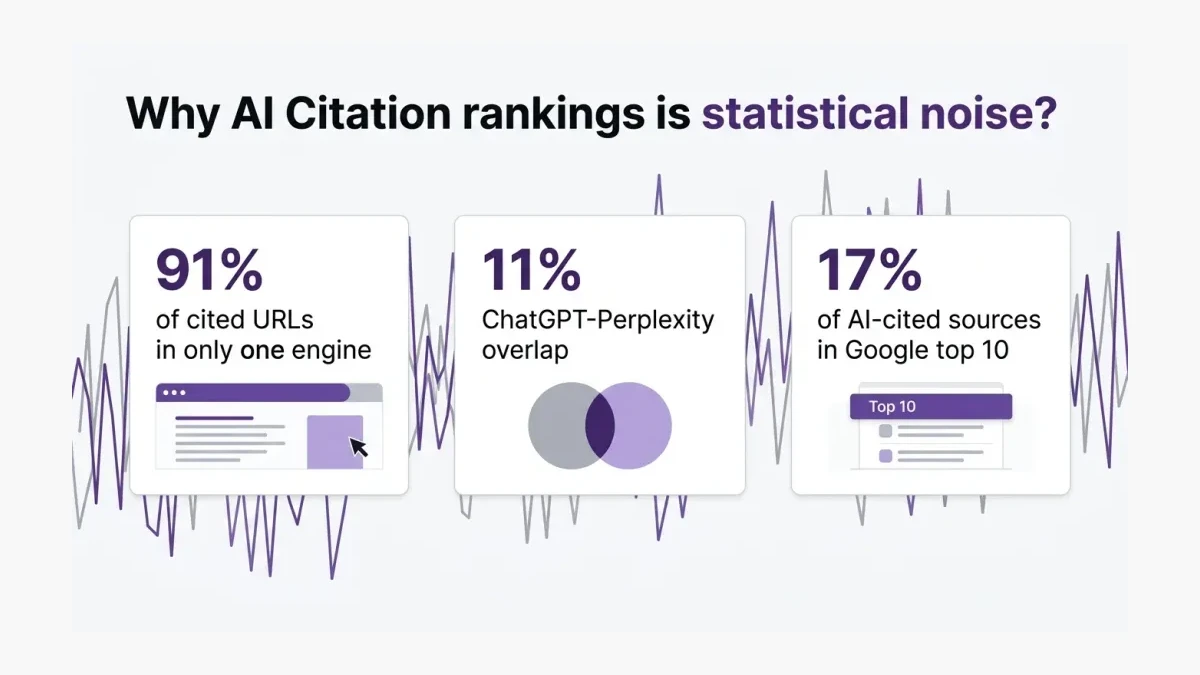
Large language models retrieve and synthesize on the fly, and that retrieval is probabilistic rather than deterministic. Ask ChatGPT the same commercial question twice in the same hour and the cited sources often differ, because the model samples from a candidate pool rather than reading from a fixed index the way Google’s classic crawler once did. Kevin Indig’s analysis of 3.7 million citations found that 91 percent of cited URLs appear in only one engine, and an Ahrefs-backed study across tens of thousands of brands found only about 11 percent overlap between the domains ChatGPT cites and the domains Perplexity cites for the same queries. The engines are not disagreeing about a shared truth; each is building a different answer from a different pool.
This has a blunt implication for Pakistani marketing managers who have been handed an “AI visibility score” by a vendor. A cross-engine score is not a number you can optimize against, because moving it does not reliably move the underlying citations. A Karachi electronics retailer that improves its score on one tool may see no change in actual purchase-time recommendations inside ChatGPT, because the tool’s score and ChatGPT’s live retrieval are measuring different things. The underlying mechanic is that retrieval is local to each engine, each session, and sometimes each refresh of the same conversation.
The ranking you are chasing is barely tied to Google rank
Book a free strategy call - we'll audit your current setup and identify the highest-impact fixes.
There is a second reason the dashboard numbers mislead, and it cuts against the assumption most Pakistani brands still operate on. The assumption is that if a brand ranks well on Google it will be cited by AI, and that if it is not cited, its SEO is failing. Neither holds in 2026. Research on Google AI Overviews found that only about 17 percent of cited sources simultaneously rank in the organic top ten for the same query, and practitioner data puts the decoupling more starkly, noting that roughly three out of four AI citations now come from outside Google’s top results. A Pakistani brand can dominate classic search for its category and still be invisible to the answer engine, or the reverse.
That decoupling matters because it changes what a Pakistani business should actually buy. Traditional SEO retainers, built around ranking ten keywords in positions one through three, were never a complete proxy for AI visibility, and in 2026 they are barely a proxy at all. The brands being recommended inside ChatGPT at the moment a buyer asks “best leather jacket brand in Pakistan” are not necessarily the brands ranking first on Google for that string. They are the brands whose entity the model can retrieve, trust, and articulate in a sentence. A business that misreads a noisy citation dashboard as proof its SEO retainer is failing will often fire the wrong vendor for the wrong reason.
What actually compounds is brand entity coherence
If retrieval is noise-prone and rank is decoupled, the question becomes what the real signal is. The most defensible answer across the 2026 research is brand entity coherence, which is how consistently and clearly a brand is described as an entity across the broader web, not just on its own pages. Entity SEO — optimization organized around distinct things like people, brands, products, and organizations and the relationships between them, rather than around keyword strings — is the discipline that produces that coherence over time.
The evidence that coherence drives AI recommendation is now measurable. One platform analysis of hundreds of brands found that those with greater than 20 percent variance in their descriptions across five or more public sources scored 41 percent lower on AI recommendation confidence than brands with aligned messaging. Inconsistency, not irrelevance, is what quietly sinks a brand in the answer layer. A Pakistani brand described as a “lawn manufacturer” on its own site, a “textile exporter” in one directory, and a “women’s fashion retailer” in a press release is three different entities to the model, and three weak entities lose to one coherent one.
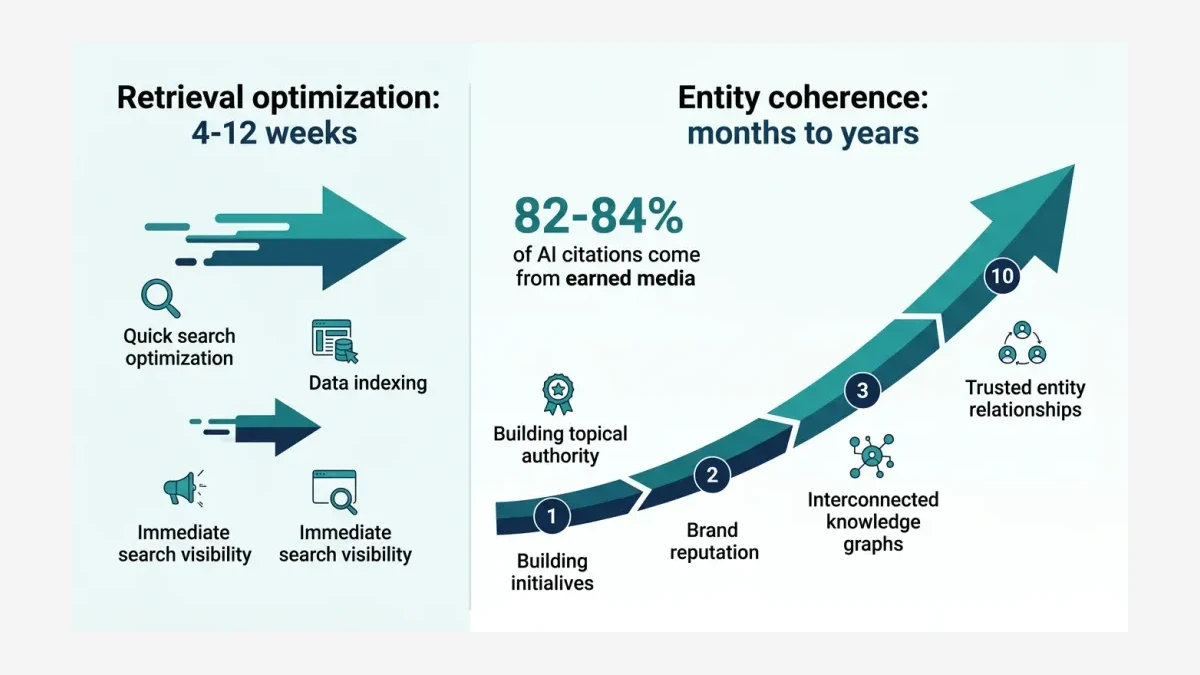
Entity coherence is slow because it is built from third-party evidence, and third-party evidence takes time to accumulate. Muck Rack’s research into how AI engines source answers found that 82 to 84 percent of AI citations come from earned media, with journalism alone accounting for roughly 27 percent of sources. Ahrefs reports that YouTube brand mentions correlate with AI visibility at around 0.737, outperforming most classic SEO factors. The implication is uncomfortable for brands that want a four-week fix: the work that compounds is public relations, directory consistency, structured organizational data, and repeated third-party description, exactly the unglamorous labor Pakistani brands tend to underfund in favor of more on-page content.
Dorron Shapow, a search user optimization expert, frames the timeline in a way every Pakistani marketing manager should read twice.
Optimizing for retrieval isn’t wrong. In systems that rely heavily on live search for commercial queries, it can absolutely influence what gets surfaced. But assuming retrieval visibility is the same as foundational model weighting is where the strategy breaks. One takes weeks. The other is the slow work of entity coherence — how consistently and clearly your brand is understood across the broader web — and it takes years. — Dorron Shapow, Search User Optimization Expert
The practical dividing line for Pakistani budgets
Retrieval optimization is not worthless; it produces measurable citation uplift inside roughly four to twelve weeks for targeted queries, assuming the site is already crawlable and carries baseline authority. Entity coherence is the slower, compounding layer that determines whether a brand is recommended across engines and across time rather than cited once and dropped. Confusing the two is where Pakistani marketing budgets leak. A brand spends its annual digital budget chasing a noisy retrieval score, watches the score bounce, and concludes that AI search does not work, when what failed was the metric, not the channel.
The honest position for a Pakistani brand in 2026 is to measure AI visibility statistically rather than anecdotally. That means a fixed panel of fifty to two hundred buyer-intent prompts, run monthly across ChatGPT, Perplexity, and Google AI Overviews, averaged into appearance and recommendation rates over a twelve-month trend. It also means investing the larger share of budget into the entity layer that compounds — consistent brand descriptions across directories, earned media coverage, structured data, and the slow accumulation of third-party evidence — rather than into chasing a weekly screenshot. For brands trying to work out whether their current agency is actually moving the needle, the question to ask is whether the entity the engines describe is becoming more coherent quarter over quarter, not whether one citation score ticked up this week.
The question to ask before paying for AI visibility
How we helped a Pakistani business achieve measurable results.
The single question that separates a useful AI visibility vendor from a dashboard seller is straightforward: do you measure with a fixed prompt panel run repeatedly over time, or do you show me one screenshot per keyword? A vendor that cannot describe its panel size, its prompt set, and its repeat cadence is selling noise dressed up as signal. Pakistani brands paying monthly retainers for AI search optimization should expect a report built on at least fifty to two hundred buyer-intent prompts, sampled across ChatGPT, Perplexity, and Google AI Overviews, with appearance rate, brand-accuracy rate, and recommendation share tracked as a trend rather than a snapshot. Anything less is astrology with a chart attached.
This is also where the entity-coherence work earns its budget. The same vendor that runs the panel should be able to point to specific third-party evidence it is building or repairing each quarter — a directory listing corrected, a press placement secured, a Knowledge Panel stabilized, a structured-data gap closed. If the only deliverable is a moving score, the brand is paying for the very noise it should be measuring past. A Lahore restaurant chain, for example, might discover through the panel that ChatGPT recommends a competitor because three food-listing sites describe that competitor consistently while describing the chain three different ways; the fix is coherence work on those listings, not another week of chasing a score inside a tool.
The principle holds across every Pakistani brand measuring its place in AI search. The number on the dashboard is noise; the entity the engines are trying to describe is the signal, and the signal is what a brand should be paying to build, one consistent description and one piece of earned evidence at a time, over years rather than weeks.
WeProms Digital, Pakistan’s leading digital PR and entity SEO agency, builds the entity coherence layer that compounds across ChatGPT, Perplexity, and Google AI Overviews rather than chasing dashboard scores that move between runs. The team sets up statistical AI visibility panels, audits brand description consistency across directories and earned media, and runs the PR and structured-data work that makes a Pakistani brand the entity the engines recommend. Start with an entity coherence review or message the team on WhatsApp at +92 300 0133399.
Sources & References
- Search Engine Journal — AI Visibility Rankings Aren’t Stable: New Research Shows It’s Mostly Statistical Noise — 2026
- Search Engine Journal — Why Publishing More Content Is Making Your SEO Worse — 2026
- GrowthX — Improve Brand Visibility in AI Search (Kevin Indig citation data) — 2026
- Astiva — Entity Correlation and AI Search — Q1 2026
- No Hacks — How to Measure AI Search Visibility — 2026
- MOJO — How We Actually Do GEO: Measuring and Improving AI Visibility — 2026
- Green Banana SEO — AI Extractability — 2026
Additional reading from industry feeds: