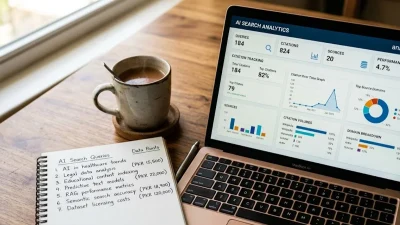
Track AI Mentions in 7 Steps: A Pakistani SME Walkthrough
By Abdul Rehman. Last updated: May 2026.
TL;DR: Pakistani businesses lose organic clicks to AI answers daily but most cannot measure the damage. This 7-step walkthrough builds a monthly tracking system using free and paid tools to monitor which AI engines mention your brand, which competitors they cite instead, and what content changes increase your AI citation rate. Setup takes one weekend. Monthly tracking takes two hours.
If you run a business in Lahore, Karachi, or Islamabad and your Google Analytics shows declining organic sessions, the cause is likely sitting at the top of your search results. Google AI Mode, powered by Gemini 3.5 Flash, now generates answers that cite sources without sending clicks. A MarTech Series study found that AI Overviews cost websites 58% of their clicks. Pakistani businesses feel this acutely because organic search has been the primary free acquisition channel for SMEs across the country.
The problem is not the traffic loss itself — it is the inability to measure what is happening. Most Pakistani businesses cannot answer a basic question: does ChatGPT, Google AI Mode, or Perplexity mention my business when someone searches for my services? If the answer is no, every month of inaction compounds the damage.
Picture this. You pay your JazzCash bill and check the receipt to confirm the payment went through. Tracking AI mentions works the same way: you check the output to confirm your business appears in the answer. Without that confirmation, you are spending on SEO without knowing whether it produces AI visibility.
This walkthrough builds a complete monthly tracking system in seven sequential steps.
First, Inventory Every Keyword AI Mode Could Answer About Your Business
Start by listing every search query where a potential customer could use AI instead of clicking your website. These are queries that AI Mode answers directly — informational questions, local service comparisons, pricing inquiries, and “best of” searches.
Open Google Search Console. Navigate to Search Results. Filter for the past 90 days. Export the top 100 queries by impressions. Sort them into three categories:
- Informational queries where AI likely generates a direct answer (“what is the cost of SEO in Pakistan,” “how to choose a digital marketing agency”)
- Local queries where AI aggregates multiple businesses (“best restaurants in DHA Karachi,” “top SEO agencies in Lahore”)
- Brand queries where someone searches your business name specifically
A Lahore-based IT training center might discover that queries like “Python course fee in Lahore” and “best IT certification institute Pakistan” drive most of their impressions. Both are queries that AI Mode can answer with a synthesized response, citing multiple training centers without requiring clicks to any single website.
Record each query in a spreadsheet with columns for: query text, current AI Mode status (does AI answer it directly?), and your current organic position. This inventory becomes the foundation for every tracking decision that follows.
The inventory should contain 30-50 queries for most Pakistani SMEs. Businesses with large product catalogs or multiple service categories may reach 100. Aim for breadth over depth at this stage.
Action: Export your top 100 queries from Google Search Console and categorize them by AI-answerability.
Then, Search Each Keyword in Three AI Engines
Book a free strategy call - we'll audit your current setup and identify the highest-impact fixes.
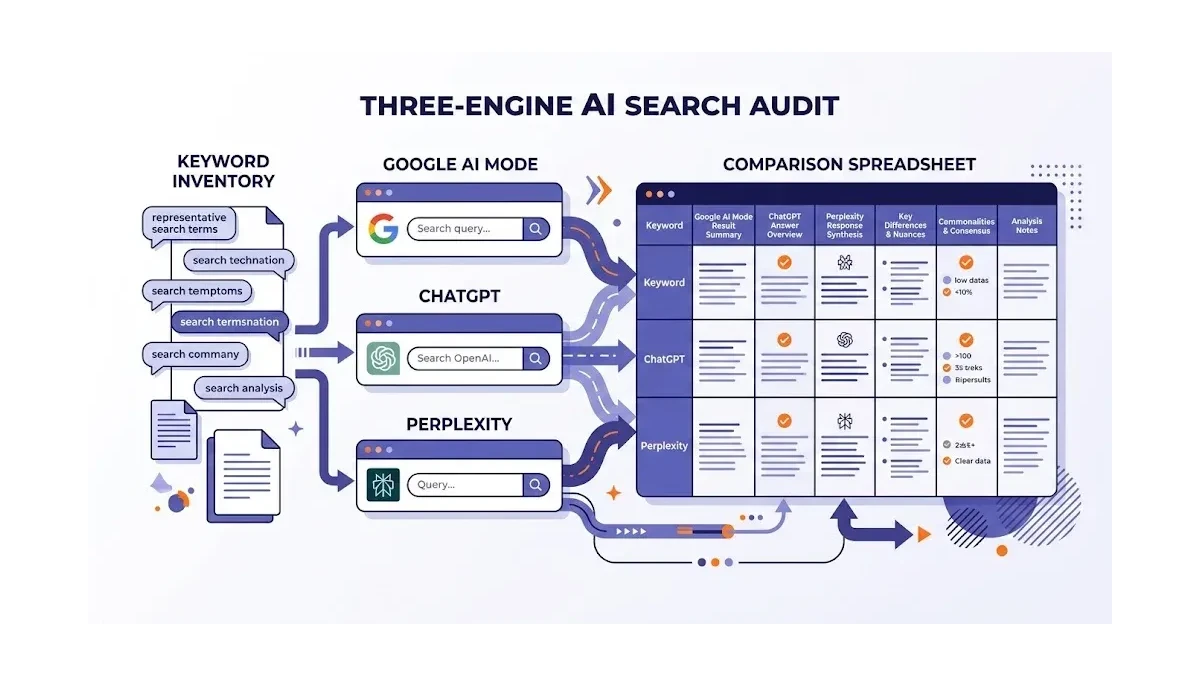
For each query in your inventory, search it in three places: Google AI Mode, ChatGPT, and Perplexity. Record the results systematically.
Google AI Mode generates answers powered by Gemini 3.5 Flash that appear at the top of search results before any blue links. When you search your target query, note whether an AI Overview or AI Mode answer appears and whether your business is cited in that answer.
ChatGPT reflects how users interact with the most widely used AI assistant in Pakistan. Ask ChatGPT: “What are the best [your service type] in [your city]?” and “How much does [your service] cost in [your city]?” Record whether your business name appears in the response.
Perplexity is a research-focused AI search engine that cites sources explicitly. Search your target queries in Perplexity and note which businesses and sources get cited. Perplexity’s citation format makes it easy to see exactly which websites AI trusts for your category.
For each query and each engine, record:
- Does the AI generate a direct answer? (yes/no)
- Is your business mentioned? (yes/no)
- Which competitors are mentioned?
- Which sources does the AI cite?
A Karachi salon searching “best bridal makeup Karachi” in all three engines might discover that Google AI Mode lists five salons (none of them theirs), ChatGPT names three different ones, and Perplexity cites a blog post from a local fashion magazine. This information reveals both the gap and the path to closing it.
The initial search across all three engines for 30-50 queries takes approximately 4-6 hours. Spread it across two evenings.
Action: Search every inventory query in Google AI Mode, ChatGPT, and Perplexity. Record results in your spreadsheet.
Next, Record Which Competitors Get Cited
The competitors that AI engines cite are the ones winning the visibility you have lost. Identifying them specifically tells you what you are competing against — and what content strategies are producing AI citations in your industry.
Create a competitor tracking section in your spreadsheet. For each query where a competitor appears in an AI answer, record:
- Competitor name
- Which engine cited them (Google/ChatGPT/Perplexity)
- What type of content the AI cited (website page, blog post, directory listing, review platform)
- The specific sentence or data point the AI extracted
Patterns emerge quickly. A Faisalabad ecommerce brand might notice that Daraz seller pages get cited by Google AI Mode for product comparison queries, while independent blog reviews get cited by Perplexity. This tells the brand that Google trusts marketplace data while Perplexity trusts editorial content. Different citation patterns require different optimization strategies.
Search Engine Journal’s study on AI citation strategies found that AI engines cite different source types depending on query intent. Informational queries favor educational content with specific data. Commercial queries favor product pages with structured pricing. Local queries favor Google Business Profile data combined with directory listings.
Understanding which competitors get cited and why gives you a blueprint for displacing them. The competitor who appears in AI answers for “best biryani in Lahore” is not necessarily the best biryani restaurant. It is the restaurant whose data AI engines can verify, parse, and trust most easily.
Action: Build a competitor citation log with at least 10 competitor entries, noting which engines cite them and what content triggers the citation.
After That, Set Up Automated Tracking With Free and Paid Tools
Manual searching works for the initial audit but becomes impractical for monthly tracking. Set up a combination of free and paid tools to automate the monitoring process.
Free tools for Pakistani SMEs:
- Google Search Console tracks organic click changes over time. Set up monthly exports comparing clicks against impressions. A rising impression-to-click gap signals AI Overviews are intercepting your traffic.
- Google Alerts for your brand name catches mentions across the web, though it does not track AI-specific citations.
- ChatGPT manual check once monthly for your top 10 queries. Consistency matters more than frequency.
Paid tools with AI tracking capabilities:
- SEMrush AI Visibility Toolkit tracks your brand’s appearance in AI-generated answers across multiple engines. The SEMrush AI Visibility Index provides a score you can track month over month.
- Microsoft Clarity launched a new AI Citations Report, as Search Engine Roundtable reported, which shows when your site appears in AI-generated answers.
- Writesonic AI Visibility Report generates a report on how AI search engines describe your brand, as Neil Patel documented.
For Pakistani SMEs with limited budgets, the practical setup is: Google Search Console (free) plus one monthly manual check across ChatGPT and Perplexity, plus SEMrush if the budget allows. Monthly cost for SEMrush starts around PKR 25,000-40,000 for basic access.
Action: Choose your tracking tools. Set up Google Search Console monthly exports. Subscribe to one paid AI visibility tool if budget permits.
At This Point, Build Your Monthly AI Visibility Score
How we helped a Pakistani business achieve measurable results.
A single number makes monthly tracking actionable. Build a simple AI Visibility Score using this formula:
AI Visibility Score = (Queries where you are mentioned / Total tracked queries) x 100
If you track 40 queries and your business appears in AI answers for 8 of them across all three engines, your AI Visibility Score is 20%. Track this score monthly. An increasing score means your optimization efforts are working. A flat or decreasing score means you need to adjust.
Break the score down by engine to identify where you are strongest and weakest:
| Engine | Queries Tracked | Mentions | Score |
|---|---|---|---|
| Google AI Mode | 40 | 6 | 15% |
| ChatGPT | 40 | 3 | 7.5% |
| Perplexity | 40 | 5 | 12.5% |
| Combined | 40 | 8 | 20% |
Note that combined mentions may be lower than the sum of individual engine mentions because the same query might produce mentions on multiple engines. Use unique query-level mentions for the combined score.
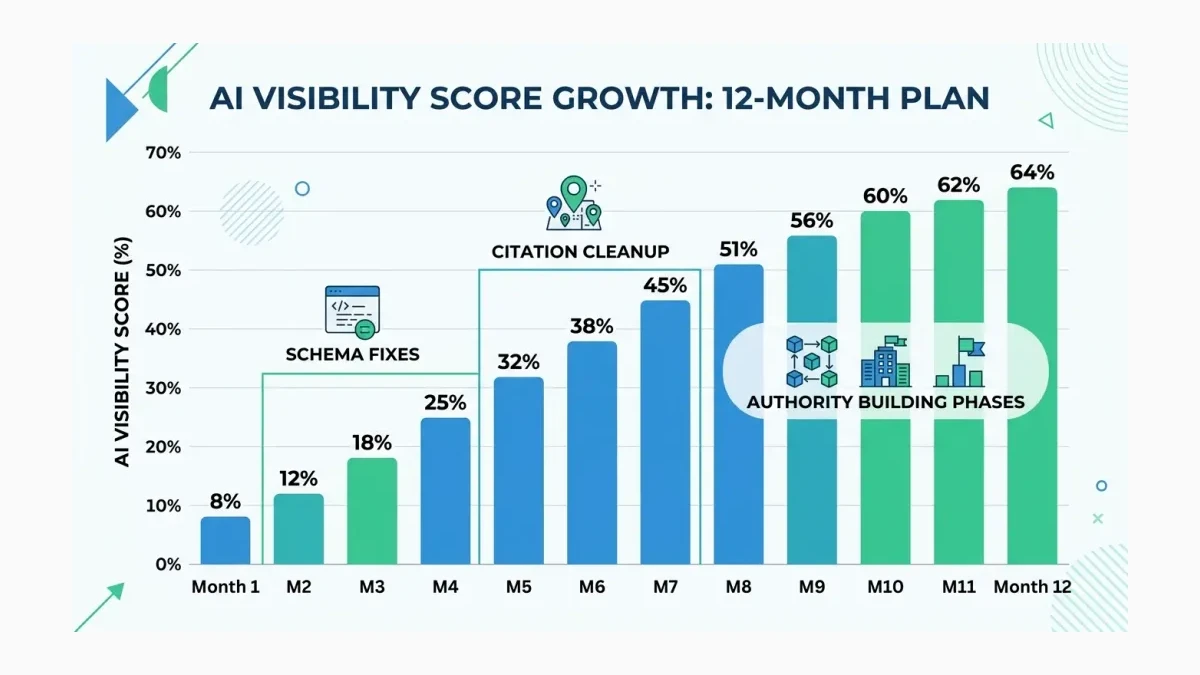
A Pakistani business with a combined score of 20% has significant room for improvement. Industry benchmarks suggest that businesses actively optimizing for AI citations can reach 50-65% within 12 months. The SEMrush measurement guide for AI search visibility recommends tracking this score alongside traditional SEO metrics like keyword rankings and organic traffic to build a complete picture.
Record your AI Visibility Score in your spreadsheet at the same time each month. The trend line over 3-6 months tells you more than any single month’s number.
Action: Calculate your baseline AI Visibility Score this week. Set a target of increasing it by 10 percentage points within 6 months.
Once You’ve Tracked 90 Days, Find the Patterns That Matter
After three months of tracking, patterns emerge. The data reveals which types of content, which optimization changes, and which citation sources produce the strongest AI visibility improvements.
Look for these specific patterns:
Query-type patterns. Which categories of queries show the highest AI citation rates for your business? If your informational blog posts get cited but your service pages do not, your service pages need richer, more extractable content with PKR amounts and specific service descriptions.
Content-type patterns. Do AI engines cite your blog posts, your service pages, your FAQ section, or your product listings? If citations come exclusively from one content type, replicate that format across other pages.
Competitor displacement patterns. When your AI Visibility Score increased, whose score decreased? Identifying which competitor lost a citation to you reveals what content changes worked.
Engine-specific patterns. Google AI Mode may cite you for local queries while ChatGPT cites you for informational queries. Different engines weight different signals. Optimizing for all three requires addressing the specific weakness each engine reveals.
A Lahore business might discover that their AI Visibility Score jumped from 15% to 28% in month three after they added detailed PKR pricing to their service pages. That pattern confirms that pricing data is a strong citation signal for their industry. The next optimization step becomes clear: add PKR pricing to every remaining service page that lacks it.
Search Engine Roundtable reported that Google is testing a “Preferred Sources” label in AI Mode citations. This suggests Google may introduce a new trust signal for AI citation selection. Businesses that build strong citation patterns now may benefit from this label when it launches.
Action: After 90 days of tracking, analyze your data for the three patterns above. Write a one-paragraph summary of what is working and what is not.
From Here, Create Your Content Update Calendar
The final step converts tracking insights into a repeatable content calendar. Each month, your tracking data tells you exactly which pages to update, which new pages to create, and which competitor citations to target.
A monthly content update calendar for AI visibility includes:
Week 1: Data collection. Run your AI search checks across all three engines. Update your spreadsheet. Calculate your monthly AI Visibility Score.
Week 2: Analysis and prioritization. Identify the five queries where you lost citations or failed to gain new ones. Check what competitors did to earn those citations. Prioritize which pages to update this month.
Week 3: Content updates. Rewrite or update 3-5 pages based on your analysis. Focus on adding PKR pricing, specific service details, local neighborhood information, and structured FAQ sections that AI engines can extract.
Week 4: Technical maintenance. Verify schema markup is rendering correctly. Check that NAP data is consistent across platforms. Update the “last updated” date on all modified pages. Submit updated sitemaps to Google Search Console.
This monthly cycle takes approximately 8-10 hours for a Pakistani SME managing their own tracking, or it can be handled by an SEO agency retainer starting at PKR 85,000 per month for businesses that prefer professional management.
The outcome of consistent monthly tracking is a steadily increasing AI Visibility Score, which correlates with higher AI citation rates, which drives brand awareness and lead generation even as traditional organic clicks decline. Pakistani businesses that track and optimize for AI citations report maintaining or growing their overall lead volume despite losing blue-link clicks, because AI-generated answers expose their brand to users who would never have scrolled past page one.
WeProms Digital includes AI visibility tracking as a standard component of its monthly SEO retainers. The team monitors client citation rates across Google AI Mode, ChatGPT, and Perplexity, adjusting content strategy based on which optimizations produce measurable citation improvements.
Read next: How to budget for AI search optimization as a Pakistani SME | AI search visibility audit for Pakistani businesses | B2B lead generation strategies for Pakistan
If tracking AI mentions sounds like more work than your team can manage internally, WeProms Digital offers monthly AI search monitoring as part of its SEO retainer services. The team handles data collection, competitor analysis, and content recommendations, delivering a monthly AI Visibility Score report with specific action items. Contact hello@weproms.com or message WhatsApp +92 300 0133399 to discuss a monitoring plan for your business.
Frequently Asked Questions
How often should I check my AI search mentions?
Monthly is the minimum effective frequency. Weekly checks provide more granular data but require significantly more time. For most Pakistani SMEs, a monthly check across Google AI Mode, ChatGPT, and Perplexity for 30-50 queries provides enough data to guide content decisions without overwhelming the team. Consistency matters more than frequency.
What AI Visibility Score should a Pakistani business aim for?
A realistic target for a Pakistani SME starting from zero is 30-40% AI Visibility Score within 6 months and 50-65% within 12 months. The exact target depends on your industry competitiveness and how many competitors are also optimizing for AI citations. Businesses in less competitive Pakistani niches may reach 50% faster.
Can I track AI mentions without paid tools?
Yes. Google Search Console is free and shows organic click trends. Manual searches in Google AI Mode, ChatGPT, and Perplexity are free but time-consuming. The free approach works for monthly tracking of up to 30 queries. For businesses tracking 50+ queries across multiple locations, a paid tool like the SEMrush AI Visibility Toolkit saves significant time.
What should I do if AI engines mention competitors but never my business?
This indicates a citation gap that usually stems from one of three issues: missing schema markup on your website, inconsistent business data across platforms, or thin content that lacks specific PKR amounts and extractable answers. Start by implementing the SOURCE method — add schema, fix citations, and rewrite your top service pages with direct, quotable content. Most Pakistani businesses see their first AI citation within 60-90 days of making these changes.
How much does WeProms charge for monthly AI search monitoring?
WeProms Digital includes AI visibility tracking in its standard SEO retainers, which start at PKR 85,000 per month for local Pakistani businesses. Standalone AI monitoring without full SEO management is available at PKR 15,000-30,000 per month depending on the number of keywords and competitors tracked. Contact the team at hello@weproms.com for a custom quote.
Sources & References
- Google Blog — Search at I/O 2026 — May 2026
- Search Engine Journal — Inside AI Citation: Proven Strategies — 2026
- GoodFirms — SEO Statistics: AI Search Rankings and Zero-Click Trends — 2026
- WeProms Digital — SEO Agency Services — 2026
Additional reading from industry feeds:
- Search Engine Journal — Google Shares First AI Mode Usage Data After One Year
- Neil Patel — How to Create an AI Visibility Report with Writesonic