
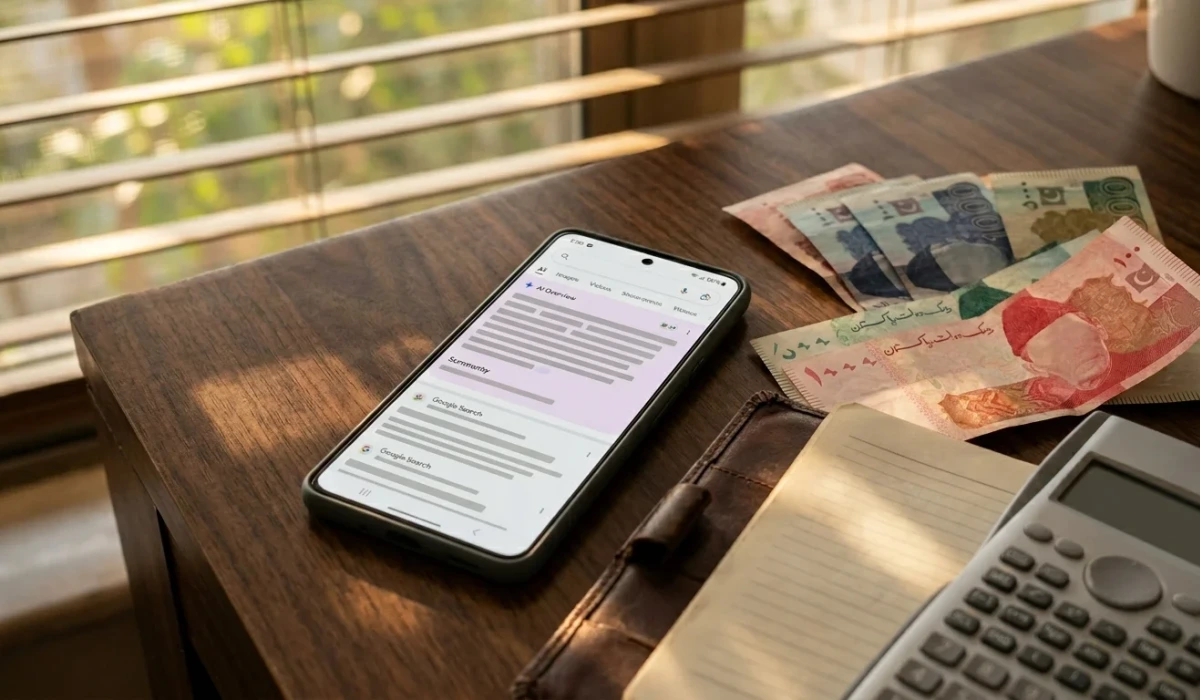
A Lahore dental clinic may still rank for informational keywords while receiving fewer organic visits, calls or WhatsApp enquiries. The cause is not always a ranking collapse. Google’s AI answer formats can satisfy research questions directly on the results page, leaving people with less reason to visit a blog post.
Doctors, law firms, consultancies, architecture studios, tax advisers and education businesses should check whether those pages still produce commercial enquiries. Stable rankings alone cannot tell you whether search is supporting the business.
Think of it like paying for a shopfront in Liberty Market. Your sign is still up, but an information stall at the entrance answers some customers’ questions before they reach your door. Others still need to speak to you. Your job is to understand which visitors you are losing and whether they were likely to buy.
The traffic drop your analytics hasn’t caught
A rankings-only report misses click-through rate (CTR) — the proportion of search impressions that result in a click. Positions can remain broadly stable while CTR falls.
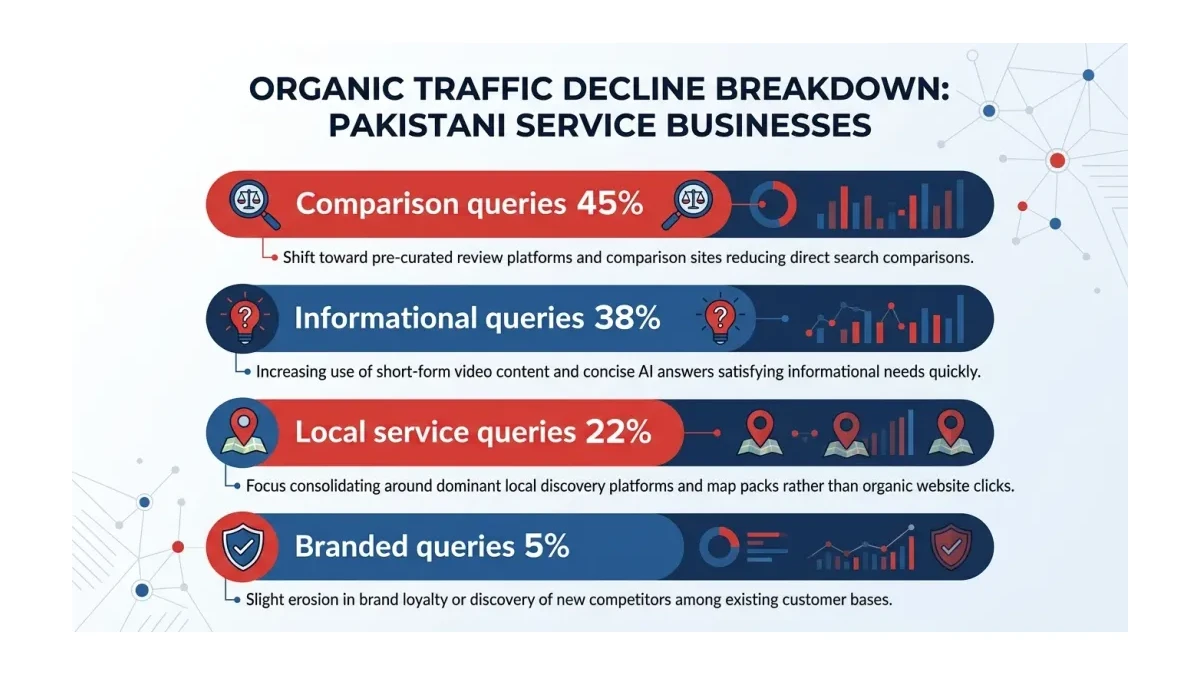
Ahrefs’ analysis of AI Overviews found an association with lower CTR for top-ranking pages in its sample. That supports investigating the risk; it does not establish a traffic-loss benchmark for Pakistani service businesses. Query intent, device, location and demand all matter.
Simple informational pages deserve attention because an answer may satisfy the searcher. Service pages, pricing information and local case studies deserve attention because they help prospective clients choose. Neither category is automatically protected from falling clicks.
For a Karachi law firm targeting “property dispute lawyer Karachi”, stable impressions alongside fewer clicks should trigger investigation. An AI answer might contribute, but so might competing listings, adverts, changing query mix or weaker demand.
Stable rankings are a starting point for an audit, not proof that your lead pipeline is healthy.
The infographic below contains figures without a verified Pakistani dataset. Treat it as a conceptual illustration, not a forecast for your business.
Where the lead loss shows up
Consider a Lahore architecture consultancy, a Rawalpindi tax advisory firm or a Faisalabad medical practice. Each needs its own baseline. A generic monthly traffic estimate tells you little about how many qualified enquiries its website should generate.
The cost can appear in the pipeline before the reporting explains it: fewer calls, fewer WhatsApp enquiries or fewer appointment bookings. Check lead quality as well as volume. Losing research visitors is different from losing people ready to book.
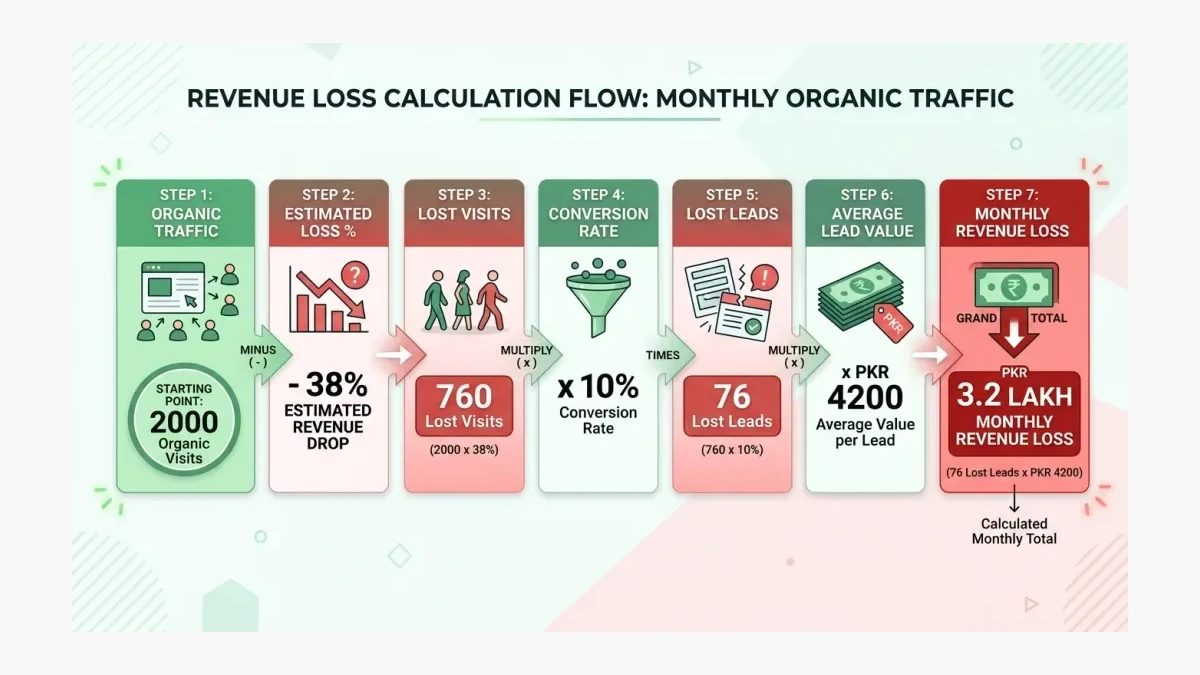
Estimate potential lost leads by multiplying lost organic sessions on relevant pages by their historical enquiry rate. To estimate revenue at risk, also account for the proportion of enquiries that become customers and the average revenue from those customers. An enquiry is not a completed sale.
Reconcile the forecast with GA4, Search Console, CRM records and call logs. Check that tracking still works before interpreting a drop as lost demand. Describe the result as an estimate, not revenue proven to have been lost to AI.
The figures in this illustration are unverified assumptions; use your own measured inputs instead.
Service pages lose differently than blog posts
“Write more blog posts” is an incomplete response to falling leads. Informational articles about registering a company, filing tax returns or choosing construction materials may answer questions that Google can summarise directly. AI answers can also include supporting links, so they do not invariably remove the opportunity for a visit.
The useful distinction is whether your content gives someone a reason to choose your business. An architecture service page can explain the consultation process, pricing basis, project constraints and relevant local experience. Generic advice rarely provides that level of decision support.
Your home-buying tips article may overlap with many other sources. Your project portfolio, client-approved case studies and explanation of how you work offer something more specific. They can help a prospective client decide whether to contact you, even when the overall search journey changes.
Review thin service pages before commissioning another batch of generic articles. Explain who the service suits, what is included, what affects the price and how an enquiry is handled. Use FAQs to address real objections rather than repeating keywords.
Structured data can describe visible page content, but Google specifies no special schema requirement for AI Overviews or AI Mode. Detailed content and accurate markup do not guarantee citations. Judge improvements by qualified enquiries as well as visibility.
The fix starts in GA4, not in content
Before writing new content, establish which pages lost visits, which queries lost clicks and whether enquiries declined alongside them.
Google Analytics 4 (GA4) reports website activity such as sessions and configured key events. Its landing page report helps connect entry pages with visitor behaviour. Google Search Console reports Google Search clicks, impressions, CTR and average position. Search Console metrics can also appear in GA4 through a linked property; they are not native columns in the standard landing page report.
Google includes AI Overviews and AI Mode activity in Search Console’s overall Web performance data. That report does not provide a separate AI breakdown that isolates their effect on your clicks.
Compare equivalent, completed periods using consistent filters. Where possible, check the corresponding seasonal period too. A partial month compared with a full month, or tax-season demand compared with a quiet period, can produce misleading conclusions.
In GA4, isolate Google organic sessions by landing page and review relevant key events. Cross-reference Search Console pages and queries, keeping country and device consistent. Our GA4 audit guide for Pakistani businesses provides further tracking guidance.
Then inspect affected search results. Record AI answers alongside adverts, map results and competing pages. An AI answer is evidence about the current results page, not proof that it caused the historical decline. Prioritise sustained changes on pages associated with qualified leads.
Your AI search audit checklist
-
Pull a GA4 comparison report. Use equivalent completed periods and filter for Google organic traffic. Export landing pages, sessions and relevant key events. Confirm that enquiry tracking works and distinguish contact-button clicks from completed enquiries.
-
Open Google Search Console. Compare the same periods in Search results using the Web search type. Review clicks, impressions, CTR and position by page and query. Surface the largest click losses, then check whether impressions or rankings also changed.
-
Inspect queries with meaningful declines. Search from the relevant location and device where practical. Record whether an AI Overview appears and inspect AI Mode separately. Save dated screenshots and repeat observations; a single result is only a snapshot.
-
Estimate commercial impact. Use lost relevant sessions, historical enquiry rates, lead-to-customer rates and average customer revenue. Check the estimate against actual enquiries and sales. Record assumptions and avoid attributing the entire difference to AI answers.
-
Segment affected queries. Separate general research from booking, pricing, hiring and consultation searches. Improve content that supports a decision: service scope, pricing context, original process details and local case studies. Keep useful educational content where it contributes to the customer journey.
-
Review structured data. Ensure markup accurately represents visible business information. Use Google’s Rich Results Test for supported Google features. FAQ rich results are restricted to well-known, authoritative government or health websites; FAQ markup is not a general route into AI answers.
-
Keep information current. Review prices, availability, staff details and legal or procedural guidance. Date genuinely time-sensitive information when useful. Aleyda Solis’s checklist recommends maintaining accurate commercial information; changing a date alone does not establish freshness or guarantee a citation.
-
Check business information across platforms. Maintain an accurate Google Business Profile where eligible and review relevant professional or industry listings. Keep your business name, address and phone details consistent. Choose directories that customers actually use, rather than registering everywhere.
Assign an owner to each issue and record what changed. Review enquiries alongside search performance after implementation so the next decision is based on results. Our AI search visibility audit guide provides a broader framework for organising that work.
Read next: What Pakistani brands should measure in AI search · How Pakistani businesses get cited in Google AI Mode
WeProms Digital helps Pakistani service businesses investigate organic traffic losses and improve service content. An audit should connect search visibility, website behaviour and lead quality so you can decide where investment is justified. Get in touch: hello@weproms.com · WhatsApp +92 300 0133399
Frequently Asked Questions
How do I know if AI Overviews are affecting my Pakistani business website?
Compare Search Console clicks, impressions, CTR and position across equivalent periods. Inspect affected queries for AI Overviews and other result changes. Stable impressions with declining clicks are a warning sign, but they do not identify the cause on their own. Check seasonality, competitors and tracking, then compare the pattern with qualified enquiries.
What types of Pakistani businesses are most affected by Google AI Mode?
Businesses depending on visits to general question-and-answer content may be exposed. That can include medical practices, legal firms, tax advisers and education consultants. There is no verified sector ranking here for Pakistan. Assess your own query mix and lead sources rather than assuming your industry determines the scale of the loss.
How much does an AI search traffic audit cost in Pakistan?
A professional audit should be scoped according to page count, analytics quality, Search Console history and whether CRM or call data is included. Ask what the deliverable covers: tracking checks, query analysis, commercial impact estimates and prioritised actions. WeProms Digital can scope an audit after reviewing your site and available data.
Can I recover the traffic I’ve lost to AI search answers?
Recovery depends on why visits fell. Better service pages and clearer conversion paths may improve qualified enquiries, even if informational traffic remains lower. Eligible pages can appear as supporting links in Google’s AI features, but inclusion and resulting clicks are not guaranteed. Measure customer outcomes rather than promising to restore every lost visit.
Should I stop writing blog posts for my Pakistani service business?
No. Publish articles that help your customers and reflect expertise you can substantiate. Original research, client-approved case studies and explanations of local requirements can provide a reason to visit. Connect those articles to relevant services. Originality can make content useful, but it does not guarantee attribution, citations or traffic.
About WeProms Digital
WeProms Digital is a Lahore-based digital marketing agency serving Pakistani SMEs, service businesses and professional practices across Lahore, Karachi, Islamabad, Rawalpindi, Faisalabad and Multan.
The team offers analytics audits, SEO audit and strategy and AI search visibility work. For service businesses, the focus is connecting technical improvements and useful content with measurable enquiries.
Get in touch: hello@weproms.com · WhatsApp +92 300 0133399