Position 1 Ranks Below 900 Pixels: What Pakistani SEO Reports Miss
By Hamza Ali · Last updated: June 2026.
TL;DR: Google search results can show AI Overviews, sponsored ads, map packs, featured snippets, and other modules above traditional organic links. Pakistani businesses paying for “rankings” without measuring actual visibility, clicks, and enquiries are flying blind.
The setup that changed everything
Google’s search results page no longer resembles its 2024 layout. AI Overviews — Google’s AI-generated answer blocks — now appear on a meaningful share of commercial and informational queries, while AI Mode is being counted inside Google Search Console totals. These AI answer features can sit above traditional organic listings, consuming vertical space that previously belonged to blue links.
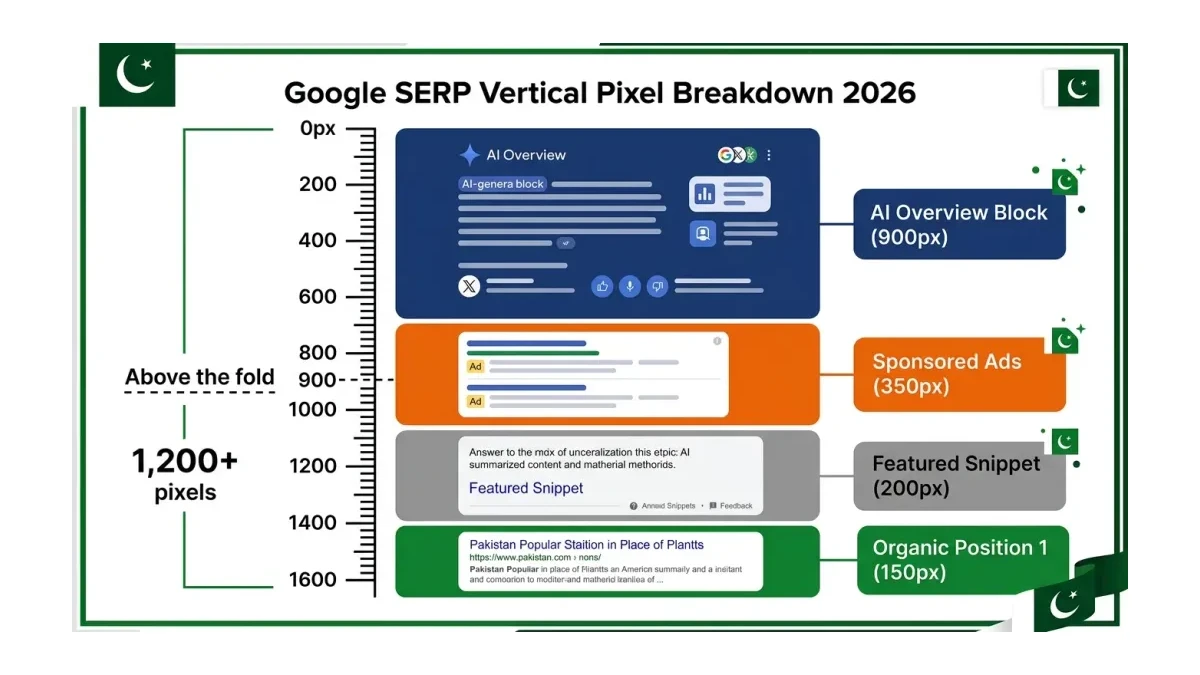
A Search Engine Journal study reframed SERP analysis by measuring results in pixels rather than rank positions. The finding: a traditional position 1 result can sit much lower on the visible page than the rank number suggests, especially on mobile. The space above belongs to sponsored Google Ads, AI-generated answer synthesis, People Also Ask carousels, and knowledge panels.
For a Pakistani SME spending PKR 150,000 to 300,000 per month on SEO retainers, the old reporting framework — “you rank position 1 for [keyword]” — presents a flattering picture that no longer matches what users actually see.
What traditional SEO reporting gets right
Book a free strategy call - we'll audit your current setup and identify the highest-impact fixes.
Rank tracking retains diagnostic value. It confirms that Google’s index recognizes the page and can serve it. It shows relative movement against competitors over time. For non-commercial, long-tail queries where AI features do not appear — something like “how to register a private limited company in Pakistan through SECP” — position 1 still delivers meaningful organic clicks.
Rank trackers also provide early warning signals. A sudden drop from position 3 to position 18 signals a technical problem: a crawl error, a lost backlink, or the impact of a Google core update. The Google May 2026 Core Update hit some sites hard on May 30, 2026, causing significant ranking volatility across multiple verticals.
The underlying infrastructure of SEO — technical health, crawlability, indexation, content quality — remains necessary and valuable. The problem is not SEO itself. The problem is treating rank position as the finish line when the race has moved to a different track.
Where rank-only reporting breaks down
Three structural changes make traditional rank reports unreliable for measuring actual business impact in 2026.
AI Overviews intercept clicks before position 1
Google’s AI-generated answers appear above the first organic result. When a user searches “best SEO agency in Lahore,” the AI Overview synthesizes an answer from multiple sources, often including business names, review scores, and pricing. Brian Solis noted at DE{CODE} 2026 that many users accept AI answers without enough scrutiny. For SEO reporting, the practical lesson is simple: an AI summary can satisfy enough intent that some searchers never scroll to the organic results.
That layout change rewrites the economics of SEO for Pakistani businesses. A position 1 ranking can still matter, but it may compete with ads, maps, AI summaries, and other modules that satisfy part of the query directly.
Sponsored results dominate the visible viewport
On commercial queries, Google typically shows 3 to 4 paid ad units above the first organic result. Each ad unit occupies roughly 100-150 vertical pixels. Combined with an AI Overview block averaging 800-900 pixels, a user on a standard 1080p laptop screen sees zero organic results without scrolling. On mobile — where over 70% of Pakistani web traffic originates — the situation is worse.
This is not theoretical. Run a search for “carpet cleaning service Karachi” or “wedding photographer Islamabad” on a mobile device. The viewport shows Google Ads, an AI Overview, a map pack, and possibly a People Also Ask section before any organic listing appears.
Google keeps adding AI surfaces, not removing them
At Google I/O 2026, Google announced expanded AI Mode features, a new content carousel within AI Overviews, and preferred source labels that designate certain publishers as authoritative within AI answers. The preferred sources feature rolled out broadly in May 2026, giving Google a mechanism to elevate specific domains in AI-generated responses.
Each new feature occupies vertical space that previously belonged to organic results. The trajectory is clear: more AI surfaces, more ad units, fewer visible organic listings above the fold.
The hidden cost for Pakistani businesses
Consider a Lahore-based legal consultancy paying PKR 200,000 monthly for SEO services. The agency reports position 1 for “corporate lawyer Lahore” and position 3 for “business registration lawyer Pakistan.” The business owner reviews these numbers monthly and assumes the phone should be ringing.
The reality on the SERP: Google displays 3 Google Ads from competing law firms, an AI Overview that names 4 law practices extracted from Google Business profiles and review sites, and a People Also Ask block with 4 expandable questions. The organic position 1 result sits approximately 1,100 pixels from the top of the page. On mobile, reaching it requires 5 full scrolls.
The consultancy receives 2 to 5 organic clicks per month from these “position 1” rankings on commercial queries. The effective cost per organic click works out to PKR 40,000 to 100,000. That same budget directed toward a structured Google Ads campaign combined with AI search visibility optimization may generate more measurable leads because it targets both immediate paid visibility and long-term citation visibility.
The comparison below illustrates the shift in what “position 1” actually delivers:
| Metric | Old SERP (2023) | New SERP (2026) |
|---|---|---|
| Position 1 visible on page load | Yes, always | No — 4-5 scrolls on mobile |
| AI or rich module above organic | Rare | Query-dependent; check real SERPs |
| Google Ads above position 1 | 0-1 | 3-4 standard |
| CTR at organic position 1 | Often stronger | Depends on ads, maps, AI summaries, and intent |
| Phone calls from “position 1” | Easier to attribute | Must be checked against calls, forms, and WhatsApp data |
| Monthly SEO cost (Pakistani SME) | PKR 100-150K | PKR 150-300K |
What Pakistani businesses should audit instead
How we helped a Pakistani business achieve measurable results.
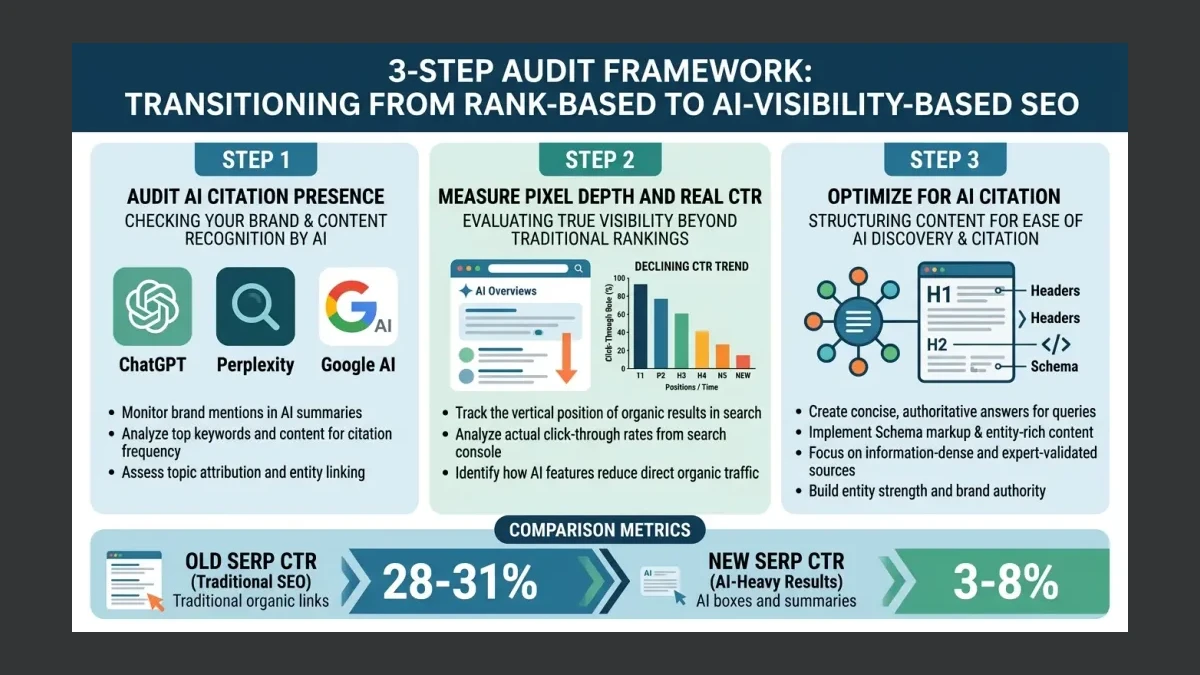
The shift from rank-based to visibility-based SEO measurement requires three concrete changes to how Pakistani businesses evaluate their search marketing investments.
Audit AI citation presence, not just rank position
Check whether the business appears in Google AI Overviews, Google AI Mode responses, ChatGPT answers, and Perplexity results. Use a combination of manual prompt checks, Google Search Console data, and specialist AI visibility tools to track brand visibility in AI-generated answers across ChatGPT, Claude, Perplexity, Gemini, and Google AI features.
If a Pakistani business holds position 1 but receives zero mentions in AI-generated answers, the ranking produces clicks only on the fraction of queries where AI features do not appear. That fraction shrinks monthly.
Measure pixel depth and real click-through rates, not rank number
Pull Google Search Console data for actual click-through rates on target keywords. A position 1 ranking with 2% CTR tells a fundamentally different story than position 1 with 25% CTR. The delta between them reveals whether AI features and ad stacks intercept clicks before users reach the organic listing.
Combine CTR data with GA4 conversion tracking to connect organic clicks to actual business outcomes: phone calls, form submissions, WhatsApp inquiries. Rank position without conversion data is a vanity metric.
Optimize content for AI citation, not just ranking signals
Google’s preferred sources program and AI Mode citation mechanics reward content that is structured, authoritative, and machine-readable. This requires structured data implementation, clear entity definitions, and content that directly answers the questions AI engines synthesize from multiple sources.
Google’s Gary Illyes strongly warned against buying or manipulating brand mentions for AI visibility at Search Central Live Shanghai 2026. The correct approach is genuine authority: earned citations, structured content, and technical accessibility that makes a site easy for AI systems to read, trust, and cite.
The businesses that adapt their measurement framework now gain a window of advantage while competitors continue celebrating position 1 reports that no longer produce revenue. Ask any SEO agency presenting rank reports a direct question: “How many of those position 1 rankings appear below an AI Overview, and what is the actual click-through rate?” The answer to that question reveals whether the investment produces business outcomes or just dashboard aesthetics.
WeProms Digital has transitioned client reporting from rank-only tracking to comprehensive AI visibility measurement — monitoring citation presence in Google AI Overviews, ChatGPT, and Perplexity alongside traditional organic metrics. If your current SEO agency reports rankings without addressing AI visibility, your budget funds a metric that no longer drives phone calls or form submissions.
Get in touch: hello@weproms.com · WhatsApp +92 300 0133399 · weproms.com/contact-us
Read next: Why Ranking Reports Don’t Pay Bills · SEO Rankings vs AI Citations for Pakistani Ecommerce Revenue
Frequently Asked Questions
How do I check if my business appears in Google AI Overviews?
Search for your target keywords in Google while logged out, in an incognito browser window. Look for the AI-generated answer block at the top of the results page. If your business name, content, or links appear in that block, you have AI citation presence. For ongoing monitoring across ChatGPT, Perplexity, and Google AI features, use dedicated AI visibility tracking tools or a documented manual testing routine that reports AI visibility separately from traditional rankings.
Is SEO still worth investing in for Pakistani businesses?
SEO remains the technical foundation for being found by both traditional search and AI engines. The content quality signals, technical infrastructure, and authority that Google evaluates are the same signals AI systems use when selecting sources to cite. The change is in measurement: track actual clicks and AI citations, not just rank position. A Pakistani business that abandons SEO loses visibility in both traditional and AI-generated search results.
What does “pixel depth” mean in SEO reporting?
Pixel depth measures how many vertical pixels from the top of the search results page a listing appears. A position 1 result in a clean SERP might appear at 150 pixels from the top. In a SERP with AI Overviews and sponsored ads, position 1 might appear at 1,100+ pixels — below the visible screen area on most devices. This metric provides a more accurate picture of what users actually see than rank position alone.
How much should a Pakistani SME reallocate toward AI visibility work?
A Pakistani SME does not necessarily need a bigger SEO budget. It may need to reallocate work toward structured data implementation, entity profile cleanup, content refresh, Search Console analysis, and citation tracking.
Should I stop SEO and switch entirely to Google Ads?
The optimal approach is a combined strategy. Google Ads guarantee visibility above AI Overviews and organic results, delivering reliable lead flow for commercial queries. SEO optimized for AI citation builds long-term authority that reduces dependence on paid channels over time. Most Pakistani SMEs benefit from running both in parallel — Google Ads management for immediate leads and AI-optimized SEO for sustainable visibility.
Sources & References
- Search Engine Journal — Google SERP Layout Shift: Position 1 Now Appears Halfway Down The Page — May 29, 2026
- Search Engine Roundtable — Google May 2026 Core Update Hits Hard Saturday — May 31, 2026
- Brian Solis — WP Engine DE{CODE} 2026: Shaping the Intelligent Web Together — May 15, 2026
- Google — Catch Up on 12 Major I/O 2026 Moments — May 28, 2026
- Search Engine Roundtable — Google AI Mode & AI Overviews Add Preferred Sources & New Carousel — May 28, 2026
- Search Engine Roundtable — Google Strongly Warns Against Manipulating Mentions For AI — May 28, 2026