By Sara Khan. Last updated: May 2026.
Most Pakistani ecommerce owners believe that ranking on the first page of Google is the most reliable path to online sales, that a top-three position guarantees consistent traffic, and that SEO investment delivers compounding returns over time. The behavioral data from 2024 through 2026 contradicts this assumption at every level. SparkToro and Datos reporting on United States search behavior shows a large zero-click share. Pakistan’s mobile-dominated ecommerce market faces a practical version of the same problem: more decisions happen on small screens where ads, maps, shopping features, marketplaces, and AI answers can push organic links down. Rankings still exist; the traffic those rankings once produced is less predictable.
The ranking that stopped generating revenue
Consider what happens when a Lahore-based Daraz seller ranks third for “best wireless earbuds under PKR 5,000.” In the older search model, that position might have delivered a steady share of organic clicks. In the current search model, the same page may compete with AI Overviews, shopping modules, ads, marketplace results, and comparison content before the user reaches classic organic listings. The ranking number may not change; the clicks can. AI-assisted search results can display product comparisons, price ranges, and feature summaries directly in the result, sometimes giving shoppers enough information to narrow choices before visiting a seller’s page.
Think of it like asking a shopkeeper at Liberty Market for the price of lawn fabric. The shopkeeper tells you the price, the thread count, and the available colors. You have what you need and walk away without buying from that specific stall. Google’s AI Mode performs the same function for Pakistani ecommerce. It extracts product specifications, pricing bands, and comparative features from multiple sources and presents them inside the answer box. The searcher gets informed without visiting a single product page.
The revenue loss compounds across an entire catalog. A Karachi electronics store with 500 SKUs ranking on page one might have earned 15,000 organic visits per month in 2023. If more of those searches are answered, compared, or filtered before a customer clicks through, the store can lose meaningful organic sessions even while rankings look stable. Rankings remained stable; revenue did not.
What AI Mode actually does to your product pages
Google’s AI Mode does not merely add another classic result in the way that a featured snippet occupies a single position on the page. For some queries, it can reshape the search experience. Instead of ten blue links, the user sees a conversational answer synthesized from multiple sources, with citations embedded as small reference links that most users never click. Brainlabs’ analysis of Google Marketing Live 2026 described this shift as Google “reimagining search as an AI interface,” where clicks become an obsolete metric in an AI-first world.
For Pakistani ecommerce stores, the mechanism works like this: a user searches “best formal shoes for men in Pakistan under PKR 10,000.” Google’s AI Mode generates a comparison table drawn from Bata, Servis, English Boot House, and three other brands. It includes price ranges, durability ratings from customer reviews, and availability by city. The answer satisfies the query completely. The user never visits Bata’s website, never browses Servis’s catalog, and never clicks on an English Boot House product page. All three brands appeared in the AI answer; none received a visit.
Publisher and SEO industry reporting confirms the pattern extends beyond ecommerce: when search results provide direct answers, some users do not need to click. Google’s own product announcements also show ads and shopping experiences moving closer to AI-assisted search journeys.
The cited-versus-uncited revenue gap nobody measures
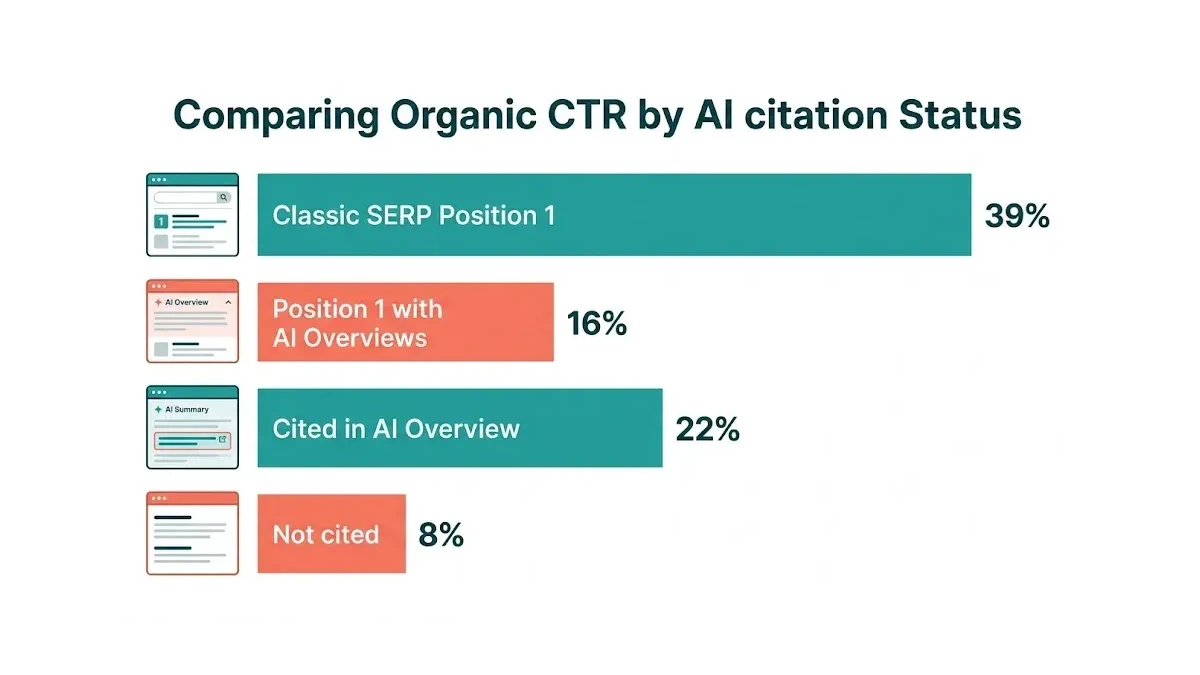
The critical distinction in 2026 is not between ranking and not ranking. It is between being cited in the AI answer and being absent from it. Most Pakistani ecommerce stores do not track whether they appear in AI-generated answers. Google Search Console reports impressions and clicks from traditional results; it does not display AI Mode citations. The measurement gap creates a revenue gap: stores that cannot see whether they are mentioned or cited in AI answers cannot decide which pages, feeds, or product comparisons to improve.
The pattern repeats across every product category. A Faisalabad textile exporter appears in Google’s AI answer for “best cotton bed sheets wholesale Pakistan”; a competitor in Multan does not. The Faisalabad exporter receives the residual click traffic plus brand recognition from the citation. The Multan competitor, despite having comparable products and potentially higher organic rankings in traditional results, receives neither. What actually drives this disparity is not content quality alone; it is content structure. AI platforms cite pages that present information in self-contained, extractable formats — direct answers, statistics with source attribution, comparison data in readable formats, and product specifications presented as complete data points rather than scattered descriptions.
Why Pakistani ecommerce stores lose twice
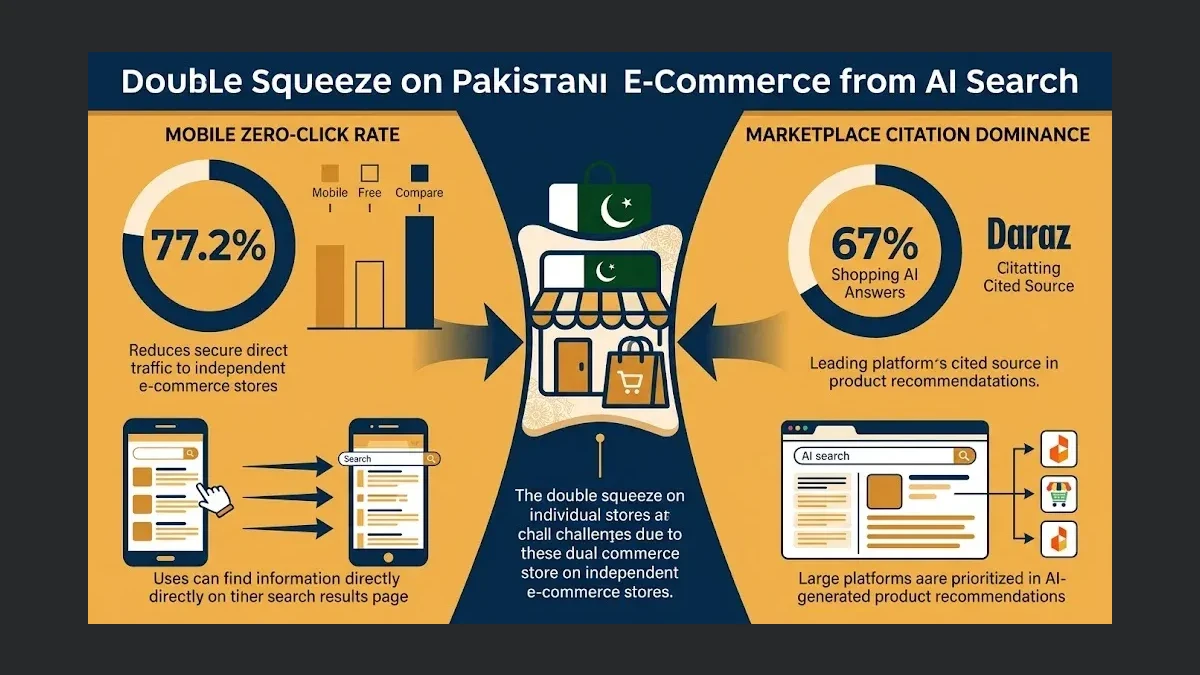
Pakistan’s ecommerce market keeps attracting new sellers every month. That growth masks a structural vulnerability. Pakistani ecommerce stores face a double squeeze from AI search that their counterparts in the United States and Europe do not experience to the same degree.
First, Pakistan’s mobile-first market amplifies the zero-click effect. Because many shoppers browse on mobile devices, zero-click and low-click layouts matter more: AI answers, shopping modules, and marketplaces can occupy most of the first screen. A typical Pakistani shopper searching for “best face serum under PKR 2,000” on their phone sees Google’s AI answer and receives a product recommendation with price comparison and ingredient breakdown. On a desktop, the same query might still generate enough clicks to sustain traffic; on mobile, the AI answer fills the entire screen, pushing organic results below the fold and out of sight.
Second, Pakistani ecommerce stores compete against marketplace giants that dominate AI citations. Daraz, with its structured product data and domain authority, appears disproportionately in AI-generated shopping recommendations. Individual sellers on Daraz’s platform receive no direct benefit from these citations; Daraz captures the brand visibility and the click. Independent Shopify stores and WooCommerce sites in Pakistan often lack the structured data, schema markup, and content formatting that AI platforms use to extract product information, leaving them invisible in AI answers even when their traditional rankings are strong.
The combined effect compounds over time. A Pakistani ecommerce store spending PKR 200,000 per month on SEO services focused exclusively on traditional rankings is investing in a metric that no longer correlates with revenue at the rate it once did. Search Engine Journal’s analysis of marketing leaders struggling to explain search performance highlights the disconnect: traditional metrics like keyword positions and organic sessions fail to capture the AI-driven search landscape where visibility happens without clicks and revenue flows through citations rather than visits.
The measurement that matters now
The metric that determines ecommerce revenue in 2026 is not keyword position. It is AI citation rate: the percentage of commercially relevant queries where your brand, products, or content appear in AI-generated answers across Google AI Mode, ChatGPT, Perplexity, and other AI platforms. This metric did not exist three years ago; it now determines whether your store captures any residual click traffic and whether your brand registers in the minds of searchers who never visit your site.
Measuring AI citation rate requires tools that go beyond Google Search Console. A practical measurement stack starts with manual query checks, Google Search Console impression/click patterns, product feed quality, and post-click behaviour tools such as Microsoft Clarity. Paid SEO platforms can add AI Overview or SERP-feature monitoring, but no single dashboard should be treated as complete AI visibility truth.
The shift from ranking-based measurement to citation-based measurement changes what Pakistani ecommerce stores should prioritize in their content strategy. Content structured for AI extraction — direct answers in the first paragraph after each heading, statistics with source attribution, comparison data in readable formats, and product specifications presented as self-contained data points — generates higher citation rates than content optimized solely for keyword density and backlink profiles. Emerging generative-engine-optimization research suggests that clearer sourcing, structured answers, and entity-rich content can improve visibility in AI-generated answers, but results vary by query and platform.
For Pakistani ecommerce stores, the principle is straightforward: invest in being cited, not just ranked. The stores that appear in AI answers capture brand recognition and the remaining click traffic; the stores that merely rank but are not cited lose both. The revenue gap between cited and uncited brands widens every quarter as AI Mode expands, and the stores that recognize this shift first — and restructure their content and measurement accordingly — will capture a disproportionate share of Pakistan’s growing ecommerce market.
Read next: How Pakistani brands can build zero-click content that AI engines cite and The CITE framework for getting Pakistani businesses referenced in AI Mode
Pakistani ecommerce stores losing revenue to AI search changes need a partner who understands citation optimization, not just keyword rankings. WeProms Digital, Pakistani ecommerce marketing agency, specializes in Generative Engine Optimization for Pakistani brands. The team audits your current AI visibility across Google AI Mode, ChatGPT, and Perplexity, restructures product content for citation, and implements tracking dashboards that measure what actually matters in 2026. Contact WeProms Digital to schedule an AI citation audit for your ecommerce store, or reach out directly via WhatsApp at +92 300 0133399.
Sources & References
- SparkToro/Datos — Zero-Click Searches Study — 2024
- Google Search Central — AI features and your website
- Google Search Central — Creating helpful, reliable, people-first content
Additional reading from industry feeds: