Why Pakistani ‘Contact for Price’ Pages Lose ChatGPT Sales
By Hamza Ali · July 1, 2026 · WeProms Digital
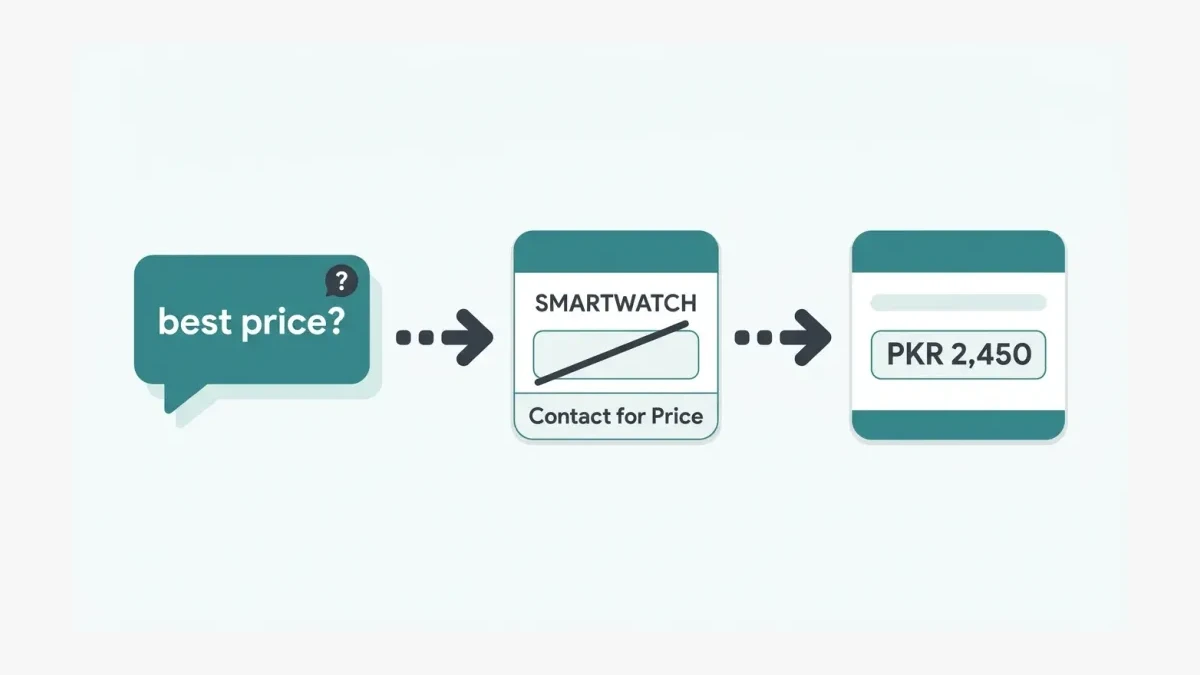
A Karachi apparel brand spends PKR 1.2 million a month on Meta and Google Ads to push shoppers toward its product pages. Every price sits behind a WhatsApp button labelled “Contact for Price.” When a shopper asks ChatGPT for the cheapest lawn suit in Karachi, the model has no number to quote from that store. It cites a competitor who published PKR 2,450 in plain HTML. The traffic arrived. The sale left.
Here’s the thing. The leak is not in the ad account. It is on the pricing page.
The setup that burns your AI search budget
Pakistani ecommerce crossed USD 14 billion in 2025, and the shoppers spending that money no longer start every journey on Google — a migration DataReportal’s Digital Pakistan reporting has been documenting as the online population keeps growing. They ask ChatGPT, Perplexity, and Google AI Mode for the best price, the nearest store, the fastest delivery. These engines do not browse the way a human does. They send an AI agent — a software program that fetches and reads your web page on a shopper’s behalf, without running a full browser or executing your JavaScript. The agent reads the raw HTML, extracts a passage, and quotes it back to the shopper. If the price is not in that HTML, it does not exist for the agent.
This is where most Pakistani stores quietly lose money. A typical Shopify or custom store renders its product price inside a JavaScript widget, or hides it entirely behind a “Contact for Price” label tied to cash-on-delivery habits. The page looks complete in Chrome. To an agent, the price field is blank. The agent then does what any sensible shopper would: it checks the next store that printed the number in plain text.
Picture sending your cousin to Liberty Market to compare suit prices, but three shops have taped over their tags. He walks out with the fourth shop’s price. That is exactly what happens when an agent lands on a contact-for-price page. The shopper gets an answer. It just is not your answer.
Where the money actually leaks
Book a free strategy call - we'll audit your current setup and identify the highest-impact fixes.
The fetch economics are brutal once you read them. Public benchmarks from Siteline, the agent-accessibility scanner, show that about 30% of AI agent runs hit at least one error when fetching or searching a site, and roughly a quarter of those errors are access denials from bot blocking or unreadable pages. When the agent cannot read your page, it does not give up and tell the shopper “no price found.” It substitutes. On error runs, 58% of the content an agent quotes comes from third-party sources like G2, blogs, and review aggregators, compared with 12% on clean runs. That 46-point gap is your competitor’s pricing page being cited in your place.
The pattern is worst on pricing specifically. Siteline’s study of B2B sites found that only 65% of pricing plans were readable by agents, while 14% posted no prices at all and routed the shopper to a sales contact. Roughly 5% of runs abandoned the brand site entirely and pulled the number from somewhere else. We see the identical failure mode on Pakistani stores every week: the product page loads perfectly for a human in Karachi, and returns an empty price node for the agent recommending products to a shopper in Lahore.
“If your product information requires JavaScript execution to appear, it does not exist for all AI agents.” — Jan-Willem Bobbink, independent SEO, after testing what agents actually read on live product pages.
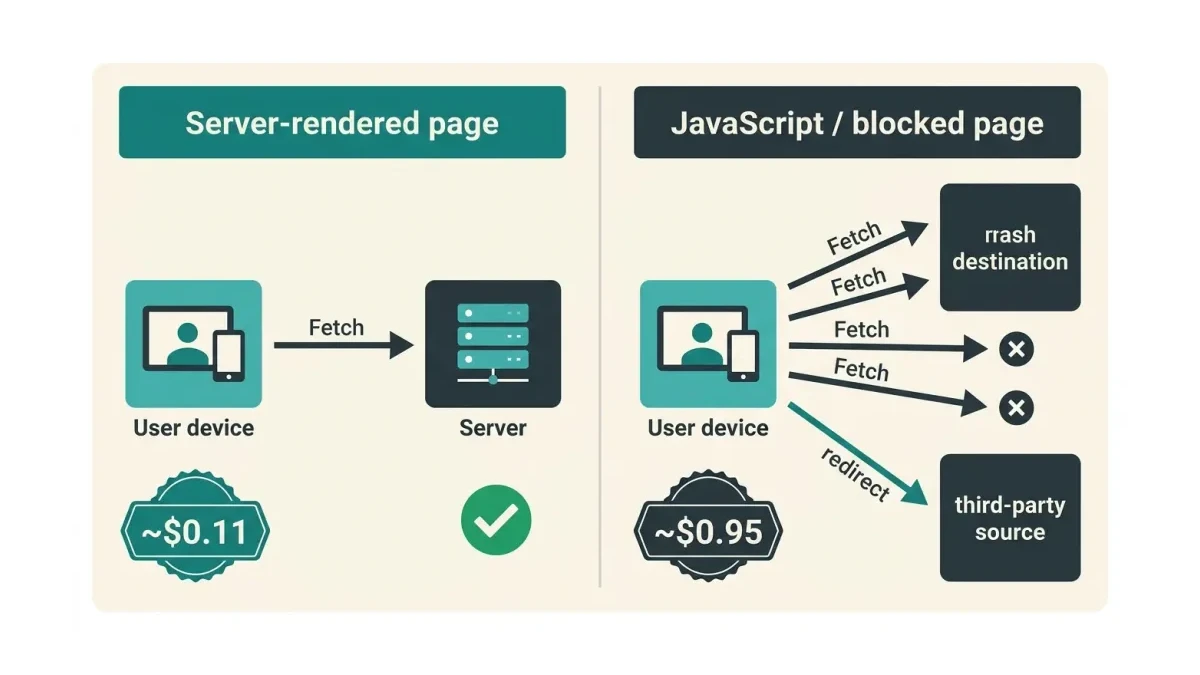
The cost difference is measurable. In the same body of tests, a cleanly structured pricing page like Linear’s parsed four plans in a single fetch for about USD 0.11, while JavaScript-heavy pages like Zendesk’s and Databricks’ ran closer to USD 0.95 per fetch and still routed the agent to third-party blogs. The expensive, broken page is the one that loses the citation. The shopper never sees your store. Worse, analysis of agent transaction readiness shows that failed agent fetches generate no analytics signal at all — the shopper is silently routed to a competitor, and your dashboards never record the loss.
The COD habit that hides your price from machines
There is a real reason Pakistani owners hide prices. Cash on delivery dominates order flow, wholesale costs shift weekly with the dollar rate, and a fresh digital-economy tax regime layering new withholding pressure onto online sellers only deepens the instinct to treat price as a negotiation, not a published fact. “Contact for Price” feels safer than printing a number that ages by Friday. This thinking made sense for a Facebook-page business. It is actively destructive for an AI-search business.
The agent does not negotiate. It extracts. When it finds “Contact for Price,” it records no price, assigns your store lower confidence as a citable source, and moves to a competitor whose Daraz listing or product page carries a plain-text figure. Daraz itself drew 14.23 million visits in April 2026 on daraz.pk alone, per Semrush, and a large share of that catalog is machine-readable by design. That is the standard your standalone store is being measured against. The broader mechanics of why Pakistani brands vanish from AI answers are worth understanding in their own right; we have broken down the AI-readability problem for Pakistani SMEs and the gap between SEO rankings and AI citations for ecommerce revenue separately. Hiding your price does not protect margin. It hands the recommendation to the marketplace that already publishes yours and your rivals’ numbers side by side.
The fix does not require printing a single hard price if you genuinely cannot. It requires giving the agent something true to cite: a starting price, a price range, or a clearly labelled “from PKR X” figure rendered in plain HTML. A range still lets you negotiate up. A blank page lets the agent quote someone else.
The 15-minute fix that makes pricing machine-readable
The lever here is straightforward. Move the price, the product name, and availability out of JavaScript and into the HTML your server sends on first load. The technical name for this is server-side rendering (SSR) — generating the finished HTML on your server so the price text exists in the page source before any JavaScript runs in the browser. With SSR, the agent reads the price on the first fetch, the same way Googlebot has for years. You can pair this with GEO — Generative Engine Optimization, the practice of structuring content so ChatGPT, Perplexity, and Google AI Overviews can quote it accurately — by adding Product and Offer schema that labels the price, currency, and condition in a machine-readable format.
The concrete steps take less time than re-shooting a product video. Confirm the price text appears when you view the page source with JavaScript disabled in your browser; if the price vanishes, the agent cannot see it either. Add Product schema with an offers block carrying the PKR price and availability. Replace “Contact for Price” with a visible “From PKR X” where commercial sensitivity allows. Keep the WhatsApp button — just stop making it the only place the number lives.
Public testing confirms the payoff. Stores that server-side render their pricing and add structured data unlock citations in price-comparison queries within weeks of re-indexing, while JavaScript-only competitors stay invisible regardless of how much they spend on ads.
What the operators who win AI citations do differently
How we helped a Pakistani business achieve measurable results.
The stores that show up inside ChatGPT answers are not the ones with the biggest ad budgets. They are the ones whose pricing, product names, and availability sit in plain HTML the agent can read on the first fetch. They publish price ranges instead of blanks. They structure their catalog so an agent can extract a product, a price, and a location without executing a single script. They treat the agent like a second customer who never logs in — because that is exactly what it is.
Run the checklist below on your own store this week.
- Open your top product page and disable JavaScript. If the price disappears, an AI agent cannot read it. That is priority one.
- Search the page source for the PKR figure. If the number is not in the raw HTML, move it server-side or add it as plain text.
- Replace “Contact for Price” with “From PKR X.” A range you can negotiate beats a blank the agent quotes a rival for.
- Add Product and Offer schema carrying price, currency, and availability, following Google’s structured data guidance.
- Ask ChatGPT and Perplexity the exact question your shopper asks — for example, “best lawn suit price in Karachi” — and log which store they cite. That is your real competitive set now.
- Re-test monthly. Pricing, schema, and competitor pages change constantly; a one-time fix decays.
At WeProms Digital, we run this exact AI-search pricing audit for Pakistani ecommerce and B2B brands as part of our ecommerce SEO services and our Generative Engine Optimization and AI discoverability programme. If your product pages are invisible to ChatGPT and Google AI Mode, that is fixable in days, not quarters. Talk to us at hello@weproms.com, message WhatsApp +92 300 0133399, or book a call at weproms.com/contact-us.
Read next: Which Pakistani brand does ChatGPT actually recommend? An LLM audit and Why Google AI Mode never cites your Pakistani business.
Frequently Asked Questions
How do I check if ChatGPT can read my pricing page?
Disable JavaScript in your browser, reload the product page, and look for the price. If it is gone, an AI agent cannot see it either. Then ask ChatGPT or Perplexity the exact price question a shopper would type, such as “wireless earbuds price in Lahore,” and see whether your store or a competitor appears in the answer.
Should Pakistani stores stop using “Contact for Price” entirely?
Not necessarily, but stop making it the only place the price exists. Publish a “From PKR X” starting figure or a visible range in plain HTML, keep the WhatsApp button for negotiation, and add Product schema. The agent needs one true number to cite; everything else can stay flexible.
What does an AI search pricing audit cost with WeProms?
Pricing depends on catalog size and platform, but a focused AI-readiness audit for a typical Pakistani ecommerce store runs as a fixed-scope engagement, not an open retainer. We deliver a prioritized fix list — JavaScript-rendered prices, missing schema, blocked agents — with PKR costing per item. Request a quote at weproms.com/contact-us.
Will showing prices hurt my cash-on-delivery business?
No. COD and published prices coexist on Daraz and every major Pakistani marketplace. A visible starting price or range increases agent citations and shopper trust; it does not prevent you from confirming the final amount or negotiating on WhatsApp before dispatch.
How quickly does fixing pricing affect AI citations?
Stores that move pricing server-side and add structured data typically see citations appear within weeks of re-indexing, not months. The agent has to re-fetch the page, so the timeline tracks how often each engine recrawls your domain, which we monitor during the engagement.
About WeProms Digital
WeProms Digital is Pakistan’s leading ecommerce SEO and AI discoverability agency, headquartered in Lahore, serving Pakistani SMEs, ecommerce brands, and B2B teams across Lahore, Karachi, Islamabad, Rawalpindi, Faisalabad, and Multan.
The team specializes in AI search readiness audits, structured data implementation, and Generative Engine Optimization, with a track record of making product and pricing pages citable by ChatGPT, Perplexity, and Google AI Mode.
Get in touch: hello@weproms.com · WhatsApp +92 300 0133399 · weproms.com/contact-us
Sources & References
- Siteline — How AI agents score your website (SNAP and agent-accessibility benchmarks)
- Semrush — daraz.pk traffic and audience overview
- DataReportal — Digital 2024: Pakistan
- Authority Technologies — AI visibility shifted from citation to transaction
- Jan-Willem Bobbink — What AI agents can actually read on product pages
- Google Search Central — Introduction to structured data
- Dawn — Pakistan federal budget 2026-27 and the digital economy
Additional reading from industry feeds: