Why Does Google AI Mode Never Cite Your Pakistani Business?
By Hamza Ali | June 2026
A Lahore dental clinic spending heavily on SEO content can still see the uncomfortable pattern: page-one rankings and stable impressions, but fewer clicks and fewer WhatsApp enquiries. The gap between those two numbers is Google AI Mode — answering patient questions directly, citing WebMD and Mayo Clinic, never once naming the clinic. Zero brand visibility. Zero WhatsApp enquiries from those searches. The pattern repeats across Karachi, Islamabad, and Faisalabad every single week.
Here’s the thing. Rankings still exist. Traffic does not. Google AI Mode sits above every organic result, reads the internet, synthesizes an answer, and presents it without requiring a single click. Your Pakistani business can rank position one and still lose.
The citation gap that kills Pakistani brands
A 2026 Semrush analysis of 21.9 million searches found that 62% of AI citations do not lead to brand mentions. Google AI Mode extracts information from your content, presents the synthesized answer, and skips your business name entirely. The user gets the information. Your brand gets nothing — no click, no mention, no attribution.
Think of it like ordering from Foodpanda. The restaurant prepares the meal, but Foodpanda gets the credit, the customer relationship, and the repeat order. Google AI Mode is the Foodpanda of search results. Your content feeds the answer engine. Google serves the answer under its own interface.
The risk is the same across most zero-click studies: the user reads the AI-generated answer and may never visit a website. Your organic ranking technically still exists, buried beneath a block of AI text that satisfies the query completely. For Pakistani service businesses — clinics in Gulberg, law firms in Blue Area, tax consultants on I.I. Chundrigar Road — the AI answer replaces the need to click through at all.
Across our audits at WeProms Digital, the pattern holds: stable impressions, declining clicks, fewer leads from organic search. The ranking report looks healthy. The revenue pipeline does not.
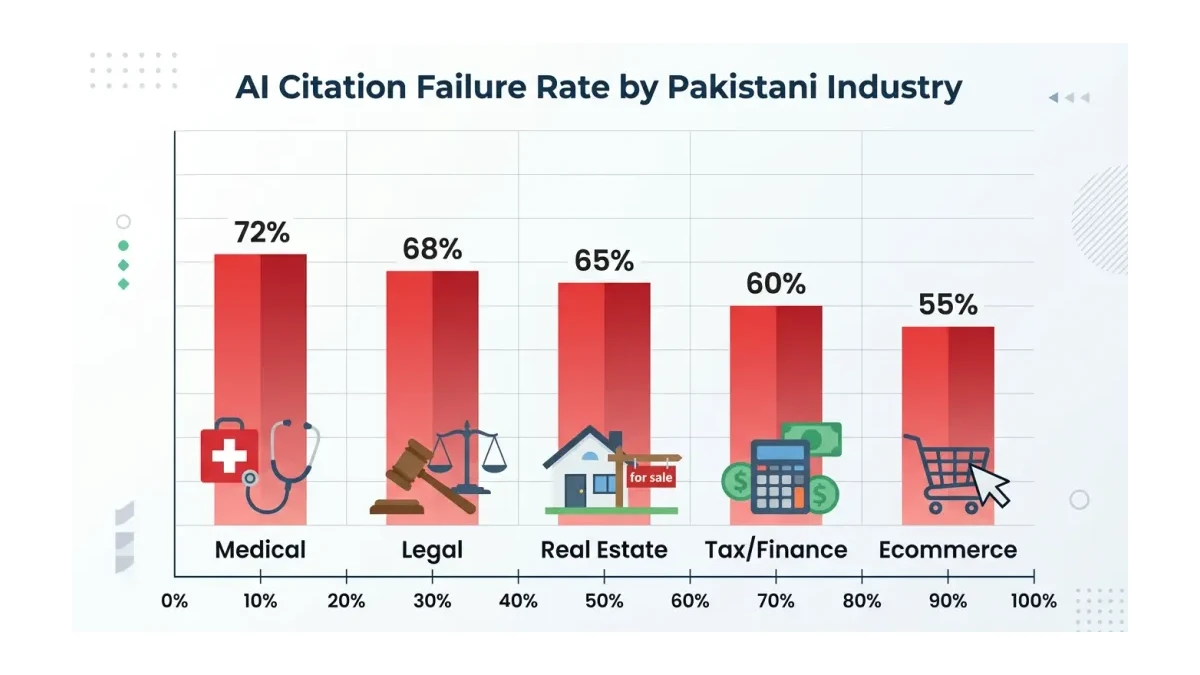
Where the money actually goes
Book a free strategy call - we'll audit your current setup and identify the highest-impact fixes.
Most Pakistani SMEs spend between PKR 80,000 and PKR 200,000 monthly on SEO retainers. These retainers produce blog posts, optimize meta titles, build internal links, and generate monthly reports showing keyword positions. The output appears fine in those reports. Impressions stable. Positions maintained.
Recent zero-click and AI Overview studies document what those reports miss: rankings can remain visible while clicks fall. When AI summaries answer the question directly, users have less reason to visit an organic result.
“When an AI Overview appears, only about 8% of users click to traditional organic links versus roughly 15% without an AI summary.” — Improvado, 2026 AI Marketing Trends Report
Read that again. Without AI: 15 out of 100 people click an organic result. With AI: 8 out of 100. That means for every 1,000 impressions your Pakistani business earns on AI-triggered queries, roughly 80 people visit your site instead of 150. Half your potential traffic disappears into Google’s answer engine, and your monthly SEO report shows that rankings are “holding steady.”
The financial math compounds fast. A Karachi law firm spending PKR 150,000 monthly on SEO generates 2,400 organic clicks from 16,000 impressions. If AI Mode absorbs 50% of those clicks, the firm loses 1,200 potential visitors monthly. Even at a modest conversion rate and consultation value, that can become a serious monthly revenue gap. The SEO retainer costs PKR 150,000. The missed revenue costs 3.6 times more.
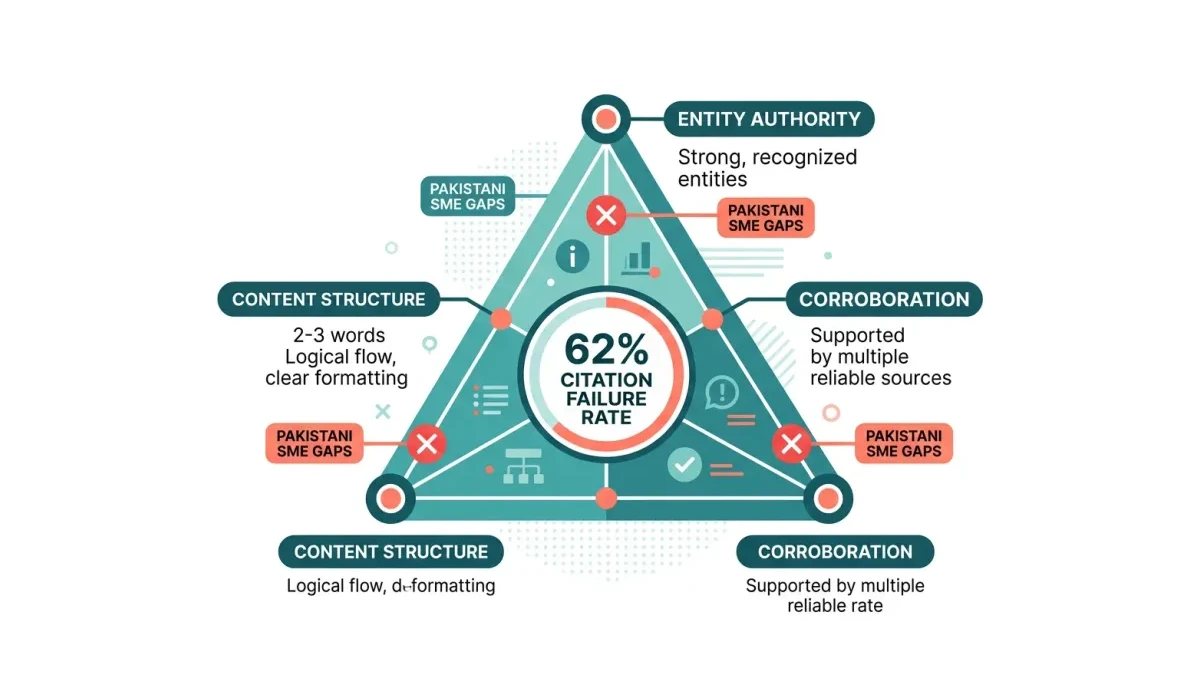
Why Google AI picks global sources over Pakistani ones
Google’s AI citation engine relies on three signals: entity authority, content structure, and corroboration across independent sources. Pakistani businesses lose on all three.
Entity authority — the AI’s confidence that your business is a recognized, verifiable entity — favors organizations with Wikipedia pages, Google Knowledge Panels, and consistent mentions across major publications. Most Pakistani SMEs have none of these. A Lahore boutique with 200 blog posts but no structured entity data is invisible to Google’s AI extraction layer. The AI simply does not recognize the business as a distinct entity worth naming.
Content structure matters more than content volume. Google’s AI extracts passages, not pages. Paragraphs that are self-contained, data-rich, and formatted with clear definitions get cited. Paragraphs that require surrounding context get skipped. Most Pakistani business blogs write in flowing, context-dependent prose that AI engines cannot cleanly extract as a standalone unit.
Corroboration means the AI checks whether multiple independent sources support a claim. A single blog post asserting “best dental implants in Lahore” carries zero corroboration weight. A structured page citing SECP registration data, Pakistan Medical and Dental Council references, or SBP healthcare spending statistics gets picked up because the AI can verify those claims against other authoritative sources.
The result: Pakistani businesses provide the raw material for AI answers but receive zero attribution. Google’s AI reads 50 Pakistani dental clinic websites, synthesizes a generic answer about dental implant costs, and cites WebMD because WebMD has entity authority, structured content, and global corroboration. Every Pakistani clinic contributed data. Not a single one gets named.
The three signals your Pakistani business needs to fix
Three structural gaps keep Pakistani businesses out of AI citations. Fixing all three is the difference between being invisible and being cited.
Gap 1: No structured entity data. Your Google Business Profile is incomplete or inconsistent. Your schema markup — the code that tells AI engines who you are — is missing, outdated, or broken. You have no Organization, LocalBusiness, or Person schema marking up your pages. Without structured entity data, Google’s AI treats your website as an anonymous content source, not a named business worth citing.
Gap 2: Non-extractable content. Your blog posts are written for scrolling, not for extraction. No FAQ sections. No inline definitions. No statistics with named sources. AI engines skip them because they cannot cleanly lift a single paragraph and present it as a standalone answer. A 1,200-word blog post about “property registration in Lahore” that never defines “property registration” in a single self-contained sentence is invisible to citation engines.
Gap 3: Zero corroboration signals. Your claims exist only on your own website. No third-party validation. No citations to authoritative Pakistani sources (SBP, PTA, SECP, PMDC). No mentions in industry publications or local news outlets. AI engines prioritize claims they can verify against multiple sources.
A Lahore boutique spending PKR 150,000 monthly on content marketing gets zero AI citations because every blog post reads like a brochure. No data. No sources. No structure. AI engines cannot extract a verifiable, quotable passage from marketing copy.
The fix is not more content
How we helped a Pakistani business achieve measurable results.
Pakistani businesses respond to declining traffic by publishing more blog posts. More content. More keywords. The logic feels reasonable — if traffic is dropping, publish more to capture more. But if your existing content is not extractable by AI engines, adding more non-extractable content compounds the problem without solving it.
Consider a Karachi real estate agency that publishes 12 blog posts per month through a PKR 120,000 monthly retainer. Each post is 800 words of generic property advice — “tips for first-time homebuyers,” “why location matters,” “how to negotiate rent.” No statistics. No named sources. No structured markup. No inline definitions. Google’s AI reads all 12 posts, extracts the generic advice, presents it in an AI answer, and never once cites the agency.
The agency spent PKR 120,000 on content that feeds Google’s AI machine while generating zero brand attribution. Publishing 24 posts instead of 12 does not change the outcome. The AI still extracts generic advice and still skips the source.
The fix requires restructuring, not volume. Each page needs one self-contained definition paragraph that an AI engine can extract as a standalone unit. Each page needs at least one specific statistic attributed to a named source. Each page needs structured data markup — FAQPage, Article, or HowTo schema — that explicitly labels the content for machine extraction. Each page needs entity references connecting the business to recognizable Pakistani platforms and institutions.
One restructured page with these four elements outperforms twelve generic blog posts for AI citation. Quality of extraction beats quantity of publication.
The 15-minute citation gap check
Before spending another PKR on SEO content, run this diagnostic on your own business. Open Google. Search your five most important commercial keywords — the ones that drive actual leads and sales. Check whether AI Overviews or AI Mode answers appear above your listing. If they do, read the AI answer carefully. Is your business named anywhere in the response? If not, search for your top three competitors. Are they named? Then check the sources the AI cites. Are those sources global publications like WebMD and Investopedia, or are they local Pakistani businesses?
If AI answers appear on three or more of your top five keywords and your business is never cited, you have a citation gap that no amount of traditional SEO content will fix. The AI search citation gap across five major platforms affects Pakistani businesses on ChatGPT, Perplexity, and Google AI Mode simultaneously — not just Google.
At WeProms Digital, a GEO and AI discoverability agency, we run this diagnostic as the first step of every AI Visibility Audit. The audit maps which AI platforms mention your brand, which ones skip you entirely, and what structural changes will get you cited.
Checklist: Close your AI citation gap this month
- Search your top 20 keywords in Google and record which ones trigger AI Overviews or AI Mode answers
- For each AI-triggered query, document whether your business name appears in the AI response
- Add Organization or LocalBusiness schema markup to every page on your website
- Restructure your 10 highest-traffic pages with self-contained, extractable definition paragraphs
- Insert at least one specific statistic with a named source (SBP, PTA, SECP, PMDC) on each key page
- Add FAQPage schema to your top informational pages
- Claim and fully complete your Google Business Profile with accurate categories, services, and area served
- Set up monthly tracking for AI citation frequency using SEMrush or Ahrefs
- Review your current SEO retainer — confirm it includes AEO deliverables, schema updates, and citation tracking
- If your SEO agency never mentions AI citations, schema, or AEO in monthly reports, find one that does
Read next: How to Track AI Search Mentions for Your Pakistani SME and SEO Rankings vs AI Citations: Pakistani Ecommerce Revenue Impact
If your Pakistani business is invisible to Google AI Mode, ChatGPT, and Perplexity, you are losing leads every day to competitors who appear in AI-generated answers. WeProms Digital provides AI Visibility Audits for Pakistani businesses starting from PKR 50,000, covering citation gap analysis, schema implementation, and content restructuring for AI extractability. Contact hello@weproms.com or message us directly on WhatsApp at +92 300 0133399 to get started.
Frequently Asked Questions
Why does Google AI Mode never cite my Pakistani business?
Google AI Mode selects cited sources based on three signals: entity authority, content structure, and corroboration across independent sources. Most Pakistani SMEs lack structured entity data in schema markup, write content that AI engines cannot cleanly extract as standalone passages, and have no third-party validation from recognized institutions. Fixing these three gaps typically improves citation frequency within 6-12 weeks.
How much does an AI Visibility Audit cost for a Pakistani SME?
An AI Visibility Audit for a Pakistani small or medium business typically costs between PKR 50,000 and PKR 100,000 depending on website size, number of service pages, and number of locations. The audit maps your brand’s presence across Google AI Mode, ChatGPT, Perplexity, and other AI platforms, identifies specific citation gaps, and delivers a prioritized fix list. WeProms Digital offers standalone audits and ongoing GEO retainers.
Can standard SEO fix my AI citation gap?
Standard SEO optimizes for rankings in a list of blue links. AI citation requires fundamentally different signals: structured data markup (Organization, LocalBusiness, FAQPage schema), self-contained extractable content paragraphs, and entity authority through third-party corroboration. A standard SEO retainer that does not include AEO deliverables will not improve your AI citation visibility.
How do I check if Google AI Mode is affecting my Pakistani business?
Open Google Search Console and compare clicks versus impressions for your top 20 pages over the past three months. If impressions remain stable or increase while clicks decline by 10% or more, AI answers are likely absorbing your traffic. Then manually search those keywords in Google and verify whether AI Overviews appear above your listing. This diagnostic takes 15 minutes and reveals exactly which keywords AI Mode has claimed.
How long before my Pakistani business gets cited in AI answers?
Pakistani businesses that implement structured schema markup, restructure content for AI extraction, and build entity authority signals typically see first AI citations within 6-12 weeks. Highly competitive niches like medical, legal, and financial services may take longer due to higher authority requirements for the AI to cite local sources over global ones.
About WeProms Digital
WeProms Digital is a generative engine optimization and AI discoverability agency, headquartered in Lahore, serving Pakistani SMEs, ecommerce brands, and professional service firms across Lahore, Karachi, Islamabad, Rawalpindi, Faisalabad, and Multan.
The team specializes in AI Visibility Audits, schema markup implementation, content restructuring for AI citation, and cross-platform GEO strategy, with a track record of getting Pakistani businesses cited in Google AI Mode, ChatGPT, and Perplexity within 90 days.
Get in touch: hello@weproms.com · WhatsApp +92 300 0133399 · weproms.com/contact-us
Sources & References
- Semrush — Zero-Click Searches Study 2024-2025 — 2025
- Yotpo — Google AI Mode vs Traditional Search Comparison — 2026
- Improvado — AI Marketing Trends 2026 — 2026
- AEO Vision — Google AI Overviews & GEO Statistics 2026 — 2026
- OptimizeGEO — How to Rank in AI Search — 2026
- Search Engine Journal — AI Mentions May Not Translate To Trust — 2026
- BizIQ — SEO Statistics for AI Search 2026 — 2026
Additional reading from industry feeds: