Free AI Citations Are a Trap Pakistan Brands Will Pay For Later
A contrarian read of the 2026 AI citation gold rush, written for Pakistani brand and marketing leaders. By Sara Khan, 11 July 2026.
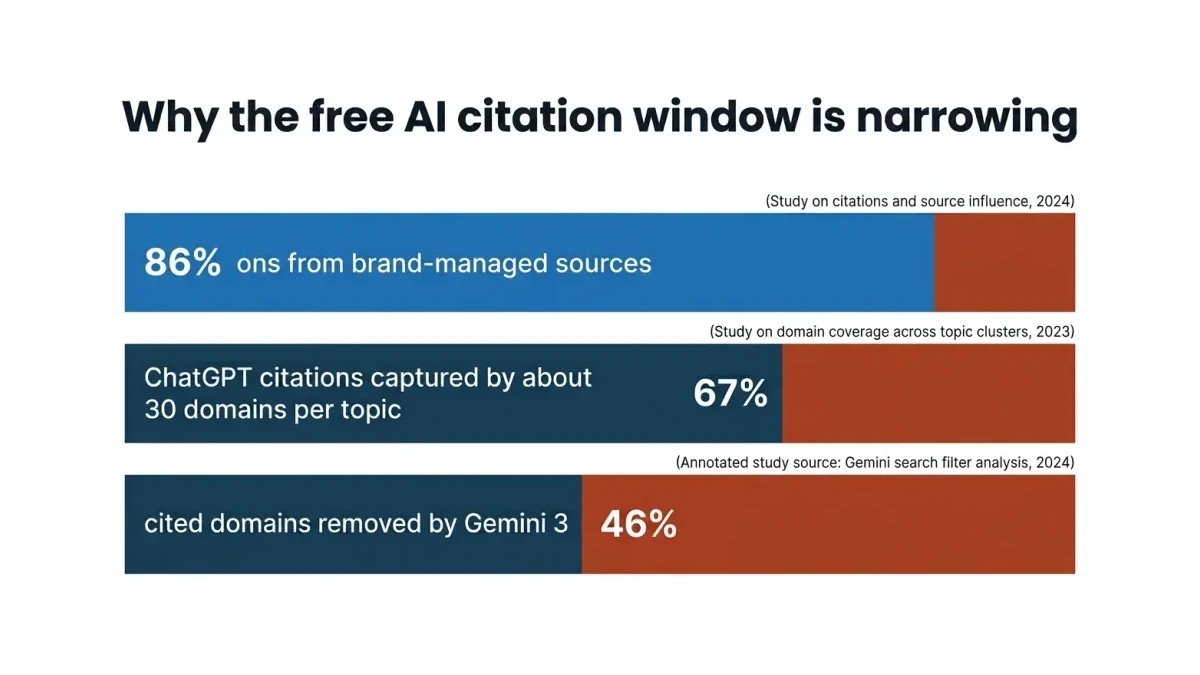
The received wisdom across Pakistani marketing circles in 2026 is that AI citations are a free, permanent channel any brand can win with the right content tactics, a conviction so widely held that it now drives content budgets, agency pitches, and entire generative engine optimization service lines from Karachi to Islamabad. The data says otherwise. Roughly 86 percent of AI citations across ChatGPT, Gemini, and Perplexity already originate from brand-managed sources — the brand’s own website, listings, and structured data — according to Yext’s August 2025 analysis of 6.8 million citations, which means the supposedly free channel was never a level playing field; it was always an owned-asset game dressed up as a discovery game. The brands being cited are not the brands that hacked the AI; they are the brands that already owned clean, structured, self-authored assets the AI could trust.
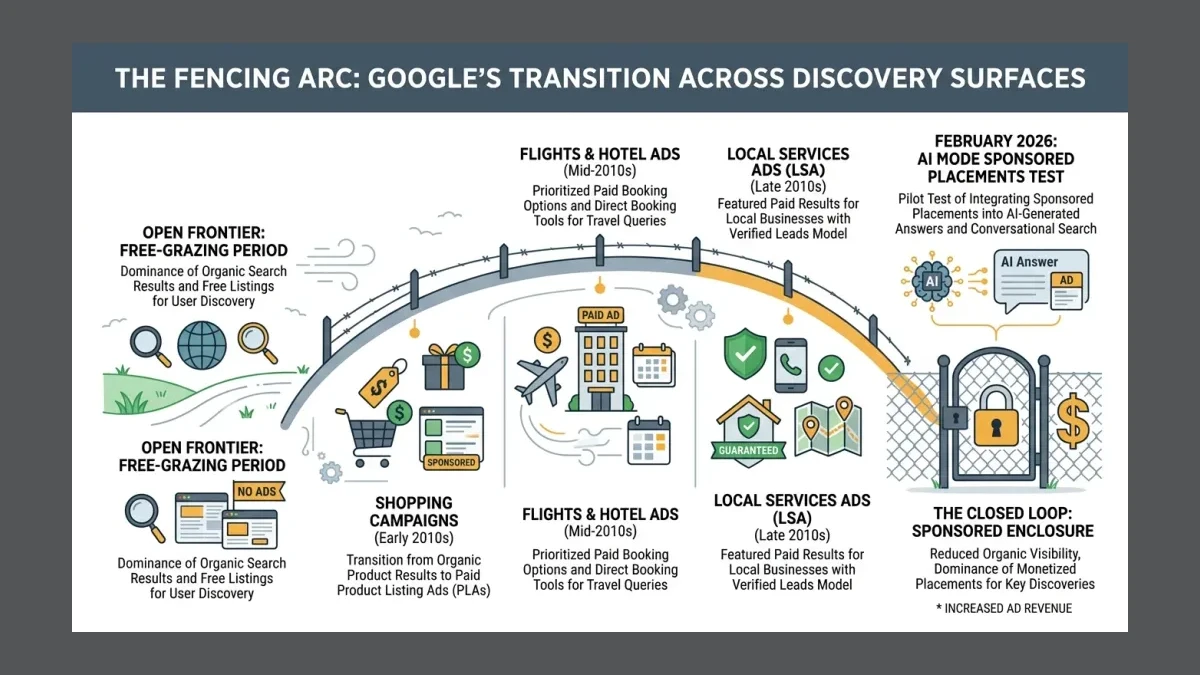
Google has fenced every wide-open field it has ever opened
Search Engine Journal’s recurring warning that free AI citations will not last is not speculation; it is pattern recognition grounded in Google’s own history. Google opened Local search to free business listings, then monetized the top of the map pack with Local Services Ads. It opened product listings, then fenced the Shopping tab behind paid Shopping campaigns. It opened Flights, Hotel ads, and job listings, then enclosed each one. Every wide-open discovery surface Google has ever launched has followed the same arc: a free-grazing period to train user behavior, followed by a paid enclosure once the habit is locked in.
The fencing of AI search has already begun. Google started testing sponsored placements inside AI Mode in February 2026, and OpenAI’s CFO publicly confirmed that ads are coming to ChatGPT. These are not future possibilities; they are live monetization experiments on the exact surface Pakistani brands are treating as a free forever-channel. The pattern repeats. The free window exists to build the habit of asking the AI, so that when sponsored placements harden into the default, the user keeps asking the same AI and the brand pays to stay inside the answer. It is, almost precisely, the Careem promo-code era of AI search: the free rides today exist to lock in the rider, so that when the promos expire the rider keeps opening the same app and paying full fare.
The free citations playbook relies on tactics Google itself debunked
Book a free strategy call - we'll audit your current setup and identify the highest-impact fixes.
The cottage industry of “AI search optimization” tactics sold to Pakistani brands in 2025 and 2026 rests on a set of moves — llms.txt files, content chunking, AI-specific rewrites, special schema markup, artificial mention-seeking — that Google’s own official AI search optimization guide, released in May 2026 and covered by Search Engine Journal, explicitly calls unnecessary. Google’s stated position is that optimizing for generative AI search is optimizing for the search experience, and thus still SEO, built on good content, clear structure, real expertise, and a brand the wider web already trusts.
“Optimizing for generative AI search is optimizing for the search experience, and thus still SEO.” — Google’s official AI search optimisation guide, May 2026, as covered by Search Engine Journal.
What actually drives citation is not a new file or a new acronym; it is non-commodity content, structured data, and external validation, the same fundamentals Google has rewarded for a decade. Brands that paid agencies to bolt on llms.txt files and rewrite pages into artificial “citation-ready” chunks spent money on moves the platform itself has now publicly dismissed. For a Pakistani marketing manager evaluating agencies, this is the single fastest red flag: any proposal whose centerpiece is a tactic Google has debunked is a proposal built on rented, soon-to-be-worthless ground. Our field notes on agency red flags in AI search for Pakistani businesses expand on the warning signs, and the broader question of whether to block, allow, or monetize AI crawlers is covered in our guide to AI crawler access for Pakistani websites.
The cited-domain field is already contracting
Even setting aside the paid-enclosure thesis, the free citation field is shrinking on its own. Gemini 3 removed roughly 46 percent of previously cited domains, leaving about one in ten AI Overviews with no cited sources at all, according to search marketing analysis from anicca. Concentration is the dominant signal: Kevin Indig’s study of 1.2 million ChatGPT responses found that roughly 30 domains capture about 67 percent of all citations within a given topic. The AI retrieves far more pages than it cites, effectively discarding the large majority of what it reads.
The implication for a Pakistani brand is uncomfortable. The cited field is not expanding to reward more participants; it is contracting toward a small set of authoritative domains per topic. A brand that is not already in that top tier is fighting for a shrinking share of a closing window, using tactics the platform has disavowed, on a surface the platform is preparing to monetize. The practical timeline pressure compounds: Search Engine Journal and Search Engine Roundtable both report that canonicalization fixes — the foundational corrections that determine which version of a page Google treats as authoritative — can take up to two weeks to resolve. Foundational technical hygiene is slow, paid enclosure is fast, and the gap between the two is where unprotected brands fall through.
What actually survives is owned, not optimized
The most defensible reading of the citation data is that ownership, not optimization, predicts survival. Because 86 percent of citations already come from brand-managed sources, the brands that maintain their position through platform shifts are the ones whose authoritative content lives on properties they control: their own domain, their own Merchant Center listings, their own structured data, their own knowledge panel and entity record. Optimization tactics travel; owned assets compound. The 67-percent-concentration finding reinforces this, because the domains that dominate citation are overwhelmingly those with deep, self-authored, structurally clean content libraries, not those with the cleverest prompt-level interventions, and a brand that has spent years publishing authoritative product and category pages holds a citation position a newer competitor cannot simply optimize its way into.
Marketing Dive’s argument that unpaid media is now essential to AI visibility lands in exactly this spot. Unpaid media — the earned, owned, and structured content a brand publishes about itself — is essential precisely because it is the substrate the AI cites, and it is the one asset class a platform enclosure cannot revoke. A sponsored placement inside AI Mode can be outbid; a deep library of authoritative brand-managed pages cannot. Retail Dive reports that a meaningful share of chief executives now fear they are underinvesting in AI, and the most expensive form of that underinvestment for a Pakistani brand is spending on disposable tactics while neglecting the owned assets that actually determine citation.
The defensible bet is to own the asset and buy the placement
How we helped a Pakistani business achieve measurable results.
The strategy that survives both the paid enclosure and the concentration contraction is a two-handed one. First, build the owned layer: a clean domain, accurate entity and structured data, authoritative product and category pages, and a knowledge presence the wider web corroborates. Second, accept that placement inside AI answers will increasingly require payment, and reserve paid budget for the sponsored surfaces — AI Mode placements, Shopping, Performance Max — that will harden into the default over the next several quarters. The brand that owns its assets and buys its placement is indifferent to enclosure; the brand that optimized for free citations on a rented tactic is exposed the day the fence goes up.
WeProms Digital, Pakistan’s leading SEO agency, approaches AI visibility as an owned-asset problem first and a placement problem second, because the data is unambiguous that brand-managed sources dominate citation regardless of tactic. The audit work that matters is the work that builds assets a platform cannot revoke. For brands that suspect their current AI-search spend is chasing debunked tactics, the GEO and AI discoverability service and the SEO audit and strategy engagements both start from owned-asset diagnostics rather than tactic checklists.
What this means for a Pakistani brand’s 2026 budget
The honest budget implication is that money allocated to disposable AI-search tactics in 2026 is money allocated against a closing window, while money allocated to owned assets compounds across every platform shift that follows. A Lahore apparel brand that spends PKR 400,000 a quarter on llms.txt, content chunking, and citation-chasing rewrites is buying short-term visibility on ground the platform is preparing to fence; the same PKR spent on entity cleanup, structured data, authoritative product content, and a paid-placement reserve builds a position that survives enclosure. The decision criterion is straightforward: if a proposed activity produces an asset the brand owns and the platform cannot revoke, fund it; if it produces a tactic on a surface the platform controls and is monetizing, treat it as a short-term expense with an expiration date. The brands that internalize this distinction in 2026 will still be cited in 2027; the brands that do not will discover that the free field they optimized was never theirs to begin with.
Read next: AI citation gap audit for Pakistani SMEs and why AI visibility tools waste Pakistani SME budgets.
At WeProms Digital, we audit Pakistani brands for the owned-asset gaps that actually drive AI citation, and we restructure budgets away from debunked tactics toward assets and paid placements that survive platform enclosure. If your agency’s AI-search proposal leans on llms.txt, content chunking, or special schema, request an owned-asset citation audit or message us on WhatsApp at +92 300 0133399. The free window is open today; the question is whether your brand is building on it or building for it.
Sources & References
- Search Engine Journal — Google’s New AI Search Guide Calls AEO And GEO “Still SEO” — May 2026
- Search Engine Journal — AI Search Is Exposing SEO’s Risk Of Losing Ownership Of GEO Outcomes — 2026
- anicca — Weekly Search Marketing Update: Gemini 3 Cuts 46% Of Cited Domains, ChatGPT Ads, AI Visibility — 2026
- The Digital Maze — Google Just Quietly Redrew The Internet: AI Mode Sponsored Placements Testing, OpenAI ChatGPT Ads Confirmed — May 2026
- Lumar — SEO & AI Search Industry News: Kevin Indig ChatGPT Citation Concentration, AI Overviews Growth — March 2026
- Statista — Social Commerce and AI-Driven Commerce Market Data — 2026
- Google Developers — Merchant API and Structured Data Foundations — May 2026
Additional reading from industry feeds: